Connect with us

General

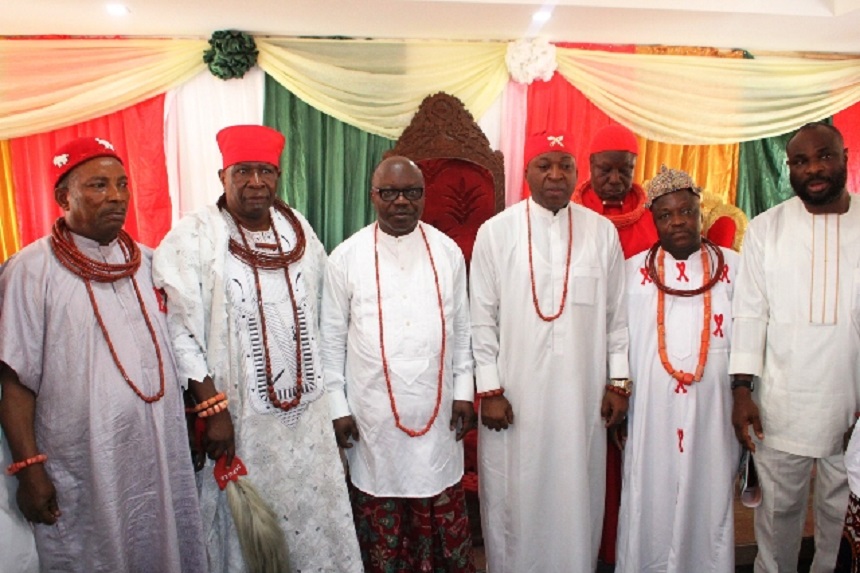
Isoko Monarchs Endorse Uduaghan for Senate

Published

on

By Dipo Olowookere

Ahead of the 2019 National Assembly elections in February, traditional rulers of Isoko ethnic nationality in Delta State have expressed their desire to have the immediate-past governor of the state and All Progressives Congress (APC) 2019 Delta South senatorial candidate, Dr. Emmanuel Eweta Uduaghan, represent the district at the upper legislative chamber for a change in status quo, and for the sake of progress in the area.

Speaking for traditional rulers of Isoko South in Oleh on Wednesday, His Royal Majesty, Anthony Ovrawah, Omogha 1, the Odio-Ologbo of Oleh, said Uduaghan had the blessings and support of the royal fathers for the senate seat.

“I have opened the door of the senate to Dr. EEU because he is an illustrious son of Isoko nation and we have confidence in him. We know him. Isoko nation benefited immensely during your tenure. You are one of us.

“I recall when you were governor, you paid me an unexpected visit. I was almost at the point of death.  I didn’t complain to you or anyone close to you of any ailment but as a true medical doctor, you detected I was sick. You insisted that your personal ambulance take me to Oghara Teaching Hospital where I was treated free of charge.

“Before your visit, my people and I had resolved to throw our support behind you and the Itsekiris. The position [senatorial seat] belongs to three children. One child should not monopolize it. It is mother’s breast, only one child cannot suck it.

“Uduaghan has the blessings and support of Isoko nation for the senatorial seat. You’re our candidate for the senate. We picked you not because of APC but for who you are.”

“This is your time; we saw what you did as a state governor. Go to the senate and do more. Your name is already in the senate. Isoko is sending you,” the monarch declared.

The former governor also met with traditional rulers from Isoko North at the palace of His Royal Majesty, Anthony Ogbogbo, Ebuka 1, Ovie of Ozoro kingdom, in continuation of his consultation with traditional rulers in Delta South for his senatorial ambition.

Speaking at Ozoro, HRM Ebuka 1, Ovie of Ozoro kingdom, who spoke on behalf of the traditional rulers, said monarchs in the state would not forget in a hurry Uduaghan’s support for the traditional institution.

The monarchs noted that Uduaghan as a governor accorded the traditional institution its due respect and as well, raised the status of royal fathers to an enviable position in the country.

“The other kings from all the other kingdoms in Isoko North are here to see the man who elevated their status. You did well for us. You fought for traditional rulers and the sanctity of our culture. You won our hearts with your issue-based speech. It is rare.

“We (traditional rulers) in Delta State will not forget you in a hurry. You did well as a governor. You won our hearts with your issue-based speech. We pray God to grant your aspiration with a resounding victory,” the Ozoro king said.

Uduaghan, while speaking during the visit to the two palaces, said he was in Isoko land to solicit the support of Isoko Nation for his senatorial race in the next month’s National Assembly election in Delta South.

He noted that as a secretary to the state government (SSG) and later governor of Delta State, he is well abreast with the role traditional rulers play in ensuring peace in the state.

The former governor also told the monarchs that if elected as senator, he would sponsor bills and law that will give constitutional backing to the traditional institution in the country as well as ensure that their pains are addressed by the federal government.

“As an SSG and secretary to the State Security Council and later as a governor of the state, I know the enormous role traditional rulers play in helping to ensure peace and security.

“Kings have spiritual powers. Somehow, they are gifted with the act of mediation and peace.

“We would have been experiencing more violence if not for the intervention of monarchs especially from Isoko who ensured that their domains were peaceful during my time as governor.

“One of the reasons I am seeking your support to go to the senate is that I believe that our traditional institution should have legal backing in their role in ensuring peace in the country.

“If elected as senator I will also push for the recognition of monarchs in the constitution of the Federal Republic of Nigeria which would give them a constitutional role to their people.

“I also believe that as people from oil producing communities, we should have a major stake in the ownership of the oil and gas companies in our communities. Through this, our communities will benefit more from the oil and gas that is derived from our area.”

“I will also push for the cleaning of impacted communities. Based on my experience as a governor, there is so much we can do to create jobs for unemployed youths in the region.

“I will push for communities to have at least 5 per cent ownership of companies operating in host communities in Delta South. This will create jobs for men, women and youths.

“I will also push for communities to be in charge of security of government and companies’ properties in their domain.

“Pipeline surveillance contract should be a form of empowerment to our youths but they are only paid peanuts at the end of the day because some persons who are not even from our region are the middlemen. When I become senator, the contract would come straight to our communities so that our youths would be empowered.

“The destruction of localized refineries otherwise known by the government as illegal refineries further causes more harm as much as our boys “cooking” crude oil in the creeks. When I become senator, I will push for the legalization of these localized “refineries”. This will ensure positive engagement across the value chain,” Uduaghan concluded.


Dipo Olowookere is a journalist based in Nigeria that has passion for reporting business news stories. At his leisure time, he watches football and supports 3SC of Ibadan. Mr Olowookere can be reached via [email protected]

Click to comment

Leave a Reply

Your email address will not be published. Required fields are marked *

General

2027: SERAP Urges Tinubu, Atiku, Obi, Others to Declare Assets, Liabilities

Published

on

SERAP

By Adedapo Adesanya

The Socio-Economic Rights and Accountability Project (SERAP) has urged all 19 presidential candidates announced by the Independent National Electoral Commission (INEC) to publish details of their assets and liabilities ahead of the 2027 elections.

The group also urged the candidates’ spouses, and where applicable, their unmarried children under 18, to do the same.

It further advised the candidates to disclose the legitimate sources of their significant assets and publicly reject vote-buying and electoral bribery before and during the election.

The organisation called on the candidates to instruct their parties, campaign organisations, agents and supporters not to offer or distribute money, gifts or other material inducements in exchange for votes.

The presidential candidates are President Bola Tinubu (APC), Mr Atiku Abubakar (ADC), Mr Peter Obi (NDC), Senator Sandy Onor (PDP), Mr Omoyele Sowore (AAC), Mr Donald Duke (PRP), Mrs Okwori Ada Elizabeth Frederick (NDP), Mr Chukwu Anita Zugwai (YPP), Mr Rufai Adekunle Omoaje (AA), and Mr Adenuga Sunday (Boot Party).

Others are Mr Memeh Samuel (DLA), Mr Nwanyanwu Daniel Danerechukwu (ZLP), Mr Okereke Sunday Chibuzor (LP), Mr Okereke Iken Esther (NRM), Mr Abbas-Bin Aliyu (ADP), Mr Dikwa Suleiman Mohammed (NNPP), Mr Adebayo Adewole Ebenezer (SDP), Mr Seyi Makinde (APM), and Mr Yusuf Kabiru (APP).

In an open letter to the candidates dated August 8, 2026, and signed by SERAP Deputy Director Kolawole Oluwadare, the organisation urged them to “go beyond the bare legal minimum and voluntarily embrace higher standards of transparency, accountability and integrity in seeking Nigeria’s highest elected office.”

SERAP said candidates seeking Nigerians’ mandate to exercise constitutional powers over public finances, natural resources, appointments and security institutions should be willing to subject their personal financial affairs to reasonable public scrutiny before asking for votes.

“Nigerians should not be asked to choose between candidates on the basis of who can spend the most money. They should be able to choose on the basis of policies, competence, integrity, character and their vision for Nigeria,” the organisation said.

SERAP said voluntary pre-election disclosure would enable voters to assess potential conflicts of interest and significant sources of wealth, strengthen public confidence in the electoral process and provide a baseline against which future changes in assets could be assessed if a candidate is elected.

“The 2027 presidential election presents an opportunity for political leaders to show that public office is a public trust. Candidates who voluntarily disclose their assets and reject vote-buying can show that they are prepared to uphold the transparency and accountability they promise to deliver if elected,” it said.

The organisation also cited constitutional and international provisions in support of its call, noting that although the 1999 Constitution, as amended, does not expressly require presidential candidates to publish their asset declarations before an election, it embodies principles of transparency, accountability, integrity in public office and meaningful participation in government.

SERAP noted that the Constitution already requires elected public officers, including the President, to declare their assets and liabilities.

It cited Paragraph 11 of Part I of the Fifth Schedule, which requires public officers to submit declarations of their properties, assets and liabilities, including those of unmarried children under 18, as well as Section 140(1), which requires a person elected President to make the prescribed declaration before assuming the functions of office.

On vote-buying, the organisation said the persistent use of money, gifts and other inducements to influence voters was a major threat to electoral integrity.

“We are also concerned about the persistent use of money, gifts and other inducements to influence voters. Vote-buying directly undermines the constitutional principle that sovereignty belongs to the people,” it said.

SERAP cited Section 14(2)(a) of the Constitution, which provides that sovereignty belongs to the people of Nigeria, as well as Section 125 of the Electoral Act 2026, which it said criminalises bribery and related conduct intended to procure the return of a person to elective office or the vote of an elector.

It added that vote-buying was particularly harmful amid poverty and economic hardship because it exploits economic vulnerability and risks turning a constitutional political right into a financial transaction.

It, therefore, urged the 19 presidential candidates to publish their assets and liabilities before the election, including relevant assets and liabilities of their spouses and unmarried children under 18, and disclose the legitimate sources of significant assets, including business interests, investments, real property, substantial gifts and inheritance, while protecting legitimate personal security and privacy.

The organisation also asked the candidates to commit to updating their public declarations if elected and explaining material increases in wealth; publicly reject vote-buying and electoral bribery; instruct their campaign organisations and political associates not to distribute money, gifts, food, transportation benefits or other material inducements in exchange for votes; report credible allegations of vote-buying involving their campaign organisations to the appropriate authorities; and sign and publish a public integrity pledge committing themselves, their parties and campaign organisations to peaceful, transparent, accountable and corruption-free elections.

“The choice before Nigerians in 2027 should be a choice based on ideas, policies, competence and integrity—not on who can spend the most money or conceal the most wealth,” it said.

Continue Reading

General

REA is an Institution for Expanding Opportunity—Tegbe

Published

on

Tegbe Fayose REA board

**Tasks Board to Prioritise Improving Livelihoods of Nigerians

By Modupe Gbadeyanka

The newly inaugurated board of the Rural Electrification Agency (REA) has been advised to prioritise the well-being and economic progress of ordinary Nigerians in every decision it makes.

This charge was given by the Minister of Power, Mr Joseph Tegbe, when he inaugurated the board, which has the former Governor of Ekiti State, Mr Ayodele Fayose, as chairman, and Mr Abba Aliyu as its chief executive.

Mr Tegbe described the board’s constitution as consistent with President Bola Tinubu’s drive to strengthen governance and accountability across public institutions.

He further described the agency as an institution for expanding opportunity, noting that every mini-grid, solar home system and electrified market, school, health centre or farm represents an investment in human capital and economic inclusion.

He pointed to REA’s existing programmes, the Energising Education, Economies and Agriculture Programmes and the Africa Mini-Grids Programme, as evidence of that strategy at work, and noted that the Board, constituted under Section 130 of the Electricity Act, takes office at a defining moment for the organisation.

On governance, the Minister drew a clear line between the board’s non-executive role of strategic direction and oversight and management’s responsibility for day-to-day execution.

He noted that the board meets quarterly to review performance while management retains operational latitude between meetings, subject to full accountability.

Mr Tegbe commended Mr Fayose’s record as a former Governor of Ekiti State, assuring of the Ministry’s continued partnership and a description of electricity as an instrument of inclusion, opportunity and prosperity.

In his remarks, the board chairman described President Tinubu’s decision to appoint Mr Tegbe as a statement of seriousness rather than a routine appointment, a signal that the administration would settle for nothing less than a lasting solution to Nigeria’s power problem.

He called the Minister a technocrat whose technical depth and managerial competence have already produced a positive turning point for the sector, affirming that REA’s leadership was proud to work with him on that effort.

Continue Reading

General

How Airports Can Reduce Ground Emissions Before Full Infrastructure Upgrades

Published

on

ElectroAir APA-100

Airport sustainability is no longer a separate environmental project. It is becoming part of daily operational planning, procurement, infrastructure development, and airline partnership discussions. For many airports, the main pressure is to reduce emissions on the ground, improve airside efficiency, and prepare for stricter environmental expectations, while continuing to support aircraft reliably every day.

The challenge is that infrastructure does not change overnight.

Full electrification remains an important direction for aviation ground operations. Fixed 400 Hz power, electric ground support equipment, charging infrastructure, energy management systems, and cleaner stand concepts are all part of the future airport. But in practical terms, many airports are still working through phased investment plans. Grid capacity may be limited. Charging points may not yet cover all operational areas. Remote stands, maintenance zones, cargo aprons, and temporary operating areas may still depend on mobile equipment.

This is where the sustainability conversation needs to become more realistic.

Airports do not have to wait for a complete infrastructure transformation before reducing emissions. There are practical steps that can be taken now, especially in aircraft ground power. The key is to look at emissions reduction as a staged process, not a single final destination.

One of the first areas to assess is the age and efficiency of existing diesel ground power units. In many operations, older GPUs continue to provide essential support because they are mobile, familiar, and independent from fixed power systems. But older diesel platforms may no longer fit the expectations of modern airport sustainability strategies. They can become harder to justify in procurement discussions, environmental reporting, and long-term fleet planning.

Replacing outdated diesel equipment with lower-emission alternatives can be a meaningful step. A modern diesel GPU with Stage V / Tier 4 Final engine technology, for example, can help operators reduce the environmental impact of ground power while keeping the operational independence that many stands and service areas still require. This does not replace the need for electrification. It helps bridge the gap while infrastructure continues to develop.

That bridge matters because airside operations are rarely uniform.

A major hub may have fixed power at many contact stands, but still rely on mobile GPUs for remote aircraft positions, maintenance activities, irregular operations, or construction phases. A regional airport may not yet have the capital or grid capacity for large-scale electrification. An MRO facility may need mobile power that can move between aircraft, hangars, and outdoor working areas. A ground handler may need equipment that supports mixed aircraft types under high turnaround pressure.

For these environments, sustainability must work in real conditions. A solution that looks good in a strategy document but does not support the daily operating model will not last.

Decision-makers should therefore evaluate aircraft ground power through several practical questions. Where is fixed power available today? Where is it planned next? Which stands still require mobile equipment? How many hours do diesel GPUs operate per day? Which aircraft types are supported? Are units oversized, outdated, or difficult to position? Is the equipment aligned with current emissions standards? Can it support cleaner operation where grid power is available?

These questions often reveal that the best path is not a single equipment choice, but a balanced fleet strategy.

Fixed power should be used where infrastructure is mature and operationally reliable. Battery-powered equipment can be introduced where duty cycles, charging plans, and climate conditions are suitable. Lower-emission diesel and plug-in hybrid ground power units can support areas where independence, runtime, and flexibility remain critical. Together, these solutions allow airports to reduce emissions without weakening operational resilience.

Plug-in hybrid utility power functionality is especially relevant in this transition phase. When external utility power is available, the unit can operate with reduced fuel use. When it is not available, the same equipment can continue supporting aircraft independently. This gives airports and operators more flexibility as infrastructure develops stand by stand, rather than forcing a complete change before the airside environment is ready.

Compact design also plays a role in sustainable operations. Airports often focus on emissions, but space efficiency is part of the same discussion. Crowded aprons create movement challenges, increase operational friction, and affect safety. A compact mobile GPU that provides the required output without adding unnecessary equipment bulk can support cleaner, more organized, and more efficient aircraft servicing.

This is why modern ground power procurement should not be based only on output figures. Power rating matters, but so do emissions performance, footprint, maneuverability, serviceability, spare parts strategy, operating environment, and fit with future infrastructure plans. Airports need equipment that can serve today’s operation while remaining relevant as sustainability expectations continue to rise.

For a deeper look at how this transition applies to aircraft ground power, ElectroAir has outlined its view on lower-emission ground power and the practical role of modern mobile GPUs in supporting airport sustainability before full electrification is possible. The company’s ElectroAir APA-100 is one example of this approach, combining compact mobile design, Stage V / Tier 4 Final engine technology, and optional plug-in hybrid utility power for operators that need both reliability and a more future-conscious path.

The next stage of airport sustainability will be built through practical progress. Some changes will come from major infrastructure investment. Others will come from better equipment decisions, smarter fleet planning, and the replacement of outdated assets with more efficient alternatives.

For airports, the priority is not to choose between today’s operation and tomorrow’s goals. The priority is to connect them. Ground power is one of the places where that connection can already begin.

Continue Reading