General
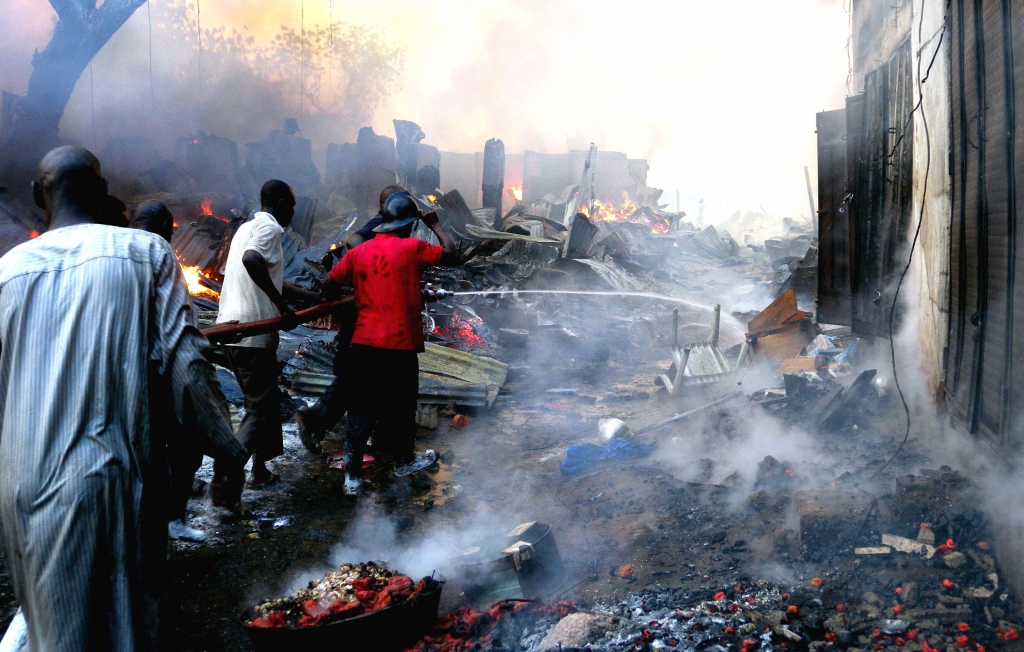
Kano Donates N500m to Fire Disaster Victims

By Modupe Gbadeyanka
The sum of N500 million has been donated by the Kano State government as assistance to victims of the fire outbreak that occurred early this year at Sabon Gari market, in the state capital.
A statement issued by the Director General of Media and Communications at the Government House in Kano, Mr Salihu Tanko Yakasai, disclosed that the donation is to help victims get back on their feet.
Mr Yakassai quoted the state Governor, Mr Abdullahi Umar Ganduje, to have announced this gesture during a speech he delivered at the signing of an agreement between the state government and an indigenous company, Brian and Hammers Ltd., for the construction of Kanawa Economic City.
He said the Governor explained that the money was sourced from Internally Generated Revenue (IGR), pointing out that because of the humanitarian disposition of his government, it had since set up a committee under Mr Aliko Dangote, to launch an appeal fund to harness money to assist the victims.
Furthermore, Governor Ganduje said the Judicial Commission of Inquiry set up by the administration to look into the immediate and remote causes of the fire has since submitted its report and a White Paper has been issued, while a committee to ensure implementation of the recommendations has also been established and has commenced work in earnest.
He maintained that the state government was paying serious attention to the development of markets as a result of which structural and road project execution has commenced at Kantin Kwari market, while that of other markets, especially Muhammadu Abubakar Rimi Market will commence in 2017
On the proposed Kano light rail project, expected to gulp about $1.85 billion, Governor Ganduje described it a creditable legacy for future generations, describing the investment as worthwhile.
“Those saying we are obtaining a loan to finance the project hence, leaving a debt burden for our children and grandchildren are indeed economically blind, politically naïve and morally mischievous”, stated the governor, adding that the government acquired the loan to bridge the infrastructure deficit in the state.
Pointing out that the vogue across the world is for developing economies to obtain loans to in order to pay for new development initiatives, he argued that the light rail project, would on completion, generate huge amounts of money daily, to service the loan.
“Kano is an emerging mega city and one of the best ways to enhance its status and physical outlook as well as attract investors is to provide sustainable transport systems that facilitate mobility and services. That is why the light rail project is our priority,” Governor Ganduje emphasized.
General
Tinubu Confirms Killing of Abu-Bilal Al-Manuki by Nigerian, US Forces
By Modupe Gbadeyanka
President Bola Tinubu on Saturday confirmed the killing of a senior ISIS leader, Mr Abu-Bilal Al-Manuki, in an overnight operation carried out by the United States and Nigeria.
President Donald Trump had earlier announced the elimination of the notorious terrorist via a post on his Truth Social.
Later, in a statement today, Mr Tinubu praised the action, describing it as “a significant example of effective collaboration in the fight against terrorism.”
“Our determined Nigerian Armed Forces, working closely with the Armed Forces of the United States, conducted a daring joint operation that dealt a heavy blow to the ranks of the Islamic State,” he said in the statement.
According to him, early assessments confirm the elimination of the wanted IS senior leader, Abu-Bilal Al-Manuki, also known as Abu-Mainok, along with several of his lieutenants, during a strike on his compound in the Lake Chad Basin.
He commended the partnership between Nigeria and America in waging war against terrorists, thanking his US counterpart “for his leadership and unwavering support in this effort.”
“I commend the personnel involved on both sides for their professionalism and courage, and I look forward to more decisive strikes against all terrorist enclaves across the nation,” the Nigerian leader added.
General
Nigeria Steps up AI Surveillance, Anti-Drone Systems for National Security
By Adedapo Adesanya
Nigeria is set to strengthen its defence architecture by deploying artificial intelligence-powered surveillance systems and advanced anti-drone technology as part of efforts to modernise the country’s military capabilities, according to the Minister of Defence, Mr Christopher Musa.
He disclosed this during a high-level visit to Monaco, where he led a Nigerian delegation to conclude discussions on the multi-domain Hybrid Intelligence Shield (HIS) project.
According to Mr Musa, the initiative is designed to enhance border security, protect urban centres and improve the country’s response to emerging security threats.
The project is expected to introduce AI-driven surveillance systems capable of identifying threats rapidly through smart algorithms, while anti-drone technology will be deployed to intercept and neutralise unmanned aerial threats.
The government also plans to establish national and regional command-and-control centres to improve real-time coordination and response to security incidents across the country.
Mr Musa said the initiative would place strong emphasis on technology transfer and local capacity development through the establishment of a military Centre of Excellence in Nigeria.
He added that the federal government would leverage partnerships with international firms, including Marss UK Ltd, while simultaneously building indigenous capabilities to address insurgency, illegal mining, piracy and other security threats.
Nigeria has continued to battle multiple security challenges in recent years, including insurgency in the North-East, banditry and kidnappings in the North-West, farmer-herder clashes in the North-Central region, crude oil theft in the Niger Delta and piracy in the Gulf of Guinea.
Nigeria is stepping up its defence as the border region of Nigeria, Benin and Niger on the southern edge of the Sahel region is becoming a new stronghold for jihadists, as militants turn forests and pastoral networks in West Africa into bases for recruitment and international attacks.
Attacks in Nigeria have also risen, with data from the website of the Armed Conflict Location & Event Data (ACLED), a conflict-monitoring group, affirming that the number of suicide bombings in Nigeria by March already matched the annual average over the past six years.
The Nigerian military has also been dealt a blow to its military bases and senior figures targeted. In April, Brigadier-General Oseni Omoh Braimah was killed when Islamist fighters attacked a base in Borno State.
To also meet the defence goal, Nigeria is stepping up efforts to build domestic arms-manufacturing capacity.
General
Nigeria, Morocco to Seal Atlantic Gas Pipeline Deal by Q4 2026
By Adedapo Adesanya
Nigeria and Morocco are set to sign a major intergovernmental agreement later this year to push forward the long-delayed Nigeria-Morocco Gas Pipeline project, a multi-billion-dollar energy corridor expected to reshape gas trade across West Africa and Europe.
The agreement, expected to be signed in the fourth quarter of 2026 by President Bola Tinubu and King Mohammed VI of Morocco, follows the completion of preliminary technical studies for the ambitious project, according to officials from both countries.
The pipeline, also known as the African Atlantic Gas Pipeline, is projected to stretch about 6,900 kilometres along offshore and onshore routes across West Africa, making it one of the largest gas infrastructure projects on the continent.
With an estimated cost of $25 billion, the pipeline is designed to transport up to 30 billion cubic metres of gas annually once completed.
Discussions on the project gained fresh momentum during a telephone conversation between Nigeria’s Minister of Foreign Affairs, Mr Bianca Odumegwu-Ojukwu, and her Moroccan counterpart, Mr Nasser Bourita.
The project would not only strengthen energy cooperation between the two countries but also improve regional economic integration and expand Africa’s access to European energy markets.
According to Morocco’s hydrocarbons and mining agency, ONHYM, part of the gas supply will support Morocco’s domestic energy demand, while large export volumes will be directed to Europe.
The project, first proposed about a decade ago, is seen as a strategic alternative gas supply route amid rising global energy security concerns and Europe’s search for more diversified energy sources.
Beyond the pipeline, Nigeria and Morocco are also exploring broader economic partnerships, particularly in fertiliser production and distribution to support food security across Africa.
Both countries also agreed on the need to revive the Nigeria-Morocco Business Council to strengthen trade and investment relations under the African Continental Free Trade Area framework.
Analysts noted that the project could significantly boost gas monetisation opportunities for Nigeria, expand regional infrastructure development, and deepen economic ties between West African nations and Europe if successfully executed.
-
Feature/OPED6 years agoDavos was Different this year
-
Travel/Tourism10 years ago
Lagos Seals Western Lodge Hotel In Ikorodu
-
Showbiz3 years agoEstranged Lover Releases Videos of Empress Njamah Bathing
-
Banking8 years agoSort Codes of GTBank Branches in Nigeria
-
Economy3 years agoSubsidy Removal: CNG at N130 Per Litre Cheaper Than Petrol—IPMAN
-
Banking3 years agoSort Codes of UBA Branches in Nigeria
-
Banking3 years agoFirst Bank Announces Planned Downtime
-
Sports3 years agoHighest Paid Nigerian Footballer – How Much Do Nigerian Footballers Earn