General
Kwara Equips Civil Service With Computers, Others
By Modupe Gbadeyanka
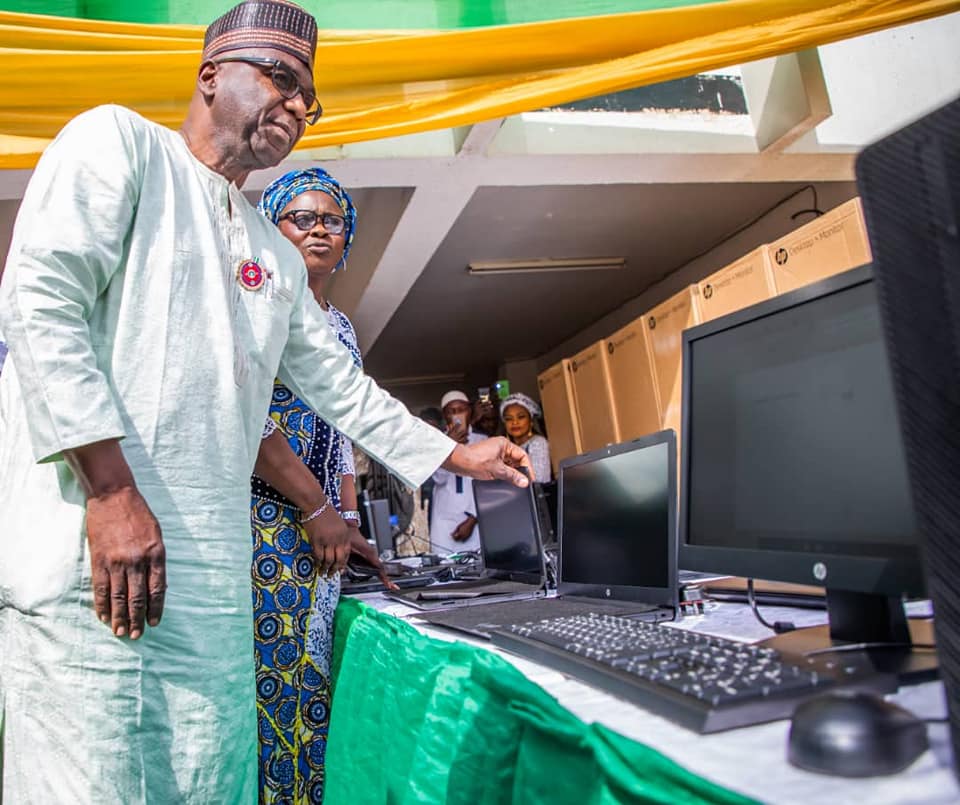
Some computers, printers and other office tools were distributed to various Ministries, Departments and Agencies (MDAs) in the Kwara State civil service on Friday by Governor AbdulRahman AbdulRazaq.
Mr AbdulRazaq said he decided to equip the civil service with modern tools in order to make the workers more efficient for the benefit of the state.
According to him, his administration discovered that most of the offices either did not have these items or the ones they had were not working.
He said the civil service is a good system with good people which only requires adequate tools to deliver on its mandate, adding that, “I hope this will help you in your productivity.”
The Governor also said he expects “these innovation tools to make work easier for you,” noting that going through ministries, “I saw that these equipment were lacking. I saw archaic equipment in offices, mostly not working, with civil servants going to business centres to type and print letters. This will be a thing of the past.”
“I am not saying that these equipment will solve all your problems today, but just like a journey of a thousand miles, which starts with a step, I believe this is a first step and we will continue to build on this,” he noted.
The Governor later witnessed the distribution of the tools which included 100 HP branded desktop computers; 100 HP Monitors (18.5’); 100 HP printers; 100 UPS; 50 Sharp photocopiers (AR602); and 20 HP laptop computers.
Kwara State Head of Service, Ms Susan Modupe Oluwole, commended the Governor for rewriting the story of the civil service, saying, “I don’t know for long we have been working without tools.
“If we get paid and there are no tools to work with, it makes no difference. So, this is a new era and we are excited that we are now getting tools to work with.”
Permanent Secretary in the Ministry of Works, Transport and Housing, Mr Garba Manjo, hailed Mr AbdulRazaq for stabilising the civil service, saying the Governor’s decision to not hurriedly scatter workers around after he was sworn in testifies to his maturity and respect for institutions.
“Your Excellency, we thank you for the good work you have been doing for the service for past seven months. We thank you for the completion of the state secretariat. We thank you for the prompt payment of salaries. We thank you for the timely release of operational grants to MDAs,” Mr Manjo said.
“We thank you for the stability you have brought into the service. In the past, we were used to changing all officers across all levels with the change in government but you chose to stabilise the service and this surprised everybody. We also thank you for ending the era of no cash backing.
“We thank you for the distribution of these computer sets which will enhance our operational efficiency. You have restored the state to the era of ‘administocracy’ which we witnessed last in the 1970s and 1980s,” he added.
The brief event was attended by top government functionaries and senior civil servants, especially representatives of the various MDAs who received the tools on behalf of their offices.
General
Nigeria’s New Alphanumeric Postcode System to Launch October 1
By Adedapo Adesanya
The Minister of Communications, Innovation and Digital Economy, Mr Bosun Tijani, has announced that Nigeria will launch a new alphanumeric postcode system on October 1, 2026, with every home expected to have a unique postcode.
Mr Tijani disclosed the development in a video post on X, describing the new system as a more precise and digitally oriented approach to addressing locations across the country.
He said the initiative would mark a significant shift in Nigeria’s postal addressing system by assigning unique postcodes to individual homes.
The initiative marks a major step in Nigeria’s digital transformation agenda. By replacing the outdated numeric-only system, the alphanumeric codes provide a more flexible and scalable framework that can accommodate the country’s rapid urban growth and diverse settlement patterns.
For emphasis, an alphanumeric postcode system is a postal indexing system that uses a combination of both letters (alpha) and numbers (numeric), along with spaces or punctuation, to identify specific geographic locations, streets, or individual buildings for mail delivery.
Unlike purely numeric postcode systems (such as the 5-digit US ZIP Code or 5-digit codes used in some European countries), alphanumeric codes offer a much higher number of unique combinations using fewer total characters. This flexibility allows postal authorities to pinpoint locations with incredible precision, often down to a single side of a street or a specific large building.
“On October 1st 2026 Nigeria’s new Alphanumeric Postcode System goes live,” Mr Tijani said.
“For the first time, every home will be assigned a unique postcode that’s simple, precise and built for a digital future,” he added.
The minister urged Nigerians to prepare to generate their individual postcodes ahead of the launch.
The new system is expected to strengthen Nigeria’s digital addressing infrastructure and improve the identification and location of homes and properties for postal and other location-based services.
The initiative is being implemented in collaboration with the Nigerian Postal Service (NIPOST) as part of broader efforts to modernise the country’s addressing and digital infrastructure.
General
Tinubu Directs Finance Minister to Give Reforms Scorecard to Nigerians
By Modupe Gbadeyanka
The Minister of Finance and Coordinating Minister of the Economy, Mr Taiwo Oyedele, has been directed to give an account to Nigerians on how the current government has fared since its inception on May 29, 2023.
This directive was given by President Bola Tinubu in a message posted on his verified social media handles on Wednesday.
This coincides with the commencement of campaigns for the 2027 presidential election scheduled for January 16.
According to the timetable of the Independent National Electoral Commission (INEC), candidates seeking to become the country’s president are eligible to kick off their campaigns from today, Wednesday, August 19, 2026.
In his message today, Mr Tinubu said, “When we began this journey of reform in 2023, I promised that the difficult decisions we were making would serve the purpose of building an economy that works better for you and a country that is stronger for our children.
“Today, your government presents The Reforms Scorecard. It sets out what our reforms have achieved, what they have cost us, and the greater costs and harms we have prevented by acting when we did.
“I have therefore directed the Minister of Finance and Coordinating Minister of the Economy, Taiwo Oyedele, to give an account to Nigerians, to explain the numbers, the choices we have made, the progress recorded, and the work that remains.
“You deserve to see the numbers. You deserve to know what has changed and what these reforms mean for you, your family, your business and our country.
“This is your government. This is your country. This is our account to you.”
Shortly after he took the oath of office over three years ago, President Tinubu declared that subsidies on petroleum products were gone. He later approved foreign exchange (FX) reforms, which devalued the Nigerian Naira, shooting from about N800 per Dollar to nearly N2,000 per Dollar. However, it is currently slightly above N1,340 per Dollar in the official market.
General
NNPC, Agip Intensify Efforts to Develop 500m-Barrel Deepwater Assets
By Adedapo Adesanya
The Nigerian National Petroleum Company (NNPC) Limited and the Nigerian Agip Exploration (NAE) Limited are advancing discussions on the development of deepwater assets estimated to hold 500 million barrels of oil reserves.
The development followed a meeting between the chief executive of the state oil company, Mr Bayo Ojulari, and Agip’s Vice Chairman and Managing Director, Mr Maurizio Pinna, in Abuja.
The talks focused on ongoing work on deepwater acreage jointly held by NNPC, NAE and Shell Nigeria Exploration and Production Company (SNEPCo) as well as plans to bring the associated resources into production.
According to NNPC, the acreage comprises the Zabazaba and Etan deepwater fields, with estimated reserves of about 500 million barrels.
The fields are located in Nigeria’s deepwater terrain and are considered significant to the country’s efforts to expand its upstream oil production base, particularly as operators seek to advance projects capable of delivering additional barrels over the medium to long term.
While details of the expected production timeline were not disclosed, the meeting underscores renewed industry focus on unlocking Nigeria’s deepwater resources and growing crude oil production.
The acreage comprises licences converted from OPL 245 and is operated by NAE in partnership with NNPC Limited and SNEPCo.
Mr Ojulari and Mr Pinna also reviewed the work currently underway on the assets and the expected production outlook, with the discussions centred on advancing deepwater development.
The engagement comes amid renewed efforts to attract investment into Nigeria’s offshore petroleum resources and increase national oil production.