General
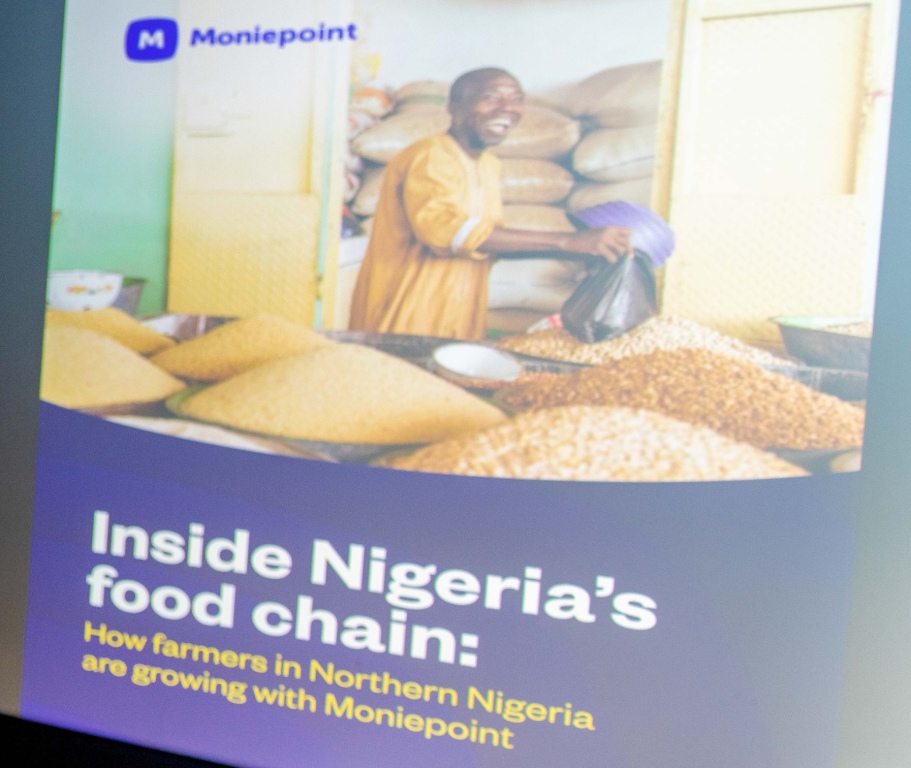
Moniepoint’s Documentary on Nigeria’s Food Industry Supply Chain Excites FG, Others
By Modupe Gbadeyanka
Prominent financial technology (fintech) company, Moniepoint Incorporated, has been given a pat on the back for its 12-minute documentary exploring Nigeria’s food industry supply chain.
The piece focused on the Northeast region, particularly Borno State, highlighting how cultivation and distribution processes connect local farmers to the broader national market.
A key finding from the case study showed that the informal, trust-based networks that power Nigeria’s food chain are not a weakness to be formalized, but a strategic asset to be strengthened. These networks, built on generational knowledge and social capital, have proven more durable and adaptable in crisis than formal institutions.
At the private screening of the documentary titled Inside Nigeria’s Food Chain in Abuja recenrly, the Special Adviser to the President on Economic Affairs in the Office of the Vice President, Mr Tope Fasua, who was among the few guests at the event, said Moniepoint has done well to showcase the resilience of the region’s agricultural value chain and empowering smallholder farmers through innovative digital payment solutions.
The economist said he was impressed that the work captured how digital financial services are driving economic inclusion among rural communities traditionally not associated with technology adoption, even amid ongoing security challenges and cost-of-living pressures across the country.
“I am happy and thrilled at the many things that this documentary and case study captures. It’s an eye opener for people to be able to see all of the operations going on. I have first-hand experience at how Moniepoint is changing the market dynamics for good.
“It was heartwarming to see the economic and financial inclusion x-rayed in the video with a lot of digitization going on at the level with people who you’d not associate with technology adoption,” Mr Fasua stated.
Furthermore he noted that in spite of the challenges with insecurity in the country, “We can see the resilience that our people have demonstrated in churning out grains, livestock and agric produces.
“This work has also shown that our people are embracing modern and subsistence level farming. On the financial inclusion front, it is delightful to watch the confidence that the people have in digital payments and Moniepoint has done a fantastic job in deepening adoption across the country.”
Speaking to the rationale behind the screening and case study and responding to questions from guests, the Vice President for Corporate Affairs at Moniepoint, Ms Edidiong Uwemakpan, noted the project is about real people and real impact.
“In view of the amounts that we process monthly as a business, we sought to peel back the layers on the naira and kobo and uncover the stories behind the transactions and what they mean for Nigeria.
“Moniepoint as a Nigerian company has been able to achieve such impact by adopting hyperlocal support to build trust with its users tailoring our services to fit the existing lifestyle and trading habits of Nigerians,” Ms Uwemakpan said.
She noted that Borno State had often been defined by negative narratives overshadowing its strengths. Therefore, the documentary does not only focus on showcasing Moniepoint’s role in supporting food distribution but also reveal the state’s agricultural diversity, which contributes significantly to feeding millions of Nigerians.
Aligning with these thoughts, a communications expert, Mr Tolu Ogunlesi, expressed his excitement and commended Moniepoint for telling this story – not just because of what it says about food but what it says about our resilience and the country as a whole.
“Watching the documentary, a lot of the towns mentioned became famous not for food but as Boko Haram affected regions. This project allows us to truly appreciate these areas for what they really contribute to the country’s socio-economic development and what they should actually be famous for. This is a part of Nigeria that has been traumatized by insecurity but they have demonstrated remarkable resilience such that when people sit in their homes and they are eating, they are reminded that some of these products come from the North East,” he said.
General
NBA Elects Oyinkansola Badejo-Okusanya as Second Ever Female President
By Adedapo Adesanya
The Nigerian Bar Association (NBA) has elected Mrs Oyinkansola Badejo-Okusanya, a Senior Advocate of Nigeria (SAN), as its next president after she polled the most votes when voting officially ended on Sunday morning.
Mrs Badejo-Okusanya, the only female among the three presidential candidates, polled 12,317 votes to emerge the winner of the election, which was held through electronic voting for 24 hours, from 7:35 am on Saturday to 7:34 am on Sunday.
She defeated her two challengers, polling 47.18 per cent of the 26,106 ballots cast in the presidential election, based on the final tally. Her closest challenger, Mr Lateef Akangbe (SAN), garnered 7,934 votes, representing 30.39 per cent of the total votes cast, while the third candidate, Mr Olumuyiwa Akinboro (SAN), polled 5,855 votes, representing 22.43 per cent, to emerge third in the contest.
The Electoral Committee of the NBA (ECNBA) Chairman disclosed that a total of 26,106 votes were recorded for the highly disputed presidential election.
With her victory, Mrs Badejo-Okusanya will become the 33rd President of the legal association, successfully re-enacting a 34-year-old history as the second female to lead the NBA since its formation in 1933.
Meanwhile, Mr Afam Okeke was elected General Secretary of the legal body, having polled a total of 8,478 votes to defeat his opponents.
All the elected officials will be in office for two years, spanning 2026 to 2028.
The NBA president-elect was absent when the results of the election were announced at the NBA headquarters in Abuja. A member of her campaign team, Mr Aminu Gadanya (SAN), revealed that she had a flight delay and declared her resolve to extend a “handshake of friendship” to all the aggrieved candidates.
In his remarks after the results were announced, the outgoing President of the NBA, Mr Afam Osigwe (SAN), noted that the election faced several challenges, including a cyberattack that almost derailed the electoral process.
“Many went to great lengths to truncate the electoral process. They maligned the process with their utterances, but we held firm. Every effort to derail the process failed,” Mr Osigwe stated.
He urged the winners to be magnanimous in victory, warning that they should celebrate moderately.
“This is a trying time for the Bar. Many people may still go to great lengths to rubbish the association. However, this is a time for healing. At the end of the day, let the Bar be the winner,” he added.
He said the ECNBA would carry out an in-depth analysis, especially of the challenges encountered, so as to come up with recommendations that will engender greater confidence in the association’s electoral process.
“The cyberattack shows that we must do more, not only for data protection, but to protect our electoral integrity. We must insulate our electoral process from such activities.
“Someday the story will be told of how the ICT system had to be rebuilt and moved to a safer server to ensure that the election was held.
“The Bar must always protect its independence and eternally determine the course of its electoral process,” the outgoing NBA President added.
General
Digital Switchover: NBS, NigComsat Train Installers in Ibadan
By Modupe Gbadeyanka
Over 50 skilled technicians drawn from various states across the South-West region of Nigeria converged on Ibadan, Oyo State, on Friday for a comprehensive technical and sensitisation training programme for set-top box installers and associated reception equipment technicians.
This training was organised by the National Broadcasting Commission (NBC) in partnership with the Nigerian Communications Satellite Limited (NIGCOMSAT) to guarantee a smooth, efficient, and error-free rollout of Nigeria’s digital broadcasting migration.
Nigeria’s journey toward digital terrestrial television has spanned nearly two decades. The country formally adopted the digital switchover policy in 2008 in line with the International Telecommunication Union’s (ITU) 2006 global mandate, which set a June 2015 deadline for member states.
Successive missed targets in 2017 and beyond stemmed from funding constraints, policy inconsistencies, infrastructure gaps, and logistical challenges. While pilot projects were implemented in Plateau, Lagos, Kano, Enugu, Kwara, Osun, Kaduna, and the Federal Capital Territory, nationwide coverage remained a distant goal.
After substantial public investment exceeding N60 billion with limited results, the federal government unveiled a bold, renewed strategy in 2025 titled The Big Picture on June 17, 2026, with a firm analogue switch-off date set for December 31, 2028.
The new framework introduces a hybrid broadcasting model that intelligently combines Digital Terrestrial Television (DTT), Direct-to-Home (DTH) satellite delivery via NIGCOMSAT-1R, and Internet Protocol (IP)-based distribution.
By prioritising satellite technology, Nigeria leverages its sovereign satellite assets to significantly reduce dependence on expensive terrestrial transmission infrastructure. This approach is projected to accelerate digital television rollout by over 65 per cent while delivering near-instantaneous national coverage.
The Head of the Digital Switchover (DSO) unit and Deputy Director of Public Affairs at the NBC, Mrs Clementine Usman-Wamba, noted that the Ibadan session is the first of many planned across Nigeria’s geopolitical zones.
The Ibadan training directly addresses the technical demands of this hybrid ecosystem. Installers will be equipped with skills in satellite dish alignment for DTH, terrestrial antenna optimisation for DTT signals, and the configuration of hybrid reception devices.
Given the significant departure from analogue systems and earlier pilots, this sensitisation is essential to minimise installation errors, reduce service disruptions, and ensure that even households in rural and underserved communities can enjoy seamless access to superior digital broadcasts.
The FreeTV platform, built on open-standard DVB-S2 technology, will offer up to 100 free-to-air high-definition channels to an estimated 40 million television households across the country.
For terrestrial reception, Nigeria has adopted the advanced DVB-T2 standard with MPEG-4 AVC compression, which supports up to 20 channels per frequency—far more efficient than previous systems.
Consumers can access the service using affordable DVB-S2-compatible set-top boxes (priced between N15,000 and N25,000) or smart TVs with built-in DVB-T2 digital tuners.
Beyond technical excellence, the DSO represents a major national economic transformation project. The reallocation of broadcast spectrum (the “digital dividend”) will unlock new opportunities in telecommunications and broadband services. The advertising market is projected to expand by up to N605.2 billion, while local manufacturing and assembly of reception equipment is expected to generate over 20,000 jobs.
General
NIMASA Launches Blue Economy Accelerator for Maritime Startups
By Adedapo Adesanya
The Nigerian Maritime Administration and Safety Agency (NIMASA) has introduced the Blue Economy Accelerator Programme, a strategic initiative to identify, nurture, and accelerate innovative startups that will contribute to the sustainable growth of Nigeria’s marine and blue economy.
The Blue Economy Accelerator Programme is aimed at attracting young, vibrant minds with innovative ideas capable of transforming Nigeria’s maritime ecosystem.
The Director-General of NIMASA, Mr Dayo Mobereola, said that through the initiative, participants will receive structured business development support, industry mentorship, and technical guidance to convert promising concepts into viable ventures that address critical challenges and opportunities within the blue economy.
“The programme reflects NIMASA’s commitment to supporting the implementation of the vision of the Federal Ministry of Marine and Blue Economy in unlocking the immense potential of the blue economy by empowering young innovators, entrepreneurs, and technology-driven enterprises. We at NIMASA want to provide a platform for investors to identify young talents and invest in them,” he said.
The NIMASA DG commended the Minister of Marine and Blue Economy, Mr Adegboyega Oyetola, for codifying the Marine and Blue Economy Policy as a clear roadmap for the sector’s development and also urged young Nigerians to embrace the programme, which has the potential to transform raw talents into big investments in the maritime sector.
Applications are open to startups and innovators developing solutions across several strategic sectors, including marine waste management and the blue circular economy; aquaculture And sustainable fisheries; maritime technology and logistics innovation; ocean energy including wave, tidal, and offshore renewable energy; marine tourism and coastal recreation; marine biotechnology such as, ocean data and analytics; green Shipping, including vessel decarbonization; smart port solutions; autonomous marine vehicles; biofouling prevention technologies; and coastal resilience through nature-based coastal defence solutions.
The first phase of the programme is expected to attract a minimum of 150 high-quality applications from within and outside the country, provided they are Nigerian citizens.