General
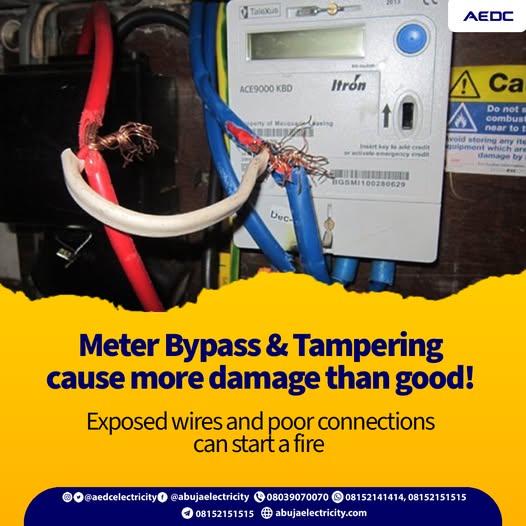
NERC Gives DisCos Procedures for Addressing Prepaid Meter Bypass, Others
By Adedapo Adesanya
The Nigerian Electricity Regulatory Commission (NERC) has directed electricity distribution companies (DisCos) to adopt a comprehensive Standard Operating Procedure to detect meter bypass, tampering and other electricity theft.
The directive was contained in Order No. NERC/2014/148, published on the commission’s website in Abuja on Thursday. It outlines investigative and enforcement procedures DisCos must follow when suspicious electricity consumption patterns or billing irregularities are detected.
According to the commission, distribution companies must interview witnesses, residents or local authorities and properly document all interviews conducted.
“DisCos shall interview witnesses, residents, or local authorities to gather information on unauthorised access or suspicious activities and document all interviews conducted,” the order stated.
NERC also directed companies to employ advanced technologies, including advanced metering infrastructure, data analytics and monitoring systems, to detect abnormal consumption patterns. The commission said distribution companies must ensure compliance with all legal and regulatory requirements during inspections and evidence gathering.
According to the regulator, the procedure aims to strengthen oversight in the Nigerian Electricity Supply Industry and protect infrastructure from losses caused by unauthorised network access.
“Distribution companies are required to first identify locations where electricity theft may be occurring by analysing consumption data, billing discrepancies and unusual indicators,” it said.
The order explained that flagged locations must undergo detailed reviews of electricity usage records to determine possible meter manipulation or illegal connections.
“The SOP also mandates surveillance and monitoring activities in suspected locations to gather additional evidence. “These may include field observations and tracking unusual activities that could indicate unlawful access to electricity infrastructure,” it said.
The directive also requires physical inspections of electricity meters in affected areas to detect tampering, illegal bypasses or unauthorised alterations. Where meters are suspected to be compromised, integrity tests must be conducted and documented through photographs and video recordings in the customer’s presence.
General
CIBN, ACAMB Advocate Women Empowerment, Sustainable Growth for Banking Sector
By Aduragbemi Omiyale
Banks operating in Nigeria have been charged to further deepen and prioritise financial inclusion, women’s empowerment and sustained growth.
This call was made by the Chartered Institute of Bankers of Nigeria (CIBN) and the Association of Corporate Communication and Marketing Professionals in Banks (ACAMB).
They want financial institutions to deploy strategic mandates and frameworks aimed at closing the financial gap and empowering small and medium enterprise (MSME) owners.
At a courtesy visit to congratulate Mr Dele Alabi on his investiture as the 24th head of CIBN on May 16, 2026, the president of ACAMB, Mr Jide Sipe, said his group was ready to work closely with CIBN to achieve these goals.
According to him, closing the imbalances in financial access helps economies grow faster, reduces inequality, and encourages greater civic participation by all.
Mr Sipe also used the occasion to announce ACAMB’s 30th anniversary, marking three decades of excellence, industry collaboration, professional development, and impactful contributions to the Nigerian banking and financial services sector.
“The association is pleased to announce the celebration of its 30th anniversary, marking three decades of excellence, industry collaboration, professional development, and impactful contributions to the Nigerian banking and financial services sector,” he said.
The ACAMB leader also formally invited the CIBN president to chair the anniversary Gala Night slated for Wednesday, September 30, 2026.
“We are inviting industry leaders to this anniversary and recognising many people who have stood by ACAMB over the years,” he stated, soliciting the institute’s support through attendance and the invitation of bank managing directors.
In his remarks, Mr Alabi thanked ACAMB for the visit, promising that the institute will prioritise financial inclusion and women’s empowerment.
He said access to savings, micro-credit, and insurance acts as a safety net during crisis and allows them to significantly improve living conditions.
At his investiture over two months ago, Mr Alabi unveiled his IMPACT Vision, themed Consolidating Our Local Impact, Enhancing Our Global Relevance.
The vision rests on six pillars: Inclusion across geographic, gender, and generational lines; Membership growth and quality; Professionalism and ethics; Accountability; Competencies and skills development; Technology, automation, and innovation. Other areas of shared interest include women empowerment, financial inclusion and literacy, as well as MSME clinics, all of which are top on his agenda.
Mr Alabi added that CIBN would be happy to drive joint knowledge sharing and exchange sessions with CBN and ACAMB across various platforms, saying, “Educating the public through public awareness programmes, with ACAMB as the rallying point, is central to what we do.”
“To this end, we intend to contribute our quota in supporting banks and financial institutions in driving gender-focused financial inclusion to close the 9 per cent gender gap in access to formal financial services,” he added.
General
Customs Launches Pilot Electronic Cargo Tracking System at PTML
By Adedapo Adesanya
The Nigeria Customs Service (NCS) has launched the pilot phase of its Management Information System (MIS) and Electronic Cargo Tracking System (ECTS) at the PTML Area Command, Lagos, as it pushes its modernisation drive aimed at enhancing trade facilitation, operational efficiency and service delivery.
The pilot launch was led by the Deputy Comptroller-General of Customs in charge of ICT/Modernisation, Mrs Oluyomi Adebakin, who represented the Comptroller-General of Customs, Mr Adewale Adeniyi.
She commended the PTML Area Command for its exceptional level of preparedness, describing its readiness as a testament to the collaborative efforts and commitment of officers towards the successful implementation of the initiative.
“Modernisation and digitalisation are no longer optional. As the lead agency in border management, the Nigeria Customs Service cannot afford to lag. If we don’t move with the cloud, we will be left behind. This pilot phase reflects our commitment to building a modern Customs Service that meets global standards,” she said.
In his welcome address, the Acting Customs Area Controller, PTML Area Command, Deputy Comptroller Nura Miko, said the command continues to prioritise trade facilitation while maintaining a balance with revenue generation and national security.
He disclosed that PTML, which currently achieves cargo clearance within two hours, is working towards reducing the clearance time to one hour through digital innovation and improved operational processes.
“At PTML, trade facilitation remains our priority. Having achieved a two-hour cargo clearance time, we are now working towards reducing it to one hour through the deployment of these digital platforms and continuous process improvements,” Mr Miko said.
The event featured a live demonstration of the MIS and ECTS by the Service’s ICT Unit, which explained that the in-house developed applications are highly scalable and designed to support indigenous technology development.
The team showcased key modules, including the Duty Roster, Internal Roster, File Tracker and Posting Management, while disclosing that officer onboarding, user training and deployment of the Electronic Cargo Tracking System are already underway as part of the pilot phase.
General
LASEPA Seals Six Steel Firms in Ikorodu Over Environmental Violations
By Adedapo Adesanya
The Lagos State Environmental Protection Agency (LASEPA) has sealed six iron and steel manufacturing companies in Ikorodu over alleged environmental violations.
The agency said the operation was carried out at the Odogunyan Industrial Layout on the directive of the Commissioner for the Environment and Water Resources, Mr Tokunbo Wahab.
It said the exercise was part of the Lagos State government’s efforts to protect public health and ensure compliance with environmental regulations.
The affected companies are Germini Steel Nigeria Ltd., Top Steel Nigeria Ltd., Pulkit Alloy Nigeria Ltd., Landcraft Steel Nigeria Ltd., Sunflag Steel Nigeria Ltd., and African Steel Nigeria Ltd.
According to LASEPA, inspections revealed emissions of brown dust, black dust, mill scale, shredded dust, dead dust and other non-metallic particulate matter, noting that the emissions posed significant risks to air quality, public health and the environment.
The General Manager of LASEPA, Mr Babatunde Ajayi, reaffirmed the agency’s commitment to enforcing environmental laws across the state, urging industrial operators to adopt sustainable production processes and install effective pollution control measures to prevent harmful emissions.
“The Lagos State government remains resolute in its determination to protect residents from the adverse effects of industrial pollution. We will continue to take decisive action against facilities that fail to comply with established environmental standards,” he said.
Mr Ajayi urged industries operating in the state to comply with environmental regulations, saying environmental responsibility was essential for sustainable industrial growth and the well-being of Lagos residents.