Connect with us

General

Nigeria’s Population Projected to Reach 237.5 million by 2025

Published

on

world population 8 billion

By Adedapo Adesanya

The latest United Nations data, as estimated by Worldometer, has projected that Nigeria will have a population of 237,527,782 by 2025.

According to the report, the country’s population will grow from 235,072,214 recorded in December 2024.

The statistics showed that between 2023 and 2024, the country’s population increased by 4,796,533.

This is as the US Census Bureau estimates released Monday, the world population increased by more than 71 million people in 2024.

This is a slight slowdown from the 75 million increase witnessed in 2023.

Worldometer’s report said Nigeria’s population is equivalent to 2.85 per cent of the total world population and the country ranks number six in the list of countries (and dependencies) by population.

The data places the most populated cities to be Lagos with 15,388,000 people, Kano at 4,910,000, Ibadan at 3,649,000, Abuja at 2,690,000 and Port Harcourt at 2,120,000, with 53.9 per cent of the population in the urban region at 125,447,884 people in 2024.

The population density in Nigeria is 255 per Km² (662 people per mi²) and the total land area is 910,770 Km² (351,650 sq. miles), the report said.

“The median age in Nigeria is 17.9 years while the life expectancy at birth for both sexes is 54.6 years.

“Females have a life expectancy of 54.9 years at birth while that of males is 54.3 years,” the report said.

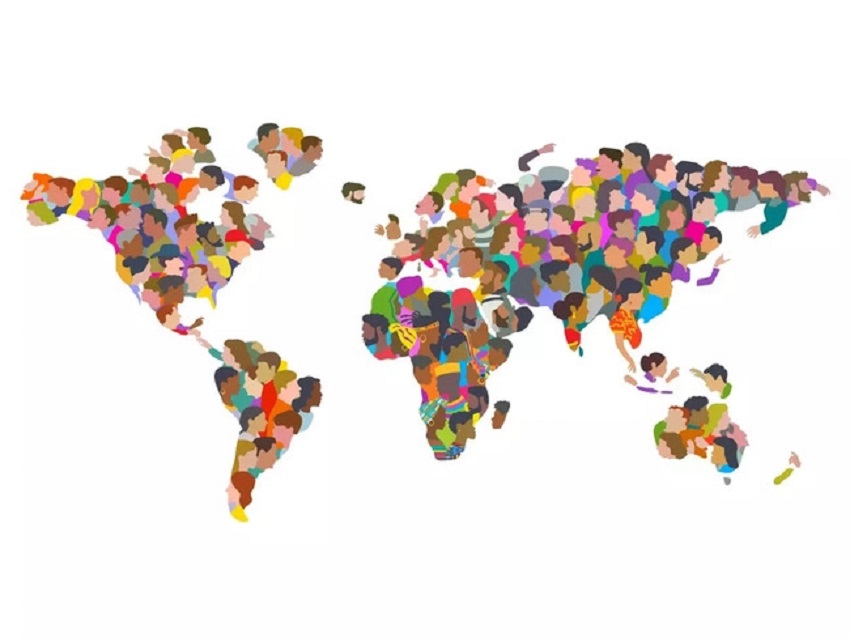
The data projected the world population to reach 8.09 billion people on Wednesday, January 1, 2025.

Recall that Nigeria alongside seven other nations will push the world population to 9.7 billion in 2050 before reaching a peak of around 10.4 billion in the 2080s to 2100.

According to the United Nations, more than half of the projected increase in the global population up to 2050 will be concentrated in eight countries: the Democratic Republic of the Congo, Egypt, Ethiopia, India, Nigeria, Pakistan, the Philippines and the United Republic of Tanzania.


Adedapo Adesanya is a journalist, polymath, and connoisseur of everything art. When he is not writing, he has his nose buried in one of the many books or articles he has bookmarked or simply listening to good music with a bottle of beer or wine. He supports the greatest club in the world, Manchester United F.C.

Click to comment

Leave a Reply

Your email address will not be published. Required fields are marked *

General

Lagos Declares Thursday August 20 Work-Free for 2026 Isese Day

Published

on

isese day

By Adedapo Adesanya

The Lagos State Government has declared Thursday, August 20, as a work-free day for public servants, political appointees and others to mark the 2026 Ìṣẹ̀ṣe Day.

The event is expected to be the largest single gathering of traditional worshippers anywhere in the world, with over three million residents expected to join the celebrations.

The Special Adviser to the Governor on Tourism, Arts and Culture, Mr Idris Aregbe, in a statement signed personally on Wednesday, described the day as one that is bigger than a holiday on a calendar.

“Ìṣẹ̀ṣe is not a relic. It is a living expression of our traditions and a celebration of Yoruba spirituality as an important part of Nigeria’s cultural and religious landscape,” he said, noting that the Yorubas are one of Africa’s largest ethnic nations with more than 55 million people globally, holding tenaciously to the Yoruba culture and inculcating it in their children.

Adhering to culture and tradition over the years has sustained the Ìṣẹ̀ṣe festivals in Cuba, Brazil, and the Caribbean, where many Yorubas live aside from Africa to this day.

“When the drums sound in Lagos on Thursday, they answer drums in Havana, in Salvador, in Port of Spain. Fifty-five million people and counting. Lagos is not observing a local holiday. Lagos is standing at the centre of a global heritage,” Mr Aregbe said.

Ìṣẹ̀ṣe Day marks the culmination of a full week of traditional activities, and has been observed as a work-free day in Lagos since 2023, following a request from the Lagos State Council of Obas and Chiefs.

Governor Babajide Sanwo-Olu has upheld it every year, in line with the administration’s commitment to indigenous values and religious inclusiveness.

Mr Aregbe expressed profound appreciation to Sanwo-Olu for his courageous support for a noble cause, and reserved special honour for the traditional institution.

“We thank Mr Babajide Olusola Sanwo-Olu. It takes real conviction for a leader to stand publicly with heritage, and he has done so without hesitation and without apology. We also bow to Kábíyèsí, the Oba of Lagos, Oba Rilwan Akiolu I, foremost custodian of Lagos culture, to all our royal fathers, our revered White Cap Chiefs, our Babaláwo and Ìyánífá, our Olóòrìṣà and every custodian and promoter who kept these rites alive when it was neither fashionable nor convenient. Governments come and go. Custodians carry the culture,” he said.

This year’s celebrations will feature prayers, rituals, processions, drumming and cultural displays dedicated to the Òrìṣà, coordinated by the Association of African Traditional Religion Nigeria and Overseas (AATREN).

Mr Aregbe urged all participants to celebrate peacefully and respectfully.

“Three million voices rising in honour of tradition is not noise. It is history, faith and cultural pride in harmony. Whether you worship in a mosque, a church or a grove, Ìṣẹ̀ṣe Day belongs to you, because heritage has no denomination. Lagos remains the city where every heritage finds its place.”

Continue Reading

General

Court Jails Two for Trading Naira Notes at Lagos Event Centre

Published

on

trade naira notes event centre

By Modupe Gbadeyanka

Two persons have been convicted and sentenced by Justice A. Aluko of the Federal High Court, Ikoyi, Lagos, for illegal Naira trading.

The judge found the duo of Ms Mutairu Omowunmi Tawa and Ms Faith Chukwujeku guilty and sentenced them to six months’ imprisonment with an option of a N50,000 fine each.

Their sentencing on Tuesday, August 18, 2026, followed their arraignment by the Economic and Financial Crimes Commission (EFCC) on one-count charge each bordering on unlawful trading of Naira notes.

“That you, Mutairu Omowunmi female, on or about July 25, 2026, at Salamagic Event Centre, Onikan, Lagos, within the jurisdiction of this court, did sell and trade in the sum of N850,000 and thereby committed an offence contrary to Section 21(4) of the Central Bank Nigeria, Act 2007, as amended and punishable under Section 21(10) of the same Act,” the charge against Ms Mutairu read.

“That you, Faith Chukwujeku on July 25, 2026, in Lagos within the jurisdiction of this court engaged in hawking the sum of N1.3 million in N200 note denomination issued by the Central Bank of Nigeria (CBN) and thereby committed an offence contrary to and punishable under Section 21(4) of the Central Bank of Nigeria (Establishment) Act, 2007,” the charge against Chukwujeku read.

They pleaded guilty when the charges were read to them.

Following their guilty pleas, the prosecution counsel, Mr Fanen Anum, reviewed the facts of the cases and urged the court to convict and sentence them accordingly.

He further urged the court to order the forfeiture of the exhibits recovered from the convicts to the federal government, being the instruments used in committing the crime.

trade naira notes event centre1

Continue Reading

General

Nigeria’s 2027 Presidential Election Campaign Kicks Off

Published

on

2027 presidential election campaign

By Adedapo Adesanya

Campaigns for Nigeria’s 2027 presidential election officially kicked off on Wednesday, August 19, 2026, setting the stage for a closely watched contest in which President Bola Tinubu is seeking a second term amid widespread economic hardship and insecurity.

President Tinubu, who is seeking re-election on the platform of the ruling All Progressives Congress (APC), faces a divided opposition led by former Vice President, Mr Atiku Abubakar of the African Democratic Congress (ADC) and Mr Peter Obi, who is running under the Nigeria Democratic Congress (NDC).

The presidential election is scheduled for January 16, 2027, alongside elections for the National Assembly. Governorship and state assembly elections will follow on February 6.

The campaign season is expected to be a test for  Mr Tinubu’s administration over its record since taking office in May 2023, particularly the impact of its economic reforms and its handling of insecurity.

Upon his assumption of office, the President scrapped the petrol subsidy and subsequently introduced major foreign exchange reforms and policies that the government says have improved fiscal stability and restored investor confidence.

However, the reforms triggered a sharp rise in the cost of living, with many households struggling with higher food, transport and other living costs.

Reuters reported that nearly 80 per cent of Nigerians surveyed by risk advisory firm SBM Intelligence believe the country is heading in the wrong direction, with economic hardship and insecurity among their main concerns.

Security is also expected to feature prominently in the campaign, as killings, kidnappings and other forms of violence continue to affect parts of the country despite government claims that military operations have improved security in some areas.

Tinubu’s re-election bid will also be tested by the performance of the APC, which has been in power nationally since 2015. The opposition is expected to campaign on the argument that more than a decade of APC rule has failed to deliver sufficient improvements in living standards and security.

Analysts told Business Post that despite voter dissatisfaction, the president retains a significant political advantage from the opposition’s fragmentation. Several prominent opposition figures remain divided, while the APC has strengthened its political base through defections from opposition parties. Thirty-one of Nigeria’s 36 state governors are currently members of the ruling party.

The 2027 elections are, therefore, expected to be shaped by the competing narratives of Mr Tinubu’s reform agenda and the opposition’s criticism of the economic and security conditions facing Nigerians.

For the President, the campaign will provide an opportunity to convince voters that the hardship associated with his reforms will translate into improved living standards, while his challengers will seek to turn widespread dissatisfaction into a unified anti-incumbent vote.

Continue Reading