General
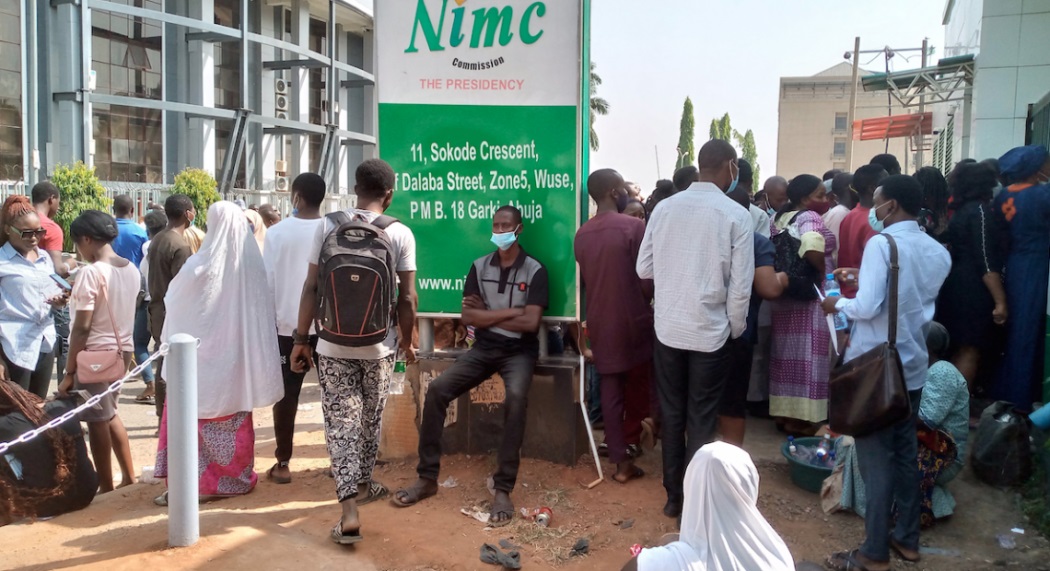
NIMC to Register 95% of Nigerians by December 2025
By Adedapo Adesanya
The National Identity Management Commission (NIMC) has embarked on an ambitious plan to register 95 per cent of Nigerians into the National Identity Database on or before December 2025.
This target was given by the Director General of the agency, Mrs Abisoye Coker-Odusote, who noted that this aligns with President Bola Tinubu’s Renewed Hope Agenda, particularly on digital governance and inclusive development.
Addressing journalists at a briefing in Abuja on Wednesday, she said the mass enrollment drive would be powered by a combination of improved infrastructure, expanded registration centres, and robust public sensitization campaigns.
“What we have done in this regard is that we will commence the Ward Enrollment Exercise to capture at least 95 per cent of Nigerians before December, year end,” she said.
So far, NIMC reports over 120 million Nigerians have been enrolled, and about 100 million more would be captured by December.
Mrs Coker-Odusote noted that the commission is working assiduously to meet this target, asserting that the ongoing Ward Enrollment Exercise when completed will allow the government to know the actual number of Nigerians and this makes it easy to plan effectively for the citizens.
On the issue of public trust, and data security, Mrs Coker-Odusote said it is expected that people might have some trust issues, however, the commission has taken several steps to ensure Nigerians can trust that their data is in safe hands.
According to her, one of the things NIMC has done to build trust is to put back the data in the hands of the people, giving them control over their own data with interventions like the NIN Authentication which includes user consent management that enables individuals access their data and choose when and how they would like to share the data for any service required.
She added that another thing the agency has done is to partner with security agencies who are working tirelessly to be able to address and arrest all those who create fake NIN websites.
Also, there is a partnership between NIMC, and the Nigeria Data Protection Commission (NDPC) to train all staff who will be handling data, especially the enrolment officers.
“We want to make sure that they all get certified by data protection [agency], I think its also another way to ensure that internally they get certified and all of our frontend partners and verification partners are also getting certified by the [Nigerian] Data Protection Commission; so this is for us to foster trust, to be able to ensure you know that the people handling your data are also certified experts,” she buttressed.
She further revealed that NIMC has strengthened its cybersecurity from the backend to make sure there is no intrusion and no one can have access to people’s data.
Mrs Coker-Odusote said NIMC is working to ensure all the ministries, departments and agencies in Nigeria do not operate in silos anymore.
“We have been working with very hard on integrating with all ministries, departments and agencies based on used cases that we’ve identified under their jurisdiction,” she noted.
The NIMC DG also revealed that the commission wants to launch its “Public Key Infrastructure” which builds trust especially within the ministries, departments and agencies (MDAs).
She also forecast that soon, MDAs will be able to use digital signing across board, and seamlessly exchange documents not only within an agency but between various establishments, thereby ushering in the e-government upon which the digital economy will thrive.
General
Electricity Workers Issue 21-Day Strike Notice Over Pay, Working Conditions
By Adedapo Adesanya
Electricity workers, under the aegis of the National Union of Electricity Employees (NUEE), have issued a 21-day nationwide strike notice to the federal government, citing unresolved labour grievances and what they described as worsening conditions across the power sector.
They formally notified the Minister of Power, Mr Adebayo Adelabu, of their intention to embark on industrial action if urgent steps are not taken to address the persistent violations of workers’ rights within the Nigerian Electricity Supply Industry (NESI).
In the letter, the union accused power sector operators of refusing to honour collective agreements, implement the 2025 National Minimum Wage Act and effect its consequential adjustments. It also alleged widespread anti-labour practices across power generation and distribution companies.
“We have written several letters to the ministry on these issues, but there has been little or no response,” the union stated, expressing frustration over what it described as official indifference.
Among the grievances listed are non-remittance of pension deductions and Pay-As-You-Earn (PAYE) taxes, denial of workers’ right to unionise, intimidation of staff, and failure to improve welfare despite repeated tariff increases.
The union said in some distribution companies, pension contributions deducted from workers’ salaries have allegedly remained unpaid for years, leaving employees uncertain about their retirement security.
The electricity workers also criticised what they termed the “militarisation” of workplaces, alleging harassment and threats in certain power firms.
According to the union, labour is increasingly being treated as an adversary rather than a critical stakeholder in a sector already struggling with public confidence.
The notice further questioned the performance of investors who acquired power assets during the 2013 privatisation exercise.
The union argued that promises of improved infrastructure, capital injection, metering expansion and better service delivery have not translated into meaningful gains for workers or consumers.
While electricity tariffs have risen multiple times in recent years, the union said workers have seen no corresponding improvement in salaries, promotions, bonuses or working conditions.
Business Post reports that the ultimatum likely places the federal government under pressure to act as a nationwide strike would significantly disrupt power generation and distribution, affecting homes, hospitals, small businesses and critical infrastructure already grappling with unreliable supply.
General
Oyetola Warns Budget Shortfall Threatens Operations of NPA, NIMASA, Others
By Adedapo Adesanya
The Minister of Marine and Blue Economy, Mr Adegboyega Oyetola, has warned that operations of agencies under his ministry were being severely constrained by excessive deductions at source by the Office of the Accountant-General of the Federation.
He disclosed on Tuesday while presenting a N10.5 billion budget proposal for the Federal Ministry of Marine and Blue Economy for the 2026 fiscal year.
He lamented that the allocation was grossly insufficient to effectively execute the ministry’s wide-ranging mandate, critical to Nigeria’s trade, transport efficiency and food security.
Mr Oyetola while defending the ministry’s budget before a joint sitting of the Senate Committee on Marine Transport and the House of Representatives committees on Ports and Harbours; Maritime Safety, Education and Administration; Shipping Services; Inland Waterways; and Ocean and Fisheries, said the proposed budget, which comprises N8.24 billion for capital expenditure, N453.86 million for overheads and N1.81 billion for personnel costs, would only sustain minimal operational continuity rather than deliver meaningful reforms or sectoral growth.
The minister explained that the ministry oversees interconnected subsectors, including ports, shipping, inland waterways, fisheries and aquaculture, which collectively handle over 90 per cent of Nigeria’s international trade by volume, national food and nutrition security, and economic competitiveness.
He noted that while agencies such as the Nigerian Ports Authority (NPA), Nigerian Maritime Administration and Safety Agency (NIMASA) and Nigerian Shippers’ Council (NSC) were self-funding and made significant remittances to the Consolidated Revenue Fund, their operations were being severely constrained by excessive deductions at source by the Office of the Accountant-General of the Federation.
According to him, these deductions had weakened liquidity and reduced the operational flexibility of key agencies responsible for maritime safety, port efficiency and regulatory oversight, with far-reaching consequences including port congestion, higher logistics costs, delayed cargo movement, revenue losses and inflationary pressures.
He stressed that what appeared to be an accounting issue had become a national economic concern.
Mr Oyetola also said that the 2026 budget of the Council for the Regulation of Freight Forwarding in Nigeria (CRFFN) was wrongly placed by the Budget Office under the Federal Ministry of Transportation, even though it is an agency under the Federal Ministry of Marine and Blue Economy, saying the misalignment undermined clarity in oversight and policy coherence within the maritime logistics value chain.
On inland waterways, the Minister appealed for increased funding to curb accidents and loss of lives. He said water transport is globally recognised as significantly cheaper than road transport.
He noted that Nigeria’s heavy reliance on road haulage for over 80 per cent of freight movement had worsened road deterioration and increased the cost of goods, arguing that safer and more efficient inland waterways would ease pressure on roads and lower logistics costs.
On fisheries and aquaculture, Oyetola said Nigeria’s annual fish demand of over 3.6 million metric tonnes far exceeded domestic production of about 1.4 million metric tonnes, sustaining imports valued at more than one billion dollars annually.
He added that post-harvest losses of up to 30 per cent further reduced supply, despite fish being one of the most affordable sourNiger.
“As long as we hinder official trade, individuals will resort to informal channels. Currently, we estimate that up to 50 per cent of our domestic areas have resorted to illegal trade, while only about 30 per cent is conducted legally, which is detrimental to our security.”
He pointed out that “this situation is beneficial for the economies of both countries. It will positively impact our maritime sector, as we expect an increase in transit cargo passing through our ports to Niger, resulting in economic activities for our investors in the maritime industry.
“Additionally, this development will benefit Nigerians in border communities, many of whom are engaged in farming and other economic activities, providing them with opportunities to export goods to Niger.”
General
Gaya Rallies APC Support for Governor Abba Yusuf
By Abba Dukawa
The independent non-executive director of the Nigeria Sovereign Investment Authority (NSIA), Mr Abdullahi Mahmud Gaya, has called on members of the All Progressives Congress (APC) and key stakeholders in Ajingi, Gaya, and Albasu Local Government Areas of Kano State to close ranks and give their full support to the state governor, Mr Abba Kabir Yusuf.
Mr Gaya described the governor’s defection to the ruling party as a bold and strategic move that reflects his deep commitment to the development and progress of Kano State, noting that APC members and stakeholders in the areas warmly welcomed the governor into the party, alongside elected and appointed officials, party leaders, and other critical stakeholders.
He made this statement during a meeting with APC leaders and stakeholders from the three local government areas, held at his office in the state capital.
According to him, the governor’s courageous decision will strengthen Kano State’s influence at the national level and open new opportunities for economic growth, improved welfare, and greater prosperity for the people.
He also urged party members to take ownership of the democratic process by ensuring they collect their APC membership cards and Permanent Voter Cards (PVCs).
In a show of solidarity and goodwill, Mr Gaya donated N6 million to party members and stakeholders during the meeting as Ramadan support.
Speaking at the gathering, a former Secretary to the State Government and Wazirin Gaya, Usman Alhaji, called on party members to intensify efforts toward strengthening the APC in the area. He said the party’s growing numerical strength in Ajingi, Gaya, and Albasu Local Government Areas already positions it as the party to beat.
Also addressing the meeting, elder statesman and senior stakeholder, Mr Uba Muhammad Danbayye, noted that the party members now recognizes the difference between a mere candidate and a true politician, saying based on Mr Gaya’s leadership style and strong relationship with the people, stakeholders have unanimously resolved to support him and will not field another candidate for the House of Representatives in the upcoming election.
-
Feature/OPED6 years agoDavos was Different this year
-
Travel/Tourism10 years ago
Lagos Seals Western Lodge Hotel In Ikorodu
-
Showbiz3 years agoEstranged Lover Releases Videos of Empress Njamah Bathing
-
Banking8 years agoSort Codes of GTBank Branches in Nigeria
-
Economy3 years agoSubsidy Removal: CNG at N130 Per Litre Cheaper Than Petrol—IPMAN
-
Banking3 years agoSort Codes of UBA Branches in Nigeria
-
Banking3 years agoFirst Bank Announces Planned Downtime
-
Sports3 years agoHighest Paid Nigerian Footballer – How Much Do Nigerian Footballers Earn