General
NLC Not Different from Bandits—Kaduna Government
**Sacks Nurses, Threatens to Dismiss Lecturers, Others
By Dipo Olowookere
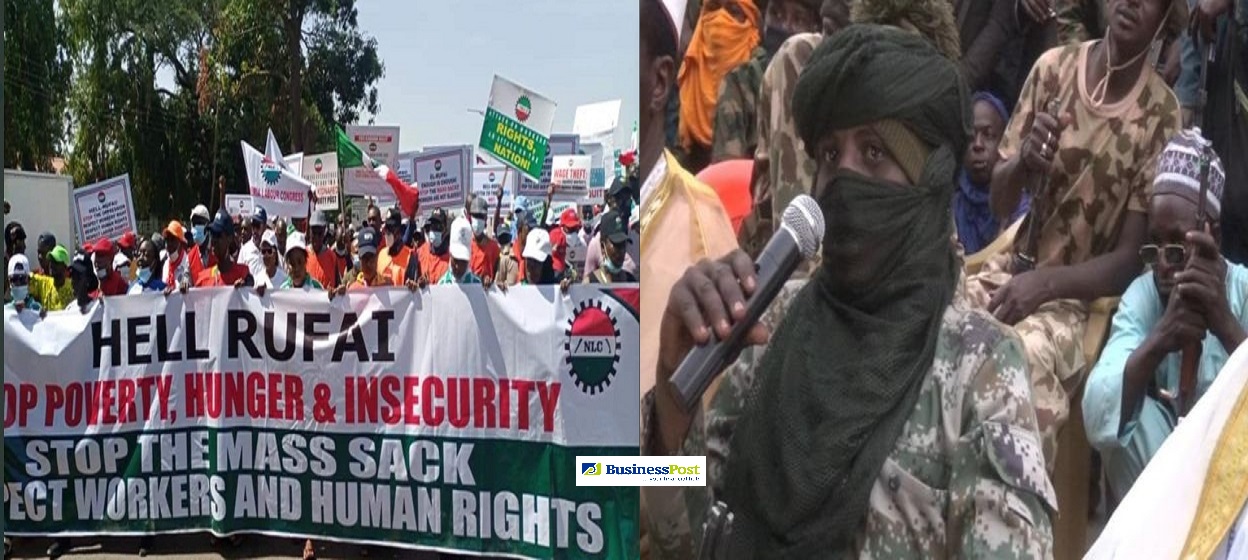
The Kaduna State Government has likened the Nigeria Labour Congress (NLC) to bandits, saying it will not tolerate criminal acts disguised as industrial action.
On Monday, workers in the state embarked on a five-day warning strike, which has pushed the economy under pressure, with electricity supply disrupted as a result of the action.
In a statement today posted on the verified Facebook page of the Governor of Kaduna State, Mr Nasir El-Rufai, said the state government frowns at the industrial action, pointing out that it was not only “unacceptable” but a violation of the law and the Trade Union Act.
In the statement, the state government said “the actions of the NLC [was] equivalent to the actions of the bandits kidnapping and menacing our citizens.”
“Bandits illegally use arms, but the NLC is deploying mob action for exactly the same ends: trying to hold hostage the freedoms, economic interests, livelihoods and resources of the people of Kaduna State.
“It is a vain expectation that this government will respond differently to sets of unlawful actions that have the same ends,” the state government stressed.
In view of this, it has declared the president of the NLC, Mr Ayuba Wabba and his senior confederates in the NLC wanted, emphasising that it vigorous prosecute them “for violations of the Penal Code of Kaduna State, the Miscellaneous Offences and the Trade Dispute (Essential Services) Acts,” advising them to “report to the Ministry of Justice and the police headquarters.”
It also said all ministries, departments and agencies (MDAs) have been mandated “to submit daily copies of attendance register to the Head of Service.
The state government also said any academic staff of the Kaduna State University (KASU) that does not report for work will be dismissed, directing authorities of the institution “to submit a copy of the attendance register for all categories of staff daily to the Secretary to the State Government and the Commissioner of Education.”
It further said the “Ministry of Health will dismiss all nurses below GL 14 for going on an unlawful strike,” adding that, “Salaries that could have gone to them are to be given as extraordinary occupational allowances to the health workers who are at their duty posts to fill the gap of those absconding from duty.”
“The Ministry of Health has been directed to advertise vacancies for the immediate recruitment of new nurses to replace those dismissed,” it also said.
Read the full statement below;
Today, the Kaduna State Government reviewed the sundry criminal actions that have defined the campaign of economic and social sabotage and lawlessness waged by the NLC.
KDSG considers as unacceptable the serial violations of the Miscellaneous Offences Act and the Trade Union Act that have occurred over the last two days. The state government commends citizens for remaining calm amidst this assault on their rights and comfort and their businesses.
However, KDSG cannot be expected to tolerate the brazen shutdown of electricity, attack on public infrastructure and buildings, locking up hospitals and forcefully discharging patients, unlawful trespass into public facilities and the wanton use of coercion and restraints of personal freedom by the NLC.
Efforts to dress up criminal activity as industrial action do not change the reality of the lawbreaking that has unfolded, including their persistently ignoring the prohibition against impeding essential services. Also, KDSG cannot ignore the illegal pressures brought to disrupt the operations of banks and other private business whose staff and customers do not have any industrial dispute with the state or any other government.
KDSG acknowledges doctors and some other categories of health workers that are trying to run public health facilities, but regrets that some nurses have joined the unlawful strike and engaged in the sabotage of some of our health facilities. Nurses were implicated in the forceful discharge of patients in many health facilities.
Reports from Barau Dikko Teaching Hospital disclosed that some identified nurses disconnected the oxygen supply of a two-day-old baby in an incubator on Monday, 17th May 2021. The names of the three nurses from the Special Baby Care Unit (SBCU) who were involved in this despicable act have been forwarded to the Ministry of Justice to initiate prosecution for attempted murder or murder in the event we lose the baby.
In addition, KDSG has decided the following:
- Ayuba Wabba and his senior confederates in the NLC are declared wanted and will be vigorously prosecuted for violations of the Penal Code of Kaduna State, the Miscellaneous Offences and the Trade Dispute (Essential Services) Acts. They are advised to report to the Ministry of Justice and the Police Headquarters to take their statements;
- The Ministry of Health will dismiss all nurses below GL 14 for going on an unlawful strike. Salaries that could have gone to them are to be given as extraordinary occupational allowances to the health workers who are at their duty posts to fill the gap of those absconding from duty. The Ministry of Health has been directed to advertise vacancies for the immediate recruitment of new nurses to replace those dismissed;
- Any academic staff of KASU that does not report for work will be dismissed. The authorities of KASU are to submit a copy of the attendance register for all categories of staff daily to the Secretary to the State Government and the Commissioner of Education;
- All MDAs are also to submit daily copies of the attendance register to the Head of Service;
KDSG views the actions of the NLC as equivalent to the actions of the bandits kidnapping and menacing our citizens. Bandits illegally use arms, but the NLC is deploying mob action for exactly the same ends: trying to hold hostage the freedoms, economic interests, livelihoods and resources of the people of Kaduna State. It is a vain expectation that this government will respond differently to sets of unlawful actions that have the same ends.
KDSG will not submit its treasury to the entitled minority. We will reform and right-size our public service to meet the needs and resources of the Kaduna State even if the NLC strikes ad infinitum. The government remains committed to using all the resources it can generate to serve the interests of the majority of its citizens, providing social services beyond paying salaries, always putting the interests of the many ahead of the few.
General
FG Boosts Civil Servants’ Pay with New Allowance Review
By Adedapo Adesanya
The federal government has approved a sweeping increase in peculiar allowances and other welfare benefits for civil servants, aimed at improving take-home pay and boosting morale across the public service.
The announcement was made on Friday by the Head of the Civil Service of the Federation, Mrs Didi Walson-Jack, during a press briefing in Abuja, where she outlined key reforms endorsed by the Federal Executive Council (FEC).
According to Mrs Walson-Jack, the review affects workers under both the Consolidated Public Service Salary Structure (CONPSS) and the Consolidated Research and Allied Institutions Salary Structure (CONRAISS), ensuring a broad-based impact across all cadres.
She said the revised peculiar allowances have been structured to reflect across all grade levels, resulting in a meaningful increase in earnings for both junior and senior officers.
In addition, the government approved an upward review of several key allowances, including duty tour allowance (DTA), estacode, and book allowance.
Mrs Walson-Jack noted that virtually all allowances listed under the Public Service Rules have now been revised.
A major highlight of the reform is the approval of 100 per cent Duty Tour Allowance for civil servants attending approved training programmes, regardless of whether travel is involved.
Beyond salary-related adjustments, the government also introduced a new exit benefit scheme for retiring civil servants under the Contributory Pension Scheme. The scheme provides 100 per cent of a retiree’s total annual emoluments as an exit package, in addition to their pension, effective January 1, 2026.
Mrs Walson-Jack described the move as a step toward ensuring dignity in retirement, stressing that no public servant should leave service without adequate financial support.
The government also confirmed the operationalisation of the Employee Compensation Scheme, designed to provide financial protection for workers who suffer job-related injuries or death.
The reforms come amid growing calls from labour unions for improved welfare, as rising living costs continue to put pressure on workers. Analysts say the combined measures could significantly enhance financial stability for civil servants and improve overall productivity in the public sector.
General
Surrogacy Laws in Ukraine: What Every International Parent Must Know Before Starting the Process
One of the primary reasons international couples choose surrogacy in Ukraine is the country’s clear and well-defined legal framework. Unlike many nations where surrogacy exists in a legal gray area or is outright prohibited, Ukraine has codified the rights of intended parents, the obligations of surrogate mothers, and the procedures for establishing legal parenthood.
Understanding these laws is not just advisable but essential. Proper legal preparation ensures that your parental rights are protected, that the process runs smoothly, and that your child’s citizenship and documentation are handled correctly from day one.
The Legal Foundation of Surrogacy in Ukraine
Surrogacy in Ukraine is primarily regulated by two pieces of legislation: the Family Code of Ukraine and the Civil Code of Ukraine. The most significant provision is Article 123, Paragraph 2 of the Family Code, which states that when an embryo conceived through assisted reproductive technologies is transferred to another woman’s body, the married couple who initiated the procedure are recognized as the parents of the child.
This provision is remarkably protective of intended parents. It means that from the moment of embryo transfer, the intended parents are considered the legal parents. The surrogate mother has no legal claim to the child, and there is no requirement for an adoption process or court hearing to establish parenthood.
Additionally, Article 139 of the Family Code reinforces the principle that the surrogate cannot contest the parentage of a child born through a surrogacy arrangement. This dual-layer legal protection is one of the strongest in the world and is a major reason why surrogacy in Ukraine is so attractive to international couples.
Who Is Eligible for Surrogacy in Ukraine?
Ukrainian law sets specific eligibility criteria for intended parents. To qualify for a surrogacy program, you must meet the following requirements:
Marital status: Both partners must be legally married. Ukraine requires a valid marriage certificate, which must be translated into Ukrainian and apostilled.
Medical indication: There must be a documented medical reason why the intended mother cannot carry a pregnancy. This could include uterine abnormalities, repeated IVF failures, recurrent pregnancy loss, or other reproductive health conditions.
Heterosexual couple: Under current Ukrainian legislation, surrogacy is available only to heterosexual married couples. Single parents and same-sex couples are not eligible at this time.
Genetic connection: At least one of the intended parents must have a genetic connection to the child. This means that either the eggs or the sperm (or both) must come from the intended parents. Donor gametes may be used for one component if medically necessary.
The Surrogacy Agreement: Legal Protection for All Parties
Before any medical procedures begin, a comprehensive surrogacy agreement must be executed between the intended parents and the surrogate mother. This legally binding contract is a cornerstone of the process and covers several critical areas.
The agreement defines the rights and obligations of both parties, the compensation structure for the surrogate, medical care provisions during pregnancy, conditions under which the agreement may be terminated, and the procedures for establishing parenthood after birth. Ukrainian law requires this agreement to be notarized, and experienced agencies ensure that all legal requirements are met.
Working with an agency that has in-house legal expertise is essential for ensuring the agreement complies with Ukrainian law and addresses the specific needs of the intended parents. Agencies like Militta provide dedicated legal teams that handle all documentation, from the initial surrogacy agreement to the final birth registration.
For more details about how the legal and medical process works, visit Militta’s comprehensive surrogacy guide.
Birth Registration and Documentation Process
One of the most important moments in a surrogacy journey is the birth of the child and the subsequent documentation process. In Ukraine, this is remarkably straightforward compared to many other countries.
Immediately after the birth, the child’s birth certificate is issued by the local civil registration office (known as RAGS in Ukraine). The certificate lists the intended parents as the mother and father, with no mention of surrogacy or the surrogate mother. The surrogate’s consent is not required for this registration because Ukrainian law already recognizes the intended parents’ rights from the moment of embryo transfer.
After obtaining the birth certificate, the intended parents must proceed with several additional steps. The birth certificate must be apostilled and translated for use in their home country. They must then visit their home country’s embassy or consulate in Ukraine to register the child’s birth, obtain citizenship documentation, and apply for a passport or travel document for the newborn.
The timeline for this post-birth documentation process typically ranges from two to six weeks, depending on the home country’s embassy processing times. During this period, intended parents usually stay in Ukraine, and their agency provides accommodation assistance and logistical support.
Country-Specific Considerations for International Parents
While Ukrainian law is clear and protective, intended parents must also consider the legal requirements of their home country. Different nations have varying approaches to recognizing children born through international surrogacy.
Parents from countries within the European Union, for example, may need to go through additional recognition procedures depending on their specific national laws. Some EU countries, such as Spain and France, have historically been more complex in recognizing surrogacy-born children, while others, like Portugal, have clearer pathways.
Parents from the United States, the United Kingdom, Australia, and China each face their own specific documentation requirements. A knowledgeable surrogacy agency will be familiar with the requirements of your home country and can guide you through the specific steps needed to bring your child home.
Surrogate Rights and Protections in Ukraine
Ukrainian surrogacy law also establishes protections for surrogate mothers. To be eligible, a surrogate must be between 18 and 35 years of age, have at least one healthy child of her own, and pass comprehensive medical and psychological evaluations. These requirements ensure that surrogates are making informed, voluntary decisions.
Surrogates in Ukraine receive compensation that is contractually guaranteed, along with full medical care throughout the pregnancy and a reasonable recovery period after birth. Reputable agencies ensure that surrogates are treated with dignity and that their health and wellbeing are prioritized throughout the process.
Surrogacy in Ukraine in 2026: Current Status and Safety
As of 2026, surrogacy programs in Ukraine continue to operate with full legal backing. The legal framework governing surrogacy has remained stable, and clinics in central and western Ukraine, particularly in Kyiv and Lviv, maintain their operational capacity.
Reputable agencies have implemented comprehensive safety protocols to protect all parties. This includes careful selection of medical facilities in secure locations, contingency planning for logistics, and continuous communication with intended parents throughout the process. International travel to Ukraine is facilitated through European transit routes, and agencies assist with all travel arrangements.
Frequently Asked Questions About Surrogacy Law in Ukraine
Can the surrogate mother change her mind and keep the baby?
No. Under Ukrainian law, the surrogate has no legal rights to the child. The intended parents are recognized as the legal parents from the moment of embryo transfer, and the birth certificate is issued in their names.
Do I need to go through an adoption process after the surrogate gives birth?
No. Unlike many other countries, Ukraine does not require any adoption proceedings for surrogacy-born children. The intended parents’ names appear directly on the birth certificate.
What documents do I need to start a surrogacy program in Ukraine?
You will typically need a valid marriage certificate (apostilled and translated), passports for both intended parents, medical documentation confirming the need for surrogacy, and a notarized surrogacy agreement. Your agency will provide a complete document checklist.
How do I bring my surrogacy-born child back to my home country?
After obtaining the Ukrainian birth certificate, you must register the birth at your home country’s embassy in Ukraine, obtain citizenship documentation, and apply for a passport or travel document for the child. This process typically takes two to six weeks.
Is surrogacy in Ukraine safe in 2026?
Yes. Surrogacy programs operate successfully in central and western Ukraine, with established safety protocols. Leading agencies like Militta have extensive experience managing programs for international clients and ensure the safety and wellbeing of all parties involved.
Ensuring a Legally Secure Surrogacy Journey
The legal landscape of surrogacy in Ukraine is one of the most favorable in the world for intended parents. With clear legislation that protects parental rights from the very beginning, a straightforward birth registration process, and no need for adoption proceedings, Ukraine provides a secure foundation for building your family.
The key to a successful surrogacy journey lies in thorough preparation and partnership with experienced professionals. By choosing a reputable agency with proven legal expertise, you can navigate the process with confidence, knowing that every step is handled in compliance with Ukrainian law and with your family’s best interests at heart.
General
ADC Lawmakers Oppose Tinubu’s $516m Loan Request for Highway
By Adedapo Adesanya
The African Democratic Congress (ADC) Legislators’ Forum has condemned the latest move by President Bola Tinubu to secure Senate approval for an additional external loan of $516,333,070 for the Sokoto–Badagry Super Highway project.
Mr Tinubu requested Senate approval for a $516.3 million syndicated loan to finance key sections of the Sokoto–Badagry Superhighway, a major infrastructure project under his administration’s Renewed Hope Agenda from Deutsche Bank.
The request, contained in a letter read during plenary on Thursday by the Senate President, Mr Godswill Akpabio, seeks legislative authorisation in line with Sections 16 and 21 of the Debt Management Office (Establishment) Act, 2011.
However, the opposition lawmakers said it is not only alarming but becoming of the Tinubu administration to make borrowing its default economic policy, with little regard for sustainability, accountability, or the well-being of future generations.
The forum, in a statement jointly signed by its chairman, Mr Uko Ndukwe Nkole, as well as leaders from each geopolitical zone, noted that while no responsible opposition undermines the importance of infrastructure development, the cost and conditions of such projects must be queried.
According to the ADC lawmakers, Mr Tinubu’s government has failed to convincingly demonstrate that its endless appetite for loans is guided by a coherent, transparent and economically viable repayment strategy.
“Instead, Nigerians are witnessing a troubling pattern; one where debt accumulation is prioritised over prudent fiscal management, innovation, and domestic resource mobilisation.
“Nigeria is already weighed down by a crushing debt burden, with debt servicing swallowing a staggering proportion of national revenue. Yet, rather than confronting this reality with discipline and reform, the Tinubu administration continues to plunge the country deeper into what can only be described as a looming debt catastrophe.
“Each new loan tightens the noose around the nation’s economic sovereignty, leaving future generations to pay for today’s lack of foresight.
“Even more disturbing is the timing of this request. As the nation inches closer to a major general election cycle, Nigerians are right to question the motives behind this borrowing spree.
“Is this truly about development, or is it another attempt to create avenues for political patronage and electoral advantage? History has taught us to be wary of last-minute, large-scale financial commitments made under the guise of national interest,” the statement read in part.
The ADC Legislators’ Forum insisted that the National Assembly must not act as a rubber stamp or a pro-group of President Tinubu in this matter.
It said the Senate, in particular, must rise to its constitutional responsibility by demanding full disclosure of the project’s financial details, procurement processes, cost-benefit analysis, and a credible repayment plan, as anything short of this would amount to a betrayal of public trust.
The lawmakers called on the administration to redirect its focus toward policies that can genuinely strengthen Nigeria’s economy; policies that promote productivity, industrial growth, job creation, and the plugging of revenue leakages.
“We must clearly state that governance is not a free ride without consequences. Those who make decisions today that endanger the economic future of millions of Nigerians must understand that a day of reckoning will inevitably come.
“The Nigerian people will demand answers, accountability, and justice for policies that have deepened hardship and mortgaged the nation’s destiny. Nigeria stands at a critical crossroads.
“We can either choose the path of responsibility, discipline, and sustainable growth, or continue down this perilous road of debt dependency and economic vulnerability,” the statement added.
-
Feature/OPED6 years agoDavos was Different this year
-
Travel/Tourism10 years ago
Lagos Seals Western Lodge Hotel In Ikorodu
-
Showbiz3 years agoEstranged Lover Releases Videos of Empress Njamah Bathing
-
Banking8 years agoSort Codes of GTBank Branches in Nigeria
-
Economy3 years agoSubsidy Removal: CNG at N130 Per Litre Cheaper Than Petrol—IPMAN
-
Banking3 years agoSort Codes of UBA Branches in Nigeria
-
Banking3 years agoFirst Bank Announces Planned Downtime
-
Sports3 years agoHighest Paid Nigerian Footballer – How Much Do Nigerian Footballers Earn