Connect with us

General

Ogun APC Guber Candidate’s Wife Gives Cash Grants, Business Tools to Widows

Published

on

Yayi's wife Chadash Empowerment Foundation

By Modupe Gbadeyanka

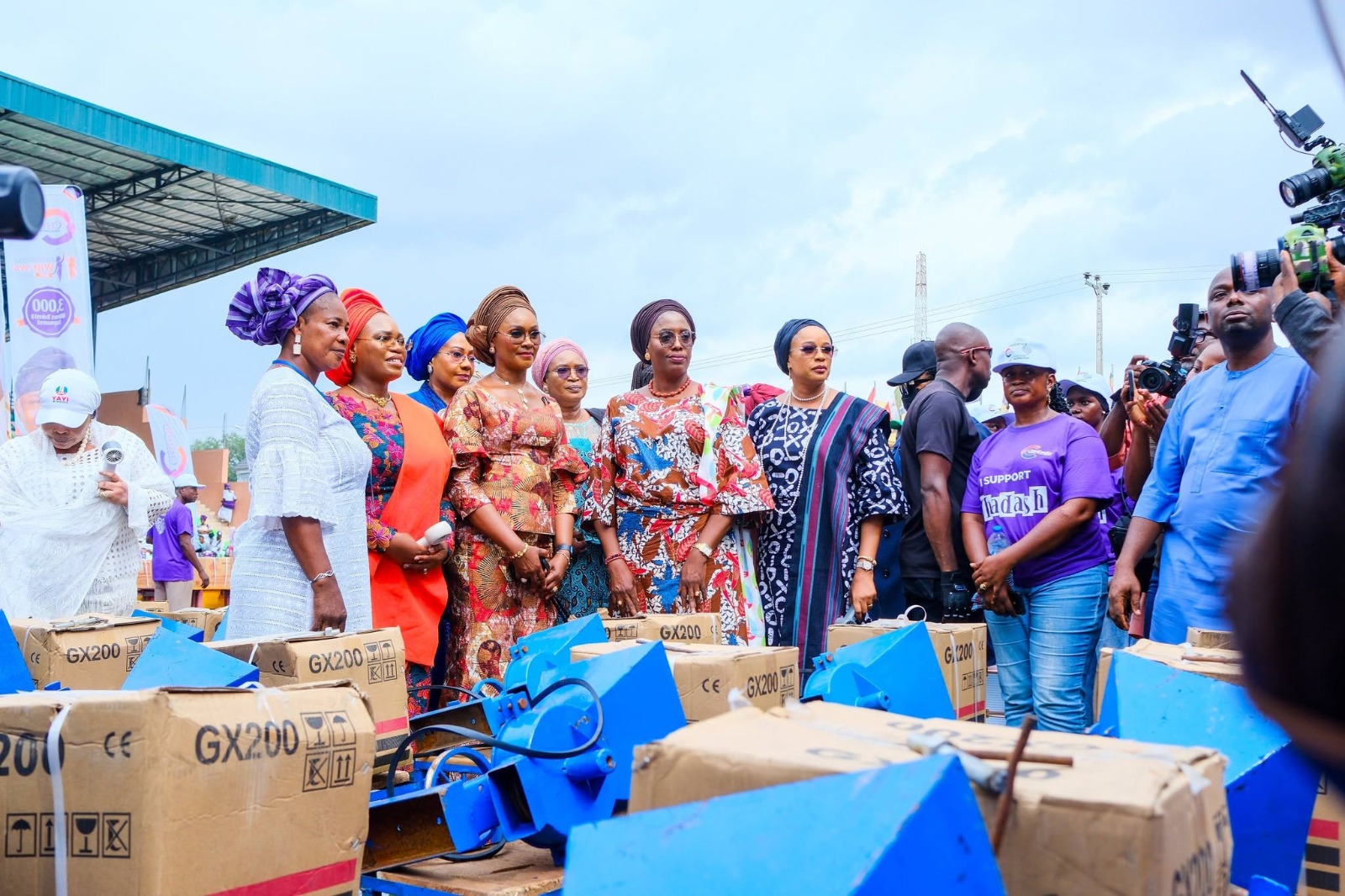
About 3,000 widows in Ogun State have been empowered with cash grants and business tools by the wife of the governorship candidate of the All Progressives Congress (APC) in the state, Mrs Temitope Adeola.

Her husband, Mr Solomon Olamilekan Adeola, popularly known as Yayi, is currently the Senator representing Ogun West Senatorial District at the National Assembly.

He was picked as the consensus candidate of the ruling APC for the 2027 gubernatorial election.

Mrs Adeola is the founder of Chadash Empowerment Foundation, and to commemorate 2026 International Widows’ Day, she gave out the items through the organisation’s annual Widows’ Empowerment Programme, which birthed in 2021, as part of efforts to promote economic independence.

The empowerment programme, held at the Ake Palace Amphitheatre in Abeokuta, Ogun State, brought together widows from across the state for a day of capacity building, entrepreneurship support and social inclusion.

As part of the initiative, widows who completed the foundation’s vocational training programme received business tools to help them establish or expand their enterprises. The tools distributed included sewing machines, grinding machines, hair dryers, makeup kits, deep freezers, and gas cookers. In addition, 2,000 widows received cash grants of N50,000 each to strengthen existing businesses, improve household income and enhance their economic resilience.

Mrs Adeola said the initiative reflects the organisation’s unwavering commitment to empowering widows through sustainable economic opportunities rather than one-time interventions.

According to her, empowering widows extends far beyond financial assistance, as providing practical skills, vocational tools and start-up capital equips them to build sustainable livelihoods, regain their confidence and become financially self-reliant.

“Seeing more than 3,000 widows gathered here today with renewed hope and confidence reminds us why we remain committed to restoring dignity, creating opportunities, and empowering vulnerable women to achieve financial independence.

“At the Chadash Empowerment Foundation, empowerment goes beyond giving; it is about equipping people with the skills, resources, and confidence to build sustainable livelihoods that will positively impact their families and communities,” the politician’s wife stated.

She urged beneficiaries to make productive use of the support provided by investing in viable businesses that generate sustainable income and improve their families’ welfare.

“The heartfelt testimonies we continue to receive from our beneficiaries reaffirm our mission. Their stories of renewed hope, restored confidence, and brighter futures inspire us to do even more. Together, we are transforming grief into growth, despair into hope, and challenges into opportunities,” Mrs Adeola stated.

Since its inception, the Chadash Empowerment Foundation has impacted more than 15,000 widows across Ogun State and the Federal Capital Territory through vocational training, entrepreneurship support, cash grants, and sustainable livelihood initiatives.


Modupe Gbadeyanka is a fast-rising journalist with Business Post Nigeria. Her passion for journalism is amazing. She is willing to learn more with a view to becoming one of the best pen-pushers in Nigeria. Her role models are the duo of CNN's Richard Quest and Christiane Amanpour.

Click to comment

Leave a Reply

Your email address will not be published. Required fields are marked *

General

IPMAN Urges FG to Review Fuel Import Licences Amid Rising Petrol Prices

Published

on

Petrol Prices

By Adedapo Adesanya

The Independent Petroleum Marketers Association of Nigeria (IPMAN) has urged the federal government to review the fuel import licences recently issued to some marketers, saying the policy is driving up fuel prices, putting pressure on foreign exchange and creating instability in the downstream petroleum sector.

Speaking in Abuja, IPMAN’s National Publicity Secretary, Mr Chinedu Ukadike, said the current import regime has not achieved its goal of making fuel more affordable. Instead, he argued that it has encouraged the importation of more expensive petrol while increasing the country’s dependence on foreign exchange.

According to Mr Ukadike, some importers plan to sell Premium Motor Spirit (PMS), also known as petrol, for about N1,350 per litre, which is higher than the ex-depot price offered by the Dangote Petroleum Refinery.

The IPMAN official questioned the need to import fuel at higher prices when locally refined products are available at lower costs, noting that the situation has made it difficult for independent marketers to plan their businesses because import costs continue to fluctuate.

Mr Ukadike also raised concerns about the quality of some imported fuel and called on regulators to ensure that only products that meet Nigeria’s standards are allowed into the country.

The association warned that continued fuel imports also increase demand for the US Dollar since importers pay for products in foreign currency. This, the association said, puts additional pressure on the naira and contributes to higher fuel prices.

The association stressed that Nigeria should focus on supporting local refining to improve energy security and reduce reliance on imported petroleum products.

It noted that the Dangote Petroleum Refinery has helped maintain steady fuel supply despite global disruptions, including tensions in the Middle East.

According to IPMAN, greater use of locally refined fuel would reduce FX demand, strengthen the refining industry, create jobs and improve economic stability. It also said producing enough fuel for local consumption while exporting excess output would help Nigeria earn more foreign exchange.

The association called on the federal government, the Nigerian Midstream and Downstream Petroleum Regulatory Authority (NMDPRA), the Nigerian National Petroleum Company (NNPC) Limited and the Presidential Committee on downstream reforms to engage stakeholders and adopt policies that support domestic refining.

IPMAN said strengthening local refining remains the best long-term solution for affordable fuel, stable supply and improved energy security in Nigeria.

Continue Reading

General

NAICOM Insists July 31 Insurance Recapitalisation Deadline Sacrosanct

Published

on

NAICOM Conplaint Management Portal

By Adedapo Adesanya

The National Insurance Commission (NAICOM) has reiterated that the July 31, 2026, deadline for insurance companies to meet the new minimum capital requirements remains firm, warning operators against treating it as a mere formality.

The Commissioner for Insurance of NAICOM, Mr Olusegun Ayo Omosehin, who gave this warning, urged companies that have yet to meet the new minimum capital requirements to act with urgency.

Speaking on Friday at the investiture of Mr Akinjide Oluwarotimi-Orimolade as the 53rd President and Chairman of Council of the Chartered Insurance Institute of Nigeria (CIIN) in Lagos, Mr Omosehin said the recapitalisation exercise remained a critical pillar of the Commission’s ongoing reforms aimed at building a stronger, more resilient and consumer-focused insurance industry.

According to him, the new minimum capital requirement is designed to improve insurers’ claims-paying capacity, strengthen their balance sheets, support higher domestic risk retention and prepare the industry for a risk-based capital regime.

“With about 14 days to the July 31 deadline, we commend operators that have made significant progress in raising capital, engaging investors, strengthening governance and submitting for the Commission’s verification process.

“However, the deadline is not symbolic; it is regulatory, and the industry must treat it with the urgency it deserves,” he said.

The Commissioner assured stakeholders that the insurance sector regulator would maintain a transparent, fair and firm process, stressing that every operator must demonstrate financial soundness, regulatory compliance and operational readiness.

He added that stronger capitalisation must ultimately translate into better service delivery, prompt settlement of claims, improved consumer protection and greater public confidence in insurance.

Mr Omosehin noted that the Nigerian Insurance Industry Reform Act (NIIRA) 2025 has provided a stronger legal framework for a more resilient, better-governed and responsive insurance market, adding that NAICOM’s reform agenda is focused on market conduct, policyholder protection, governance, insurance penetration, financial inclusion and responsible innovation.

He described professionalism as the foundation of a trusted insurance market, saying the industry’s growth depends not only on adequate capital and effective regulation but also on ethics, competence, innovation and public confidence.

“The strength of insurance depends not only on capital and regulation but also on professionalism, ethics, innovation and public confidence. A trusted insurance market cannot be built on capital alone. It requires competent professionals, ethical institutions, credible advice and fair treatment of policyholders,” he stated.

Continue Reading

General

Customs Eastern Maritime Command Auctions N26m Seized Petrol, Palm Oil, Others

Published

on

Customs auctions petrol palm oil

By Bon Peters

About 29,645 litres of premium motor spirit (PMS), otherwise known as petrol, as well as industrial palm oil, edible palm oil and vegetable oil with a Duty Paid Value (DPV) of N26 million have been auctioned by the Eastern Marine Command of the Nigeria Customs Service (NCS).

The products were seized by the agency from some smugglers and auctioned on Thursday, July 16, 2026, at the Oron Outstation of the Command in Akwa Ibom State, in strict compliance with Section 119 of the Nigeria Customs Service (NCS) Act 2023.

It was gathered that the command auctioned 14,720 litres of petrol and 14,925 litres of industrial palm oil, edible palm oil and vegetable oil, according to a statement issued over the weekend in Port Harcourt, Rivers State, by the command’s spokesman, Mr Joshua Iliya, a Deputy Superintendent of Customs.

It was disclosed that the exercise aligned with the service’s statutory mandate to transparently dispose of seized, forfeited, and abandoned goods after all due legal processes have been completed.

The petrol had a DPV of N11.4 million, 14,200 litres of industrial palm oil with a DPV of N14.1 million, 600 litres of edible palm oil with a DPV of N840,000, and 125 litres of vegetable oil with a DPV of N141,000.

Declaring the auction open, the Acting Comptroller of the Eastern Marine Command, Mr Esien Etim Esiet, stated that the items were intercepted during successful anti-smuggling operations within the command’s jurisdiction, adding that the seizures followed direct violations of the NCS Act and other extant laws governing restricted goods.

“This exercise reflects our unwavering commitment to transparency, accountability, and the prudent management of government assets,” he stated, reiterating that, “Beyond the lawful disposal of goods, this auction serves as a stark reminder that smuggling is an economic crime.”

“It undermines national development, threatens local industries, and deprives the government of critical revenue,” he averred, commending the resilience and professionalism of the command’s officers for securing Nigeria’s maritime borders despite operating in challenging terrains.

The customs officer assured bidders that the process was structured to be fair, open, and legally compliant while offering equal opportunity to all eligible participants.

Continue Reading