Connect with us

General

Oil Theft: Nigerian Army Busts Oil Camps in Imo, Delta

Published

on

oil theft

By Adedapo Adesanya

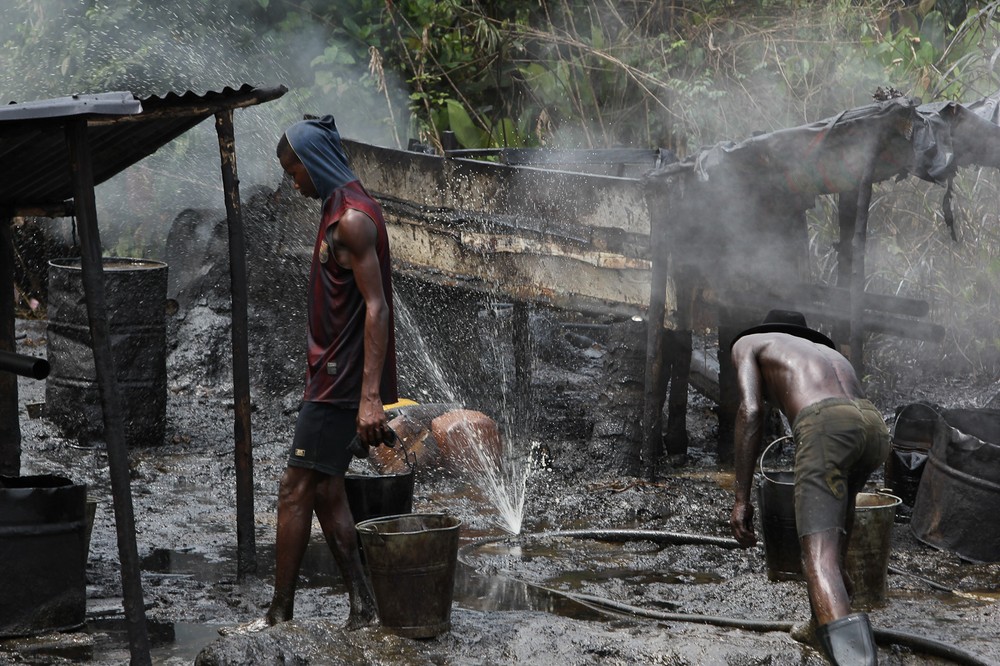
The Nigerian Army has announced that it clamped down on illegal oil camps in Imo and Delta States this week.

The army spokesperson, Mr Onyema Nwachukwu, disclosed this in a statement signed on Wednesday.

He stated that in Imo state, the army apprehended suspected crude oil thieves in Obokofia, a community in Ohaji/Egbema Local Government Area of Imo State, South-east Nigeria.

Mr Nwachukwu, a brigadier-general, said the operation was carried out by troops of the 33 Artillery Regiment on Monday as part of their anti-oil theft operations in the country.

“In the crackdown, the vigilante troops intercepted 15 sacks and 13 jerry cans of illegally refined Automotive Gas Oil (AGO) concealed in the camp,” he said.

Two pumping machines, three power generators, a hose, and a toolbox used for hacking into oil pipelines were the items recovered from the suspects, according to the army.

The army spokesperson said, in response to a tip-off on Tuesday, troops intercepted a wooden boat loaded with 110 sacks of illegally refined AGO concealed in the creeks of Egbema West in the same Ohaji/Egbema Council Area.

“The vigilant troops equally intercepted two vehicles loaded with 18 sacks of illegally refined AGO within the same council area,” he said.

In a similar operation on Monday, troops of 3 Battalion clamped down on an “active illegal refining site” in Enokora, a community in Burutu Local Government Area of Delta State, South-south Nigeria.

The army spokesperson said the refining site contained three cooking ovens and reservoirs.

He enjoined Nigerians to report to security agencies any suspected act of sabotage or criminality to enhance ongoing operations to curb oil theft in the country.

Oil theft and its negative impact on the country’s economy have been a source of concern to the Nigerian government over the years.

According to the latest data from the National Bureau of Statistics (NBS), the oil sector contributed only 5.34 per cent to the country’s real GDP in Q2 2023 in the second quarter of the year.

This is as Nigeria’s GDP grew by 2.51 per cent. Oil production in the review period dropped to 1.22 million barrels per day, lower than the daily average production of 1.43 million barrels recorded in the same quarter of 2022 and less than the first quarter of 2023 production volume of 1.51 million barrels per day.

The Federal government in August 2022 awarded a pipeline surveillance contract reportedly worth N48 billion per year (N4 billion per month) to Mr Government Ekpemupolo, who is popularly known as Tompolo, to check massive oil theft in the region.

Even as there is evidence of the progress of the outfit as well as that of other Nigerian troops in the fight against oil theft, activities of illegal bunkering still continue to plague the nation.


Adedapo Adesanya is a journalist, polymath, and connoisseur of everything art. When he is not writing, he has his nose buried in one of the many books or articles he has bookmarked or simply listening to good music with a bottle of beer or wine. He supports the greatest club in the world, Manchester United F.C.

Click to comment

Leave a Reply

Your email address will not be published. Required fields are marked *

General

Apapa Customs Foils Intercepts Expired Pharmaceuticals, Canadian Loud

Published

on

Customs Expired Pharmaceuticals

By Modupe Gbadeyanka

Some expired pharmaceutical products and 1.8 tonnes of Cannabis Sativa have been intercepted by officials of the Nigeria Customs Service (NCS), Apapa Area Command.

The command’s Public Relations Officer, Mr Isah Sulaiman, a Chief Superintendent of Customs (CSC), disclosed that the pharmaceutical products are suspected to be pushed into the Nigerian market by relabelling them.

It was disclosed that the items were intercepted based on credible intelligence and enhanced risk profiling systems, in collaboration with the National Drug Law Enforcement Agency (NDLEA) and other relevant regulatory bodies.

In one of the major interceptions, officers of the command seized a 40-foot container numbered CAAU7569127, which was found to contain a large consignment of Cannabis Sativa, popularly referred to as Canadian Loud.

The command revealed that a total of 3,639 sachets of the illicit substance were recovered, each weighing 500 grams, for a total estimated weight of about 1,819 kilograms (1.81 tonnes). Preliminary field tests confirmed the substance as Cannabis Sativa. The drugs were concealed inside a vehicle and within bags and drums packed inside the container.

Speaking on the seizures, Comptroller Emmanuel Oshoba warned perpetrators to desist from criminal activities, stating that “unpatriotic importers and their collaborators who deliberately engage in smuggling, drug trafficking and the importation of expired pharmaceuticals are enemies of Nigeria’s progress.”

“We have the intelligence, the technology and the resolve to identify and apprehend them. Anyone still contemplating these criminal acts should desist immediately, because the consequences will be swift, decisive and uncompromising,” he added.

He further reiterated that Apapa Port and all Customs-controlled areas remain under constant surveillance, adding that enforcement operations will continue to be intelligence-driven while ensuring legitimate trade is not hindered.

Continue Reading

General

Skite to Help Nigerian Experts Monetise Skills With All-in-One Creator Platform

Published

on

Skite

By Adedapo Adesanya

Skite is expanding its push into Nigeria’s rapidly growing knowledge economy with an all-in-one platform designed to help creators, coaches, consultants, educators and other professionals monetise their expertise from a single hub.

The platform enables users to sell courses and digital products, host paid communities, organise live events, offer one-on-one video consultations and monetise audience interactions without relying on multiple tools.

The move comes as more Nigerians turn to knowledge-based businesses as a source of income, creating demand for platforms that simplify how expertise is packaged, sold and delivered online.

While the creator economy has traditionally been associated with content creation and social media influence, a growing number of professionals are increasingly building businesses around coaching, training, consulting and digital education.

However, many creators still depend on several platforms to manage payments, courses, communities, customer engagement and events, often increasing operational costs and complexity.

Skite is seeking to address that gap by consolidating these functions into a single ecosystem built specifically for knowledge entrepreneurs.

According to the company, creators using the platform have recorded an average 30 per cent increase in revenue after consolidating their operations, while premium subscribers enjoy a zero-transaction-fee structure on earnings.

Speaking on the opportunity within the sector, Skite chief executive, Mr Samuel Obinna, said the company was focused on providing the infrastructure needed for creators to build sustainable businesses around their expertise.

“The knowledge economy is creating unprecedented opportunities for professionals to earn from what they know. We are building the tools that make it easier for creators to launch, manage and scale those businesses,” he said.

As Nigeria’s digital economy continues to expand, industry stakeholders expect knowledge entrepreneurship to become an increasingly important segment of the creator economy, with platforms such as Skite positioning themselves to serve the next generation of digital business owners.

Skite is an all-in-one creator monetisation platform that enables knowledge creators to build, grow and monetise their businesses from a single platform. The platform provides tools for selling courses and digital products, hosting paid communities, running live events, offering one-on-one consultations, monetising direct audience interactions and managing sales funnels. Skite is designed to help creators turn expertise into sustainable and scalable income.

Continue Reading

General

FG Activates 115,000 GovMail Accounts to Safeguard Communication

Published

on

GovMail

By Adedapo Adesanya

The federal government has directed all civil servants to immediately discontinue the use of personal email accounts for official communication, as part of efforts to prevent rising cyberattacks and safeguard the flow of information.

It has mandated the adoption of approved government email platforms across the federal public service.

The directive was announced by the Head of the Civil Service of the Federation, Mrs Didi Esther Walson-Jack, during a digital transformation summit held in Abuja to commemorate the 20th anniversary of Galaxy Backbone.

According to Mrs Walson-Jack, more than 115,000 official GovMail accounts have been activated to enhance the security, professionalism, and accountability of government correspondence.

She emphasised that official government business must no longer be conducted through personal email services or informal communication channels, which often pose challenges for record-keeping and institutional accountability.

She explained that one of the primary reasons for the policy is to ensure continuity in government operations. Official records and communications, she noted, must remain within government-controlled systems even after public officers leave office, preventing the loss of critical information tied to individual accounts.

The Head of Service also revealed that the Federal Government achieved a major digital transformation milestone by successfully digitising work processes across all 38 federal ministries and extra-ministerial departments before the end of December 2025.

Describing the accomplishment as a testament to effective leadership and institutional commitment, Mrs Walson-Jack said the milestone demonstrates the civil service’s growing readiness to embrace modern governance and technology-driven service delivery.

She further acknowledged longstanding challenges associated with manual processes, including delays, misplaced files, and bottlenecks in approval workflows.

The transition to digital systems, she said, has significantly improved document tracking, strengthened accountability mechanisms, and enhanced performance monitoring across government institutions.

The paperless civil service initiative is expected to accelerate decision-making, reduce bureaucracy, improve transparency, and ensure faster retrieval and processing of official records, ultimately creating a more efficient and responsive public service.

Continue Reading

Trending