Connect with us

General

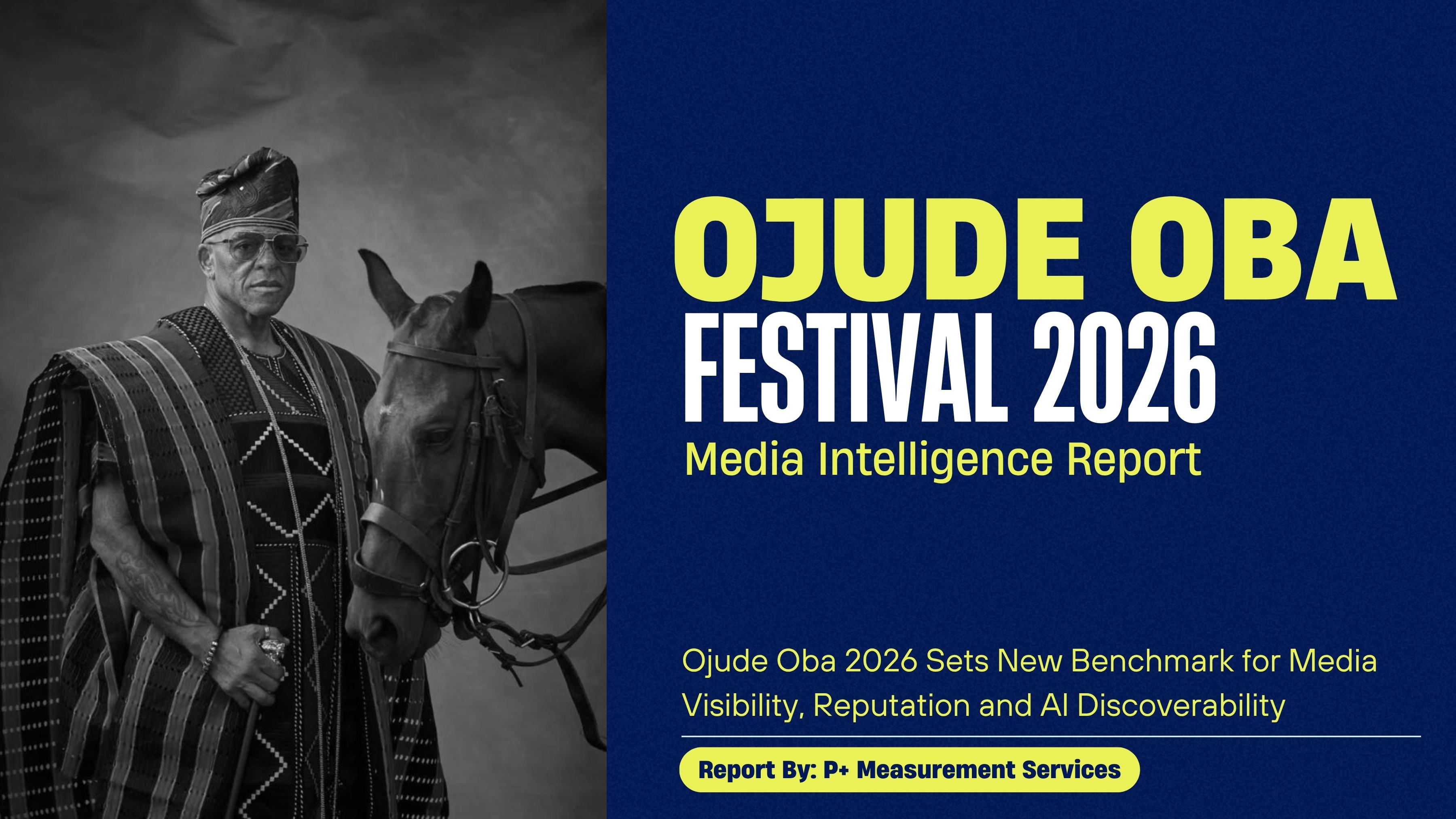
Ojude Oba 2026 Sets New Benchmark for Media Visibility, Reputation and AI Discoverability

Published

on

Ojude Oba Festival 2026

The Ojude Oba Festival is no longer merely one of Nigeria’s most celebrated cultural gatherings; it is rapidly emerging as one of Africa’s most influential cultural brands.

A newly released Media Intelligence Report by P+ Measurement Services reveals that Ojude Oba 2026 recorded its strongest media performance to date, achieving significant growth across audience reach, media visibility, social engagement, international attention and digital discoverability.

The report analysed media conversations and coverage generated between May 20 and June 5, 2026, across print, online, social media and broadcast platforms, while benchmarking performance against the 2025 edition of the festival.

The findings paint a compelling picture of a cultural institution that is not only preserving heritage but also increasingly shaping conversations across modern media ecosystems.

According to the report, total media mentions grew by 56 per cent year-on-year, increasing from 18,420 mentions in 2025 to 28,735 mentions in 2026. Audience reach expanded even more dramatically, growing by 75 per cent from 124.8 million to 218.6 million people globally.

Social media emerged as the primary engine of visibility, generating over 81,000 public conversations during the monitoring period, representing an 88 per cent increase compared to the previous year. Engagements more than doubled, rising by 115 per cent from 3.9 million interactions in 2025 to 8.4 million interactions in 2026.

Perhaps most notable was the improvement in public sentiment.

Positive sentiment increased from 60 per cent in 2025 to 79 per cent in 2026, while negative sentiment declined by half, dropping from 10 per cent to just 5 per cent. Conversations around cultural pride, heritage preservation, fashion, equestrian displays, community identity and the enduring legacy of the late Awujale of Ijebuland, Oba Sikiru Adetona, drove the overwhelmingly positive perception.

The report identified the legacy narrative of Oba Sikiru Adetona as the single most influential thematic driver of media coverage throughout the reporting period.

Unlike previous years, where conversations focused primarily on spectacle and pageantry, the 2026 edition witnessed a deeper engagement with themes of history, leadership, continuity and cultural preservation, elevating the festival beyond entertainment and positioning it as a significant cultural institution.

International visibility also recorded substantial growth.

While Nigeria remained the dominant source of conversations and media coverage, the festival generated measurable attention across the United Kingdom, United States, Canada, France, Germany, South Africa, Ghana, the United Arab Emirates, Kenya and the Netherlands. This expansion contributed to a near doubling of the festival’s global footprint and reflects the growing interest in African cultural experiences among international audiences and diaspora communities.

The report further found that social media accounted for the largest share of total conversations, followed by online news platforms, print publications and broadcast media. Coverage was amplified through extensive reporting by Channels Television, TVC News, OGTV, City People TV, Araba TV and GoldMyneTV, alongside significant digital coverage from leading Nigerian news and entertainment platforms.

Among personalities driving online conversations, Farooq Oreagba once again emerged as the most discussed cultural figure associated with the festival. Other highly visible personalities included Eniola Badmus, Lateef Adedimeji, Rotimi Salami, Jide Awobona and Samuel Banks, whose appearances and social media mentions helped sustain public interest throughout the event period.

Corporate sponsorship continued to play a critical role in the festival’s visibility ecosystem.

Globacom retained its position as the most visible sponsor, followed by Orijin, FCMB, Goldberg, Rite Foods, Maltina, Honeywell Foods, Adron Homes, Maggi, SIFAX Group and Seaman Schnapps. The report notes that brands increasingly view Ojude Oba as a strategic platform for cultural storytelling, community engagement and reputation building.

One of the most significant additions to this year’s report is the application of the AMEC GEO Framework, the newly introduced global measurement model designed to help organisations understand how reputation, content and visibility influence outcomes in AI-driven information environments.

Using the framework’s three core dimensions—Upstream Reputation Signals, Search and Content Readiness, and Downstream AI Outputs—the analysis assessed Ojude Oba’s performance not only in traditional media but also within emerging AI-powered discovery systems.

The assessment found strong performance across earned media authority, cultural relevance, content visibility and reputation consistency. The festival demonstrated growing discoverability within AI-assisted search environments and generated strong indicators for future cultural visibility across generative search platforms.

According to P+ Measurement Services, this represents a fundamental shift in how cultural events should be evaluated.

“Media success is no longer defined solely by coverage volume or impressions,” the report notes. “In an AI-driven information ecosystem, discoverability, authority, narrative consistency and reputation signals increasingly determine whether institutions remain visible, trusted and relevant. Ojude Oba’s performance demonstrates the importance of measuring cultural influence through both traditional media metrics and emerging AI visibility frameworks.”

The report concludes that Ojude Oba has evolved beyond its traditional role as a cultural celebration and now functions as a powerful platform for tourism promotion, economic storytelling, cultural diplomacy, national branding and global heritage engagement.

As governments, tourism agencies, brands and cultural institutions seek new ways to compete for attention in an increasingly fragmented media environment, Ojude Oba offers a compelling case study in how heritage can be transformed into measurable influence, sustained visibility and long-term reputation value.

With record audience reach, stronger public sentiment, expanded international visibility and growing AI discoverability, the 2026 edition marks a defining moment in the festival’s evolution from cultural event to global cultural brand.


Click to comment

Leave a Reply

Your email address will not be published. Required fields are marked *

General

ICPC Confirms Probing Gbajabiamila Over ‘Fake’ Presidential Investment Council

Published

on

Femi Gbajabiamila

By Adedapo Adesanya

The Independent Corrupt Practices and Other Related Offences Commission (ICPC) says it has probed the Chief of Staff to President Bola Tinubu, Mr Femi Gbajabiamila, concerning its investigation into the activities of a purported Presidential Foreign Investment Promotion Council (PFIPC).

The commission stated that it invited Mr Gbajabiamila to help establish how the organisation operated for about two years from within the Federal Secretariat in Abuja, despite not being established by any law or presidential proclamation.

It said Mr Gbajabiamila fielded questions from investigators when he visited its headquarters in Abuja on Monday, but failed to give more details regarding his revelation.

“Mr Gbajabiamila arrived at the Commission in the afternoon and spent some time attending to enquiries from investigators, after which he departed the premises,” said Mr Okor Odey Head, Media and Public Communications of the ICPC, in a statement on Tuesday.

The agency clarified that Mr Gbajabiamila was not arrested, stating that his appearance “was on the invitation of its investigators and consistent with its ongoing efforts to gather all relevant facts in the matter.”

“He was not arrested; he simply willingly honoured an invitation,” the statement added.

“Investigations continue, and further updates will be communicated as appropriate.”

The ICPC statement came a day after Mr Gbajabiamila’s lawyer, Mr Jiti Ogunye, announced on Monday that he had appeared before the commission’s investigators.

Mr Ogunye said Mr Gbajabiamila visited the commission at about 3.00 p.m. on Monday, in full cooperation with the ICPC, acting as directed by President Tinubu.

“My client gave his testimony, responded to questions accordingly, and has returned to his duty post,” Mr Ogunye wrote.

Mr Tinubu ordered the ICPC earlier this month to investigate the fake agency scandal and submit its findings within 30 days.

The federal government disowned the PFIPC as a fraudulent entity allegedly operated by Mr Adeniyi Adeyemi, who is accused of posing as its director-general.

The scandal came to public attention after Mr Adeyemi allegedly claimed that he paid N400 million in bribes to facilitate the establishment and operation of the purported agency, including money paid to an individual he believed was Mr Gbajabiamila. Using official government documents, the organisation allegedly secured office space at the Federal Secretariat, obtained budgetary allocation, opened accounts with the Central Bank of Nigeria and employed public servants.

Mr Adeyemi was recently apprehended by the Nigerian Police Force.

Continue Reading

General

ECOWAS Signs Pact to Fast-Track African Atlantic Gas Pipeline

Published

on

gas projects

By Adedapo Adesanya

The African Atlantic Gas Pipeline (AAGP) project recorded a major milestone after Heads of State of the Economic Community of West African States (ECOWAS) signed the Intergovernmental Agreement (IGA) for the multibillion-dollar regional energy initiative at the ECOWAS Summit in Freetown, Sierra Leone.

The development was announced in a statement on Monday by the Chief Corporate Communications Officer of the Nigerian National Petroleum Company (NNPC) Limited, Mr Andy Odeh.

According to the statement, the agreement provides the legal and institutional framework required to accelerate the implementation of the pipeline project, which is expected to strengthen regional energy security, drive industrialisation and deepen economic integration across West Africa.

The AAGP is designed to transport about 30 billion cubic metres of natural gas annually through a nearly 6,900-kilometre pipeline stretching from Nigeria to Morocco along the Atlantic coast, with interconnections to landlocked Sahel countries and onward linkage to the Maghreb-Europe Gas Pipeline.

The project is jointly being developed by NNPC and its Moroccan equivalent – Office National des Hydrocarbures et des Mines (ONHYM), with sovereign backing from Nigeria, Morocco, Mauritania and ECOWAS member states.

NNPC said the latest signing gives practical effect to the approval granted during the 66th Ordinary Session of the ECOWAS Authority of Heads of State and Government held in Abuja in December 2024 and concludes the institutional process initiated after the 2022 Memorandum of Understanding between Nigeria and Morocco.

The company added that Morocco and Mauritania are expected to sign the agreement in a subsequent ceremony to complete the intergovernmental framework for the project.

The statement noted that the pipeline, conceived under the shared vision of the late former President Muhammadu Buhari and King Mohammed VI of Morocco, continues to enjoy the support of President Bola Tinubu.

It also disclosed that significant preparatory work had already been completed, including Front-End Engineering Design (FEED) studies, route reconnaissance surveys, environmental and social impact assessments, as well as the development of legal, regulatory and commercial frameworks required to move the project towards implementation.

The pipeline is expected to enhance gas supply across the region, support electricity generation, promote industrial development, encourage value addition to natural resources and create employment opportunities across West Africa.

Commenting on the development, the chief executive of the state-oil-owned company, Mr Bayo Ojulari, described the signing of the agreement by West African leaders as a critical step towards the project’s implementation.

“This milestone reflects the clear mandate of His Excellency President Bola Ahmed Tinubu GCFR. The AAGP is central to delivering that mandate by providing the infrastructure required to bring about 3 bcf/d of Nigerian gas to market. NNPC Limited is proud to co-lead this endeavour with ONHYM.”

Also speaking, the Director General of ONHYM, Mrs Amina Benkhadra, described the signing as another major achievement in the realisation of the transcontinental energy project.

According to her, “The Project fully reflects His Majesty’s vision for an integrated Atlantic Africa.”

NNPC said the next phase of the project would include the establishment of the Pipeline Higher Authority (PHA) in Abuja and the African Atlantic Gas Pipeline Project Company in Casablanca to oversee implementation and prepare for the Final Investment Decision (FID).

The company reaffirmed its commitment, alongside ONHYM, to delivering the project in line with international standards of technical excellence, environmental sustainability and good governance.

Continue Reading

General

Navy Conducts 580 Operations in Three Months, Recovers 4.7m Litres of Stolen Crude Oil

Published

on

Operation Delta Sentinel

By Adedapo Adesanya

The Nigerian Navy said it has intensified a crackdown on crude oil theft and other forms of economic sabotage in the Niger Delta, recovering more than 4.698 million litres of stolen crude oil and illegally refined petroleum products during the second quarter of Operation Delta Sentinel.

The Navy disclosed that the renewed offensive, conducted between April and June 2026, also led to the arrest of over 91 suspects, the dismantling of more than 48 illegal refining sites, and the interception of several vessels linked to crude oil theft.

The Director of Naval Information, Navy Captain Abiodun Folorunsho, said the intensified operations followed the successful completion of the first quarter of the operation and were aimed at consolidating gains in the fight against crude oil theft, illegal refining, pipeline vandalism, militancy and other forms of economic sabotage.

According to him, naval forces carried out over 580 intelligence-driven operations across Rivers, Bayelsa, Delta, Cross River and Lagos States, significantly disrupting the activities of criminal syndicates operating within the Niger Delta.

Among the notable achievements recorded during the period was the arrest of the motor tankers MKPODU, WESTAF and STELIOS K, which were allegedly involved in the theft of more than 900 metric tonnes of suspected stolen crude oil.

The Navy also recovered over 708,000 litres of illegally refined petroleum products and 310,000 litres of stolen crude oil from a single illegal refining site in Ndoni, Rivers State.

Captain Folorunsho said several intelligence-led operations further dismantled reactivated illegal refining camps, intercepted illicit petroleum consignments and prevented criminal networks from restoring illegal production capacity across the region.

He noted that coordinated riverine operations resulted in the destruction of numerous illegal refining sites, reservoirs, dugout pits, storage facilities, warehouses, concealed fuel dumps, illegal pipeline connections and militant hideouts.

According to him, the Navy also uncovered a growing pattern of criminal groups attempting to reactivate previously dismantled refining camps.

He said sustained follow-up operations successfully prevented the regeneration of the illegal refining ecosystem and further weakened the economic viability of crude oil theft networks.

The Navy attributed the operational successes to sustained intelligence-led operations and enhanced collaboration with other security agencies.

It noted that the achievements coincided with the recent announcement by the Nigerian Upstream Petroleum Regulatory Commission (NUPRC) that Nigeria’s crude oil production rose to 1.735 million barrels per day in June 2026, representing 104 per cent of the country’s production quota by the Organisation of the Petroleum Exporting Countries (OPEC) and the highest production level recorded since April 2020.

The service said the improved production figures reflected enhanced security around critical oil and gas infrastructure and the collective efforts of security agencies in tackling crude oil theft.

It added that the persistent naval presence across the Niger Delta waterways had denied economic saboteurs freedom of operation, disrupted illicit petroleum supply chains and strengthened the protection of strategic national assets.

Reaffirming its commitment to safeguarding Nigeria’s maritime domain, the Navy pledged to sustain intelligence-driven operations and deepen inter-agency cooperation to further dismantle oil theft networks.

The Service also said it remains committed to supporting the federal government’s target of increasing Nigeria’s crude oil production to 2.5 million barrels per day by 2027, in line with the vision of the Chief of the Naval Staff, Vice Admiral Idi Abbas.

Continue Reading