General
Oshiomhole Showers Praises On Ambode

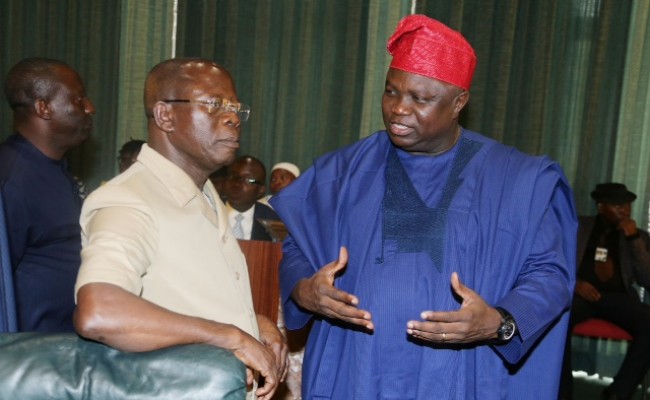
Governor of Edo State, Mr Adams Oshiomhole, on Wednesday commended his Lagos State counterpart, Mr Akinwunmi Ambode for his various interventions in the last 18 months of his administration, saying that it has greatly impacted on the State, especially in the area of traffic reduction.
Mr Oshiomhole, who spoke at the closing ceremony of the 16th National Women Conference, organised by the Committee of Wives of Lagos State Officials (COWLSO), commended the wife of the Governor of Lagos State, Mrs Bolanle Ambode, particularly for sustaining COWLSO since its establishment, adding that the choice of the theme for this year’s Conference “Strong Family, Strong Nation’, was quite instructive.
Speaking on the specific challenges posed by modern lifestyle on the family where the parents would have to leave home early and come home late, Mr Oshiomhole said Governor Ambode, with his strategic traffic management initiatives was to a very large extent addressing the challenges.
Mr Oshiomhole said, “As I was coming to this place today, I noticed something that I think is worth celebrating because of its impact in helping family unity and family union. Why will you wake up at 5am or 4am just to be at work at 8am devoting all the time to traffic?
“The reason was because of the huge traffic challenges but when I received the invitation for today’s event and I was advised that it was10am and I know my brother, Governor Ambode keeps to time, I said we have to get up early and I told my wife that we are going to spend about two hours from Ikeja Airport to get to Ikoyi, but I was very pleasantly surprised that coming from Ikeja to this place, it was like flying a first class aircraft from Alausa to the heart of Ikoyi.”
“When I got here, I was asking the Governor on how he did it and he shared with me the interventions put in place within months of his assumption of office that have helped to completely reorder the traffic in Lagos such that when we slow down to about 20km per hour, we noticed people asking what is causing this go slow but things have changed so much.”
He said the interventions of the Governor was not only reducing traffic and fuel consumption, but was also bringing back the good times of family bonding as travel time has reduced, hence husbands and wives don’t have excuse of traffic to get home late or leave very early.
Mr Oshiomhole said over the years as Governor of Edo State, he has had cause to learn and borrow from the template Lagos was running, expressing optimism that his successor and Governor-elect, Mr Godwin Obaseki, would be willing to borrow a leaf from the COWLSO Conference as well as the traffic management strategy of Lagos.
“We borrowed what is happening in Lagos to make the case for Godwin Obaseki in Edo that Nigeria must move away from a tradition in which you have to be a celebrated politician to become eligible to contest for a political office, and that what we need in times like this are skills and people with managerial acumen and competence and we readily referred to Lagos as an example of what works with a seasoned and indisputable leader like Asiwaju Bola Ahmed Tinubu laying the foundation, dreaming big, dreaming clearly and setting the vision and identifying capable young men and women to translate those vision in a manner that is unprecedented in the history of our country,” Mr Oshiomhole said.
He added that with the achievements of Governor Ambode, so far, he (the Governor) has shown that the only poverty to address is the poverty of ideas, adding that once the brain is creative and imaginative with a Governor that is ready to apply himself, there is no problem that would defer solution.
“You have shown that our task as leaders is not to lament what does not work but to think through how to make it work and that you are doing; that you have done and I know that you will continue to do,” Mr Oshiomhole said.
Earlier in her remarks, wife of the Governor of Lagos State, Mrs Bolanle Ambode said the three-day conference had opened the mind of participants to new ideas, information and statistics, saying that the women are better empowered to become change agents.
She explained that the success story of the conference could not have been without the excellent cooperation of the women who form COWLSO, just as she admonished them to put all what they were taught at the conference into use in their respective offices and homes.
General
Swedfund Supports Climate Resilience in African Food Systems With $12m
By Modupe Gbadeyanka
An investment that supports growing food and agriculture companies across Africa that strengthen agricultural value chains has been made by Swedfund.
The organisation is putting down about $12 million to strengthen climate resilience in African food systems through the Acumen Resilient Agriculture Fund II (ARAF II).
By improving access to markets, finance and essential services, these companies help smallholder farmers become more resilient to climate and economic shocks.
Over 30 million smallholder farmers operate across Sub-Saharan Africa, accounting for 80 per cent of all farms and producing 70 per cent of the region’s food (IFAD). Yet many face limited access to finance, quality inputs, reliable buyers and market information. At the same time, they are among those most exposed to climate change and weather-related shocks, which threaten harvests, incomes and food security.
The investment has an ambition to reach around four million smallholder farmers through ARAF II’s portfolio companies. It also aims to meet the criteria of the 2X Challenge, which promotes investments that support women’s economic empowerment.
ARAF II invests in businesses that address key gaps in agricultural value chains, from improving market access and reducing post-harvest losses to expanding financial and digital services for farmers. By helping these businesses grow, the investment aims to improve productivity, strengthen local value chains and increase the resilience of food systems.
Swedfund invests alongside other development finance institutions and investors to help mobilise long-term capital for businesses that often struggle to access financing despite their potential to strengthen food security, climate resilience and economic development across Africa.
“Climate change is already affecting the livelihoods of millions of smallholder farmers across Africa. Investing in businesses that improve access to markets, finance and agricultural services helps farmers strengthen their resilience, increase productivity and build more stable incomes. That is essential for more resilient food systems,” the Investment Director of Food Systems and Strategic Investments at Swedfund, Ms Helen Hagos, said.
General
SERAP Urges Tinubu to Probe Alleged N6.79bn Diversion in Police, Ministry
By Adedapo Adesanya
The Socio-Economic Rights and Accountability Project (SERAP) has urged President Bola Tinubu to order a probe into the alleged diversion, disappearance and misapplication of more than N6.79 billion in public funds within the Nigeria Police Force (NPF) and the Federal Ministry of Police Affairs.
The grave allegations are documented in the latest Annual Report of the Auditor-General of the Federation published on September 9, 2025.
SERAP said, “Anyone suspected to be responsible—including contractors, companies and public officials implicated in the report—should be promptly prosecuted, while all missing public funds, firearms and ammunition should be fully recovered, secured and properly accounted for.”
In the letter dated August 1, 2026, and signed by SERAP deputy director, Mr Kolawole Oluwadare, the organisation said: “The Auditor-General’s findings suggest a grave betrayal of the public trust and raise serious concerns about corruption and the management of public funds, police exhibits, firearms and ammunition.”
SERAP said: “The report also raises serious concerns over missing firearms and ammunition, the unauthorised use and release of police exhibits, failures to properly account for exhibits, and the insecure storage of firearms, creating significant risks to public safety and national security.”
According to the group, “The diversion of funds meant for policing, abandoned security projects, missing firearms and ammunition, and the misuse of police exhibits undermine the operational effectiveness of the Nigeria Police Force, weaken public confidence and may contribute to Nigeria’s worsening insecurity.”
The letter, read in part: “The report documented numerous alleged financial irregularities within the Nigeria Police Force and the Federal Ministry of Police Affairs, including payments for projects that were never executed, abandoned contracts, inflated contract costs, and irregular procurement.”
“The report also documented unretired cash advances, unsettled insurance claims, payments for services allegedly not rendered, and other suspected diversion and misapplication of public funds amounting to over ₦6.79 billion.”
“The allegations also include missing firearms and ammunition, the unauthorised use and release of police exhibits, failures to properly account for recovered firearms and other exhibits, and the insecure storage of firearms, posing serious risks to public safety and national security.”
“We would be grateful if the recommended measures are taken within seven days of the receipt and/or publication of this letter. If we have not heard from you by then, SERAP shall consider appropriate legal action to compel your government to comply with our request in the public interest.”
Some of the others include: N499,875,500.00 for the construction of Police College Phase II, Bashar, Plateau State; N12,931,000.00 for the rehabilitation of Block B, Department of Logistics and Supply (Works) building, Garki; N111,635,864.64 for the construction of 12 one-bedroom transit camp units and rehabilitation of the administration block at the NPF Pre-retirement Skills Acquisition Centre, Kudana, Kaduna State; N4,011,627.89 inserted as taxes to inflate a contract; N1,938,299,452.00 for 14 ongoing projects that were abandoned; N5,050,000.00 in monetary exhibits released without proper authorisation; N112,026,424.00 for outstanding allowances paid to officers to cover 2020 liabilities; and N6,000,000.00 as annual payment to the Inspector General of Police’s Senior Special Assistant on Revenue and Tax Matters.
Others include N10,080,000.00 as cash advances for the provision of office equipment and accessories for the NPF Database Management Centre; N438,066,845.73 for the supply of bulletproof vests, ballistic helmets and procurement of a Styr Punch Vistar troop carrier; N18,000,000.00 for the training of women in cosmetology and provision of empowerment kits in Ondo Central Senatorial District, Ondo State; N258,989,999.75 for the procurement of 10 JAC patrol vehicles for NPF outpost stations in Kano State; N30,853,250.00 as security allowances for personnel attached to the Ministry of Police Affairs; N681,406,593.18 for the settlement of insurance claims through insurance brokers; N1,628,108,434.18 for outstanding insurance policy liabilities for 2020/2021; N57,484,515.30 for the procurement of video cameras, customised umbrellas, gift bags and customised towels for the Nigeria Police Force Public Relations Office; N7,760,409.56 in withholding tax and value added tax that was not deducted from contracts awarded.
General
N68.7m Contract: Court Sentences ex-Reps Member With N50,000 Fine Option
By Aduragbemi Omiyale
A former member of the House of Representatives, Mr Onamusi Onadeko, has been sentenced to nine months’ imprisonment with an option of a fine of N50,000.
The former lawmaker, who represented Ogun East Federal Constituency in the National Assembly from 1999 to 2003, was sentenced by Justice Chizoba Oji of the Federal Capital Territory High Court in Abuja on Thursday, July 30, 2026.
He was found guilty on count 11 and convicted for making inconsistent statements but discharged and acquitted on counts 2, 3, 4, 6, 7, 8, 9 and 10.
Mr Onadeko’s journey to the court started in 2017, when he was charged by the Independent Corrupt Practices and Other Related Offences Commission (ICPC) for his alleged involvement in the award and execution of a N68.7 million contract.
The politician, according to a statement from the ICPC, was accused of using his private companies, Stanton Engineering Limited and Haines and Baines Limited, to execute several constituency projects while working as a Senior Legislative Aide to late Senator Buruji Kashamu, who represented Ogun East Senatorial District between 2015 and 2019.
The commission, had in the course of the eight years trial told the court that several contracts like buying of ambulance vehicles, supply of hospital equipment and drugs for Primary Health Centres, as well as construction of classrooms for some selected schools in six communities of Ogun East Senatorial District, were awarded to both Stanton Engineering Limited and Haines and Baines, where the convict doubles as a Managing Director and nominal Director, respectively, an action that violates Sections 12 and 19 of the Corrupt Practices and Other Related Offences Act, 2000.
ICPC also accused Mr Onadeko of making an inconsistent statement that contradicted the one previously made to the Commissioner for Oaths, where he stated that he is a Director of Haines and Baines Limited in an affidavit dated June 30, 20216, but subsequently wrote another statement while under investigation on May 5, 2017, that he is not a shareholder or Director of Haines and Baines Limited.
This action violates Section 25(1)(b) of the ICPC Act and, upon conviction, is liable to a fine not exceeding N100,000 or to imprisonment for a term not exceeding two years or to both such fine and imprisonment.
However, Mr Onadeko, through his counsel, Mr Wahab Olatoyebi, argued in the course of the trial that his client was not a public officer as his appointment at that material time was on a short-term basis and non-pensionable, hence he, (Onadeko) did not fall within the category of those that could be tried under Sections 12 and 19 of the Corrupt Practices and Other Related Offences Act, 2000 which criminalize and punish abuse of office by public officers.
But this argument was rejected by Justice Oji, who stressed that based on the defendant’s letter of appointment as well as the decision of the Supreme Court in the case of Federal Government of Nigeria v. Farouk Lawan, legislative aides are public officers and therefore could be prosecuted under the relevant provisions of the Corrupt Practices and Other Related Offences Act, 2000.