Connect with us

General

PEARL Builds Chemical Treatment Plant in Nigeria

Published

on

PEARL Chemical Treatment Plant

By Modupe Gbadeyanka

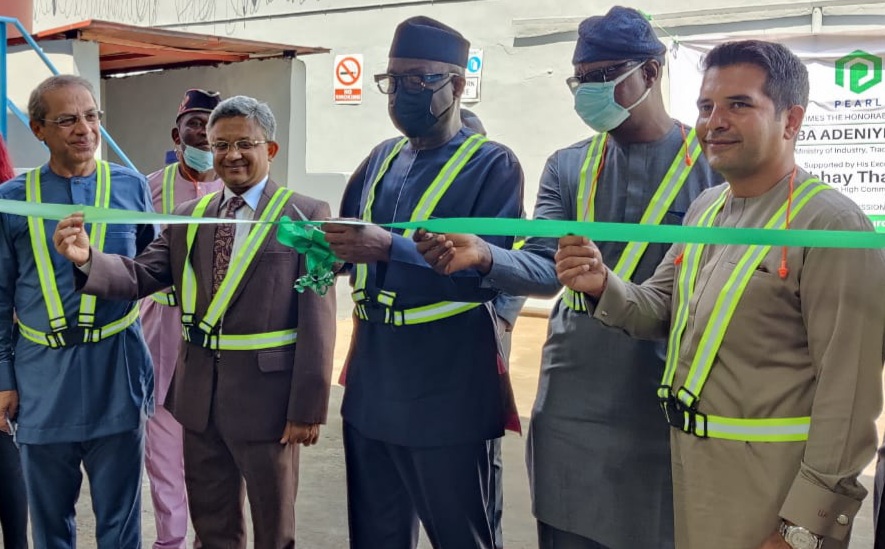
An ultra-modern manufacturing plant for drilling chemicals, water and oil-based production chemicals has been launched in Nigeria by Pacegate Energy and Resources Limited (PEARL).

PEARL, an arm of Pacegate Limited with an Integrated Management System (ISO 9001:2015, ISO 14001:2015 & ISO45001:2018) will provide chemical treatment solutions, laboratory testing and services, and professional field support services to the upstream and downstream sectors, as well as other relevant sectors.

This is in a bid to meet the growing needs of the oil and gas and transportation sectors of the Nigerian economy and Africa at large.

This has been made possible by its partnership with global energy solutions provider, Canadian Energy Solutions (CES).

The partnership sees PEARL’s wide reach in both offshore and onshore operations supported and extended by CES’ global capabilities.

PEARL will commence the formulation of eco-friendly products and provide superior innovative treatment chemicals and application technology services to oil and gas exploration and production platforms, refineries, petrochemical plants, among others.

PEARL’s well-trained and highly experienced engineers’ partner with clients to identify and proffer proper resolutions to challenges related to upstream production and downstream chemical treatment solutions, as well as specialised chemical solutions for the transportation sector.

The team of engineers support customer needs with extensive laboratory and real-time field testing to help solve queries using world-class standards and industry best practice.

Speaking on the partnership, General Manager, PEARL, Franklin Oranusih said that PEARL was established out of a desire to solve industrial challenges with innovative solutions and partnerships.

“We have a commitment to deliver quality and eco-friendly products as we continue to play our part in supporting local content in Africa.

“As the oil & gas sector continues to grow, it is expedient that we consider the effect it has on the environment, among others.

“This partnership is a sign of our commitment and we are delighted to announce it. We also appreciate the support of the Ministry of Industry, Trade and Investment and the Nigerian Content and Development Board – NCDMB for its support as we continue to fulfil this commitment,” he said.

Commenting on the partnership, the Minister of Industry, Trade and Investment, Mr Adeniyi Adebayo, stated that there is a need for innovative partnerships such as this to boost local content in Nigeria.

“I am pleased to formally commission the first local content fluids and chemical solutions manufacturing plant in Nigeria, which represents a significant landmark for the country’s industrialisation programme.

“Domestication of products has been at the centre of this administration’s industrialisation programme to drive job intensive growth of the Nigerian economy. It will increase local production, create job opportunity and improve our foreign exchange reserve position.

“I believe this will help in taking us ahead in our effort to diversify the economy and increase the contribution of the manufacturing sector to GDP. Most especially, the plant will provide jobs to Nigeria’s workforce, promote local content, and save the nation the extra cost of importing the now locally produced input.”

Also speaking, the Executive Secretary of the Nigerian Content Development and Monitoring Board (NCDMB), represented by the General Manager, Project Authorisation and Certification, Engr. Paul Zuhumben, said, “We commend the effort of Pacegate Energy Resource Limited for investing an installed capacity of 12.9 metric tonnes into the manufacturing of chemicals solutions aspects of the hydrocarbon value chain in Nigeria.

“At the beginning of local content implementation, the board had always emphasised that its focus will be on developing in-country capacity in manufacturing, fabrication, engineering and other high-end services supporting the oil and gas industry. This project by Pacegate speaks effectively to this.”

Founded in 2001, CES Energy Solutions has extensive testing capabilities for corrosion, scale, hydrogen sulphide scavenger and other production-related requirements.

The company will provide technical assistance to PEARL who is the exclusive representative for production chemicals in the oil-producing countries of Africa.

CES manufactures raw ingredients that PEARL formulates within Nigeria to provide field strength chemicals.

PEARL manufactures a wide range of chemicals and products such as Demulsifiers & Water Clarifiers, Corrosion Inhibitors, Scale Inhibitors, Biocides, and so on, while its technology partner, CES provides upstream chemical products bases.


Modupe Gbadeyanka is a fast-rising journalist with Business Post Nigeria. Her passion for journalism is amazing. She is willing to learn more with a view to becoming one of the best pen-pushers in Nigeria. Her role models are the duo of CNN's Richard Quest and Christiane Amanpour.

Click to comment

Leave a Reply

Your email address will not be published. Required fields are marked *

General

NAFDAC, NEPZA Deepen Collaboration on Pharmaceutical Regulation in Free Zones

Published

on

NAFDAC

By Adedapo Adesanya

The Nigeria Export Processing Zones Authority (NEPZA) and the National Agency for Food and Drug Administration and Control (NAFDAC) are strengthening joint oversight within Nigeria’s free trade zones.

The collaboration focuses on pharmaceutical and consumable products manufactured by enterprises operating in the zones.

The Director-General of NAFDAC, Mrs Mojisola Adeyeye, disclosed this during a visit to the Managing Director of NEPZA, Mr Olufemi Ogunyemi, at the authority’s headquarters in Abuja.

Mr Adeyeye said the visit was aimed at deepening collaboration and partnerships that would enable NAFDAC to effectively discharge its regulatory responsibilities within the free trade zones nationwide.

According to her, the agency remains committed to monitoring the importation, exportation, production, and distribution of pharmaceuticals, food products, cosmetics, and other regulated consumables within the zones.

“We must view this meeting as a responsibility we have to the country to protect citizens from fake drugs and consumables infiltrating our markets from known and unknown destinations,” she said.

The NAFDAC boss said the agency had consistently insisted on strict testing procedures and compliance with approved standards to guarantee quality control across regulated manufacturing and export industries.

She emphasised the strategic importance of the free trade zone scheme to Nigeria’s industrialisation drive and broader economic growth objectives, particularly in manufacturing and export promotion activities.

However, Mr Adeyeye said stronger monitoring mechanisms were necessary to ensure the safety, efficacy, and quality of products entering Nigeria’s customs territory from the free trade zones.

“NEPZA and NAFDAC can fix this misalignment by jointly insisting on compliance. We can close this gap through excellent facility management and improved inspection across production lines,” she said.

On his part, Mr Ogunyemi welcomed the collaboration, describing it as critical to addressing alleged irregularities associated with medical supplies and consumable products originating from enterprises operating within the free trade zones.

According to him, the free trade zone scheme, comprising 63 zones and more than 900 enterprises, remains a major gateway for industrial growth, investment attraction, and national economic development.

The NEPZA managing director, however, acknowledged that regulating operations within the zones still presented significant challenges requiring stronger inter-agency collaboration and improved enforcement mechanisms.

“We need a joint effort to address some of the irregularities. We will allow NAFDAC to perform its regulatory functions because the public’s health depends on it,” he said.

Mr Ogunyemi added that NEPZA remained committed to ensuring that free trade zones were not used as safe havens for illicit activities or the circulation of substandard products.

“We fully endorse this partnership and collaboration, which has the potential to enhance the scheme’s global compliance across all production and export activities for the benefit of the country,” he said.

The meeting also featured the confirmation of an eight-member technical committee to examine challenges affecting seamless regulatory operations between both agencies within the nation’s free trade zones.

Continue Reading

General

Court Upholds $100m Judgment Against Chinese Oil Firm in OPL 471 Dispute

Published

on

China National Petroleum Corporation

By Adedapo Adesanya

A Federal High Court sitting in Port Harcourt has reaffirmed a $100 million judgment against China National Petroleum Corporation (CNPC) in favour of Nigerian indigenous firm, Cutra International Limited, over a disputed Oil Prospecting Licence (OPL) 471.

In a judgment delivered on April 24, 2026, the court dismissed CNPC’s application seeking to overturn an earlier judgment entered on May 23, 2025, in Suit No. FHC/PH/CS/136/2022 between Cutra International Limited and CNPC.

The Chinese oil giant filed the application on October 28, 2025, asking the court to set aside the judgment, but the court held that there was no legal basis to revisit the matter.

The dispute arose from the ownership structure and equity participation in OPL 471, which was awarded by the federal government to CNPC and its Nigerian partner, Cutra International Limited, in 2006/2007.

Under the arrangement, Cutra held a 10 per cent equity interest in the oil block. However, the company alleged that CNPC unilaterally returned the licence to the Federal Government without consulting or obtaining its consent.

Aggrieved by the action, Cutra approached the court, seeking compensation for the loss of benefits and entitlements tied to the asset.

In its earlier judgment, the court ruled in favour of Cutra after finding that evidence presented by the Nigerian firm on the estimated value of the oil block was not challenged by CNPC.

The court noted that Cutra’s claim that the minimum yield from the OPL was valued at $5 billion remained uncontroverted during proceedings.

Relying on the evidence before it, the court awarded damages of $100 million against CNPC.

Dismissing CNPC’s attempt to reopen the case, the court held that it had become functus officio after delivering judgment on the matter.

According to the court, “when a Court takes a position on a matter in controversy before it, that Court becomes functus officio with respect to that matter in controversy, and the Court stands and remains bound by the decision.”

“It is equally the position of the law that where a trial Court in the course of the proceedings in a matter before it decides on a particular issue or question, it becomes functus officio to revisit that issue or question,” the court added.

The ruling is seen as a major legal victory for Cutra International Limited and a significant development in Nigeria’s commercial dispute resolution landscape involving foreign corporate entities.

Legal and industry observers say attention may now shift to the enforcement phase of the judgment, given the international dimensions of the dispute and the substantial financial implications of the court’s decision.

Continue Reading

General

Tegbe Denies Promising to Fix Nigeria’s Power Grid in Three Months

Published

on

Tegbe Senate screening

By Modupe Gbadeyanka

The Minister of Power designate, Mr Joseph Tegbe, has refuted reports making the rounds that he promised to resolve Nigeria’s power grid within three months.

It was claimed that Mr Tegbe gave this assurance when he appeared before the Senate for screening this week after his nomination by President Bola Tinubu.

In a statement on Friday by his spokesperson, Adeola A. Adelabu, the Minister-designate emphasised that he never promised to fix the national grid issue in 90 days.

One of the major challenges facing the country’s electricity sector is the frequent collapse of the grid. The country, blessed with more than 220 million people, generates less than 5,000MW of electricity.

The power grid has had to break down frequently, especially while Mr Tegbe’s predecessor, Mr Adebayo Adelabu, was in charge.

In the statement today, the new person chosen by the President to lead the power sector reform noted that his remarks at the upper chamber of the National Assembly were misrepresented.

It was stressed that at his Senate screening on May 6, 2026, Mr Tegbe made no such commitment, but stated unequivocally that the timelines were still being worked on and subject to diagnostics and stakeholder engagements.

While assuring that initial grid stabilisation efforts would commence within the first 100 days, he made clear that structural reforms, particularly in sector credibility, gas supply, and metering, might take about a year.

“My promise to this chamber and to Nigeria is that Nigerians will see visible improvement in the sector,” Mr Tegbe said, pledging to stabilise the national grid, modernise infrastructure, enhance commercial frameworks, and enforce accountability across the entire electricity value chain.

On tariff reforms, he promised to protect vulnerable households while balancing sustainability, investor confidence, and broader sector efficiency.

The Minister-designate said he remains open to constructive media engagement and welcomes requests for clarification where necessary, recognising the role of the media as partners in nation-building, especially in fostering accurate public understanding of the imminent reforms in the power sector.

Continue Reading

Trending