
General
Police Restricts Movement in Lagos Saturday for By-Elections

By Modupe Gbadeyanka
Movements in and out of Lagos East Senatorial District and Kosofe 11 Constituency have been restriction from 6am to 6pm on Saturday, December 5, 2020.
This is because there would be by-elections in the areas tomorrow and the Lagos State Police Command said in order to have free, fair and credible exercises, this action had to be taken.
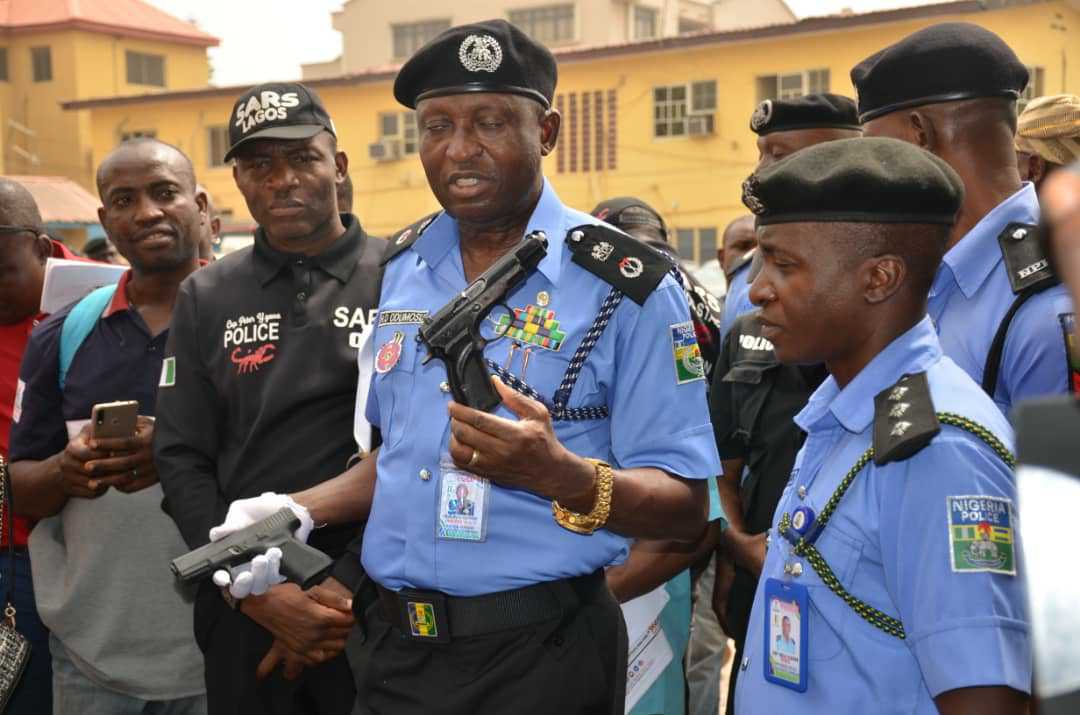
In a statement, the Commissioner of Police for Lagos, Mr Hakeem Odumosu, stressed that securities operatives will frown against the vehicular and pedestrian movement in and out of the affected local government areas during the elections on Saturday.
However, he maintained that those on election duties, essential services and accredited domestic and foreign election observers will be allowed passage.
He said the affected councils include Epe, Ibeju Lekki, Kosofe Somolu and Ikorodu, warning the electorates and political gladiators to play the game according to the rules and provisions of the Electoral Act 2010.
He emphasised that no police aides or security agents will be allowed to escort their principals or any Very Important Personalities (VIPs) to polling units or on any movement while the elections last.
While maintaining that any security aides caught violating this directive will be arrested and made to face the full weight of the law, Mr Odumosu assured the general public of safety and smooth conduct of the elections.
He reaffirmed the commitment of the police to achieving free, fair, credible and acceptable elections in the affected local government areas.
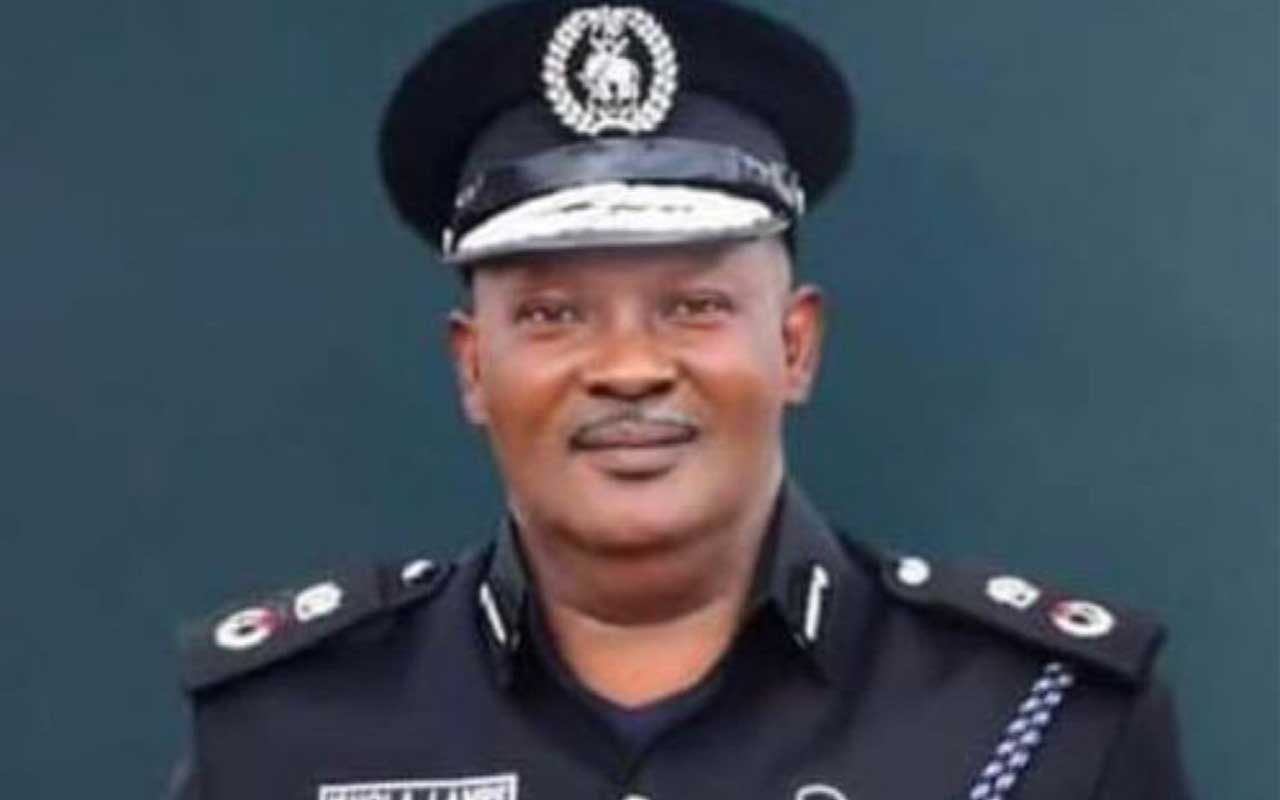
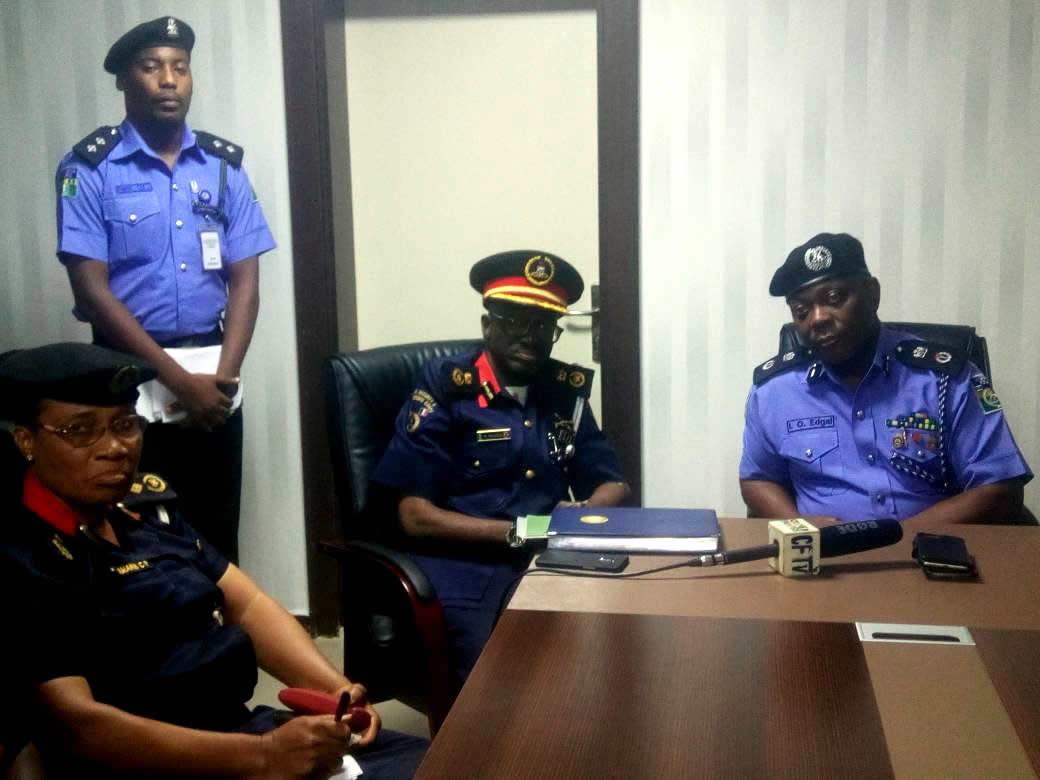
On Thursday, the police chief held talks with election monitoring officers deployed from the Force Headquarters, Abuja, on the strategies put in place to assist and monitor the elections in Lagos State.
The election monitoring team, which comprises two Commissioners of Police, some Assistant Commissioners of Police and other officers, led by the Commissioner of Police, Community Policing, Force Headquarters, Mr Kola Okunola, reported to Lagos State Command yesterday in preparation for the deployment and monitoring of police personnel and other security agents detailed for the election duties in 1,928 polling units.




By Modupe Gbadeyanka
The pastor in charge of the Celestial Church of Christ at Agonvi Sea Beach in the Sakpo area of Seme border, Badagry, Lagos State, Mr Afolabi Hodonu, has been arrested by operatives of the National Drug Law Enforcement Agency (NDLEA).
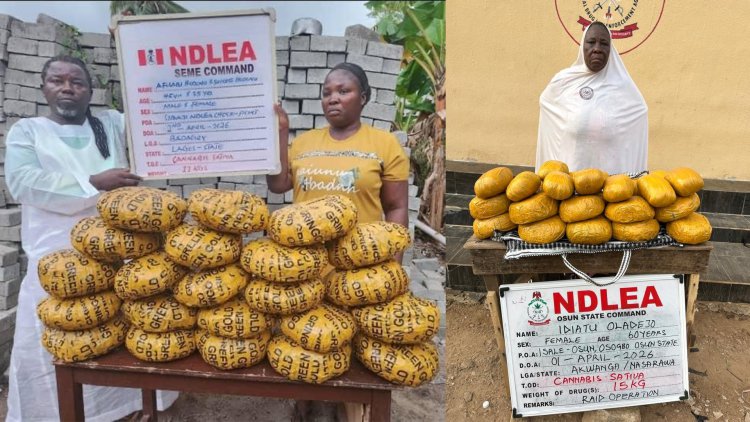
The 45-year-old cleric was apprehended on Thursday, April 2, 2026, alongside his 35-year-old wife, Mrs Success Hodonu, with blocks of skunk weighing about 11kg.
A statement issued on Sunday by the spokesman of the NDLEA, Mr Femi Babafemi, disclosed that the couple were stopped at the Gbaji checkpoint, and a search of their Honda Pilot SUV led to the recovery of the drugs concealed in hidden parts of their vehicle.
Their arrest followed the apprehension of a fake security agent, Mr Sunday Samuel, 35, at the same checkpoint on Monday, March 30, while conveying 24.5kg of skunk from the Seme border to Lagos.
The statement further disclosed that NDLEA operatives also successfully dismantled a drug trafficking syndicate in high stakes intelligence led operations that lasted three weeks during which cocaine consignments concealed in tins of palm kernel extract heading to the United Kingdom were intercepted and the warehouse where the shipments are packaged raided, while all three layers of the group were unravelled, leading to the arrest of the kingpin.
The breakthrough began on Wednesday, March 11, 2026, when NDLEA officers of the Murtala Muhammed International Airport (MMIA) Strategic Command, Ikeja, Lagos, intercepted 3.10 kilograms of cocaine at the export shed of the airport. The illicit substance was meticulously hidden inside tins of palm kernel extract intended for shipment to the UK.
Two suspects handling the shipment, Idris Olayiwola Amoo and Akinlami Akinsoji Adedoyin, were promptly arrested.
To unravel the sender and the arrowhead of the drug syndicate, a well-coordinated sting operation was carried out on Thursday, April 2, leading to the arrest of Ezemuwo Joel, who operates under a fake identity as Ajayi.
His arrest provided the link to the syndicate’s head, 52-year-old King Arinze, who was flushed out of a hideout in the Isolo area of Lagos.
He was thereafter taken to his warehouse at 11, Ola Ifa Street, Bucknor, Isolo, where NDLEA operatives recovered 886 tins of palm kernel extract prepared for drug concealment; industrial tools, including a sealing machine, tin openers, paint sprays, 52 grams of cannabis sativa and a pack of hand gloves. Arinze has since confessed to personally draining the oil from the tins to conceal the cocaine.
In a separate operation in Borno state, NDLEA operatives on Wednesday, April 1, intercepted a female drug supplier to bandit groups operating between the North East and Chad, 28-year-old Aisha Adamu. She was arrested along the Gamboru Ngala road in possession of 4.3 kilograms of Colorado, a potent synthetic strain of cannabis.
In Adamawa State, NDLEA officers on patrol along Namtari road, Yola South, on Monday, March 30, intercepted a trailer marked RUW 947 XA transporting 48,000 pills of tramadol. The truck driver, Abdulaziz Ismail Korede, was arrested while a follow-up operation led to the arrest of the recipient, Idris Adamu.
While 60-year-old Idiatu Oladejo was arrested with 15kg of skunk in Isale Osun, Osogbo, Osun state, on Wednesday, April 1, NDLEA operatives, acting on credible intelligence, raided the Itaogbolu forest, Akure, Ondo State, where they recovered 351 kilograms of skunk and its seeds. No fewer than 28,600 capsules of tramadol were seized from a 66-year-old Aminu Usman Gembu when he was arrested at Aliade, Benue state, on Wednesday, April 1.
In Edo State, a suspect, Roland Owie, 37, was arrested on Monday, March 30, following the raid of his warehouse at Egbanke community, Orhionmwon LGA, where 1,378 kilograms of skunk were recovered.
A notorious drug dealer, 40-year-old Ayantola Omodunmomi (a.k.a Iya Elle) was on Wednesday, April 1, arrested at Eleta area of Ibadan, the Oyo State capital. Her arrest follows intelligence and surveillance on how she uses her 11-year-old daughter, Anjola, to deliver illicit drugs to her customers. At the time of her arrest, a 45.6kg skunk was recovered from her warehouse.

By Abba Dukawa
A chieftain of the ruling All Progressives Congress (APC), Mr Abdullahi Mahmud Gaya, reaffirmed his commitment to purposeful leadership, declaring he is not given to making empty promises to the electorate.
The politician, who intends to represent the Ajingi, Gaya, and Albasu Federal Constituency in the National Assembly in the 2027 general elections, stressed that his record of performance over two consecutive terms stands as clear evidence of his capacity and credibility, noting that his tenure has consistently delivered beyond expectations.
According to him, governance should be measured by tangible results rather than rhetoric, and his track record reflects a sustained dedication to the welfare and development of his constituency.
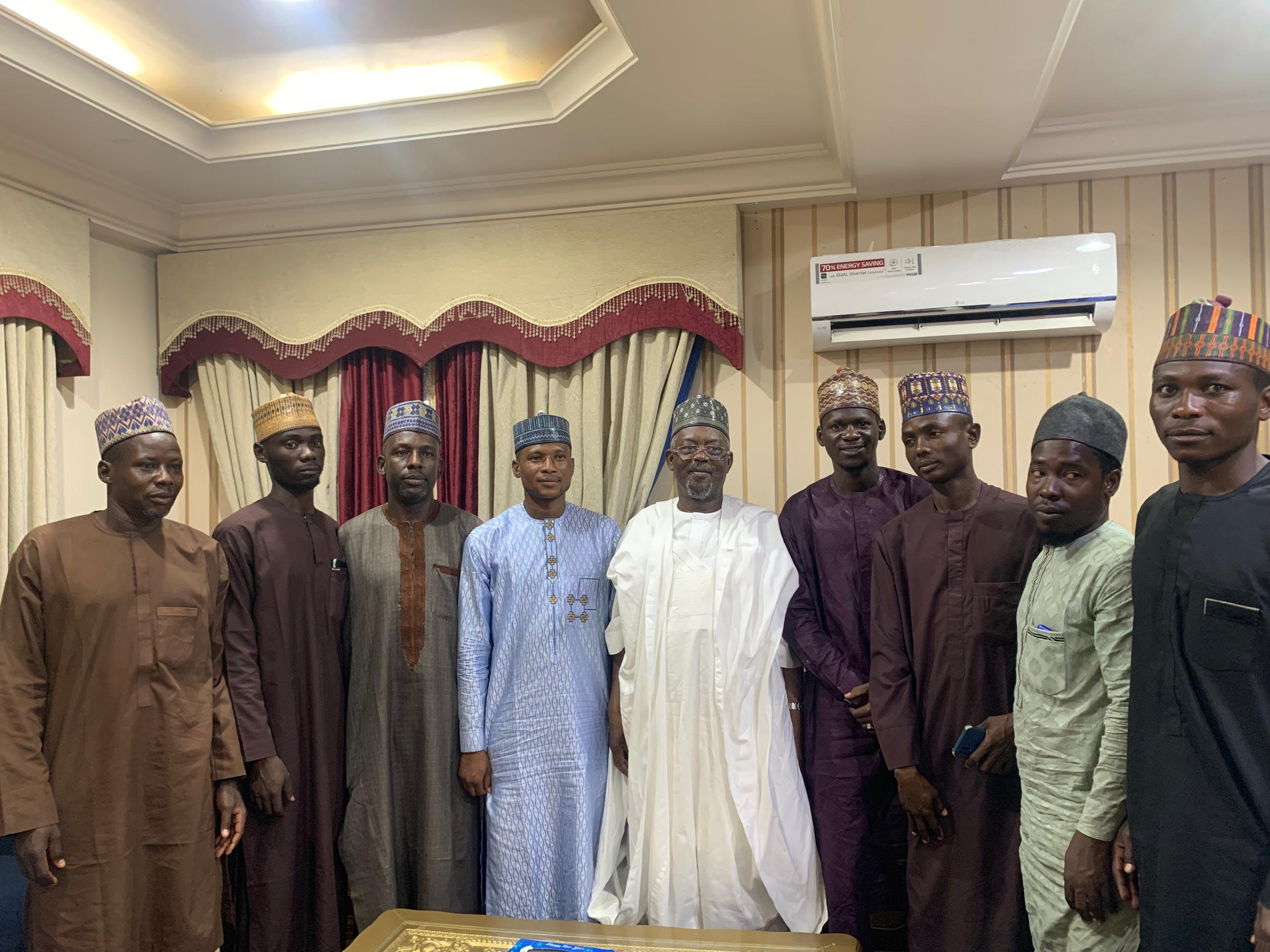
Speaking on Sunday while receiving various support groups at his residence in Kano, Mr Gaya reiterated his resolve to consolidate on past achievements and continue championing policies that will advance the collective interests of his people.
He urged them to return to their respective wards, villages, and towns to enlighten the electorate on the visible developmental strides recorded across the constituency over the past three years under his leadership, emphasising the need for voters to clearly distinguish these achievements from previous representations.
Mr Gaya further stated that there is no retreat in his resolve to contest the seat, stressing that the election is not about personal ambition, but about the collective well-being and continued progress of the people across the three local government areas.
He also urged them to take note that the Electoral Act 2026 outlines two methods through which political parties can nominate candidates, adding that these methods are direct primaries and consensus. Direct primaries involve all registered party members voting to choose their candidates, while the consensus method requires aspirants to voluntarily agree on a single flag bearer.
Speaking on behalf of various support groups, Mr Ismaila Ado, who has benefited from a monthly allowance as a volunteer teacher in one of the schools constructed during his tenure, stated that in addition to the allowance, the politician also facilitated his permanent appointment in the Kano State Ministry of Education.
Also speaking, an elder of the APC in Gaya Local Government Area, Mr Iliyasu Muhammad Gamoji, noted that prior to 2015, the communities of Ajingi, Gaya, and Albasu suffered from years of neglect and slow development.
He explained that when Mr Gaya represented the constituency in the House of Representatives, he did so with a strong commitment and a clear sense of responsibility.
He added that, over time, the lawmaker’s efforts brought tangible progress that positively impacted many lives, noting that roads were constructed, schools were improved, and the communities began to receive renewed attention and meaningful government support during his tenure.


By Aduragbemi Omiyale
The sum of N3.3 trillion has been approved by President Bola Tinubu to finally clear the outstanding debts in the power sector.
A statement issued on Sunday by the Special Adviser to the President on Information and Strategy, Mr Bayo Onanuga, said the “long-standing debts accumulated between February 2015 and March 2025.”
It was stated that the payment plan for the debts under the Presidential Power Sector Financial Reforms Programme should restore reliable electricity to the country.
“Following verification, N3.3 trillion has been agreed as a full and final settlement, ensuring a fair and transparent resolution,” a part of the statement noted.
“Implementation has begun, with 15 power plants signing settlement agreements totalling N2.3 trillion. The federal government has already raised N501 billion to fund these payments. Out of the amount, N223 billion has been disbursed, with further payments underway,” it added.
The statement said, “With payments reaching the power value chain, generation will be more stable. With power plants supported, electricity reliability will improve.”
“This programme is not just about settling legacy debts. It is about restoring confidence across the power sector — ensuring gas suppliers are paid, power plants can keep running, and the system begins to work more reliably,” the Special Adviser to the President on Energy, Ms Olu Arowolo-Verheijen, was quoted as saying in the statement.
“It is part of a broader set of reforms already underway — including better metering and service-based tariffs that link what you pay to the quality of electricity you receive.
“The government is also prioritising power supply to businesses, industries, and small enterprises — because reliable electricity is critical to creating jobs, supporting livelihoods, and growing the economy.
“The goal is simple: more reliable power for homes, stronger support for businesses, and a system that works better for all Nigerians,” she added.
President Tinubu has commended all stakeholders who supported efforts to resolve the legacy issues in the power sector. He has also confirmed that the next phase (Series II) will begin this quarter.
-
 Feature/OPED6 years ago
Davos was Different this year
-
Travel/Tourism10 years ago
Lagos Seals Western Lodge Hotel In Ikorodu
-

 Showbiz3 years ago
Estranged Lover Releases Videos of Empress Njamah Bathing
-
 Banking8 years ago
Sort Codes of GTBank Branches in Nigeria
-

 Economy3 years ago
Subsidy Removal: CNG at N130 Per Litre Cheaper Than Petrol—IPMAN
-

 Banking3 years ago
Sort Codes of UBA Branches in Nigeria
-

 Banking3 years ago
First Bank Announces Planned Downtime
-

 Sports3 years ago
Highest Paid Nigerian Footballer – How Much Do Nigerian Footballers Earn