Connect with us

General

Senate Confirms Onnoghen as Chief Justice of Nigeria

Published

on

By Modupe Gbadeyanka

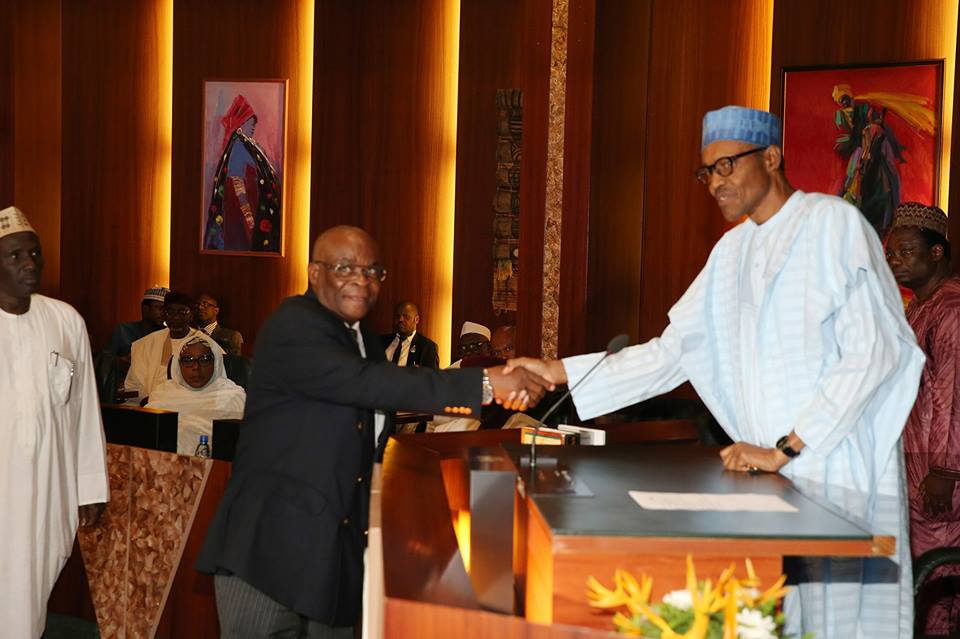
Justice Walter Onnoghen has been confirmed as the Chief Justice of Nigeria, making him the first Southerner to occupy the position in nearly 30 years.

Justice Onnoghen was confirmed on Wednesday, March 1, 2017, by the Senate after undergoing screening before the lawmakers.

The exercise took over one hour, but at the end, he was unanimously confirmed for the position after his nomination from the presidency.

During his questioning by the red chamber, the new CJN promised to reforms in the judiciary and also restore its dignity and integrity.

Justice Onnoghen, during his screening, emphasised the need to maintain independence of the judiciary, warning that attempt to politicise it could spell danger.

Prior to his confirmation today, Justice Onnoghen had been in acting capacity since November 10, 2016 when President Muhammadu Buhari approved his nomination from the National Judicial Council (NJC), following the retirement of Mahmud Mohammed.


Modupe Gbadeyanka is a fast-rising journalist with Business Post Nigeria. Her passion for journalism is amazing. She is willing to learn more with a view to becoming one of the best pen-pushers in Nigeria. Her role models are the duo of CNN's Richard Quest and Christiane Amanpour.

Click to comment

Leave a Reply

Your email address will not be published. Required fields are marked *

General

Top 10 Real Estate Companies in Nigeria in 2026

Published

on

real estate transactions nigeria

Nigeria’s real estate industry has experienced significant growth over the years, with developers now moving beyond basic land sales to building smart cities, luxury apartments, lifestyle estates, and integrated residential communities.

At the same time, concerns around fraud and failed projects have made trust, transparency, and delivery capacity more important than ever, especially for diaspora investors looking to own property back home.

From Lagos to Abuja and other emerging cities, several companies have distinguished themselves through innovation, infrastructure, quality developments, and customer confidence. Here are some of the top real estate companies in Nigeria in 2026.

  1. LandWey Investment Limited

LandWey remains one of the most influential names in Nigeria’s modern real estate sector. Headquartered in Lagos, the company has built a strong reputation around smart infrastructure, lifestyle communities, and futuristic urban development.

Their flagship project, Isimi Lagos, is one of the most talked-about developments in the country. The project combines residential living with wellness infrastructure, recreation, technology hubs, and eco-friendly concepts.

LandWey’s developments are largely concentrated along the Lekki-Epe corridor, where they continue to shape conversations around premium residential investment.

  1. Palton Morgan Holdings

Palton Morgan Holdings has established itself as one of Nigeria’s leading luxury real estate developers, particularly within the high-end Lagos and Abuja property markets.

The company is known for premium residential developments that combine smart living, luxury architecture, and modern urban design. Their projects are recognised for sophistication, premium finishing, and strong lifestyle appeal.

Some of their major developments include Paramount Twin Towers, L5 Banana, Rockhampton, The Meadows, and Kadars Gate.

  1. Mshel Homes Limited

Mshel Homes Limited is a fast-growing real estate development company that is increasingly recognised as one of the top real estate companies in Nigeria, particularly in Abuja’s expanding property market. Known for its structured developments and strategic site selection, the company has earned a reputation as a trusted real estate company delivering modern residential and mixed-use projects.

Its portfolio spans over 60 estates in key locations across Abuja, Lagos, Kano and Yola. Mshel Homes outlets in Kaduna, Port Harcourt, and Maiduguri.

Mshel Homes is a driver of sustainability and is known for eco-friendly, innovative projects with flexible payment options, which continue to attract both homebuyers and investors seeking long-term value in Nigeria’s evolving real estate sector.

Mshel Homes Limited has rapidly grown into one of the most respected and trusted real estate companies in Nigeria. Established in 2018 and headquartered in Abuja, the company is widely recognised for its integrity, transparency, honesty, and commitment to delivering value.

In an industry where credibility matters greatly, Mshel Homes has built a reputation around verified property documentation, quality construction, sustainable living, and affordable luxury.

One of its landmark projects is Hutu Exclusive, a luxury golf resort estate on Airport Road in Abuja. Widely regarded as Nigeria’s first golf resort estate, the development combines luxury living with wellness, recreation, and lifestyle infrastructure.

The estate gained national recognition after winning the “Best Branded Lifestyle Project of the Year, 2025” award at the Africa Housing Show.

Mshel Homes has a reputation for delivering amazing projects, as evident in Asokoro, Guzape, Gaduwa, Katampe Extension, and Airport Road in Abuja, among others.

  1. Cosgrove Investment Limited

Cosgrove has earned a strong reputation as one of Nigeria’s leading smart real estate developers. Headquartered in Abuja, the company focuses heavily on technology-driven communities and energy-efficient residential developments.

Cosgrove is recognised for integrating automation, smart security systems, and modern infrastructure into its projects, making its estates particularly attractive to professionals and investors seeking contemporary urban lifestyles.

Their emphasis on innovation gives them a unique advantage in Nigeria’s evolving property market.

  1. Veritasi Homes and Properties

Veritasi Homes has grown significantly through aggressive expansion and investment-focused developments. The company has become highly visible within the Lagos real estate market and is particularly known for flexible payment plans and land banking opportunities.

Their projects appeal strongly to both local and diaspora investors looking for long-term property appreciation and strategic investment locations.

Veritasi continues to strengthen its position as one of Nigeria’s fast-rising real estate brands.

  1. Dantata & Sawoe Construction Company Nigeria Limited

Dantata & Sawoe remains one of the oldest and most established construction and infrastructure companies connected to Nigeria’s real estate sector.

Unlike many modern developers focused mainly on residential estates, the company’s strength lies in engineering expertise, large-scale infrastructure projects, and urban development execution.

  1. Efab Properties Limited

Efab Properties has maintained relevance for years within Abuja’s real estate market. The company became known for delivering residential estates and housing projects targeted at middle and upper-middle-income buyers.

Its long-standing presence in the Federal Capital Territory continues to contribute to its recognition in Nigeria’s property industry.

  1. Nest & Nails Limited

Nest & Nails has emerged as a fast-growing real estate company focused on modern residential developments and lifestyle-oriented communities.

The company has gained attention for blending luxury aesthetics with practical housing solutions while maintaining strong market visibility and branding.

Their developments continue to attract younger homeowners and upwardly mobile investors.

  1. Brains & Hammers

Brains & Hammers is widely regarded as one of the most structurally ambitious real estate companies in Nigeria.

The company became prominent through large-scale residential developments, urban housing projects, and premium estates across Abuja and other cities.

Their strength lies in delivering infrastructure-heavy developments that combine affordability with modern living standards.

  1. Bilaad Realty

Bilaad Realty continues to build recognition within Nigeria’s competitive property market through residential estate projects and investment-focused developments.

Although still growing compared to some industry giants, the company is steadily expanding its footprint and increasing brand awareness within key investment locations.

Final Thoughts

Nigeria’s real estate industry is becoming increasingly sophisticated, with developers now competing beyond land sales alone.

Today, the leading companies are those building smart cities, lifestyle communities, luxury developments, and infrastructure-backed estates while maintaining transparency, trust, and long-term value for investors and homeowners.

Continue Reading

General

Lagos Grants 14 Licences for Embedded Power, Mini-Grid, Metering Services

Published

on

lagos off-grid

By Adedapo Adesanya

The Lagos State government has approved 14 licences to private operators for off-grid generation, embedded power, independent distribution, metering, and mini-grid services as part of efforts to reshape the electricity landscape in the commercial capital.

The approvals were issued by the Lagos State Electricity Regulatory Commission (LASERC) at its maiden stakeholder engagement in Lagos, signalling the formal activation of the state’s decentralised electricity market.

At the centre of the new framework is a clear shift away from dependence on the national grid towards a structured, state-driven electricity system built on private investment and localised power supply.

Late last month, Business Post reported that the state signed Power Purchase Agreements (PPA) with three firms- Fenchurch Power, Mainland Power, and Viathan for about 60MW of generation, to increase capacity to serve major public facilities in the state.

Under the new licences, Axxela Limited will develop a 5.8MW off-grid power project at Cadbury Nigeria’s facility in Agidingbi. Daybreak Power Solutions Limited secured multiple off-grid generation approvals across major industrial sites, including Seven-Up, Nigerian Breweries, NBC, Crown Flour Mill, Nigerdock, and Promasidor.

Isolo Power Gen Limited also received approval for a 9MW embedded generation project along the Apapa–Oshodi corridor, one of Lagos’ busiest industrial zones.

In addition, Isolo Power Supply Limited was licensed as an Independent Electricity Distribution Network operator. New Hampshire Capital, GossLink Engineering, and Enaro Energy Mini-Grid Limited were approved for metering services and mini-grid operations.

LASERC said the licences are designed to deepen private sector participation and improve electricity reliability across industrial clusters, estates and peri-urban communities where supply remains unstable.

According to the commission, Lagos is building a decentralised electricity model that allows generation and distribution to operate closer to end users rather than relying solely on the national grid.

It noted that the move is to improve access, reduce losses and attract long-term investment into power infrastructure.

The state has set an ambitious target of achieving 97.5 per cent electricity availability by 2030, alongside reducing market losses to below 10 per cent through a performance-driven structure.

As part of the rollout plan, LASERC will introduce two to three 24-hour electricity franchise zones by October 2026. These zones are expected to serve as pilot districts for uninterrupted power supply under private management.

The commission is also preparing a full metering push, targeting 100 per cent coverage by July 2026. Consumer complaint centres will begin operations in phases from August 2026, starting with Amuwo Odofin, followed by Ikorodu and Epe.

One of the most notable reforms is the introduction of the “Electric Eye of Lagos” (EEL) programme, an AI-enabled metering and monitoring system designed to track consumption, reduce estimated billing and improve revenue collection. The pilot phase is expected to begin in October 2026.

LASERC also confirmed that draft market rules will be released in October 2026, finalised by December 2026, and supported with regulatory sandbox guidelines to encourage innovation in the electricity sector.

The reforms are built on the Lagos Electricity Law signed in 2024, which formally created the state’s independent electricity market and empowered LASERC to regulate generation, distribution and tariffs within the state.

That law replaced the earlier 2018 power sector reform framework and marked a structural shift in how electricity is governed in Nigeria’s commercial capital.

In March 2026, the Lagos State Government inaugurated the LASERC board, giving full operational backing to the regulatory framework.

Continue Reading

General

CBN Urges States to Reduce Reliance On Overdrafts, Short-term Financing

Published

on

CBN Ways and Means

By Adedapo Adesanya

The Central Bank of Nigeria (CBN) has called on state governments to cut down on overdrafts and short‑term financing.

According to a statement by the apex bank on Sunday, the advice was given by its Deputy Governor in charge of the Economic Policy Directorate, Mr Muhammad Abdullahi, during an engagement with sub‑national stakeholders, facilitated through the Nigerian Governors Forum Secretariat.

Mr Abdullahi advised them to ensure that borrowing decisions align with debt sustainability thresholds, improve budget realism and revenue forecasting, prioritise expenditure, and better synchronise fiscal calendars with prevailing macroeconomic conditions.

He emphasised the critical role of State Governments in ensuring a successful transition to an Inflation Targeting (IT) monetary policy framework, stressing that sustained price stability can be achieved only through coordinated fiscal discipline across all tiers of government.

Mr Abdullahi described the move toward inflation targeting as a shift to a more rule‑based, transparent, and forward‑looking monetary framework that demands close collaboration with state authorities.

According to him, while the CBN retains responsibility for deploying monetary policy tools to control inflation, fiscal actions, particularly at the sub-national level, play a significant role in shaping inflation outcomes within a federal system such as Nigeria’s.

Mr Abdullahi explained that inflation targeting is fundamentally about managing expectations, warning that uncoordinated or expansionary fiscal actions by State Governments could either reinforce or undermine monetary policy signals.

He noted that states influence inflation through multiple channels, including borrowing decisions, domestic debt accumulation, expenditure patterns, wage bills, capital project execution, salary arrears, overdrafts, contractor financing, and weak coordination on the Federation Account Allocation Committee (FAAC) receipts, cash management, and debt servicing.

“In an inflation‑targeting regime, persistent, unpredictable or expansionary fiscal behaviour at the sub‑national level can significantly undermine price stability,” he said.

The Deputy Governor emphasised that the absence of fiscal dominance, where government borrowing pressures compel the bank to monetise deficits, is a core prerequisite for successful inflation targeting.

He noted that this principle applies not only at the federal level but equally to State Governments.

He urged the states to reduce reliance on overdrafts and short‑term financing, ensure that borrowing decisions align with debt sustainability thresholds, improve budget realism and revenue forecasting, prioritise expenditure, and better synchronise fiscal calendars with prevailing macroeconomic conditions.

Under the inflation‑targeting framework, Mr Abdullahi outlined four key responsibilities for state governments: maintaining fiscal discipline and predictability; pursuing responsible borrowing aligned with medium‑term fiscal frameworks; strengthening coordination on cash and debt management; and enhancing internally generated revenue mobilisation.

He warned that unplanned expenditures, excessive supplementary budgets, and unsustainable debt accumulation could trigger liquidity shocks and elevate inflationary risks.

He reiterated that inflation targeting is a collective national commitment to stability, credibility, and long-term prosperity.

While the CBN remains accountable for delivering price stability, he said the framework’s success ultimately depends on disciplined fiscal behaviour across all tiers of government.

By strengthening coordination and embedding price stability as a shared objective, he added, state governments would support the new framework and lay firmer foundations for growth, job creation, and improved social welfare.

On his part, the Director-General of the NGF, Dr Abdullateef Shittu, represented by Mr Olalekan Yunusa, commended the Governor of the apex bank and the bank’s leadership for what he described as the strategic foresight behind the engagement, particularly the decision to involve sub‑national fiscal authorities at an early stage of the transition process.

He noted that the shift from a monetary-targeting framework to inflation targeting reflects a deliberate commitment to price stability as the central anchor of economic policy.

He added that sustainable macroeconomic stability cannot be achieved through monetary policy alone and requires disciplined coordination across all tiers of government.

Continue Reading

Trending