Connect with us

General

Stanbic IBTC Gives Succour to Children at 10th Together4Alimb Charity Walk

Published

on

Together4Alimb Charity Walk

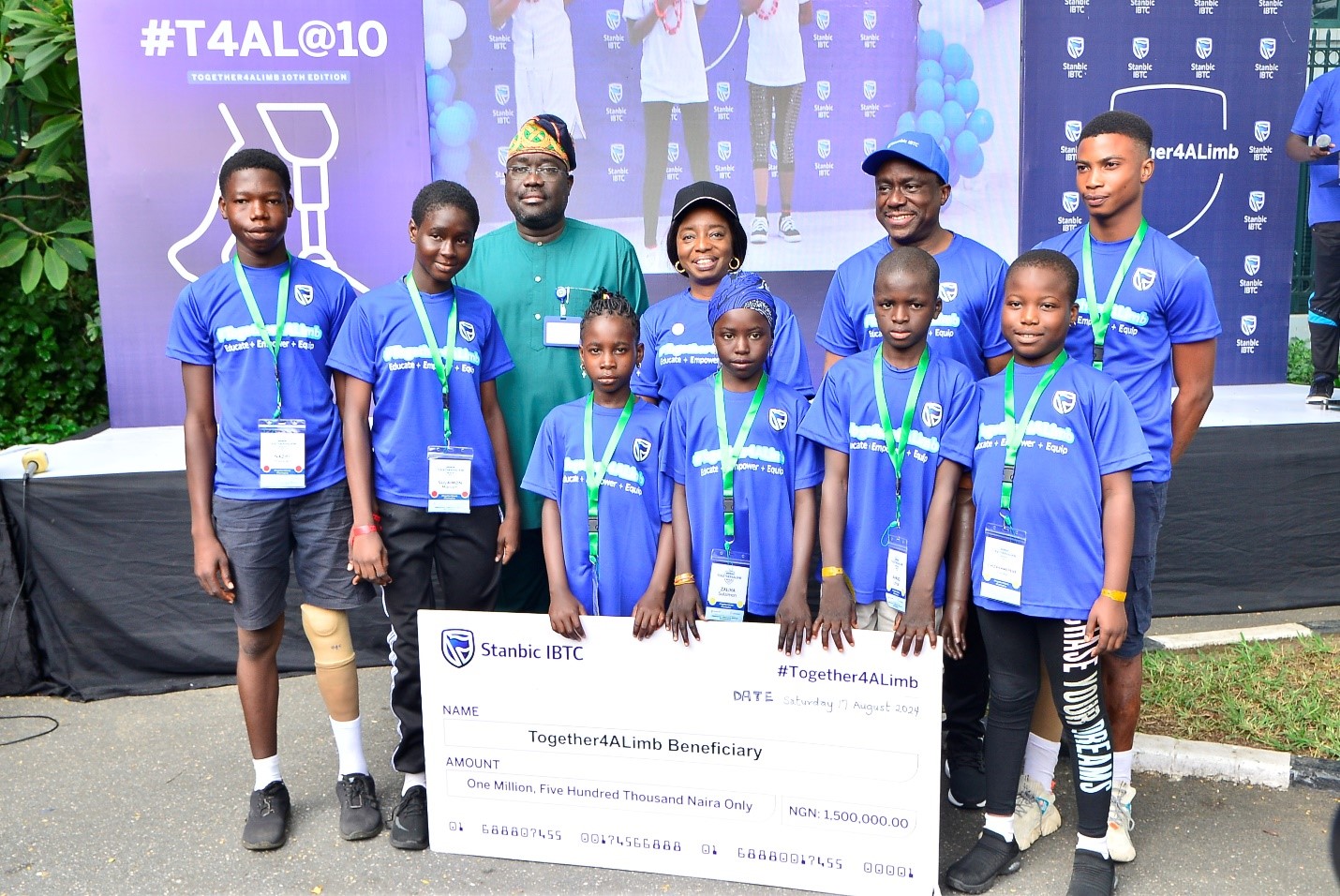
In a profound demonstration of commitment to societal welfare and support for underprivileged children, Stanbic IBTC Holdings, a subsidiary of the Standard Bank Group, successfully commemorated the 10th edition of its flagship Corporate Social Investment (CSI) initiative, the Together4ALimb Walk, on 17 August 2024. This hallmark event marks years of dedicated efforts towards enriching the lives of children living with limb loss and underscores Stanbic IBTC’s steadfast dedication to social responsibility.

Speaking at the event, Dr Demola Sogunle, the Chief Executive, Stanbic IBTC Holdings, emphasised the significant impact of limb loss on children’s emotional, psychological, and societal well-being. He highlighted the organisation’s holistic support approach, tackling not just the medical needs but also the financial and social challenges encountered by the families.

He emphasised the crucial role businesses play in offering comprehensive support, urging them to recognise that limb loss presents a complex challenge that goes beyond the physical condition. He highlighted the efforts of Together4ALimb, explaining how the initiative addresses both the visible and hidden obstacles faced by these families, ultimately providing a more holistic and inclusive form of support.

“Businesses have a crucial role in delivering comprehensive support, recognising limb loss as a complex life challenge beyond the physical condition. Through Together4ALimb, we address both the tangible and intangible hurdles these families face,” Demola stated.

The 2024 Together4ALimb Walk, resonating with the theme “Wellness in Motion” 2.0, was engineered to spotlight and ease the challenges faced by underprivileged children suffering from limb loss. Since the initiative’s inception in 2015, Together4ALimb has significantly improved the lives of 55 children by providing them with prosthetic limbs and creating educational trust funds of N1.5 million for each beneficiary. The programme witnessed a considerable expansion in 2023, extending its benevolence to 45 additional recipients.

To this day, the initiative proudly boasts of assisting 136 beneficiaries nationwide, ensuring each child receives an annual prosthetic limb replacement until age 18. This year’s event further solidified Stanbic IBTC’s commitment by welcoming 36 children into the programme, thereby cementing Stanbic IBTC’s role in creating brighter futures for children experiencing limb loss.

During the event, Dr Ibijoke Sanwo-Olu, First Lady of Lagos State, highlighted the remarkable impact of the initiative noting with admiration that 136 children have benefited from the organisation’s esteemed Corporate Social Responsibility (CSR) initiative.

She said, “I want to sincerely appreciate Stanbic IBTC’s commitment and consistency over the years through this laudable initiative. It is imperative to note that supporting special children who have experienced limb loss either through accidents, mismanaged injuries, or congenital issues/birth defects and providing prosthetic limbs and educational trust funds for them will further assist them in realising their full potential and give them a sense of love, care, and support from society.”

“Over the years, issues around welfare and rights of persons with disabilities have become a recurring decimal in national discourse with successive administrations coming up with various initiatives to end discrimination and generally promote the principle of social inclusion.  In today’s world, our society has realised that physical disability is not inability and therefore should not, in any way, hinder anyone from achieving something positive in life,” she stated.

Ejike Anih, Founder and Chief Executive Officer of IfeanHealth Orthopaedics, stated that Stanbic IBTC has accomplished milestones through the Together4Limb initiative.

“This initiative explicitly targets the upliftment of underprivileged children, a segment of society often overlooked yet deeply impacted by systemic inequalities. By focusing on this group, the organisation sheds light on these children’s pressing issues and actively works to create tangible positive changes in their lives.”

“Such initiatives are paramount today, as they embody the essence of corporate responsibility—recognising the roles of businesses in the economy and as pillars of society with the power and resources to enact real change. By dedicating a portion of its resources to the welfare of underprivileged children, the organisation sets a laudable example for others to follow, demonstrating how corporations can make a significant difference in the world, one child at a time,” Ejike said.

Speaking at the event, Brigadier General Samson Okoigi, ⁠Corps Commander—Medical, Nigerian Army, commended the Together4ALimb initiative for its significant contribution, providing much-needed hope and support to those affected. This initiative is crucial in helping recipients tap into their inherent potential and navigate life more confidently despite their physical challenges.

He stressed, “We understand firsthand the impact of losing a limb, not just physically, but emotionally and psychologically. I stand here today with pride, recognising the vital work that Stanbic IBTC has been doing through this remarkable initiative. Your dedication to restoring mobility to individuals with limb loss across Nigeria aligns with our mission in the Nigerian Army to rehabilitate and support the brave men and women who have sacrificed so much in service to our nation. We know that the journey to recovery is not just about restoring what was lost but empowering individuals to regain their independence, confidence and sense of purpose.”

The 10th Together4ALimb Walk commenced at the Stanbic IBTC Head Office on Walter Carrington Crescent, Victoria Island, Lagos, and concluded at the Law School Bus Stop on Ozumba Mbadiwe Avenue.

This year’s event marked a significant milestone by expanding its reach beyond Lagos, bringing the Together4ALimb Walk to several cities across Nigeria with staff and partners joining the walk with the aid of Steps by Stanbic IBTC. This expansion underscores Stanbic IBTC’s commitment to fostering the nation’s social, economic, and environmental welfare.


Click to comment

Leave a Reply

Your email address will not be published. Required fields are marked *

General

FG Seeks Public Input on National Policing Bill

Published

on

state police bill

By Modupe Gbadeyanka

Members of the public have been invited to submit memoranda and policy proposals on the proposed National Policing Bill.

The Chairman of the Working Group, Mr Femi Gbajabiamila, announced this on Monday after the team’s meeting at the State House in Abuja.

The group, headed by the Chief of Staff to President Bola Tinubu, is calling for input from Nigerians as part of efforts to establish a comprehensive legal and operational framework for state policing.

It is reviewing the Police Act 2020, the Police Service Commission framework, police regulations, and other relevant laws to support the development of an effective, modern policing system.

The proposed framework will set national minimum standards, define state readiness and grant certification, clarify jurisdictional responsibilities, ensure independent oversight, uphold human rights, and guarantee sustainable funding. It would also spell out an orderly transition to a dual-policing structure.

The call for memoranda will run for two weeks, allowing citizens, professionals, civil society, security agencies, state and local governments, academics, and other stakeholders to contribute. Submissions will be reviewed and integrated into the draft bill, which will then be subject to further national consultation before being finalised and sent to the National Assembly.

The Working Group has adopted a seven-week work programme running from July 27 to September 14, 2026. The draft Executive Bill is scheduled for presentation to President Bola Ahmed Tinubu on September 3, 2026, with national consultations to follow before the final approval.

The new National Policing Bill will set out requirements for recruitment, training, oversight, funding, and transition arrangements to ensure credible, effective, and accountable policing nationwide.

“A proposed State Police Service must demonstrate that it has credible arrangements for recruitment, vetting, training, pay, pensions, equipment, custody, complaints, discipline, data, firearms control, independent oversight and financial sustainability before it begins policing,” Mr Gbajabiamila said.

The representative of the Nigeria Governors’ Forum and Governor of Ogun State, Dapo Abiodun, who described State Police as a landmark reform, described the initiative as one of the defining reforms of President Tinubu’s administration.

Responding to concerns about federal overreach, he clarified that there is no Federal attempt to control State Police. He added that the proposed legislation is intended to provide an operational framework rather than centralise control.

Prince Lateef Fagbemi, the Attorney-General of the Federation and Minister of Justice, said the proposed National Policing Bill is designed to guarantee the security of lives and property while ensuring that the establishment of state police does not become a tool for political persecution.

The Attorney-General added that states not immediately ready to establish their own police services would continue to benefit from the presence of the Federal Police until they meet the required standards.

Other participants at the meeting included the Inspector General of Police, Tunji Disu; President of the Nigerian Bar Association, Afam Osigwe; Chairman, Policy Advisory Committee, Justice Abdullahi Liman (rtd); Professor Olu Ogunsakin, Head, Nigeria Police Reform Secretariat; Senior Special Assistant to the President on Planning and Research, Nnadubem Moghalu; and Brigadier General Olutayo Muyiwa Adesuyi, representing the National Security Adviser.

Continue Reading

General

NMDPRA Records 30% Drop in Gas Imbalance on Western Network

Published

on

NMDPRA fee regulations

By Adedapo Adesanya

The Nigerian Midstream and Downstream Petroleum Regulatory Authority (NMDPRA) says it recorded a 30 per cent reduction in gas imbalance on the country’s Western Network following the conclusion of its first-half 2026 Nigerian Gas Network Reconciliation (NGNR) Workshop.

The workshop brought together gas transporters, suppliers, shippers and off-takers to reconcile gas volumes traded between January and June 2026, while introducing a Network Entry/Exit Point Measurement Infrastructure Audit Template aimed at improving metering accuracy and accountability across the gas transmission network.

In a communiqué issued after the workshop, the authority said participants also reviewed the performance of the Nigerian Gas Transmission Network, assessed progress on major pipeline infrastructure projects, and received updates on the ELPS Gas Shrinkage Factor and Hydraulic Modelling Project.

Discussions focused on addressing metering gaps, improving network visibility through Supervisory Control and Data Acquisition (SCADA) integration, and enhancing system reliability ahead of the commissioning of the Ajaokuta-Kaduna-Kano (AKK) Pipeline System.

The workshop adopted key resolutions, including the execution of outstanding Network Exit Agreements, mandatory submission of measurement audit templates and closer collaboration among industry stakeholders to improve network pressure management.

Speaking at the closing session on behalf of the authority’s chief executive, Mr Rabiu A. Umar, the Director of Transportation Systems and Networks, Mr Joseph G. Musa, said the biannual reconciliation exercise had become critical to promoting equitable gas transactions, transparency, investor confidence and efficient network operations.

Mr Musa noted that since the NGNR process was introduced in 2023, it had significantly improved gas measurement, strengthened regulatory compliance through consequence management, reduced operational imbalances and contributed to a more reliable domestic gas supply.

The workshop concluded with participants adopting the reconciled H1 2026 gas volumes, reaffirming the authority’s commitment to a transparent, efficient and reliable domestic gas market.

Continue Reading

General

Swedfund Supports Climate Resilience in African Food Systems With $12m

Published

on

Agriculture in nigeria

By Modupe Gbadeyanka

An investment that supports growing food and agriculture companies across Africa that strengthen agricultural value chains has been made by Swedfund.

The organisation is putting down about $12 million to strengthen climate resilience in African food systems through the Acumen Resilient Agriculture Fund II (ARAF II).

By improving access to markets, finance and essential services, these companies help smallholder farmers become more resilient to climate and economic shocks.

Over 30 million smallholder farmers operate across Sub-Saharan Africa, accounting for 80 per cent of all farms and producing 70 per cent of the region’s food (IFAD). Yet many face limited access to finance, quality inputs, reliable buyers and market information. At the same time, they are among those most exposed to climate change and weather-related shocks, which threaten harvests, incomes and food security.

The investment has an ambition to reach around four million smallholder farmers through ARAF II’s portfolio companies. It also aims to meet the criteria of the 2X Challenge, which promotes investments that support women’s economic empowerment.

ARAF II invests in businesses that address key gaps in agricultural value chains, from improving market access and reducing post-harvest losses to expanding financial and digital services for farmers. By helping these businesses grow, the investment aims to improve productivity, strengthen local value chains and increase the resilience of food systems.

Swedfund invests alongside other development finance institutions and investors to help mobilise long-term capital for businesses that often struggle to access financing despite their potential to strengthen food security, climate resilience and economic development across Africa.

“Climate change is already affecting the livelihoods of millions of smallholder farmers across Africa. Investing in businesses that improve access to markets, finance and agricultural services helps farmers strengthen their resilience, increase productivity and build more stable incomes. That is essential for more resilient food systems,” the Investment Director of Food Systems and Strategic Investments at Swedfund, Ms Helen Hagos, said.

Continue Reading