General
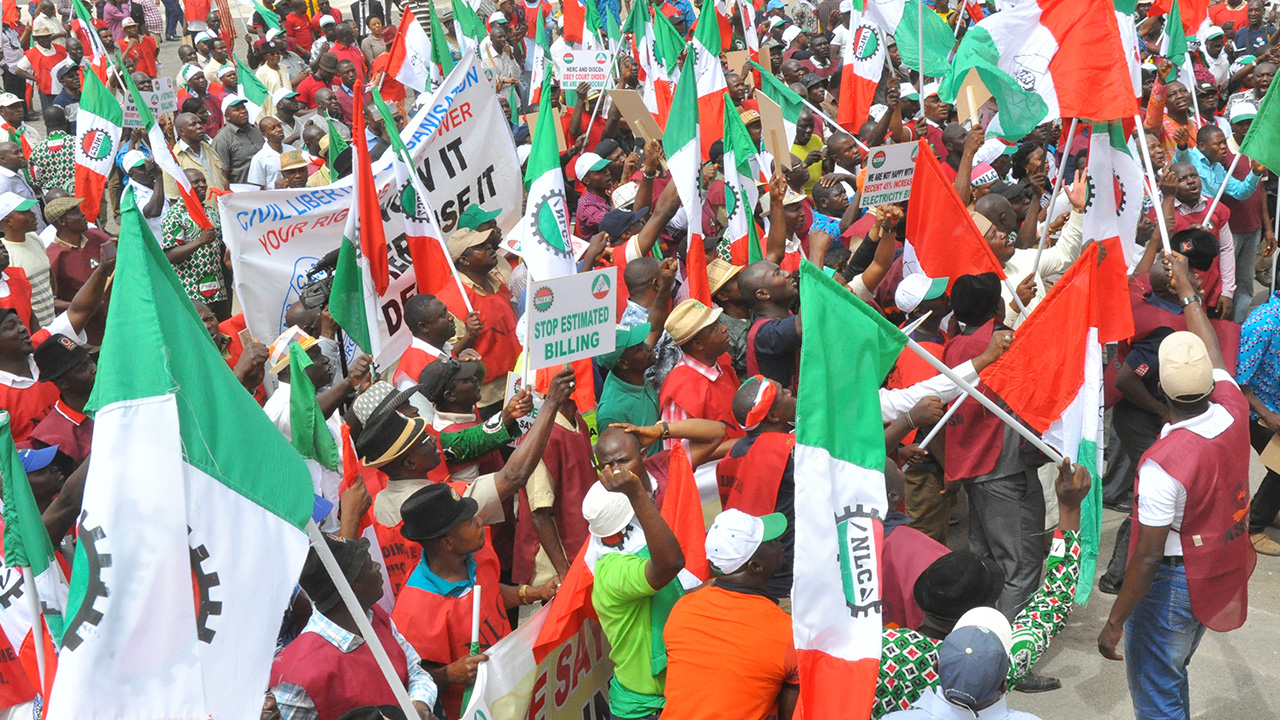
Subsidy Removal: Court Stops Proposed Nationwide Strike by NLC, TUC
By Modupe Gbadeyanka
The proposed nationwide strike to kick against the removal of fuel subsidy by the federal government may suffer a setback as the National Industrial Court (NIC) has restrained the Nigeria Labour Congress (NLC) and the Trade Union Congress (TUC) from going on with the action.
In a ruling on an interim order sought by the federal government on Monday in Abuja, Justice O. Y. Anuwe ordered the unions to stop the strike pending the determination of a suit filed by the government.
The judge directed the government to serve the NLC and the TUC the interim order and the substantive suit marked NICN/ABJ/158/2023, fixing June 19, 2023, for hearing of the matter.
“The defendants/respondents are hereby restrained from embarking on the planned Industrial Action/or strike of any nature, pending the hearing and determination of the motion on notice dated 5th June 2023.
“It is ordered that the defendant/ respondents be immediately served with the originating processes in this suit, the motion on notice, and the order of this court hereby made.
“The motion on notice is hereby fixed for hearing on 19th June 2023. Hearing notices to that effect shall be served on the defendants/respondents along with the other processes,” Justice Anuwe ruled.
Business Post reports that the Federal Ministry of Justice filed an ex-parte motion to stop the planned industrial action by the labour unions, arguing that the strike was capable of disrupting economic activities, the health sector and the educational sector.
General
Pension Harmonisation to Restore Fairness for Retirees—PTAD
By Adedapo Adesanya
The Pension Transitional Arrangement Directorate (PTAD) has said the implementation of the Defined Benefit Scheme Pension Harmonisation is a reform meant to advance and enhance pension payment equity in the country.
The chief executive of PTAD, Mrs Tolulope Abiodun Odunaiya, said this initiative was a landmark reform designed to restore fairness, improve retirees’ welfare and strengthen confidence in the administration of the country’s legacy pension system.
The harmonisation exercise marks one of the most significant policy interventions in the Defined Benefit Scheme since PTAD was established in 2013 to take over the management of pensions under the old federal pension arrangement.
Unlike periodic pension increases that merely raise existing benefits by a percentage, she stressed that pension harmonisation was further than that by recomputing pensions using the latest approved salary structures that existed before the closure of the Defined Benefit Scheme.
She noted that the objective is to ensure that retirees who held similar positions and rendered comparable years of service receive equitable pension benefits regardless of their retirement dates.
The initiative comes against the backdrop of years of agitation by pensioners over historical disparities in pension computation.
She added that the PTAD’s harmonisation programme seeks to resolve that challenge by restoring parity within the system. According to her, pension harmonisation is the formal recomputation of pensions using approved salary structures applicable before the DBS cut-off date.
In practical terms, it ensures that pension outcomes are determined by rank, grade level and years of service rather than the year of retirement.
The Directorate believes the exercise will significantly improve social justice by correcting historical inequities that disadvantaged thousands of retirees.
The harmonisation applies primarily to pure Federal Government pensioners as well as eligible retirees under the Parastatals Pension Department (PaPD), Defunct and Transferred Agencies Pension Department (DTAPD), and the Education and Health Pension Department (TEHPD), particularly those who initially served under the Federal Government before their agencies were transferred to state governments.
General
Alleged Fake Agency: Police to Arraign Adeniyi Adeyemi Today
By Adedapo Adesanya
The Nigeria Police Force will today, Tuesday, July 14, 2026, arraign the controversial director-general of the non-existent Presidential Foreign Intervention Promotion Council (PFIPC), Mr Adeniyi Adeyemi.
The arraignment will take place before Justice Mohammed Umar of the Federal High Court in Abuja.
The police had charged Mr Adeyemi alongside two others with eight counts, including forgery and impersonation, in the case marked FHC/ABJ/CR/562/2025.
The case was initially filed on November 27, 2025, by Mr Wisdom Madaki, a police prosecutor.
Court proceedings had stalled on June 16, scheduled for Mr Adeyemi’s arraignment, due to his absence from court on grounds of ill health.
According to the court documents, proposed prosecution witnesses to testify against the defendants include the Chief of Staff to the President, Mr Femi Gbajabiamila; Paul Emmanuel, Jeremiah Imoukhede and Ituah Sylvester.
Others are civil servants working in the Office of the Accountant General of the Federation, Mr Akimbo Shola and Mr Adamu Balongu, a deputy superintendent of police, were on the list.
Also listed as witnesses are Mr Ojo Victor, Mr Omeh Amarachukwu, and Mr Wakili Saidu, all of whom were allegedly posted to work with Mr Adeyemi at the non-existent agency.
Others are Mrs Joy Ngwoke, the owner of Kachi Hotel in Abuja, and Mr Ven Okoriko, the pastor of St. Matthew’s Anglican Church, Maitama.
The documentary exhibits planned to be tendered by the prosecution to prove the case include the police investigation report, Mr Gbajabiamila’s petition dated October 17, 2025, and Mr Adeyemi’s fake presidential appointment letter dated March 8, 2024.
They also include the request for a note verbale by Mr Adeyemi sent to the Ministry of Foreign Affairs and the approvals he got to open accounts with the Central Bank of Nigeria (CBN), the request for approval of self-accounting status Mr Adeyemi sent to the Accountant-General of the Federation’s office and the conveyance of approval for take-off of the PFIPC.
Other documents listed by the prosecution are a letter of request for collaboration with the ministry in the area of land acquisition and offices across the 36 states of the federation; statements of all the witnesses and that of the defendants, and pictures.
The police, in the court document, said, “The prosecution shall at the trial call any other related witness or witnesses to prove its case.”
The prosecution accused Mr Adeyemi of operating the fictitious agency from the 2nd Floor of the Federal Secretariat Complex in Abuja, Phase III, before his arrest.
Last week, President Bola Tinubu directed the Independent Corrupt Practices and Other Related Offences Commission (ICPC) to conduct a thorough investigation into the activities of the fictitious agency.
The president gave the ICPC 30 days to complete the investigation, so it is currently unclear how the outcome of the ICPC investigation would impact the police prosecution.
General
Nigeria’s Private Sector to Unlock Inclusive Growth With NGCP
By Aduragbemi Omiyale
A coordinated push to position gender inclusion as a driver of business competitiveness, investment and long-term economic growth has led to the introduction of the Nigeria Gender Country Programme (NGCP) by the private sector.
This initiative, led by the International Finance Corporation (IFC), a member of the World Bank Group, in partnership with Nigerian Exchange (NGX) Group Plc and the Lagos Chamber of Commerce and Industry (LCCI), aligns advisory expertise, funding and partnerships to strengthen women’s representation in leadership, improve access to quality employment, and expand access to finance, technology and markets for women and women-led businesses.
It builds on the CEO Roundtable held in June and the progress achieved through Nigeria2Equal, IFC’s earlier initiative, as it now moves into implementation, with participating organisations expected to adopt practical, measurable gender-smart business practices.
The economic case is significant, with the program underpinned by research showing that closing gaps in women’s leadership, employment and entrepreneurship could generate an estimated $22.9 billion in additional economic output annually, reinforcing the economic case for stronger private sector action on gender inclusion.
“Advancing women’s economic participation is no longer simply a social aspiration; it is a business imperative, an investment in productivity, a catalyst for innovation and a driver of sustainable economic growth.
“Through the Nigeria Gender Country Program, we are creating a practical framework that will help businesses strengthen leadership, expand opportunity and unlock the inclusion dividend for Nigeria’s economy,” the chairman of NGX Group, Mr Umaru Kwairanga, stated.
The Governor of Lagos State, Mr Babajide Sanwo-Olu, represented by the Commissioner for Commerce, Cooperatives, Trade and Investment, Mrs Folashade Ambrose-Medebem, reaffirmed the state’s commitment to creating an enabling environment for women-led enterprises and strengthening inclusive economic development, while the Minister of Women Affairs, Mrs Imaan Sulaiman-Ibrahim, represented by Ms Aishatu Digili, called for stronger collaboration between government, development institutions and the private sector to accelerate women’s economic empowerment and expand opportunities for women across key sectors of the economy.
The Division Director for West and Central Africa at IFC, Mr Olivier Buyoya, said, “Creating more and better jobs is central to IFC’s mission across Africa. Economies grow faster, and businesses perform better when women have equal opportunities to participate, lead, innovate and succeed.
“Through the Nigeria Gender Country Program, we are bringing together the private sector, capital markets and development partners to help companies turn this opportunity into stronger business performance, greater competitiveness and more inclusive growth. We look forward to working with Nigerian businesses to unlock the full economic potential of women as a driver of Nigeria’s future prosperity.”
Speaking on behalf of the Director-General of the Securities and Exchange Commission (SEC), Mr Emomotimi Agama, the Commission’s Executive Commissioner, Legal and Enforcement, Ms Frana Chukwuogor, said, “The Commission welcomes the Nigeria Gender Country Program as an important platform for deepening collaboration, innovation and knowledge sharing in support of inclusive market development. We commend the IFC for its leadership in promoting inclusive private sector development globally, and for its partnership with Nigeria in strengthening our financial markets.”