Connect with us

General

Supreme Court, UI, OAU, Others Fail ICPC Ethics Integrity Test

Published

on

supreme court Nigeria

By Adedapo Adesanya

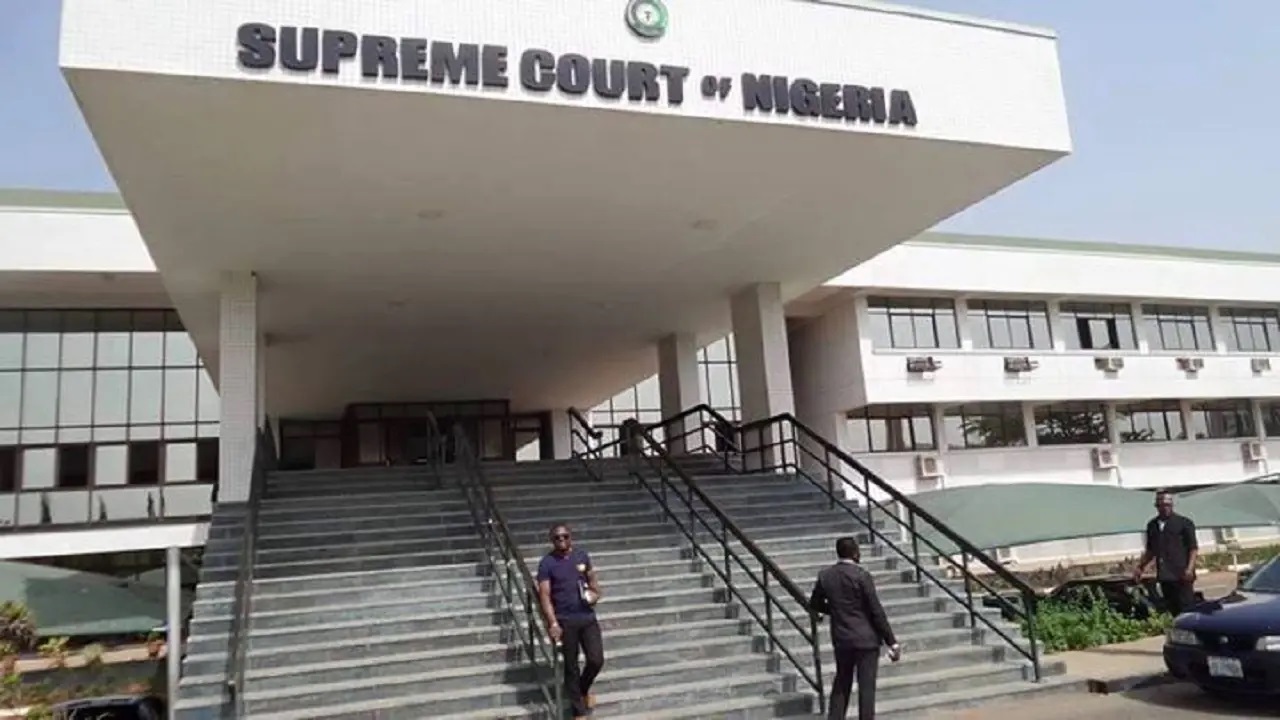
The Independent Corrupt Practices and Other Related Offences Commission (ICPC) has revealed that the Supreme Court of Nigeria and 14 other bodies failed to meet the requirements of its 2024 Ethics and Integrity Compliance Scorecard (EICS).

This announcement highlights the failure of several key institutions to meet the required ethical standards and guidelines set by the ICPC for the year.

The chairman of the ICPC, Mr Musa Aliyu, while unveiling the EICS on Thursday in Abuja, said 330 Ministries, Departments, and Agencies (MDAs) were assessed in the outgoing year, but none achieved full compliance with the EICS.

The chairman, represented by the ICPC Director of Public Enlightenment and Education, Mr Demola Bakare, emphasised that the 15 non-compliant MDAs had completely failed to conduct any system studies or submit necessary financial and audit reports.

Mr Aliyu said among the non-compliant bodies were the University of Ibadan (UI), Obafemi Awolowo University (OAU), Ile-Ife, Legal Aid Council, Abuja, and Federal Teaching Hospital, Gombe.

Other entities on the list, he said included the Federal Civil Service Commission (FCSC), Abuja; Council of Nigerian Mining Engineers and Geoscientists; Institute of Chartered Chemists of Nigeria; the National Hajj Commission of Nigeria (NAHCON), and the National Obstetrics Fistula Centre, Ningi, among others.

The ICPC head warned that the ICPC would take appropriate actions, including enforcement measures, against these MDAs to ensure they complied with government directives.

In spite of the non-compliance of some agencies, the Chairman commended the Joint Admissions and Matriculation Board (JAMB) for emerging as the top performer in the EICS with a score of 89.75 per cent.

The Nigeria Railway Corporation (NRC) came second with 89.33 per cent, followed by Nigeria Bulk Electricity Trading Plc (NBET) with 88.73 per cent.

The assessment covered key indicators, including Management Culture and Structure (MCS), Governance and Executive Management, and Financial Management Systems (FMS).

It also examined Finance, Revenue, and Audit Processes, as well as Administrative Systems (AS), which included policies, ethics education, and whistle-blowing mechanisms.

The EICS serves as a preventive tool to assess and improve MDAs’ compliance with ethical standards, policies, and anti-corruption measures.

He said that the scorecard aimed to identify organisational gaps, provide actionable insights, advise the government on policy development, and foster self-evaluation within MDAs.

Mr Aliyu further revealed that between December 2023 and December 2024, the ICPC tracked 1,500 projects across 22 states valued at N610 billion.

“During this period, the commission recovered N346 million in cash, assets worth N400 million, and helped the government save N30 billion.

“The tool covered 323 responsive MDAs, with 15 categorised as non-responsive and high-risk for corruption,” he said, noting that no MDA achieved full compliance in 2024.

He attributed these results to the absence of whistle-blower policies, strategic plans, and effective stock verification units, adding that 29.55 per cent of MDAs achieved substantial compliance, 51.62 per cent partial compliance, 15.91 per cent poor compliance, and 2.92 per cent were non-compliant.

The chairman said ICPC would continue recognising MDAs with substantial compliance and deploying tools to promote integrity and accountability.


Adedapo Adesanya is a journalist, polymath, and connoisseur of everything art. When he is not writing, he has his nose buried in one of the many books or articles he has bookmarked or simply listening to good music with a bottle of beer or wine. He supports the greatest club in the world, Manchester United F.C.

Click to comment

Leave a Reply

Your email address will not be published. Required fields are marked *

General

Ogun NSCDC Arrests 210 Suspects for Vandalism, Illegal Mining

Published

on

Ogun NSCDC

By Adedapo Adesanya

The Ogun State Command of the Nigeria Security and Civil Defence Corps (NSCDC) says it arrested 210 suspects for vandalism, fraud, and illegal mining in the last 18 months as part of its anti-vandalism drive.

The Ogun State Commandant, Mrs Remilekun Ekundayo, disclosed this during a courtesy visit to the Nigeria Union of Journalists, NUJ, council in Abeokuta, the state capital.

Mrs Ekundayo said the command had also recovered over N23 million in fraud-related cases for victims and resolved more than 1,700 disputes through alternative dispute resolution mechanisms within the same period.

She added that the command has sustained intelligence-driven operations that have prevented several criminal activities and ensured the protection of pipelines, railway corridors, and power installations across the state.

While stressing that security remains a shared responsibility, Mrs Ekundayo called for stronger collaboration with the media to enhance public awareness and safety in the state.

According to her, the visit was aimed at strengthening cooperation between the corps and the media, describing journalists as critical partners in the state’s security architecture.

“In matters of security, your role becomes even more strategic and impactful,” she said.

“The NSCDC is statutorily empowered to protect critical national assets and infrastructure, prevent vandalism and economic sabotage, and support disaster management and emergency response,” she said.

In his remarks, the Ogun State Chairman of the NUJ, Mr Wale Olanrewaju, assured the commandant of the council’s support and continued partnership through accurate and prompt reporting of security issues.

Continue Reading

General

Defence Minister Musa Warns Mali Conflict May Destabilise West Africa

Published

on

defence minister christopher musa

By Adedapo Adesanya

Nigeria’s Minister of Defence, Mr Christopher Musa, says the capture of a key Malian town by rebels poses a threat to West Africa that requires foreign intervention to prevent the insurgency from spreading.

A series of coordinated attacks by militants in late April left Mali’s Defence Minister dead and forced Malian and Russian mercenary forces to withdraw from the northeastern stronghold of Kidal.

Mr Musa, a retired army general, said in an interview with Bloomberg that the international community must come together to deal with the insurgents before they wreak havoc on the region.

The deteriorating situation in Mali may trigger a wider regional crisis, the defence minister said.

His admittance comes as the border region of Nigeria, Benin and Niger on the southern edge of the Sahel region is becoming a new stronghold for jihadists, as militants turn forests and pastoral networks in West Africa into bases for recruitment and international attacks.

“If they allow them to get any foothold in Mali, completely, they are not stopping there,” he warned.

He called for a joint campaign style like that of the United States against the Islamic State in Syria as a way to root out terrorists in West Africa.

General Musa noted that the collapse of states across the region has been the main driver of arms proliferation, with coastal West African states, including Ghana and Togo, becoming increasingly vulnerable.

He cited the fall of former Libyan dictator Muammar Gaddafi in 2011 as a turning point that released vast stockpiles of weapons into circulation, a problem compounded by ongoing instability in Sudan.

The combined crises have created an open corridor across the Sahel, allowing small arms, light weapons and ammunition to flow largely unchecked.

He added that this has worsened due to weak border controls and the ease of movement across the region.

Attacks in Nigeria have also risen, with data from the website of the Armed Conflict Location & Event Data (ACLED), a conflict-monitoring group, affirming that the number of suicide bombings in Nigeria by March already matched the annual average over the past six years.

The Nigerian military has also been dealt a blow to its military bases and senior figures targeted. In April, Brigadier-General Oseni Omoh Braimah was killed when Islamist fighters attacked a base in Borno State.

The minister said disruptions linked to global conflicts, including the war in Ukraine, as well as the ongoing war in Iran, have made it harder to source weapons even when funding is available. To meet its defence goals, Nigeria is stepping up efforts to build domestic arms-manufacturing capacity.

Continue Reading

General

N33.8bn Fraud: Court Convicts ex-Power Minister Saleh Mamman

Published

on

Saleh Mamman

By Modupe Gbadeyanka

A former Minister of Power in Nigeria, Mr Saleh Mamman, has been convicted by a Federal High Court in Abuja over his connection with a N33.8 billion fraud.

He was found guilty of a 12-count charge brought against him by the Economic and Financial Crimes Commission (EFCC).

While delivering his judgment on Thursday, Justice James Omotosho declared that the former government official is guilty of all the charges levied against him by the agency.

In the suit marked FHC/ABJ/CR/273/2024, the EFCC informed the court that the convict, who served under the administration of late President Muhammadu Buhari, conspired with ministry staff to divert about N22 billion meant for the Zungeru and Mambilla Hydro Electric Power projects.

He was removed from office by the late president in 2021 and arrested by the anti-money laundering organisation four months after. He was said to have used embezzled funds of up to N33.8 billion to acquire properties.

At the court today, the judge confirmed that Mr Mamman made a cash payment of $655,700 (equivalent to N200 million) for landed property in Abuja, without recourse to a financial institution.

He was also found guilty of criminal breach of trust in relation to funds released by the federal government for the Mambilla and Zungeru Hydroelectric Power Plant projects.

“The evidence of the prosecution is overwhelming against the scanty and almost absent defence of the defendant.

“The defendant did not offer any credible evidence to rebut the prosecution’s case,” Justice Omotosho held.

“Rather than creating a legacy to tackle the epileptic power supply in the country, the defendant was living large at the expense of ordinary citizens.

“Little wonder that Nigerians have remained in darkness till today,” the judge added.

Continue Reading

Trending