General
TikTok, ICC Unveil Digital Commerce Labs to Equip Entrepreneurs
By Aduragbemi Omiyale
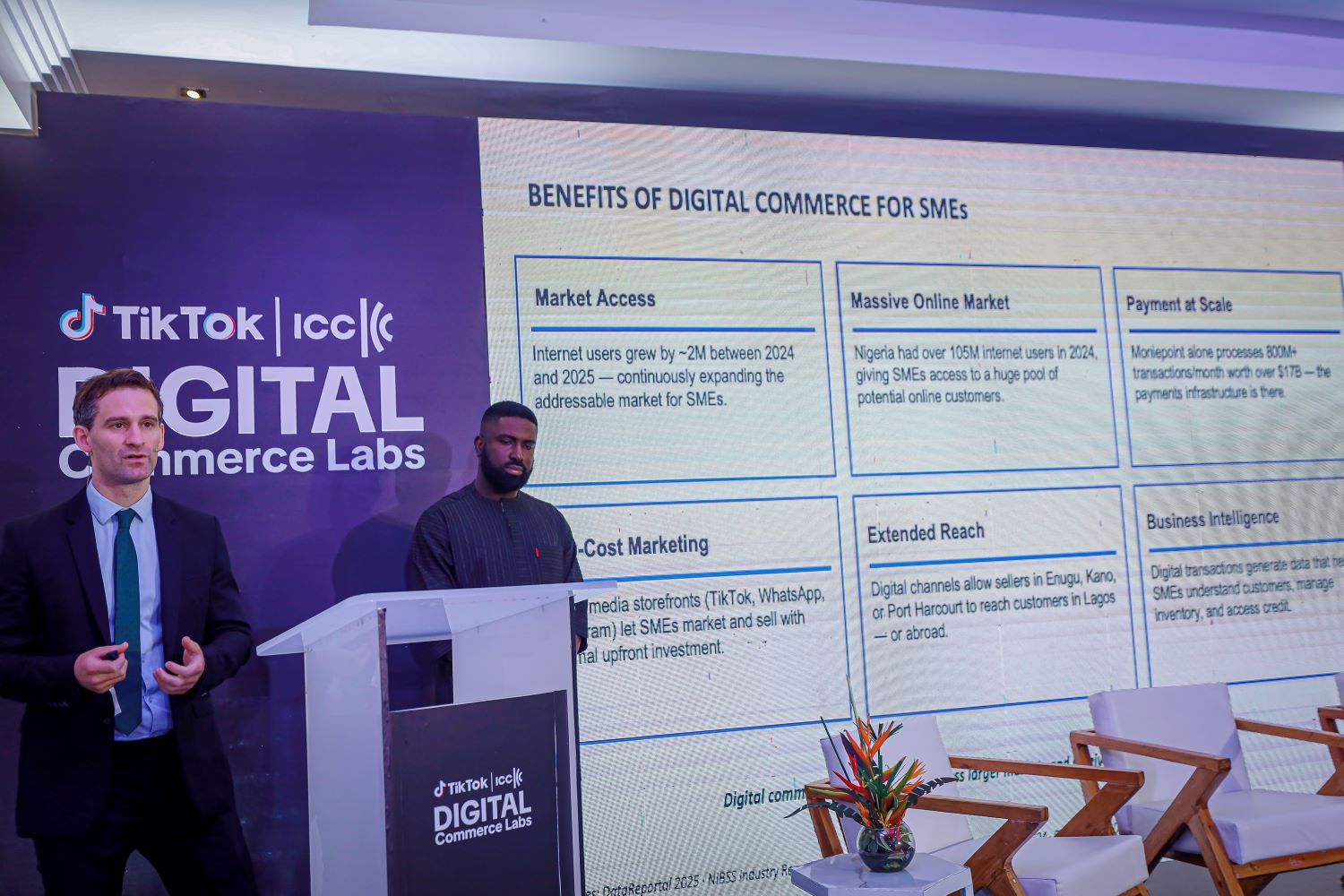
An initiative designed to equip entrepreneurs with the knowledge, tools and confidence to participate fully in an increasingly digital marketplace, helping them compete, scale and thrive on their own terms, has been launched by TikTok in partnership with the International Chamber of Commerce (ICC).
Known as the Digital Commerce Labs, this programme will empower small business owners in Nigeria and accelerate economic inclusion and digital skills development across Sub-Saharan Africa.
The scheme is supported by the National Information Technology Development Agency (NITDA) and the Lagos State Employment Trust Fund (LSETF).
At the unveiling in Lagos recently, stakeholders involving small businesses, entrepreneurs, digital creators, business associations, and government and industry representatives brainstormed on how Nigerian small businesses can harness the power of digital to grow, scale and build lasting impact.
“Digital commerce is reshaping how businesses grow across Sub-Saharan Africa, and Nigerian entrepreneurs are at the heart of that shift,” the acting Head of Government Relations and Public Policy for Sub-Saharan Africa at TikTok, Tokunbo Ibrahim, stated.
“Through our partnership with ICC, we are committed to making sure that the benefits of that transformation reach every small business owner in this region.
“We have seen how TikTok has made discoverability and purchase decision-making easy with hashtags such as #TikTokMadeMeBuyIt. Social commerce has an extraordinary power to unlock opportunity, level the playing field and place the tools of growth in the hands of those who need them most,” Ibrahim added.
Also speaking, the chief executive of NITDA, Mr Kashifu Inuwa Abdullahi, said, “At NITDA, our vision is to make Nigeria a digitally enabled nation, fostering inclusive economic development through technological innovation. We will achieve this by fostering digital literacy and cultivating the digital talent needed among our youth to thrive in a global market.
“We have seen that platforms like TikTok have evolved beyond entertainment; they are now powerful engines for economic growth, enabling small businesses to reach new audiences, tell their unique stories, and scale rapidly.
“We highly commend TikTok’s commitment to supporting our local ecosystem through this small business event. By bridging the gap between creativity and digital commerce, we are collectively fostering innovation and building a more inclusive, digitally empowered Nigeria.”
“Digital commerce is a powerful engine for inclusive growth. By equipping small businesses with the tools and skills they need to participate in the digital economy, we are opening new pathways for entrepreneurship, trade and job creation. With the Digital Commerce Labs, ICC is committed to ensuring that small businesses in Nigeria can fully seize these opportunities and grow beyond their local markets,” the ICC Deputy Secretary General, Julian Kassum, stated.
Social commerce and the MSME opportunity in Nigeria
The timing of the DCL launch could not be more significant. Nigeria’s social commerce market is one of the fastest-growing in the world, projected to reach $2.04 billion in 2025 and expand to nearly $4 billion by 2030. Across the African continent, the social commerce sector is forecast to grow at a compound annual growth rate of 16.2%, reaching $9.43 billion by 2030.
For Nigerian small businesses, social media is already the primary engine of online trade. A GSMA survey found that 56 per cent of Nigerian businesses sell online exclusively through social media, with a further 19 per cent combining social platforms with a website or marketplace. Meanwhile, over 40 per cent of internet users in Nigeria, Kenya and South Africa have already purchased through social commerce platforms. These figures point to an ecosystem in which the line between content and commerce has already blurred, and where the right skills and support can be genuinely transformative.
It was against this backdrop that a lecturer from Lagos Business School, Dr Henrietta Onwuegbuzie, addressed event participants on the rapid growth of social commerce in Nigeria and across the continent, reinforcing a central theme of the day: “This is not a prospect for Nigerian businesses. It is happening now, and those equipped with the right skills are already seeing the results.”
Funding made accessible by Lagos State Employment Trust Fund
In a strategic move to fortify the local entrepreneurial ecosystem, the Lagos State Employment Trust Fund (LSETF) has joined the Digital Commerce Labs to provide critical operational support for small businesses. Through this collaboration, LSETF will deliver robust capacity-building training focused on essential pillars of business sustainability, including financial literacy and wellness, strategic business structuring, book and record keeping, and expert taxation and legal advisory services.
Following completion of the program, market-ready small businesses will directly enter into LSETF’s financial ecosystem, with an opportunity to directly access SME funding.
A day of learning, conversation and community
Two keynote lectures set the tone for the day, examining how digital commerce is reshaping the landscape for small businesses in Nigeria. The first explored how digital platforms are fundamentally changing how small businesses reach customers, manage operations and build brand credibility. The second took a broader view, considering how digital commerce is enabling MSMEs to grow beyond profit: strengthening customer relationships, deepening community connections and building businesses with a clear sense of purpose.
Attendees were then introduced to the full DCL programme through a dedicated presentation, which offered a preview of the learning modules available, outlined the benefits of participation and explained how entrepreneurs can apply and register.
The Digital Commerce Labs offer a comprehensive, two-part learning experience designed to help Nigerian businesses harness the full potential of digital commerce. Starting in July, participants can access self-taught online modules — developed by local experts and covering topics from building a digital presence and creating effective content, to leveraging AI-driven e-commerce tools and preparing for both domestic and international growth. Delivered in a mobile-first format through short, engaging lessons with interactive elements, the modules are tailored to the Nigerian market to ensure relevant, high-quality learning. From there, virtual classrooms will complement the online modules with live, trainer-led sessions that bring theory to life in a collaborative setting, helping Nigerian entrepreneurs and businesses explore real-world digital commerce growth opportunities.
Nigeria’s Creator Economy Spotlight: Real stories, real growth
One of the most eagerly anticipated segments of the day was the Creator Economy Spotlight, in which three successful entrepreneurs and content creators shared candid accounts of how they built their businesses using platforms like TikTok. This fireside chat included Nigeria’s Dr Olawale Ogunlana, Medical Doctor, World Health Organisation’s Fides Network Creator, TikTok’s 2026 Global Discover List Creator, and Founder of HealthKraft Consulting. He was joined on stage by Kolade Mayowa, the innovative owner of the fashion brand HookedByLade, and Oluwatobi Anointing, the creative force behind the fashion business, Tobi Closet, both of whom shared invaluable insights into leveraging their TikTok platform to scale their brands.
Their accounts offered an honest and inspiring perspective on what it means to build a business in the digital age, grounded in the lived experience of entrepreneurs who use platforms like TikTok to reach customers and clients they would never otherwise have found.
General
Vandalism Threat: TCN Seeks Enhanced Backing from NSCDC, ONSA
By Adedapo Adesanya
The Transmission Company of Nigeria (TCN) is seeking increased assistance from the Nigeria Security and Civil Defence Corps (NSCDC) and the Office of the National Security Adviser (ONSA) to curb vandalism of transmission infrastructure.
The chief executive of TCN, Mr Sule Ahmed Abdulaziz, told a visiting delegation from both parties at the company’s corporate headquarters in Abuja, on Wednesday, that the partnership between TCN and security agencies was growing and remained vital to protecting the national transmission network.
He said sustained inter-agency partnership, intelligence sharing, prompt response and effective law enforcement were critical to combating vandalism and protecting critical infrastructure.
Mr Abdulaziz said vandalism was a major financial and operational challenge for TCN.
He cited recent attacks that damaged six transmission towers on the Apir–Makurdi line and led to the loss of 14 spans of conductors on the Lambata 132kV line.
The TCN boss disclosed that the damage forced TCN to mobilise contractors for emergency repairs despite financial constraints, and that the vandals had struck again while repairs were ongoing.
He said TCN had been carrying out community sensitisation programmes across the country, engaging host communities, traditional rulers and security agencies to promote collective ownership and protection of transmission facilities.
He added that because the transmission network is widely spread, there was an urgent need to deploy technology-driven surveillance systems and to establish a joint monitoring centre for real-time monitoring and prompt response to threats.
On his part, Air Vice Marshal E. E. Effiom of the Nigerian Army Intelligence Programme in the office of the National Security Adviser said there was a need for innovative approaches to protect critical national assets.
He proposed a three-tier asset protection strategy he described as Delay, Awareness and Response, explaining that Delay involved physical barriers to stall intruders; Awareness meant using surveillance technology for early detection; and Response focused on apprehending and prosecuting offenders.
He added that community vigilantes remained important partners but needed timely intelligence and technological support to be effective.
Assistant Commandant General, Power, Mrs Esther Akinlade of the NSCDC, told the meeting that the Corps was committed to supporting TCN in safeguarding transmission infrastructure.
She said NSCDC commands across the federation were ready to respond to reported incidents and to work with TCN to ensure offenders were investigated and prosecuted according to the law.
TCN, in a statement, said the meeting ended with a renewed commitment by TCN, ONSA and the NSCDC to deepen institutional collaboration through improved intelligence sharing, regular stakeholder engagement and coordinated security operations.
The company said the agencies were confident that a sustained partnership would significantly reduce vandalism and help create a more reliable and resilient national grid.
General
States to Get N83.2bn Fund to Address Flood Risks, Climate Threats
By Adedapo Adesanya
The National Economic Council (NEC) has approved N83.2 billion for the Anticipatory Action Task Force (AATF) interventions to mitigate the impacts of anticipated flooding and other climate-related emergencies nationwide.
This is just as the chairman of the council, Vice President Kashim Shettima, called on states to work with the federal government in resolving the logistical and compliance barriers that prevent farm produce from reaching international markets.
The approval of the N83.2 billion intervention funds was made at the 158th meeting of the NEC on Thursday, following a presentation to the council by the Minister of Budget and Economic Planning, Mr Atiku Bagudu, on the need to proactively address issues associated with flooding across Nigeria, particularly during the rainy season.
In addition, the group noted the importance of the AATF in addressing disasters and emergencies across the country, underscoring that NEC cannot continue to be seen as always taking reactive measures in emergency and disaster management.
Speaking at the meeting, the Vice President said the President Bola Tinubu administration’s reform agenda must now produce visible results across the federation.
Mr Shettima noted that the council’s work must be judged by the changes it brings to the lives of ordinary Nigerians, especially farmers, manufacturers, vulnerable citizens, unemployed young people, and children who will inherit the country.
He stated, “When this council last met, I called our economy a workshop. A place of measurement and correction. A place where plans are turned into systems, and systems into institutions, before any of it becomes prosperity.
“A workshop is judged by one thing. Not by the plans pinned to its walls, but by what comes off the bench. We return to that bench today. Not to admire the image, but to ask the question that honours it. Is the work taking shape?”
He said Nigeria remains a federation moving from stabilisation to production, from aspiration to implementation, and from isolated interventions to coordinated national growth.
According to him, the agenda before the council was not a new conversation, but a continuation of the national assignment with greater pressure for action and results.
“The assignment has not changed. We remain a federation moving from stabilisation to production, from aspiration to implementation, from isolated interventions to coordinated national growth. What has changed, I hope, is our proximity to delivery.
“A federation does not earn its prosperity by leaving its most vulnerable behind and hoping they catch up. The dignity of the citizen with the least is the floor beneath which we have resolved that no Nigerian shall fall.”
Mr Shettima pointed out that the social protection agenda before the council was an opportunity to convert national conscience into a durable system that protects citizens and strengthens human capital.
On exports and production, the VP said Nigeria must stop relying on exporting raw materials while importing finished products from other countries.
He maintained that the country’s economic transformation depends on a complete value chain linking farms to factories, factories to standards, standards to ports, and ports to markets.
“We cannot continue to export raw materials and import finished products,” he said.
The VP also assured that the council would confront bottlenecks that weaken Nigeria’s agricultural exports, especially those affecting the movement of goods through ports and the standards required by international markets.
He averred that improving port processes and meeting export compliance requirements are central to rewarding farmers, strengthening manufacturers and expanding Nigeria’s participation in global trade.
General
Stanbic IBTC Pension Managers Engages 3,714 Pre-retirees in Lagos, Others
By Modupe Gbadeyanka
About 3,714 pre-retirees across Lagos, Akure, Port Harcourt, Abuja, and Kano were recently engaged by Stanbic IBTC Pension Managers, a subsidiary of Stanbic IBTC Holdings, through its 2026 Pre-Retirement Seminar series.
The programme was crafted to give attendees a thorough and practical understanding of what it truly means to retire well in today’s Nigeria.
The annual series has firmly established itself as one of the most impactful and far-reaching retirement education platforms in the country’s financial services industry.
One of the most anticipated elements of this year’s edition was a live interview panel session that brought together representatives from Stanbic IBTC’s subsidiaries speaking directly to the financial realities facing pre-retirees.
The panel addressed key market intelligence questions on pension management, income planning, and life after work. The open format encouraged substantive exchanges that helped participants gain clarity on complex decisions and understand the full range of options available to them as they transitioned out of active employment.
A dedicated health talk rounded out the core sessions, addressing a dimension of retirement planning that is often overlooked: the critical role of physical wellbeing in sustaining a fulfilling post-work life.
Throughout the day, carefully placed interludes highlighted the breadth of Stanbic IBTC’s product and service offerings, ensuring attendees left with both the knowledge and the resources to take meaningful steps towards securing their retirement.
“This seminar series reflects our broader definition of what financial services should deliver. Success is not just measured by the assets we manage, but by the quality of life our clients are able to live in retirement.
“The strong engagement across all five cities highlights a growing appetite among Nigerians to take ownership of their retirement journey,” the chief executive of Stanbic IBTC Pension Managers, Mr Olumide Oyetan, said.
“For many, years of pension contributions have not always translated into a clear understanding of their future. These seminars are designed to address that gap in a direct and practical way – ensuring every client leaves with clarity on their current position, available options, and the steps to take next.
“This initiative is a clear expression of our commitment to our clients, and one we will continue to invest in, because they deserve nothing less,” Mr Oyetan added.
-
Feature/OPED6 years agoDavos was Different this year
-
Travel/Tourism10 years ago
Lagos Seals Western Lodge Hotel In Ikorodu
-
Showbiz3 years agoEstranged Lover Releases Videos of Empress Njamah Bathing
-
Banking8 years agoSort Codes of GTBank Branches in Nigeria
-
Economy3 years agoSubsidy Removal: CNG at N130 Per Litre Cheaper Than Petrol—IPMAN
-
Banking3 years agoSort Codes of UBA Branches in Nigeria
-
Banking3 years agoFirst Bank Announces Planned Downtime
-
Sports3 years agoHighest Paid Nigerian Footballer – How Much Do Nigerian Footballers Earn