

General
Tinubu Pledges More Jobs, Industrial Growth in Nigeria’s New Economic Phase

By Adedapo Adesanya
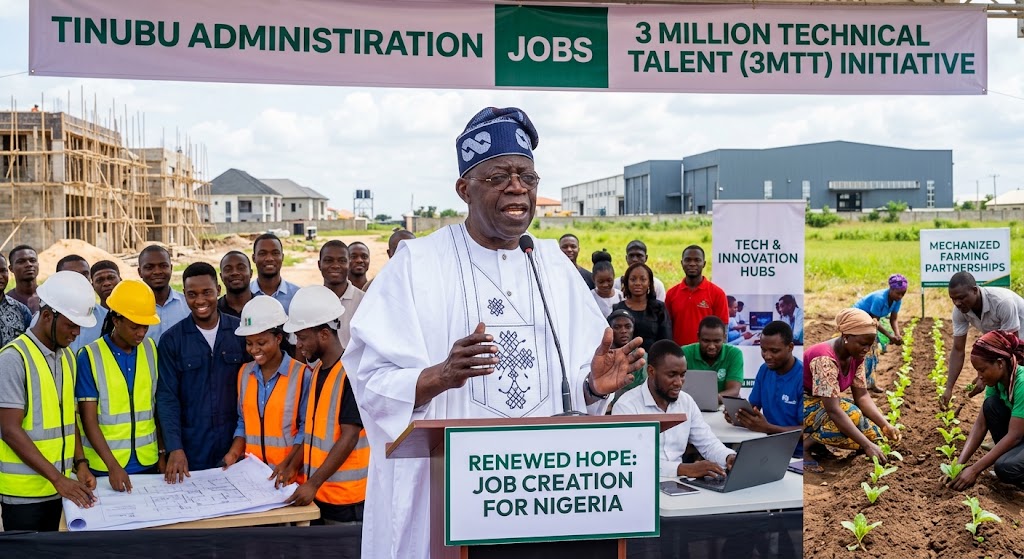
President Bola Tinubu has said job creation, industrialisation and enterprise will remain at the centre of Nigeria’s economic policy as the country enters what he described as a new phase of prosperity.
President Tinubu stated this in his Independence Day address on Thursday, where he declared that Nigeria’s reform era is over and the country is now entering the age of prosperity.
He stressed the need to harness Nigeria’s growing young population through productive employment, skills development and expanded opportunities for businesses.
“Nigeria is a young country. Millions of young Nigerians enter adulthood every year with talent, energy and ambition,” the President said.
“Our responsibility is to ensure that this great demographic strength becomes an engine of production rather than a source of despair.”
He said the government would leverage Nigeria’s gas resources to power new industries, support businesses seeking to revive factories in major industrial centres and expand digital connectivity to underserved communities.
President Tinubu also promised increased investment in skills demanded by employers, as well as infrastructure and financing to enable Nigerian businesses to expand.
“I want to see more Nigerians making things,” he said.
“I want to see more Nigerian farms feeding our cities and supplying our factories. I want to see Nigerian businesses selling Nigerian goods to the whole world.”
The President said the government wanted young Nigerians to build globally competitive companies within the country.
“I want young Nigerians building unicorns and creating opportunities for others here at home,” he said.
The Nigerian leader linked industrial expansion and job creation to efforts to reduce the cost of living, saying increased domestic production would help lower the cost of goods.
He said the government would invest in mechanised irrigation, dry-season farming, seeds, fertiliser, agricultural mechanisation, storage and transportation to boost agricultural output and reduce losses between farms and markets.
According to him, improvements in roads, railways and ports would also strengthen connections between farms, factories and markets.
“Our logic is simple,” Mr Tinubu said.
“When a farmer produces more cheaply, when fewer crops are lost between the farm and the market, when a manufacturer spends less on electricity, when a truck reaches its destination faster, and when the business environment fosters fair competition, all those savings will ultimately find their way into the price of goods in the market.”
The President acknowledged that millions of Nigerians remained under financial pressure despite the economic reforms implemented over the past three years.
He said the government would strengthen direct support for the poorest households, improve the National Social Register and expand access to education, healthcare and consumer credit.
President Tinubu said the measures were intended to serve as a bridge towards a more productive economy and not as a permanent substitute for prosperity.
“It will take time. It will require discipline. It will require sustained growth year after year and the creation of millions of productive opportunities across our country,” he said.
He said the ultimate objective was to build an economy where prosperity is broadly shared, and Nigerians can improve their lives through productive work.


