General
Troops Rescue 85 From Boko Haram Den In Lake Chad

By Modupe Gbadeyanka
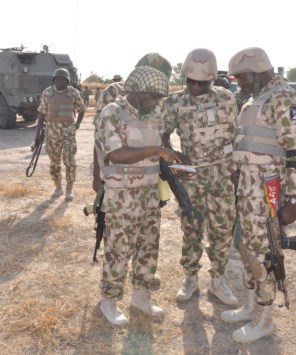
Troops of 7 Division Nigerian Army, Operation LAFIYA DOLE, led by the General Officer Commanding of the Division, Brigadier General Victor Ezugwu, conducted a decisive clearance operation into the remnants of Boko Haram strategic hub town of Chukungudu on the southern fringes of the Lake Chad Region, northern parts of Borno State between Friday 4th and Saturday 5th November 2016.
This information was disclosed by the Acting Director Army Public Relations, Colonel Sani Usman in a statement issued on Sunday.
He said the manoeuvring Brigade led by 3 Battalion of 22 Brigade, successfully cleared Geram, Bulankassa and Chukungudu believed to be the Boko Haram terrorists’ stronghold in that area.
Col Usman added that the gallant troops rescued 85 people, comprising of mostly women and children held hostage by insurgents.
Similarly, they neutralized five Boko Haram terrorists’ fighters in a fierce encounter that made several of the terrorists running into the Lake Chad waters.
He also said the troops recovered 4 rounds of Rocket Propelled Grenade (RPG) bombs, 1 Double Barrel Gun, 349 packets containing various rounds of ammunitions, 3 Magazines, a link belt of machine gun ammunition and 1 AK-47 rifle magazine.
During the clearance operations, the troops made spectacular discovery of an Improvised Explosive Device (IED) making factory at Geram.
In the factory, they found several already primed suicide bombers’ vests. They also discovered a well-equipped motor vehicles and motorcycles’ workshop and spare parts where house at Chukungudu village.
The troops recovered 3 vehicles and several newly acquired motorcycles.
Unfortunately, a soldier died during the encounter, he said.
According to him, in line with Rules of Engagement, IED factory, vehicles and motorcycles were destroyed.
General
Daystar Power Expands Nestlé Solar Partnership Across West Africa
By Adedapo Adesanya
Daystar Power Group has expanded its renewable energy partnership with Nestlé in West Africa, commissioning solar power systems with a combined capacity of 6.884 megawatts across four manufacturing facilities in Côte d’Ivoire, Ghana, and Senegal.
According to a statement, the deployments bring the total installed capacity across Nestlé’s sites to 6,884 kWp, nearly 7 megawatts, making it one of the largest commercial and industrial solar partnerships in the region.
The four sites, two in Abidjan, one in Tema, and one in Dakar, are all fully operational, with each system designed around the specific grid and operational profile of its location.
“Nearly 7 megawatts across four Nestlé facilities is a number we are proud of, but what it represents matters more than the figure itself. It means that one of the world’s most demanding manufacturers has tested our model, trusted it, and come back. Our job now is to keep earning that, across every market where industry needs energy it can count on,” Mr Yischai Beinisch, CEO, Daystar Power Group said in a statement.
The partnership began with a single commissioning and expanded to span three countries and four facilities. In Côte d’Ivoire, Daystar Power has delivered 3,447 kWp across two Abidjan sites. In Ghana, a 2,547 kWp system powers Nestlé’s Tema factory. In Senegal, an 890 kWp installation operates at the Dakar facility.
The company said each system is sized and configured to deliver measurable environmental and social impact, including reduced greenhouse gas emissions and improved energy resilience. The design is tailored to the operational and grid conditions at each location, ensuring reliable, clean energy access while supporting local development and aligning with Nestlé’s publicly stated net-zero commitments.
Adding his input, Mr Samer Chedid, CEO, Nestlé Central and West Africa Region, said the investment reflects its commitment to building a business that not only grows but does so responsibly.
“By advancing solar energy projects in Ghana, Côte d’Ivoire, and Senegal, we are embedding sustainability into our growth, reinforcing our role as a force for good, creating long-term value for communities, and ensuring that our footprint actively contributes to a cleaner, more resilient future,” he said.
General
Nigeria Adopts New Security Framework to Safeguard Oil Assets
By Adedapo Adesanya
Nigerian Upstream Petroleum Regulatory Commission (NUPRC) and the Federal Ministry of Defence have agreed to deepen collaboration on the protection of critical oil and gas infrastructure through a new non-kinetic security framework designed to curb threats, strengthen community relations and sustain rising output.
The initiative comes as Nigeria recorded crude oil production of nearly 1.8 million barrels per day, one of the highest production levels in recent years, amid intensified efforts to combat crude oil theft, pipeline vandalism and other security challenges across the Niger Delta.
Speaking during a courtesy visit by a delegation from the Ministry of Defence to the Commission’s headquarters in Abuja, the chief executive of NUPRC, Mrs Oritsemeyiwa Eyesan, said the country’s recent production gains were directly linked to coordinated interventions involving security agencies and industry stakeholders.
“Today, we are benefiting from those efforts. Last month, we recorded production of nearly 1.8 million barrels per day throughout the month,” Mrs Eyesan said.
She noted that sustained investments in security operations, technology deployment and human capacity development had significantly improved production stability and operational efficiency in the upstream petroleum sector.
According to her, maintaining and expanding the gains has become critical as Nigeria seeks to increase crude oil output, attract fresh investments and maximise revenue generation from the petroleum industry.
“As we look to the future, we desire to grow production and must have assurances that security threats can be effectively managed. We can only achieve this through stronger collaboration with security agencies and industry stakeholders,” she stated.
Mrs Eyesan stressed that safeguarding oil and gas assets remains central to Nigeria’s energy security strategy and economic growth objectives, noting that production assurance has become a key requirement for investors considering new upstream projects.
She disclosed that the Commission was exploring wider deployment of advanced technologies, including drone surveillance systems, to improve monitoring of the country’s vast oil and gas infrastructure network and detect threats before they escalate into operational disruptions.
The NUPRC boss further revealed that the Commission would work closely with operators to refine and implement a new security framework, while providing leadership in stakeholder engagement and governance structures needed to ensure long-term sustainability.
The Minister of Defence, Mr Christopher Gwabin Musa, said the Ministry was introducing a non-kinetic security intervention model aimed at addressing the underlying causes of insecurity in oil-producing communities.
Rather than relying solely on military operations, he explained that the strategy would focus on community engagement, youth empowerment and social inclusion programmes to build lasting peace around critical energy infrastructure.
“One of the best ways to engage youths in oil-producing areas is through sports-based interventions,” Mr Musa stated.
He explained that the initiative would utilise sports development programmes to channel youthful energy into productive activities, reduce vulnerability to criminal networks and strengthen community ownership of critical national assets.
The Defence Minister, who was represented by one of his aides, added that the intervention would also include structured programmes for persons living with disabilities, creating broader opportunities for participation and economic inclusion in host communities.
According to him, the initiative aligns with the Host Community Development provisions of the Petroleum Industry Act (PIA) and is expected to strengthen relationships between operators and host communities while promoting sustainable development.
General
PTML Unveils $50m Expansion Plan for Tin Can Island Port
By Adedapo Adesanya
Port and Terminal Multiservices Limited (PTML) has disclosed the investment of $50 million to expand its terminal at Tin Can Island Port, Lagos, as part of efforts to strengthen Nigeria’s bid to become the leading maritime hub in West and Central Africa.
PTML Managing Director, Mr Ascanio Russo, made the disclosure on Wednesday during a visit to the Minister of Marine and Blue Economy, Mr Adegboyega Oyetola, in Abuja.
The investment by PTML, a member of the Grimaldi Group, will expand berthing capacity and acquire additional modern port equipment.
“The Grimaldi Group remains deeply committed to Nigeria and believes in the country’s potential as the leading maritime and logistics gateway in West and Central Africa,” Mr Russo said.
“This $50 million investment is designed to expand our berthing capacity and deploy modern equipment that will enhance operational efficiency, cargo handling, and service delivery.”
He said the upgraded berths would enable PTML to receive next-generation Container/Roll-on Roll-off, Con-Ro, vessels, including the largest Con-Ro ships currently operating globally, directly at the Lagos terminal.
“The maritime industry is evolving rapidly, with larger vessels becoming the standard for international trade. Through this expansion, PTML will be fully equipped to accommodate these next-generation Con-Ro vessels and keep Nigeria competitive for global shipping lines,” Mr Russo stated.
He added that the project responds directly to the Federal Government’s call for increased private-sector participation in port modernisation.
Mr Russo said the expansion would facilitate trade, increase cargo throughput, create jobs during construction and operations, and boost government revenue through higher port activity.
On his part, Mr Oyetola welcomed the investment as a vote of confidence in the Federal Government’s maritime reforms.
“This investment shows our reforms are yielding results and that international investors recognise the opportunities in Nigeria’s maritime sector,” the minister said. “We are determined to transform our ports into modern, efficient, and globally competitive gateways that support economic growth and position Nigeria as the maritime hub of West and Central Africa.”
Mr Oyetola said the government was implementing measures to improve port efficiency, reduce bottlenecks, upgrade infrastructure, and strengthen the ease of doing business.
He said these include port modernisation, deeper collaboration with private operators, digitalisation of port processes, and policies to attract more maritime trade.
-
Feature/OPED6 years agoDavos was Different this year
-
Travel/Tourism10 years ago
Lagos Seals Western Lodge Hotel In Ikorodu
-
Showbiz3 years agoEstranged Lover Releases Videos of Empress Njamah Bathing
-
Banking8 years agoSort Codes of GTBank Branches in Nigeria
-
Economy3 years agoSubsidy Removal: CNG at N130 Per Litre Cheaper Than Petrol—IPMAN
-
Banking3 years agoSort Codes of UBA Branches in Nigeria
-
Banking3 years agoFirst Bank Announces Planned Downtime
-
Sports3 years agoHighest Paid Nigerian Footballer – How Much Do Nigerian Footballers Earn