Connect with us

Health

Merck Empowers Ugandan Infertile Women

Published

on

By Modupe Gbadeyanka

Leading science and technology company, Merck, today continues their commitment for the second year to empower infertile women in Uganda through improving access to information, health, change of mind-set and economic empowerment.

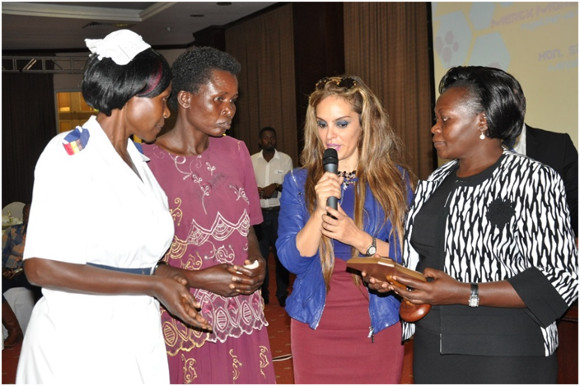
Through ‘Empowering Berna’, Merck in partnership with Uganda Ministry of Health inaugurates today small businesses that been established this year to support infertile women across the country.

The day’s program also included a courtesy visit to Uganda’s First Lady H.E. Janet Museveni at State House, Kampala by the Merck delegation to brief her on the ‘Merck More than a Mother’ initiative and to explore possible areas of collaboration. The delegation consisted of H.E. Madame Brigitte Touadera, First Lady, Central African Republic; Sarah Opendi, Minister of State for Health, Uganda; Belen Garijo, CEO, Merck Healthcare; Virginie Baiokua, Minister of Social Affairs and National Reconciliation, Central African Republic; Zuliatu Cooper, Deputy Minister of Health and Sanitation, Sierra Leone; Joyce Lay, Member of Parliament, Kenya; Dr. Rasha Kelej, Chief Social Officer, Merck Healthcare; and Lina Ekomo, Central African Republic.

Speaking at the event, Belén Garijo, Member of Executive Board and CEO of Merck Healthcare emphasized: “I believe in women empowerment and especially childless women – they are mistreated and discriminated in many cultures for being unable to have children and start a family. Empowering these women through access to information, health, and change of mind set to remove the stigma of infertility is needed. Through ‘Merck More than a Mother’ we are supporting this strong message together with our partners and we will continue our commitment to improve access to regulated and effective fertility care in Africa.”

“In Africa including Uganda, infertile women still suffer discrimination, stigma and ostracism. More often an inability to have a child or to become pregnant results in the woman being greatly isolated, disinherited or assaulted. This sometimes also results in divorce or physical and psychological violence. I am glad to see an initiative that addresses this challenge in the public domain in Africa as it is something that no one talks about and is treated as secret. ‘Merck More than a Mother’ is therefore very important for Africa since it aims to define interventions to reduce the stigma and social suffering of infertile women across the continent,” said, Sarah Opendi, Minister of State of Health, Uganda.

Madame Brigitte Touadera, the First Lady of the Central African Republic (CAR) said: “I am very happy to participate in today’s launch another milestone of ‘Merck More than a Mother’ in Uganda as it follows the one we had for the Central African Republic (CAR) last month and in Kenya yesterday. As the champion for the initiative in CAR and for Francophone Africa, I acknowledge the social suffering infertile women go through and the role that ‘Merck More than a Mother’ is playing to eliminate this suffering and stigmatization by raising awareness about infertility prevention, male infertility and the necessity of a team approach to family building among couples which is very critical for Africa.”

Rasha Kelej, Chief Social Officer, Merck Healthcare explained: “Empowering those women across Ugandan rural villages was very essential, those women suffered great deal of discrimination, violence and isolation. Moreover meeting community members and leaders there to emphasize the importance to change their perception of infertility and infertile women in specific was very productive. I have witnessed firsthand the instant change of their mind-set and the transformation of those vulnerable childless women to strong, proud and productive community members.”

According to the World Health Organization (WHO), lower levels of development are thought to be associated with higher levels of non-genetic and preventable causes of infertility such as poor nutrition, untreated sexually transmitted infections (STIs), unsafe abortion, consequence of infections caused by the practice of female genital mutilation, exposure to smoking and to leaded petrol and other environmental pollutants. Hence prevention awareness is very important,” Sarah Opendi added.

“The businesses established by ‘Empowering Berna’ project are benefitting over 800 women in many districts in Uganda who have come together in groups and have been trained and supported to establish bakery, catering and tent hire businesses and more. They are currently able to earn an income to support themselves from their own new businesses – they are now ‘more than mothers’,” Rasha Kelej added.

Over 1,000 infertile women in Kenya, Uganda, Nigeria, Ghana, Tanzania, CAR, Ethiopia, Liberia and Cote D’Ivoire who can no longer be treated have been empowered socially and economically to lead independent and happier lives through ‘Empowering Berna’.

The event in Uganda was attended by policy makers including ministers and fertility experts and included: Sarah Opendi, Minister of State of Health, Uganda; Zuliatu Cooper, Deputy Minister of Health and Sanitation, Sierra Leone; Virginie Baikoua, Minister of Social Affairs and National Reconciliation, CAR; Joyce Lay, Member of Parliament, Kenya; Oladapo Ashiru, President of Africa Fertility Society; Joe Simpson, Past President, International Federation of Fertility Societies; Paul Le Roux, President of Southern African Society of Reproductive Medicine and Gynaecological Endoscopy; Kamini Rao, Chair International Institute for Training & Research in Reproductive Health, India; and Mohamed Kamal, President of Future Assured Foundation, Nigeria.


Modupe Gbadeyanka is a fast-rising journalist with Business Post Nigeria. Her passion for journalism is amazing. She is willing to learn more with a view to becoming one of the best pen-pushers in Nigeria. Her role models are the duo of CNN's Richard Quest and Christiane Amanpour.

Click to comment

Leave a Reply

Your email address will not be published. Required fields are marked *

Health

Resident Doctors Suspend Proposed Indefinite Strike

Published

on

Resident Doctors

By Adedapo Adesanya

The Nigerian Association of Resident Doctors (NARD) has suspended its planned indefinite strike following the federal government’s reversal of the implementation of the reviewed Professional Allowance Table (PAT) and renewed assurances on outstanding payments.

The decision was announced in a communiqué issued at the end of an emergency National Executive Council (NEC) meeting held virtually on Saturday.

NARD had earlier resolved to embark on a total and indefinite strike over the government’s suspension of the reviewed allowance structure and other unresolved welfare concerns affecting resident doctors nationwide.

However, the association said it reconsidered its position after reviewing the outcomes of high-level engagements with key government officials and health-sector stakeholders.

According to the communiqué signed by NARD President, Dr Mohammad Usman Suleiman; Secretary-General, Dr Shuaibu Ibrahim; and Publicity and Social Secretary, Dr Abdulmajid Yahya Ibrahim, the Federal Government has now reversed its earlier decision on the allowance table.

“The NEC observed that the earlier decision to halt the implementation of the reviewed Professional Allowance Table (PAT) has been reversed, with implementation expected to reflect in the April salary and beyond,” the statement read.

The association also noted the government’s renewed commitment to settling outstanding promotion and salary arrears owed to resident doctors in affected institutions.

In addition, NARD said initial approval had been secured for the 2026 Medical Residency Training Fund (MRTF), with assurances that the disbursement process would be concluded.

“The NEC observed that the Budget Office has indicated its readiness to commence the process for the payment of the outstanding nineteen months’ arrears of the Professional Allowance,” the communiqué added.

Despite the progress, the doctors expressed concern about the continued delay in paying house officers’ salaries and called for urgent action to address the issue.

Following its deliberations, the NEC demanded the sustained implementation of the reviewed allowance structure, the prompt payment of all outstanding arrears, and the expedited disbursement of the residency training fund.

It also called for the immediate commencement of the process to clear the 19-month arrears and the convening of an urgent stakeholders’ meeting to resolve delays affecting house officers’ salaries.

“In light of the above developments, the NEC resolves to suspend the proposed total, indefinite, and comprehensive strike action, with a review of progress to be undertaken at the May Ordinary General Meeting (OGM) in Kano,” the statement said.

NARD expressed appreciation to President Bola Tinubu, Vice President Kashim Shettima, and several ministers, government agencies, and stakeholders for their interventions in resolving the dispute.

Continue Reading

Health

Over 1.5 million Nigerian Children Living With Sickle Cell Disease—Report

Published

on

sickle cell disease

By Modupe Gbadeyanka

More than 1.5 million children under the age of 15 are living with sickle cell disease in Nigeria, a new international study published in The Lancet Child & Adolescent Health, one of the world’s leading medical journals, has revealed.

In the report made available to Business Post, it was disclosed that Nigeria carries the highest burden of disease globally, far exceeding other high-burden countries such as the Democratic Republic of the Congo and Ethiopia.

The findings highlight both the scale of the challenge in Nigeria and the opportunity for the country to lead Africa in tackling one of the most preventable causes of childhood illness and death.

The study shows that nearly nine million children across sub-Saharan Africa are living with sickle cell disease in 2023, including around 1.17 million infants and 2.75 million children under five, who face the highest risk of early death without treatment.

Sickle cell disease is an inherited blood disorder present at birth. With early diagnosis and access to simple, low-cost interventions such as newborn screening, penicillin prophylaxis, routine vaccinations, malaria prevention, and hydroxyurea, most complications and deaths can be prevented.

However, in Nigeria, access to these essential services remains limited. Many children are only diagnosed after severe and avoidable complications, while others are never diagnosed at all, contributing to high levels of preventable illness and early childhood deaths.

The researchers emphasise that strengthening Nigeria’s health system response will be critical. This includes expanding newborn screening programmes, improving access to essential medicines, and integrating sickle cell care into primary healthcare services.

They called for urgent and coordinated action across government, health institutions, and development partners, including expanding newborn screening programmes, improving access to essential medicines and vaccines, and embedding sickle cell care within primary healthcare services.

The researchers, led by Professor Davies Adeloye, Professor of Public Health at Teesside University, United Kingdom, and Director of the International Society of Global Health (ISoGH), also called for increased domestic investment, supported by international partnerships, as well as stronger data systems to improve surveillance and guide policy decisions.

They concluded that even modest improvements in early-life screening and treatment in high-burden countries like Nigeria could transform child survival and significantly reduce preventable deaths.

“Nigeria now stands at the centre of the global sickle cell crisis. With over 1.5 million children affected, the scale is enormous, but so is the opportunity to act. We already know what works. Newborn screening and early treatment are effective, affordable, and can be delivered through existing health systems.

“If Nigeria prioritises sickle cell disease within its national health agenda and integrates care into routine maternal and child health services, we could save hundreds of thousands of young lives and significantly reduce avoidable deaths.” Professor Adeloye noted.

It was learned that the study analysed data from 40 studies across 22 African countries to produce the most comprehensive country-level estimates of childhood sickle cell disease to date.

Continue Reading

Health

Helical Secures $10m Funding Package for Expansion

Published

on

Helical

By Dipo Olowookere

A $10 million capital has been raised by Helical to support expansion across more top-20 pharma programmes and growth of its deployed science engineering team.

The firm will also use the money to build the compounding evidence layer that improves performance across diseases, as its mission is to make every scientist able to test hypotheses at the speed of inference and to turn in-silico discovery into a reliable engine for R&D throughput.

The funding package was from redalpine, Gradient, BoxGroup, Frst and notable angels, including Aidan Gomez (CEO Cohere), Clement Delangue (CEO HuggingFace) and Mario Goetze (pro soccer player).

Helical has a product known as the virtual AI lab for pharma, an application layer that turns biological foundation models into decision-ready, reproducible in-silico discovery workflows.

The platform has two product surfaces — the Virtual Lab for biologists and translational scientists, and the Model Factory for ML engineers and data scientists — built on the same data, the same models, and the same results.

By putting both sides in the same system, Helical closes the gap between computational predictions and biological decision-making, so teams that traditionally worked in silos can collaborate on the same evidence.

Helical was founded in early 2024. It was created by three school friends who took different paths to the same problem.

Rick Schneider built tech at Amazon and later helped the German enterprise Celonis scale in France and Japan. Maxime Allard led data science teams at IBM before pursuing a PhD focused on reinforcement learning and robotics. Mathieu Klop became a cardiologist and genomics researcher.

When bio foundation models emerged, the trio saw the chance to build the missing application layer that would let pharma teams move from model experimentation to reproducible, production discovery.

“The models alone don’t discover drugs. The system does. Pharma teams need a system that turns foundation models into workflows scientists can run, validate, and defend.

“We built Helical to make in-silico science reproducible at pharma scale, so teams can go from hypothesis to decision in days instead of months,” the co-founder of Helical, Mr Rick Schneider, said.

“We are at a unique point in time where biological foundation models and general language reasoning models are converging.

“We backed Helical because we strongly believe they have what it takes to build the pharma AI orchestration platform that will drive this transition from siloed AI models to integrated virtual AI labs,” the General Partner at redalpine, Mr Daniel Graf, stated.

Continue Reading

Trending