Jobs/Appointments
Dangote to Employ Additional 17,000 for Refinery Project
By Modupe Gbadeyanka
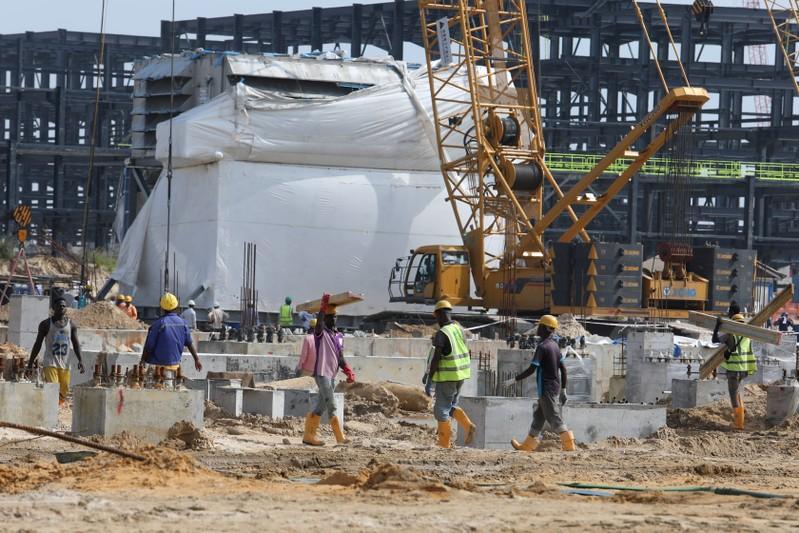
Additional 17,000 personnel would be employed in the coming months by Dangote Industries Limited for the refinery project in Lagos, the President/Chief Executive Officer (CEO) of the firm, Mr Aliko Dangote, has disclosed.
At the moment, the human capacity at the Dangote Petroleum Refinery project site stands at 40,000 but the owner of the project, who is Africa’s richest man, wants to increase it to 57,000.
A total of 29,000 Nigerians and 11,000 foreigners are working on the soon-to-be-completed oil facility, which has the capacity to refine 650,000 barrels of crude oil per day. It is the world’s largest single refinery project.
This is a ratio of around three Nigerians to one expatriate presently, which will increase local talent with the new additions.
“When we started the project, we were supposed to bring a lot of foreign workers, but as we speak today, we have less than 11,000 expatriates.
“We have almost about 29,000 Nigerian workers that are getting massive training. We are also creating a lot of capacity in the country, which will be of great help for future oil projects in Nigeria, most especially with the opening up of the oil industry through the new Petroleum Industry Act (PIA), Mr Dangote informed Arise TV.
“It means that the country can boast of human capacity needed in the oil and gas sector. Most of these Nigerians can compete anywhere in the world in terms of electrical, welding, mechanical erection etc. We have actually created massive capacity,” he added.
The business mogul said construction of the Dangote Petroleum Refinery was informed by his desire to help the federal government tackle the lingering issue of petroleum products importation.
“It makes me feel terrible to see a country as big and resourceful as Nigeria with a high population, importing all its petroleum products. It is very painful.
“So, we decided it is time to tackle this challenge. We tried before in 2007, but we were not able to make it happen. So, we jettisoned the idea,” Mr Dangote explained.
He added, “What actually inspired me is when you look at what happened in a country like India where entrepreneurs went ahead and created about five million barrels-per-day oil refinery.
“This country does not have as much oil as Nigeria. Nigeria is here sitting on over 2.4 million barrels per day at a point and we do not refine the oil we produce. Here, we have a country of over 200 million people and we are importing 100 per cent of what we consume.
“It is not sustainable. If you go to some places in Nigeria, you will discover that there are petrol stations that are not working.
“This actually pushed me into saying that this is a big challenge, which needed to be addressed urgently. Because I’m a Nigerian and if there are issues to be sorted out, I should be one of those who will bring solutions to our national problems.”
Mr Dangote described the refinery project as an investment that would transform the economies of countries in sub-Saharan Africa.
“This refinery is going to help transform, not only the oil sector, it is going to assist to transform the entire economy of Nigeria and all the countries in sub-Saharan Africa. It is unfortunate that all sub-Saharan African countries are importing petroleum products, and this is not what it is supposed to be.
“It is not the government’s responsibility alone to address the challenge of petroleum products importation in Nigeria. No, we have to collaborate with the government to tackle these issues of petroleum importation. It will put millions of people directly and indirectly at work.
“The refinery is going to massively transform the economy. By this transformation, the government will have more money to take care of infrastructure, health, education. So, it is a massive transformational project,” he added.
Mr Dangote emphasized the need for the country to shift attention from crude oil export and diversify the economy.
“We should not as a country be comfortable with generating revenue from crude oil export alone because tomorrow, people may not need crude oil. If we don’t move from crude oil to something else, we will have issues as a country. This is one of the things that I took upon myself to help address in this country,” he said.
Jobs/Appointments
Tinubu Appoints Fayose Rural Electrification Agency Chairman
By Modupe Gbadeyanka
The former Governor of Ekiti State, Mr Ayodele Fayose, has been appointed by President Bola Tinubu as the chairman of the Rural Electrification Agency (REA), with immediate effect.
A statement signed by the Special Adviser to the President on Information and Strategy, Mr Bayo Onanuga, on Monday night said Mr Tinubu also made 25 other new appointments into 10 federal government agencies and commissions.
Also appointed was Major General Junaid Bindawa as chairman of the National Salary and Wages Commission.
On the board of REA are Mr Ahmadu Abubakar and Engineer Ilyasu Ibrahim Makinta as members and non-executive directors. The incumbent DG of the agency, Abba Abubakar Aliyu, and three executive directors previously appointed make up the remaining board members.
President Tinubu made eight other appointments to the Wages Commission, along with Mr Bindawa. Former member of the House of Representatives from Lagos, Olajumoke Okoya-Thomas, is the new secretary of the commission. Dr Ogbole Ene Lilian, Oladele Olatubosun, and Yakubu Umar Barde, representing Benue, Oyo and Kaduna, were appointed as commissioners.
Dr Mai Adamu Yau, from Borno, Ginika Florence Tor (Enugu), Engineer Lawrence Okoh (Edo) and Bello Morenike Iyabode (Kogi) were appointed as members of the commission.
Tosin Johnson Adeyanju, who was previously appointed as the Executive Secretary of the National Lottery Trust Fund (NLTF), has now been moved to the Revenue Mobilisation and Fiscal Commission as Secretary.
Mr Tinubu also appointed Dr Abuh Mohammed as the DG of the National Population Commission, Dr Akinola Odeyemi as Managing Director of the Nigerian Bulk Electricity Trading (NBET), and Dr Anthony Inalegwu Godwin as chairman/CEO of the Nigeria Atomic Energy Commission. Engineer Julius Oloro, a former council chairman, is the new CEO of the Kwara-based National Centre for Agricultural Mechanisation (NCAM), replacing Dr A.R. Kamal, who died last January.
The President constituted the board of the Fiscal Responsibility Commission, with Dr Abdullahi Maikano Saidu as chairman. Members include Mohammed Asmau, Mohammed Aliyu Makama, Dr Suleiman Gidado, Louis O. Ndukwe, Amaechi Ugwele and Olaniyi Idowu Onikola.
Shuni Muhammad Dahiru is the new executive secretary of the National Commission for Mass Literacy, Adult and Non-Formal Education, replacing Professor Shu’aibu Shehu Aliyu, who was reassigned to the Petroleum Trust Development Fund (PTDF) in April.
To replace Mathias Byuan, the former executive director, finance of the Federal Housing Authority, who resigned to contest the governorship election in Benue, President Tinubu named Gisaor Vincent Iorja. The new occupier of the position is an economist, legal scholar, and academic currently serving as the secretary of the Benue State Independent Electoral Commission (BSIEC).
Jobs/Appointments
Elumelu Quits as UBA Chairman, Nnorom Takes Over
By Aduragbemi Omiyale
In line with the 12-year tenure prescribed for non-executive directors of banks by the Central Bank of Nigeria (CBN), Mr Tony Elumelu will on August 21, 2026, cease to be chairman of United Bank for Africa (UBA) Plc.
The board of the financial institution at its meeting on July 6, 2026, has elected Mr Emmanuel Nnorom as the new chairman.
In a notice to the Nigerian Exchange (NGX) Limited, the lender said Mr Elumelu’s successor, a non-executive director of the company, will assume the new role on August 21, 2026.
Mr Nnorom is a chartered accountant with over 40 years of experience in banking, finance and audit. He brings to the role extensive leadership experience and deep institutional knowledge of UBA.
“I am honoured by the trust the Board has placed in me and deeply conscious of the legacy I inherit.
“I look forward to working with my colleagues on the board, management and our staff across all our markets to sustain UBA’s momentum and continue delivering long-term value to our shareholders, customers and stakeholders,” Mr Nnorom stated.
Commenting on his retirement, Mr Elumelu said, “Serving United Bank for Africa has been one of the great privileges of my career.
“UBA has a unique competitive position, across Africa and globally, and I leave the Board with great confidence in UBA’s future.
“Emmanuel Nnorom is a leader of integrity, experience and sound judgement, and I am confident that the Bank will continue to thrive under his leadership.”
The board thanked him for his visionary leadership and exceptional contribution to the growth, transformation and institutional strength of the UBA Group.
Jobs/Appointments
WACT-APM Terminals Appoints Obadagbonyi as Managing Director
By Adedapo Adesanya
WACT-APM Terminals Nigeria has announced the appointment of Mr Courage Obadagbonyi as Managing Director, effective July 1, 2026, succeeding Mr Jeethu Jose and becoming the first Nigerian to hold the post.
The appointment reflects the organisation’s continued focus on developing strong leadership from within its global talent pool while ensuring sustained growth and operational excellence.
A seasoned executive with more than two decades of international experience, Mr Obadagbonyi has held leadership roles across finance, operations and general management at leading global organisations, including APM Terminals, General Electric and Lafarge.
Prior to this appointment, he served as Chief Financial Officer (CFO) for the APM Terminals Nigeria cluster, with responsibility for financial strategy across Nigeria and San Pedro, Côte d’Ivoire.
He also served in an acting capacity as Managing Director of APM Terminals Apapa between 2025 and March 2026, further strengthening his operational leadership experience.
With experience spanning sectors such as oil and gas, power generation, logistics and healthcare, Mr Obadagbonyi brings deep expertise in financial management, risk optimisation and business performance.
Speaking on his appointment, he said, “I look forward to building on the strong foundation already in place at WACT. The terminal plays a critical role in connecting businesses in Eastern Nigeria to global markets, and we will continue to focus on safe, reliable and efficient operations.”
On his part, the Chief Executive Officer of APM Terminals Nigeria, Mr Frederik Klinke, noted that the appointment reflects the company’s commitment to leadership development and long-term growth.
“Across APM Terminals globally, we see strong collaboration and talent development across our teams. This appointment reflects the depth of experience within our organisation and our continued focus on building capabilities that support sustainable growth. Nigerians have continued to distinguish themselves through exceptional performance and leadership. Colleagues from our Apapa and Onne terminals have contributed their expertise internationally while also bringing back valuable best practices to strengthen operations in Nigeria.”
He added that Mr Obadagbonyi’s experience would support the next phase of operational excellence and value delivery at WACT.
The outgoing MD, Mr Jose, said, “It has been a privilege to lead WACT-APM Terminals Nigeria during a period of meaningful progress. The team has built a strong platform for the future, and I am confident in the continued success of the organisation.”
West Africa Container Terminal (WACT)-APM Terminals in Onne, Rivers State, is one of Nigeria’s leading container terminals, having commenced commercial operations in 2006.
The company has continued to invest in capacity expansion and modernisation, including a $115 million terminal upgrade project launched in 2020. The upgrade also includes the deployment of reefer racks with a 600-plug capacity, as well as the expansion of the existing yard, a new workshop, a new terminal auto gate, modernised offices and state-of-the-art technology. These investments have enhanced efficiency, strengthened service delivery and reinforced WACT’s role as an important gateway for trade beyond Lagos.