Jobs/Appointments
Experts Brainstorm on Future Work Template at Stanbic IBTC Bank Forum
By Olubori Oduntan
In a rapidly changing world, more so in the digital space, finding the right models to anchor human capital development will remain a paramount determinant of corporate success. This thinking underscores the Workplace Banking Seminar’ organized by Stanbic IBTC Bank PLC, a member of Stanbic IBTC Holdings PLC, in Lagos, recently.
The seminar, with the theme, ‘The Future of Work and the Role of Human Capital’, attracted participants from both the public and private sectors, including Human Resources Managers , Financial Service Institutions, Insurers, Fintechs, Government Agencies, Regulators, Private Equity and Venture Capital firms, amongst other players from diverse fields.
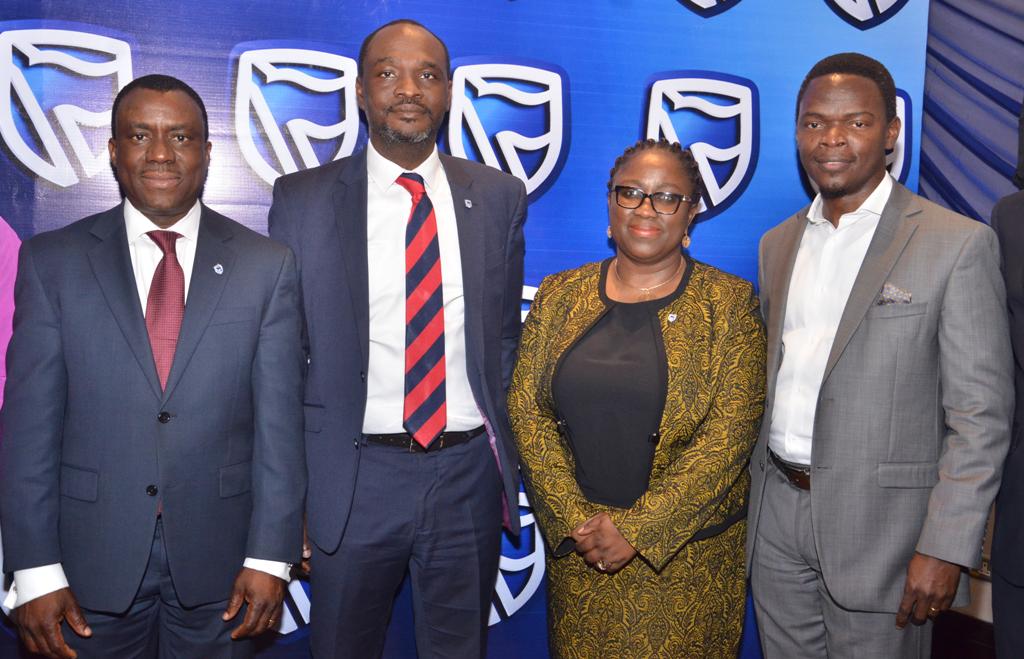
In his opening comments, Chief Executive, Stanbic IBTC Bank PLC, Dr. Demola Sogunle, said by settling for a theme that seeks to unravel the future of work, the organization aims to prepare and equip its clientele for future success. Employee experience, just like customer experience, is imperative to drive corporate success. Therefore, workers must be sufficiently motivated, engaged and empowered, he stated.
This objective underlines the numerous stakeholder engagements organized by the Stanbic IBTC Group to provide a platform to connect with clients and avail them with information to make informed decisions. As an institution designed to meet the financial needs of customers at every phase in life, Dr. Sogunle said the group would continuously offer value propositions to move people and businesses forward.
Guest speaker, Mr Boye Ademola, noted that the whole essence of digital application is to create intrinsic value. Any technology that does not generate value is worthless. Besides, value cannot be created without commensurate talent.
Mr Ademola, who is Partner & Lead for Digital Transformation Technology at KPMG, stated that the future of work has three crucial dimensions: workforce, workspace and work culture. These three elements are critical to attract the millennials, who would constitute the bulk of the future workforce. Nigeria for instance, has over 90 million of its population under 30 years of age and as the population increases, they would naturally trigger change. Already, the average age of millennial CEOs is in the 30s. In meeting the demands of the future, there is the need for a paradigm shift from today’s work structure. Critical factors to drive this change include focus on value creation, agility, co-creation, co-option of millennials and appropriate operating models.
The session also had a panel discussion that featured Usen Udoh, Group Chief, Human Resources, Dangote Group; Alero Onosode, General Manager, Human Resources, Seplat Petroleum Plc; Abudullahi Jubril Saba, Human Resources Director, IHS Towers; Country Head, Human Capital, Stanbic IBTC, Olufunke Amobi; and Boye Ademola. They highlighted other factors pivotal to the future of work as education, mining ecosystems, life-long learning, breaking of hierarchies and silos, challenging leadership and unrelenting value creation.
Another highlight of the event was the question and answer session which was very interactive and engaging. Major talking points included creating an engaged workforce by fusing learning and talent management, using technology to leapfrog, ensuring inclusion, participation in activities and initiatives as well as using meritocracy as a yardstick for appraisal.
The ‘Workplace Banking Seminar’, now in its fourth edition, comes on the heels of the Bank’s hugely successful financial planning sessions for Enterprises. The seminar hosts HR Heads drawn from various sectors and focuses on topical HR issues with a view to equipping the audience with vital skills and knowledge aimed at impacting Employee/Business efficiency, productivity, profitability, continuity, growth and sustainability.
Head, Personal Banking, Stanbic IBTC Bank PLC, Nkolika Okoli, said the Bank is constantly trying to add value, which goes beyond providing banking services to its customers. By looking at the whole spectrum of financial literacy drawn from the Stanbic IBTC Group expertise, Ms. Okoli stated that Stanbic IBTC Personal Banking business aims to equip Individuals with the knowledge required to attain financial freedom before retirement.
Executive Director, Personal & Business Banking, Stanbic IBTC Bank PLC, Mr. Babatunde Macaulay, who gave the vote of thanks, said as a member of the Standard Bank Group, Africa’s largest bank by assets and earnings, Stanbic IBTC will continue to leverage on the 155-year experience, expertise and strong financial clout of the mother brand to deliver superior sustainable shareholder value by meeting the needs of its clientele. “Our main goal is to continue to render best-in-class service to our customers who cut right across Nigeria’s socio-economic spectrum and play a leading role in supporting individuals, businesses and the Nigerian economy,”
Stanbic IBTC Holdings PLC, a member of Standard Bank Group, is a full service financial services group with a clear focus on three main business pillars – Corporate and Investment Banking, Personal and Business Banking and Wealth Management. Standard Bank Group is the largest African bank by assets and market capitalization. It is rooted in Africa with strategic representation in 20 countries on the African continent. Standard Bank has been in operation for over 155 years and is focused on building first-class, on-the-ground financial services institutions in chosen countries in Africa; and connecting selected emerging markets to Africa by applying sector expertise, particularly in natural resources, power and infrastructure.
Jobs/Appointments
Norfund Appoints Erik Sandersen New CEO
By Modupe Gbadeyanka
A Norwegian investment fund for developing countries, Norfund, has appointed Mr Erik Sandersen as its new chief executive, succeeding Mr Tellef Thorleifsson, who in January announced that he would step down after over seven years in the position.
The appointee, who assumes office on July 1, 2026, will be responsible for Norfund’s three mandates: the original development mandate from 1997, aimed at reducing poverty through job creation in developing countries; the Climate Investment Fund, which Norfund has managed since 2022; and the Ukraine Fund, established in December 2024.
A statement disclosed that Mr Sandersen is armed with 25 years of experience from the financial sector and has, for the past decade, headed Norfund’s Financial Inclusion department.
He joined Norfund in 2014 as Investment Director in the Financial Inclusion department, which invests in banks, microfinance and fintech, with a particular aim of contributing to job creation in small and medium-sized enterprises.
Since 2016, he has headed the department, and from 2024, he has also led the work on the Ukraine Fund. Over a number of years, he has represented Norfund on the boards of, among others, Arise, an investment company for banks in Africa, and Abler Nordic, which invests in microfinance in Africa and Asia.
The chairman of the Norfund board, Ms Olaug Svarva, said Mr Sandersen “has strong investment expertise, in-depth knowledge of Norfund’s work and a strong commitment to the fund’s mission.”
Reacting to his appointment, Mr Sandersen described Norfund’s profitable investments as “an effective tool for development – whether it is about creating jobs in low-income countries, avoiding emissions in emerging economies or contributing to reconstruction in Ukraine.”
“The strong results Norfund delivers are based on the efforts of a highly skilled and diverse staff of 152 employees from 33 nationalities, and I look forward to working closely with them to further develop Norfund as a leading purpose-driven investment company,” he added.
Mr Sandersen said he looks “forward to leading the organisation going forward at a time when access to the capital and expertise we can offer is becoming increasingly important.”
Jobs/Appointments
Oyo Guber: Adelabu to Resign as Power Minister, Gets Tinubu’s Blessings
By Adedapo Adesanya
The Minister of Power, Mr Adebayo Adelabu, is set to resign from his position in the coming days after a high-level meeting with President Bola Tinubu at the Presidential Villa, Abuja.
The development was confirmed in a statement issued by the Minister’s Special Adviser on Strategic Communications and Media Relations, Mr Tunji Bolaji, after the closed-door meeting on Tuesday.
“President Tinubu commended the minister for his dedication and the progress recorded, particularly in laying a strong policy foundation for the transformation of the power sector,” the statement read, adding that the President granted Mr Adelabu his “consent and blessing” to pursue his governorship ambition in Oyo State for 2027.
“In view of this development, Adebayo Adelabu is expected to resign his position as Minister of Power in the coming days,” the statement added.
At the meeting on Tuesday, Mr Adelabu presented a comprehensive report on his stewardship of the power sector over the past two and a half years.
He outlined key milestones recorded during his tenure, including efforts to stabilise electricity generation, strengthen transmission infrastructure, and implement reforms aimed at improving efficiency across the power sector value chain.
A major highlight of the engagement was the presentation of the National Integrated Electricity Policy (NIEP), alongside its Strategic Implementation Plan (SIP), as well as the Medium- to Long-Term Integrated Resource Plan for the power sector.
The minister, who’s an Oyo native, explained that the NIEP provides a long-term roadmap for achieving energy security, expanding electricity access, integrating renewable energy, and building a more resilient electricity system.
The SIP, on the other hand, serves as the operational framework detailing specific actions, timelines, and institutional responsibilities required to translate policy objectives into measurable outcomes.
The minister noted that the timing of his anticipated resignation reflects his commitment to addressing critical challenges in the sector and ensuring continuity in ongoing reforms before exiting office.
These include efforts to stabilise electricity supply amid recent declines in generation caused by gas supply constraints, pipeline repairs, and outstanding obligations to gas suppliers.
Mr Adelabu also expressed appreciation to the president for his support, reaffirming his commitment to the advancement of Nigeria’s power sector and national development.
His planned exit follows weeks of speculation surrounding his political future and compliance with a presidential directive requiring cabinet members with political ambitions for the 2027 elections to resign.
Rumours of his resignation spread around late March 2026, when a purported resignation letter circulated widely on social media. However, his camp denied the rumours.
Following the March 31 deadline reportedly set for political appointees, speculation intensified that Mr Adelabu had halted his governorship ambition, but he debunked the claim.
With the latest development, Mr Adelabu is expected to join the Oyo State governorship race under the All Progressives Congress (APC), where he will face strong competition from other aspirants within the party.
He had attempted governorship bids in 2019 and 2023.
He ran in 2019 as the candidate for the APC. Despite strong backing, he lost to Seyi Makinde. In 2023, after losing the APC primary to Teslim Folarin, he defected to the Accord Party to run as their flag bearer. He finished third in the general election.
Jobs/Appointments
John Ternus to Become Next Apple CEO as Tim Cook Steps Down
By Adedapo Adesanya
Apple, makers of the iPhone and iPad, said on Monday that Mr Tim Cook will step down as the company’s chief executive, after 15 years at the helm. Senior Vice President of Hardware Engineering, Mr John Ternus, will take the top executive position on September 1.
Mr Cook, who succeeded the late Steve Jobs in 2011, will not leave Apple but will remain at the company as executive chairman, and Mr Ternus will join Apple’s board of directors.
Mr Arthur Levinson, who has served as Apple’s non-executive chairman for the past 15 years, will become lead independent director, also effective September 1.
Mr Cook expanded his predecessor’s vision after he died of pancreatic cancer just six weeks after formally handing off the job. He grew Apple into a $4 trillion business with annual revenue that has more than quadrupled on his watch.
A statement said Mr Cook turned Apple Services into a business exceeding $100 billion annually and credits him with creating the flourishing wearables category at Apple.
“It has been the greatest privilege of my life to be the CEO of Apple,” Mr Cook said in the statement on Monday. “I love Apple with all of my being, and I am so grateful to have had the opportunity to work with a team of such ingenious, innovative, creative, and deeply caring people who have been unwavering in their dedication to enriching the lives of our customers.”
Mr Ternus, who joined Apple in 2001, has played a central role in reviving products such as the Mac, which has gained market share against personal computers. Though he has kept a low public profile, he has been deeply involved in shaping Apple’s biggest products, such as iPads and AirPods.
The incoming CEO, Mr Ternus, said: “Having spent almost my entire career at Apple, I have been lucky to have worked under Steve Jobs and to have had Tim Cook as my mentor,” he said. “I am humbled to step into this role, and I promise to lead with the values and vision that have come to define this special place for half a century.”
On his part, Mr Cook said of his successor, “John Ternus has the mind of an engineer, the soul of an innovator, and the heart to lead with integrity and with honour,” he said. “He is without question the right person to lead Apple into the future.”
-
Feature/OPED6 years agoDavos was Different this year
-
Travel/Tourism10 years ago
Lagos Seals Western Lodge Hotel In Ikorodu
-
Showbiz3 years agoEstranged Lover Releases Videos of Empress Njamah Bathing
-
Banking8 years agoSort Codes of GTBank Branches in Nigeria
-
Economy3 years agoSubsidy Removal: CNG at N130 Per Litre Cheaper Than Petrol—IPMAN
-
Banking3 years agoSort Codes of UBA Branches in Nigeria
-
Banking3 years agoFirst Bank Announces Planned Downtime
-
Sports3 years agoHighest Paid Nigerian Footballer – How Much Do Nigerian Footballers Earn