
Media OutReach
A New Urban Revolution, Unexpectedly from Vietnam: Vinhomes Green Paradise


According to research by Knight Frank, demand for sustainable real estate is being led decisively by younger generations. A significant majority of respondents in its Next Generation Survey indicated they are willing to pay up to 20 percent more for environmentally friendly products. More importantly, this preference is already translating into action: 63 percent of Millennials have invested in sustainable portfolios, compared with just 35 percent of Baby Boomers.
At the very top of the wealth pyramid, ultra-high-net-worth individuals are setting explicit targets to reduce their personal carbon emissions. Real estate, among the most carbon-intensive and capital-heavy asset classes, is therefore under direct pressure to evolve. At the same time, institutional investors are placing growing emphasis on social outcomes, from workplace wellbeing to broader community health. Assets that fail to meet these expectations increasingly face liquidity risk.
In this context, ESG is now widely understood as a form of future-proofing. Like a massive ship altering course in open waters, the global real estate industry may take time to visibly change direction. But once the new trajectory is set, those that fail to adapt will inevitably be left behind.
The Limits of Retrofitted Sustainability
Yet most cities were never designed for this moment. Built for speed, density, and economic efficiency, they now struggle to reconcile legacy structures with contemporary ESG demands. The prevailing response has been retrofitting, adding green technologies, improving energy efficiency, or introducing pockets of open space where possible.
These measures are necessary, but they reveal a fundamental limitation. ESG, when layered onto an outdated urban model, can only go so far. There is a ceiling to how sustainable a city can become if its foundations were never meant to support that vision.
This raises a more radical question: What if ESG were not an upgrade, but the starting point? What if a city were conceived entirely around environmental balance, social wellbeing, and long-term governance from its very first blueprint?
An answer to that question is emerging, not from Europe or North America, but from Vietnam.
Vinhomes Green Paradise and the Idea of “ESG++ from the Ground Up”
On the southern edge of Ho Chi Minh City, where land meets sea, Vingroup is developing what many observers consider one of the world’s rare examples of a truly next-generation urban model, Vinhomes Green Paradise.
This is not a conventional large-scale real estate project with sustainability features added along the way. It is a city built entirely on the logic of ESG, what some experts have begun to describe as “ESG++ from the ground up”.
The location itself tells the first chapter of that story. Vinhomes Green Paradise is framed by the East Sea and a vast mangrove ecosystem recognized by UNESCO as a World Biosphere Reserve. Spanning more than 75,000 hectares, the Can Gio mangrove forest is one of Southeast Asia’s most important natural assets, functioning as a carbon sink, a biodiversity haven, and a natural coastal defense system.
Rather than pushing against this environment, the project is shaped by it.
Covering 2,870 hectares, Vinhomes Green Paradise maintains a construction density of just 16 percent. The overwhelming majority of land is dedicated to green space and water. A 121-kilometer coastline defines the city’s interface with the sea, while at its heart lies an 800-hectare natural seawater lagoon, an ecological and civic centerpiece rarely seen even among the world’s most ambitious coastal cities.
Here, nature is not an amenity. It is infrastructure.
A Global Contender for the Cities of the Future
Because of this foundational approach, Vinhomes Green Paradise is increasingly viewed as a strong Asian contender, often described as a “hidden gem”, in global initiatives recognizing future-ready urban developments.
Environmental integration alone, however, does not define the project. Its aspiration extends equally to technology, governance, and human experience.
Designed as a fully integrated smart city, Vinhomes Green Paradise applies IoT, big data, and artificial intelligence across urban management, operations, and environmental monitoring. The objective is not technological spectacle, but a city that operates intelligently, efficiently, and transparently, one that adapts in real time to how people live, move, and interact.
If the environment forms the foundation and technology provides the nervous system, people are unmistakably at the center of Vinhomes Green Paradise.
The project’s social infrastructure is planned as a cohesive ecosystem rather than a collection of isolated amenities. Healthcare is anchored by Vinmec, in collaboration with Cleveland Clinic, bringing international clinical standards into everyday urban life. Education is delivered through Vinschool alongside Brighton College, ensuring continuity from early education to globally benchmarked schooling.
The city’s vision extends across generations. Purpose-built senior living, cultural venues, and public spaces are seamlessly integrated. A seven-hectare waterfront theater establishes a cultural anchor, while sports and recreation are elevated through two championship 18-hole golf courses designed by firms founded by Tiger Woods and Robert Trent Jones. Large-scale entertainment and lifestyle destinations further contribute to a city that is not only sustainable, but vibrant.
According to Arnaud Ginolin, Managing Director of Boston Consulting Group in Vietnam, Vinhomes Green Paradise brings together all the elements required to establish a new global benchmark, one that balances sustainability with dynamism and ESG principles with holistic human experience.
Vietnam’s Statement to the World
In the first nine months of 2025, Vietnam recorded more than 58,000 successful real estate transactions, doubling year on year. In Hanoi and Ho Chi Minh City, primary residential prices have reached historic highs, compressing opportunities and pushing investors toward new frontiers.
Can Gio has emerged as one of those frontiers. Once viewed as a geographic dead end, the district is now being repositioned as Ho Chi Minh City’s strategic gateway to the sea. Search interest has surged, and capital flows from northern Vietnam are increasingly directed southward.
Infrastructure is the catalyst behind this transformation. Planned high-speed rail will connect central Ho Chi Minh City to Can Gio in just minutes. The long-awaited Can Gio Bridge is set to remove persistent bottlenecks. New interregional road links, port developments, and proximity to Long Thanh International Airport are integrating the area into regional and global trade networks.
What was once peripheral is becoming strategic.
In an era when many of the world’s great cities are struggling to reinvent themselves, Vietnam is offering a different answer: Build differently from the start. Use ESG not as a corrective tool, but as a foundation.
Vinhomes Green Paradise is therefore a statement, about where the next ideas in urban living may come from, and how sustainability, human wellbeing, and long-term value can be aligned rather than traded off.
While the ESG conversation has long been dominated by Western capitals, one of its most ambitious realizations is taking shape in Southeast Asia, guided by willingness to rethink the fundamentals of urban life.
Hashtag: #VinhomesGreenParadise
 https://vinhomes.vn/en
The issuer is solely responsible for the content of this announcement.



Media OutReach
CUKTECH Officially Launches Its Online Store in Indonesia, Expanding Charging Technology Presence in Southeast Asia
CUKTECH focuses on the development of power and charging solutions, with a product portfolio that includes power banks, charging cables, wall chargers, and car chargers. Product development emphasizes charging efficiency, safety standards, and long-term reliability, addressing everyday usage scenarios involving smartphones, tablets, laptops, and other connected devices. The brand’s solutions are designed to support increasingly common multi-device lifestyles, including mobile work and frequent travel.
Prior to the launch of the official online store, CUKTECH operated in Indonesia mainly through third-party distribution channels, resulting in limited product availability. With the establishment of an official channel, the company is gradually introducing a more complete product lineup to the Indonesian market, aligning local availability with that of other Southeast Asian markets such as Vietnam, Malaysia, and the Philippines.
According to the company, the official online store serves as a centralized platform for presenting product specifications, technical features, and launch updates in a consistent manner. This approach is intended to improve transparency and accessibility for consumers while supporting a more structured, long-term market strategy in Indonesia.
Looking ahead, CUKTECH plans to continue expanding its product portfolio in Indonesia, introducing additional products to address evolving local usage needs. Future launches will focus on scenarios such as multi-device charging, mobile productivity, and daily commuting, reflecting changing consumer behavior.
This market-oriented approach aligns with CUKTECH’s brand philosophy, “In somewhere, For somewhere,” which emphasizes adapting products and solutions to the specific needs of each market rather than applying a uniform global model.
Updates on product launches, brand developments, and the official online store can be found through CUKTECH’s official social media channels on Instagram and TikTok:cuktech_id
https://www.tokopedia.com/cuktech-official-store
https://shopee.co.id/shop/1748675224
Hashtag: #CUKTECH
The issuer is solely responsible for the content of this announcement.
Under the partnership structure, Green SM provides the technology platform, all-electric vehicle fleet, operational standards, and driver development system, while Taksi Komotra contributes its established local expertise and network across Bali. The collaboration integrates electric mobility technology with on-the-ground operational capabilities to deliver a scalable, governance-driven transportation model.
Operations in Bali are implemented under Green SM’s “5 Green Promises” service commitment framework. Established as a foundational operating standard since the company’s inception, the framework ensures that each ride delivers an excellent customer experience, professional drivers, high-quality and safe vehicles, fair and transparent pricing, and a meaningful contribution to environmental sustainability.
The service operates an all-electric fleet that produces no exhaust emissions or fuel combustion. All vehicles are maintained under strict technical and safety protocols to ensure consistent service performance while contributing to cleaner air and quieter urban environments.
A central pillar of the launch is the Green SM Driver ecosystem. Drivers are positioned as professional green mobility ambassadors guided by five core values: Respect, Professionalism, Dedication, Discipline, and Competitive Income with Stable Career Pathways. Structured training, transparent earnings mechanisms, and disciplined service governance aim to elevate driving into a respected profession while maintaining safety and reliability as foundational standards. This framework aligns income stability with environmental responsibility, reinforcing the role of drivers in supporting Bali’s sustainable tourism trajectory.
The launch comes amid rising mobility demand driven by tourism growth and daily transportation needs across the island. The Indonesia Tourism Outlook 2025 report notes a sustained shift toward environmentally responsible travel, underscoring the relevance of electric mobility in long-term development planning. According to projections from Indonesia’s National Development Planning Agency (Bappenas), green employment nationwide is expected to reach 4.8-5.3 million by 2029, reflecting the broader economic potential of sustainable industries.

Mr. Deny Tjia, Managing Director of Green SM Indonesia, said: “The partnership with Taksi Komotra reflects our long-term commitment to building a high-quality, well-governed mobility ecosystem in Indonesia. By combining electric vehicles with professional driver development and clear operational standards, we aim to support Bali’s sustainable tourism ambitions while delivering safe, reliable, and comfortable rides for the community.”
H. Hasbi, Chairman of Koperasi Komotra, said: “We are proud to partner with Green SM to introduce electric taxis in Bali. Electric mobility will become part of the new standard for tourism and daily transportation on the island, and this collaboration helps us better serve local residents and visitors while preparing for the future of sustainable transport.”
The Bali launch marks another strategic milestone in Green SM’s expansion in Indonesia, following earlier operations in key markets including Jakarta, Makassar, Bekasi, and Surabaya. In these cities, the service has been positively received by local residents and international visitors alike, who value its clean electric fleet, professional drivers, and structured safety standards that enhance travel confidence.
With its growing presence across the country, Green SM continues to build a scalable electric mobility ecosystem that balances environmental responsibility, service excellence, and inclusive economic growth.
Hashtag: #GreenSM
The issuer is solely responsible for the content of this announcement.
About GSM and Green SM
GSM (Green Smart Mobility) is the world’s first company to operate a fully electric ride-hailing service across multiple platforms. As a pioneer in sustainable transportation, GSM has laid the foundation for a cleaner, smarter, and more responsible mobility model powered entirely by VinFast electric vehicles. Founded by Vingroup Chairman Pham Nhat Vuong, GSM is committed to building a future-ready mobility ecosystem while promoting more environmentally conscious lifestyles in markets that are rapidly embracing sustainability.
Green SM is GSM’s official global brand, representing the company’s vision and values in every market it serves. In Southeast Asia, the brand operates as Green SM in Indonesia, Xanh SM in Vietnam and Laos, and Green GSM in the Philippines. Across all markets, the service consistently delivers a modern travel experience through VinFast electric vehicles, professional drivers, and a service culture that prioritizes safety and passenger comfort.
Green SM symbolizes progress toward a future where technology, people, and the environment move forward in harmony. Beyond providing zero-emission transportation, the brand is also committed to fostering environmentally aware communities in every market where it operates.
About Taxi Komotra
Taksi Komotra Bali is part of the Koperasi Mobil Transport Bali, which was established in 1993 under its original name, KOMITRA Bali. In 1996, the cooperative officially changed its name to KOMOTRA Bali and has continued to grow as one of Bali’s local transportation operators.
Today, Taksi Komotra Bali manages two core transportation services: rural bus services and taxi operations. For more than three decades, Komotra Bali has remained committed to providing safe and reliable transportation while supporting local mobility and the tourism sector across the Island of the Gods.


Launched on February 14, the “Chinese Folk Music Odyssey” featured seven major concerts alongside a series of academic and grassroots cultural exchanges. The tour served as a high-level dialogue between the traditional heritage of China’s Jiangnan region and the classical musical heartlands of Europe.
The tour opened at the Centre for Fine Arts in Brussels, where a capacity crowd of 2,000 experienced the vibrant Spring Festival Overture. The ensemble presented a “Chinese Music Feast,” using traditional instruments to paint an auditory “Jiangnan Scroll” of southern Chinese life. In a poignant finale, Chinese fiddles joined forces with local keyed violins to perform the classic Horse Racing. The fusion of Eastern and Western strings brought tears to the eyes of the Chinese diaspora and earned standing ovations from local attendees.
“The melodies possess both natural charm and profound cultural heritage,” noted Belgian music critic Philippe, following six curtain calls. “It is a truly borderless musical exchange.”
Beyond the concert halls, the group engaged with European pop culture in the heart of Brussels’ Comic Strip district. A “flash mob” titled Tintin’s Encounter with Jiangnan Music saw musicians performing alongside iconic murals of Tintin, engaging local youth and residents through social media-friendly cultural interaction.
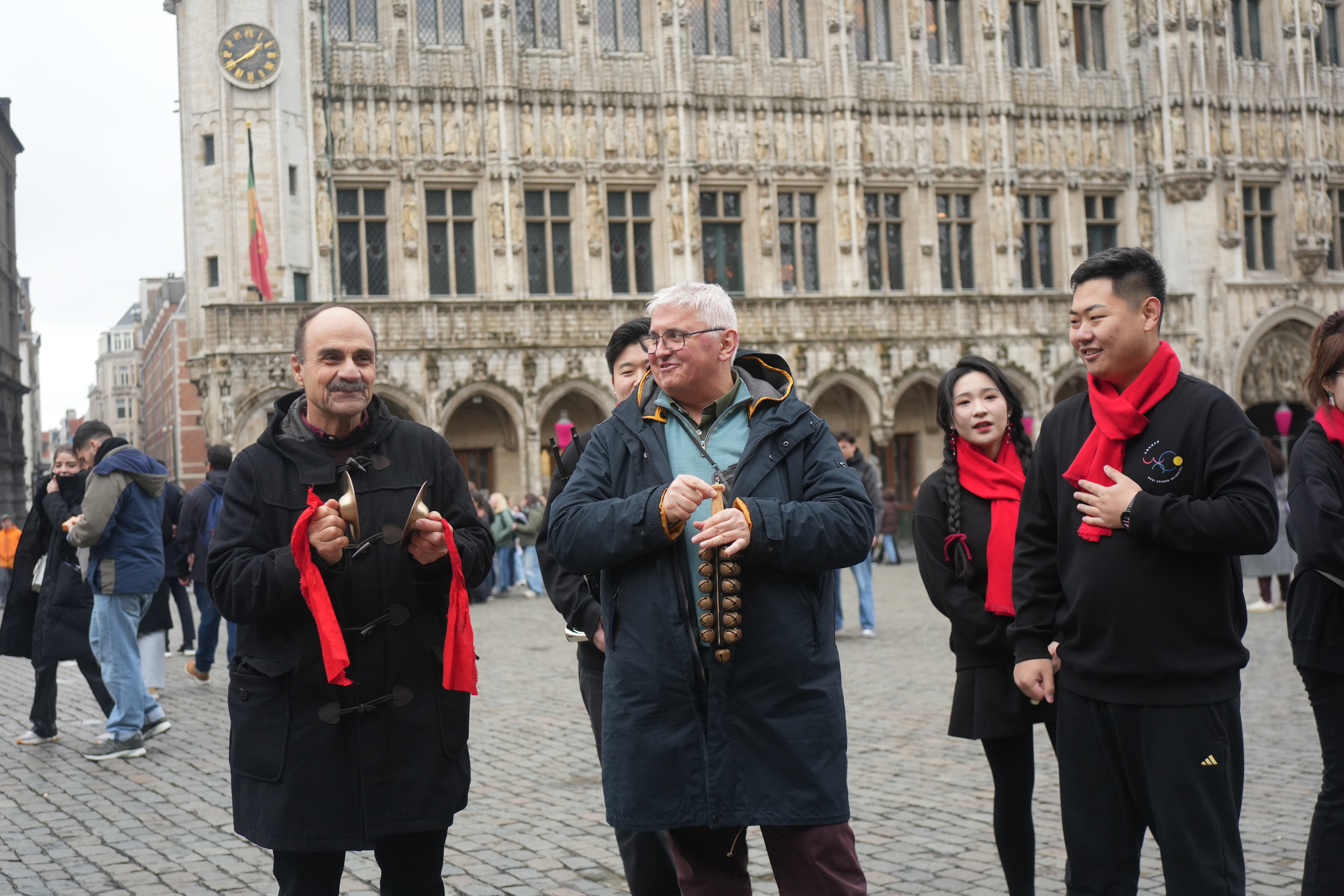
The journey continued through Germany’s elite venues, including Hamburg’s Elbphilharmonie and the Tonhalle Düsseldorf, showcasing the technical precision of Chinese folk orchestration. In the Austrian Tyrol, the tour took an improvisational turn as Wuxi musicians performed alongside local artists against the backdrop of the Alps, a live demonstration of the “beauty without borders”.
The tour concluded on February 26 in Vienna, where the ensemble hosted the “Dreamy Jiangnan” cultural salon at the Wiener Konzerthaus. The event paired musical performances with an interactive exhibition of Wuxi’s intangible cultural heritage, featuring traditional embroidery and clay figurines. The delegation also visited the University of Music and Performing Arts Vienna for the “Jiangnan Charm, Harmonious Resonance” China-Austria Music Exchange event. Through a series of academic dialogues with faculty and students, both sides engaged in a meaningful cultural encounter. These interactions went beyond simple performances, significantly deepening mutual understanding and strengthening the musical ties between East and West.
By integrating the “Voice of China” into the “World Symphony,” the Wuxi Cultural Exchange Group has opened a new chapter in Wuxi’s enduring musical engagement with the world.
Hashtag: #WuxiInformationOffice
The issuer is solely responsible for the content of this announcement.












-
 Feature/OPED6 years ago
Davos was Different this year
-
Travel/Tourism10 years ago
Lagos Seals Western Lodge Hotel In Ikorodu
-

 Showbiz3 years ago
Estranged Lover Releases Videos of Empress Njamah Bathing
-
 Banking8 years ago
Sort Codes of GTBank Branches in Nigeria
-

 Economy3 years ago
Subsidy Removal: CNG at N130 Per Litre Cheaper Than Petrol—IPMAN
-

 Banking3 years ago
Sort Codes of UBA Branches in Nigeria
-

 Banking3 years ago
First Bank Announces Planned Downtime
-

 Sports3 years ago
Highest Paid Nigerian Footballer – How Much Do Nigerian Footballers Earn