Media OutReach
Allianz Risk Barometer 2026: Cyber remains top business risk but AI fastest riser at #2 in Asia Pacific
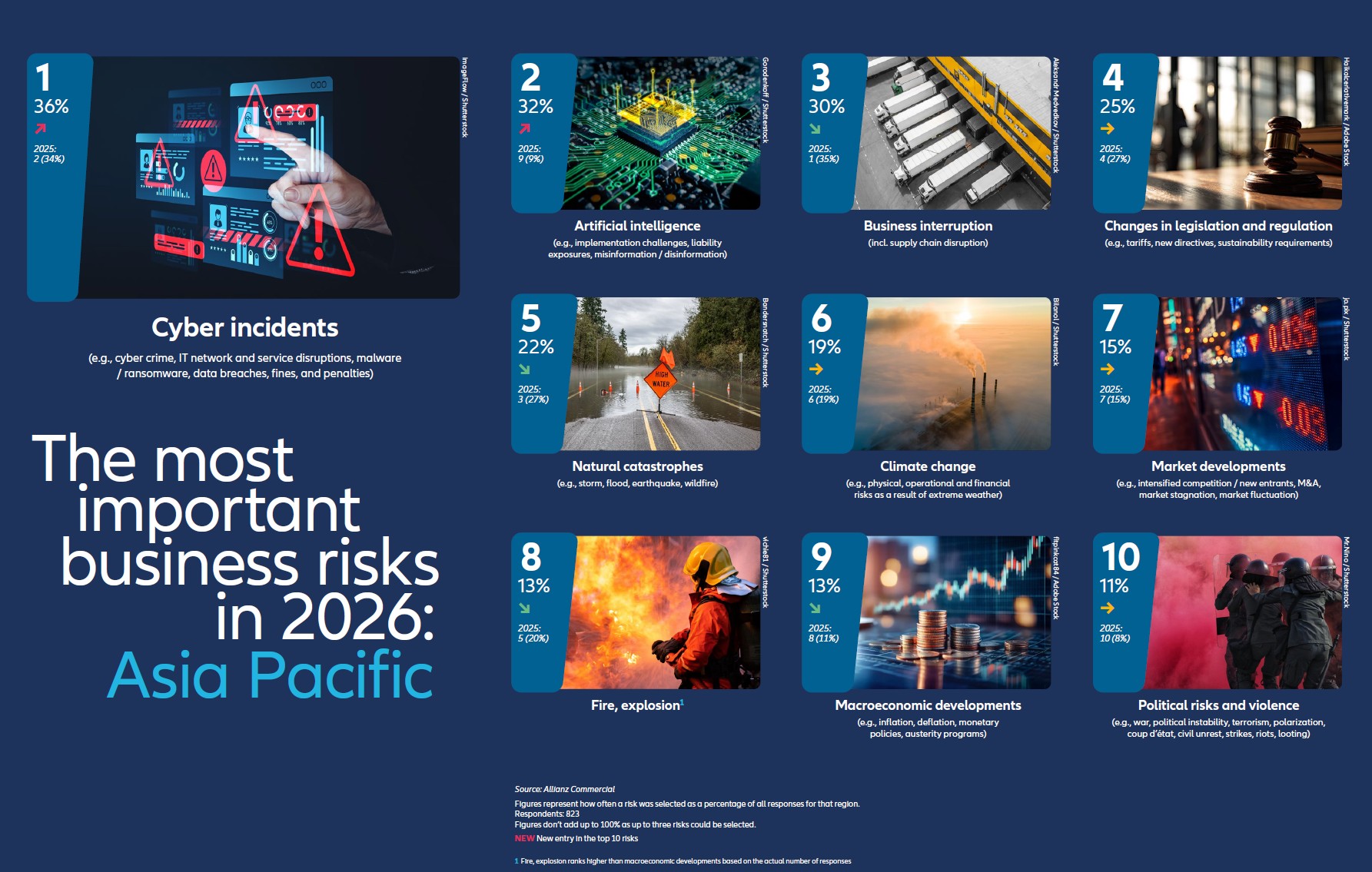
- Cyber, especially ransomware attacks, ranks as the #1 risk for companies of all sizes (36% of responses)
- Artificial Intelligence is the biggest riser and jumps from #9 to #2 (32%), highlighting the emerging risks for companies in almost all industry sectors
- Business interruption, strongly connected to geopolitical risks and natural catastrophes, remains a significant concern at #3
Allianz Commercial CEO Thomas Lillelund comments: “Following the volatility and uncertainty of 2025, businesses continue to face interconnected and highly complex risks in 2026’s fast-changing environment. Given the continuing rise of AI across society and industry, it is unsurprising that it is the big mover in the Allianz Risk Barometer. As well as bringing huge opportunities, its transformative potential and rapid evolution and adoption are also reshaping the risk landscape, making it a standout concern for firms of all sizes worldwide, alongside other more established threats.”
Christian Sandric, Allianz Commercial President, Commercial, Asia Pacific, says, “The evolving risk landscape, particularly in the areas of cyber threats and the adoption of AI, pose new challenges to businesses in the region. With Asian economies playing a pivotal role in global and regional trade, the potential for business interruption also remains a significant concern. This volatile environment stresses the importance of resilience in a business’ supply chain, response measures, and risk management strategies to withstand and recover from disruptions.”
Cyber risks the biggest concern for companies
Cyber incidents is the top risk in Asia Pacific, and a top three risk in Australia, Hong Kong, India, Japan, Singapore, South Korea, and Thailand. The Asia Pacific region experienced the most cyberattacks in 2024, increasing 13% year-on-year and accounting for 34% of attacks globally. While businesses in Asia, in particular large companies, have shown an increase in cyber resilience and appetite for cyber risk transfer solutions, their overall cyber coverage is generally lower compared to American or European peers and a significant portion of large organizations still remain self-insured.
Globally, cyber incidents is the top risk for the fifth year in a row, with its highest-ever score (42% of responses), and by a higher margin than ever before (+10%). It ranks as the main corporate concern in every region (Americas, Asia Pacific, Europe, and Africa and Middle East). The continued presence of cyber at the top of the Allianz Risk Barometer reflects a deepening reliance on digital technology at a time when the cyber threat landscape, and geopolitical and regulatory environments, are fast evolving.
AI creates emerging risks as well as new business opportunities
Ranking #2 in Asia Pacific, AI is a top three risk and biggest riser in Australia, China, Hong Kong, India, Malaysia, and Singapore, economies which are in the top 50% in terms of AI readiness. More than 90% of companies in the region are planning to scale up Generative AI over two years, with a focus on managing costs and lifting revenues.
Globally, AI has surged into the top tier of business concerns, rising to #2 (32%) in 2026 from #10 in 2025 – the biggest jump in this year’s ranking. It is a big mover in all regions – ranked #2 also in the Americas, Africa and the Middle East, and #3 in Europe – and is a growing risk for companies of all sizes too, moving into the top three for large, mid-sized and smaller firms. As AI adoption accelerates and becomes more deeply embedded in core business operations, respondents expect AI-related risks to intensify, especially when it comes to liability concerns. The rapid spread of generative and agentic AI systems, paired with their growing real-world use, has raised awareness of just how exposed organizations have become.
Business interruption strongly connected to geopolitical risks and natural catastrophes
Business interruption (BI) is the third most significant risk in Asia Pacific and a top three risk in China, India, Japan, Malaysia, Philippines, Singapore, and South Korea. The closely linked risk of changes in legislation and regulation – which includes trade tariffs – ranks #4 (25%), unchanged year-on-year driven by concerns over growing protectionism. Commerce is increasingly taking place between geopolitically aligned economies, resulting in new paths in global trade and the emergence of next generation trade hubs, including Vietnam, Malaysia, and Thailand in the region.
2025 marked a shift towards protectionist trade policies and tariff wars that brought uncertainty to the world economy. Geopolitical risks are putting supply chains under increasing pressure, but as risks rise, just 3% of Allianz Risk Barometer respondents view their supply chains as “very resilient”. In the past year alone, trade restrictions have tripled to affect an estimated US$2.7trn of merchandise – nearly 20% of global imports according to Allianz Trade – fueling companies exploring trends such as friendshoring and regionalization. These developments lead to a high-risk perception – 29% of respondents rank BI as a top peril, placing it at #3 globally, although it drops a position year-on-year.
Natural catastrophes ranks #5 (22%) in Asia Pacific, and is a top three risk in Japan, Malaysia, Philippines, and Thailand. The region experienced several natural catastrophes in 2025, including the Myanmar Earthquake, Typhoons Matmo, Ragasa, and Bualoi, Cyclone Alfred, wildfires in South Korea, as well as floods in Malaysia and Thailand. A delayed onset of the tropical cyclone season resulted in flooding and landslides, exerting a high human and economic toll in Asia where the insurance gap remains high at over 80%. According to research, there has been a significant increase in the intensity of tropical cyclones in recent decades, and these trends are linked to rising ocean temperatures and climate change, which retains its #6 ranking (19%) in the survey.
Resources:
Hashtag: #Allianz #AllianzCommercial #AllianzRiskBarometer #ARB2026
https://commercial.allianz.com/
The issuer is solely responsible for the content of this announcement.
About Allianz Commercial
Allianz Commercial is the center of expertise and global line of Allianz Group for insuring mid-sized businesses, large enterprises and specialist risks. Among our customers are the world’s largest consumer brands, financial institutions and industry players, the global aviation and shipping industry as well as family-owned and medium enterprises which are the backbone of the economy. We also cover unique risks such as offshore wind parks, infrastructure projects or film productions. Powered by the employees,
financial strength, and network of the world’s #1 insurance brand, we work together to help our customers prepare for what’s ahead: They trust us in providing a wide range of traditional and
alternative risk transfer solutions, outstanding
risk consulting and
Multinational services as well as seamless
claims handling. Allianz Commercial brings together the large corporate insurance business of Allianz Global Corporate & Specialty (AGCS) and the commercial insurance business of national Allianz Property & Casualty entities serving mid-sized companies. We are present in over 200 countries and territories either through our own teams or the Allianz Group network and partners. In 2024, the integrated business of Allianz Commercial generated around €18 billion in gross premium globally.
https://commercial.allianz.com/
Media OutReach
Taiwan International Plant-Based Festival Launches in Singapore: High-End Culinary Partnerships and Diplomatic Exhibitions Shape Premium Agri-Product Branding
The culinary campaign features a high-profile partnership between “Yang Ming Spring”—a prominent Taiwanese pure vegan culinary group honored with the Michelin Green Star—and Si Chuan Dou Hua Restaurant at PARKROYAL on Beach Road under the Pan Pacific Hotels Group. From July 1 to September 30, this exclusive plant-based menu highlights premium fresh ingredients sourced directly from Taiwan, including water snowflake, green bamboo shoots, cabbage, tea leaves, and the rising export star, the “Mango Pineapple,” elevating Taiwanese produce onto international five-star tables.
The launch was attended by MOA Deputy Minister Hu Jong-I, Ministry counselor Wu Wen-ling, Pan Pacific Hotels Group Executive Director Ms. Wee Wei Ling, and Yang Ming Spring Founder Mr. Chen Chien-Hung. Deputy Minister Hu noted that this festival marks a critical milestone for Taiwanese agriculture as it integrates with green gastronomy globally. The MOA aims to connect Singaporean consumers with Taiwan’s top-tier produce, establishing a premium brand image rooted in food safety and trust to unlock future export channels.
The launch elegantly incorporated Taiwan’s Phalaenopsis orchid floral aesthetics to create a “five-sensory feast” that harmonized taste, vision, and cultural narrative, solidifying Taiwan’s premium brand image. The event successfully drew over 80 distinguished guests, including mainstream Singaporean media, food critics, business chamber representatives, and executive chefs.
Concurrently, the official residence of the Taipei Representative Office in Singapore hosted the festival’s thematic opening reception, serving as a premier venue for cultural diplomacy and showcasing the narrative of Taiwan’s agricultural excellence. The exhibition focused on three themes: Taiwanese orchid aesthetics, Mango Pineapple innovation, and sustainable agriculture tourism. This space demonstrated Taiwan’s agricultural evolution from precision R&D to green sustainability, highlighting its export potential to foreign diplomats and Singaporean trade buyers.
The MOA emphasized that the initiative’s core strategy is to “drive tangible procurement through engaging and immersive experiences in our target markets.” By bridging high-end dining with diplomatic prestige, the three-month campaign will maximize the visibility of Taiwanese agri-products across Southeast Asian markets. Aligning with global net-zero sustainability trends, the festival establishes a safe, premium brand image, paving the way for Taiwanese agriculture to integrate into global high-end supply chains and broader Asia-Pacific channels.
Hashtag: #YMSpring
The issuer is solely responsible for the content of this announcement.
Media OutReach
SIM Academy Enhances Flexible Upskilling Pathways for Adult Learners and Working Parents
As workforce transformation accelerates, many adult learners face a common challenge: balancing professional responsibilities, caregiving commitments, and personal development. Recognising that time constraints remain a key barrier to learning, SIM Academy has developed a range of flexible programme formats that enable learners to upskill without disrupting their daily routines.
Short and focused pathways for working parents
Learning programmes with long course duration can be intimidating for busy adults. Working parents often prefer shorter and more manageable course modules. This is especially useful for parents who may only have short windows of time in the evenings, during lunch breaks, or over the weekend.
Instead of commuting to class every session, parents can learn from home and control their pace more easily. SIM Academy’s online courses are designed to support career mobility and future-proof skills. This is a practical option for learners who need both flexibility and relevance. When pathways are flexible, learners can choose the direction that best aligns with their current stage of life and career.
Supporting career progression across growth areas
SIM Academy’s learning pathways are structured to support progressive skill development across key industry domains. Learners can begin with foundational courses and advance to specialised areas aligned with their career goals.
For instance, individuals seeking to transition into digital roles can build core capabilities before moving into more advanced technical or applied programmes. Similarly, professionals aiming to strengthen leadership competencies can develop skills in communication, collaboration, and people management.
In response to the growing importance of sustainability, SIM Academy also offers programmes tailored for senior professionals, including C-suite leaders, senior management, and SME decision-makers. These courses focus on equipping leaders with the knowledge and tools to address climate-related risks, strengthen governance frameworks, and integrate sustainability into business strategy in line with evolving regulatory requirements.
Enabling Lifelong learning through flexible delivery
As organisations continue to evolve, SIM Academy remains committed to enabling lifelong learning through accessible, practical and flexible education pathways that support both professional growth and personal responsibilities.
References
- Catalyse Your Career Growth with SIM Academy: https://www.sim.edu.sg/professional-development/overview
- Why Learn at SIM?https://www.sim.edu.sg/professional-development/why-sim-for-professional-development
- Online short professional courses: https://www.sim.edu.sg/professional-development/courses/online-courses
- Sustainability courses for C-suite Leaders: https://www.sim.edu.sg/professional-development/courses/sustainability-courses
Hashtag: #SIMAcademy #SIMA
The issuer is solely responsible for the content of this announcement.
About SIM Academy
SIM Academy provides leading-edge professional development and enterprise solutions. SIM Academy offers over 300 executive and business programmes that help almost 10,000 professionals annually on average hone their competencies to drive business value and achieve peak personal and enterprise performance.
Our programmes encompass a comprehensive range of lifelong learning opportunities designed to empower professionals with the knowledge, skills, and competencies necessary to become effective change-makers and leaders in today’s volatile and uncertain business landscape.
For more information on SIM Academy, visit sim.edu.sg
Media OutReach
Yeebo Announces Annual Results for FY25/26 Consolidated Revenue Increased by 13.7% to Approximately HK$1,181 Million Profit Attributable to Owners Amounted to Approximately HK$1,951 Million
AI Business on the Rise, Revenue Soared by Nearly 2.8 Times Fuelling Future Growth
HONG KONG SAR – Media OutReach Newswire – 1 July 2026 – Yeebo (International Holdings) Limited (“Yeebo” or the “Company”, stock code: 00259.HK, which together with its subsidiaries is referred to as the “Group”) announces its annual results for the year ended 31 March 2026 (the “Year”).
The Group recorded a consolidated revenue of approximately HK$1,181.0 million for the Year, representing a year-on-year increase of 13.7%. The Group’s product portfolio comprises Liquid Crystal Displays (“LCDs”), Liquid Crystal Display modules (“LCMs”), Thin Film Transistor modules (“TFTs”), Capacitive Touch Panel modules (“CTPs”) (collectively “Display Business”), as well as artificial intelligence (“AI”)-related products and AI computing services (collectively “AI Business”). During the year under review, revenue for Display Business increased by 2.6% to HK$1,021.7 million. Among which, the contribution of CTPs to the Group’s total revenue has become increasingly significant, reflecting the Group’s progress in expanding into higher value-added product segments. Meanwhile, the AI Business recorded strong growth, with revenue rising significantly by nearly 2.8 times to HK$159.3 million, emerging as a new growth driver. This rapid expansion highlighted the Group’s early success in developing this segment, which is expected to play an increasingly important role in supporting the Group’s long-term revenue and profitability.
For the year ended 31 March 2026, the Group achieved a gross profit of HK$125.9 million. The gross profit margin decreased slightly to 10.7%. This decline was mainly due to the high fixed costs associated with the AI Business. Profit attributable to owners of the Company surged to approximately HK$1,950.6 million, representing a decrease of HK$838.1 million as compared with that for the preceding year. This was primarily due to a non-recurring gain recorded in the preceding year from the disposal of the Group’s entire interests in Nantong Jianghai Capacitor Company Ltd. (“Nantong Jianghai”) (including the deemed disposal of the remaining 13.81% equity interests), which was a former associate of the Group. Basic earnings per share were HK212.7 cents. The board of directors (“Board”) has proposed to recommend the payment of a final dividend of HK5.0 cents per share for the Year.
Commenting on the annual results of the Group, Mr. Fang Yan Tak, Douglas, Chairman of Yeebo, said, “During the year under review, the global business environment remained challenging. Amid geopolitical tensions and macroeconomic uncertainties, Yeebo remained committed to prudent execution, strengthening operational resilience, and focusing on long-term value creation. On one hand, we continued to broaden the application base of our core display business and deepen customer relationships. On the other hand, we made encouraging progress in scaling up our AI business, advancing ecosystem development, and driving commercial deployment. During the Year, the Group continued to increase its investment in AI compute and related businesses, achieving notable results in building a more comprehensive domestic AI compute service platform in Mainland China. Benefiting from the rapid development of the domestic AI compute industry, our AI business delivered strong growth and has increasingly become a key engine driving the Group’s overall development.”
For the Display Business, Yeebo is encouraged by the meaningful progress made in broadening our product offering, reflecting stronger product development capability and deeper engagement with customers. During the Year, the Group successfully secured consistent or first mass production orders across four application segments, namely (i) commercial coffee machines, (ii) automotive, (iii) household appliances and (iv) agricultural and construction machinery, demonstrating the Group’s continued market expansion and laying a solid foundation for robust growth in Display Business going forward.
Regarding to the AI Compute and related business, Yeebo has operated its AI compute and related businesses through its wholly owned subsidiary, Suanova Technology Limited (“Suanova”) over the past few years, and has successfully established itself as a key participant in China’s AI industry value chain. Yeebo continued to step up its investment in AI compute and related businesses during the Year. Its investments into early-stage AI companies, including MetaX Integrated Circuits (Shanghai) Co Ltd (688802.SH), Shanghai Biren Technology Co Ltd (06082.HK) and Shanghai Xizhi Technology Co Ltd (01879.HK), have generated strong and favorable returns.
For the AI Business development, the Group expanded the number of domestic graphics processing unit (“GPU”) clusters operated or managed under the public cloud service model to five, with utilization generally maintained at above 90%. These compute resources supported a broad range of AI for Science (“AI4S”) applications as well as foundation model training and inferencing scenarios. It demonstrated the Group’s increasingly mature capabilities in multi-network architecture compatibility, multi-platform scheduling, layered compute optimization and diversified application deployment. At the same time, the Group began to engage in the integration and delivery of private cloud GPU clusters of different scales and commenced the development of full-stack end-to-end AI solutions, taking initial steps toward becoming a domestic compute service provider with broader and more comprehensive service capabilities.
Over the past year, users of domestic GPU clusters were primarily concentrated in the AI4S field. Through long-term collaboration with leading universities and research institutions (Shanghai Jiao Tong University, Fudan University, Tsinghua University, the Shanghai AI Laboratory, the Shanghai Institute for Advanced Algorithms, Zhejiang University, Hong Kong Polytechnic University, Hong Kong University of Science and Technology, Westlake University etc.), the Group established a strong base of core users for the domestic GPU clusters. The Group progressively expanded the usage of domestic GPU clusters to foundation models and vertical industry-specific models across both training and inferencing. Through investing in selected early-stage AI companies with differentiated core capabilities, the Group further promoted the adoption of domestic GPU clusters. In addition, the Group has also completed the first single domestic GPU cluster training task at the thousand-card scale, further strengthening its leading position in the industry.
The Group believes the long-term strategic importance of domestic compute capabilities remains compelling. Through equity investments, joint research and development and business collaboration, the Group has actively begun to build an integrated ecosystem. Leveraging the AI computing ecosystem, the Group has collaborated closely with various key domestic hardware and software partners to enhance mutual compatibility and achieve synergistic optimization. This further strengthens the Group’s capabilities in computing adaptation and scheduling optimization. Looking ahead, the Group will further accelerate the development of end-to-end domestic AI compute solutions for selected industries, including healthcare, financial services and AI4S, as well as model tools and extensions (such as low bit low resource training and memory OS). By combining relevant AI solutions with integrated domestic AI compute hardware and software, and offering flexible deployment through public cloud or private cloud models, we believe this business is increasingly well positioned to capture the opportunities arising from the continued development of AI.
The Group’s capacitor-related investment interests continued to contribute to the overall strength of the Group’s asset base during the Year. As at 31 March 2026, the Group held 100,600,932 shares in Nantong Jianghai, with a fair value of approximately HK$3.3 billion.
Mr. Fang Yan Tak, Douglas, Chairman of Yeebo, concluded, “Looking ahead, we will continue to refine our product portfolio, elevate production excellence, and optimize our customer structure to sustain our market position in the display market, while exploring new applications for our products across various sectors. We will continue to strengthen its strategic deployment in AI computing, and actively support Suanova in unlocking its technological innovation capabilities and platform potential. We believe that as AI applications continue to expand and deepen, computing power is gradually evolving into a core driving force behind a new wave of industrial upgrading. In the face of the historic opportunities brought by the AI wave, the Group will further intensify its investment in AI business, focusing on high-growth technology companies, and create synergies through collaboration to fully capture the development opportunities arising from the continued expansion of the AI computing market. We firmly believe that by upholding our commitment to technological innovation and continuously deepening ecosystem collaboration, we will sustain a leading position in the intelligent era and deliver long-term, sustainable value to the Group and its shareholders.”
Hashtag: #Yeebo
The issuer is solely responsible for the content of this announcement.
About Yeebo (International Holdings) Limited
Founded in 1988, Yeebo (International Holdings) Limited is a diversified electronic component company with a well-established presence in the global market. The Company’s core business spans flat panel displays, computing power and capacitors, serving a broad spectrum of industrial and consumer applications. Headquartered in Hong Kong, Yeebo operates its manufacturing operations primarily in the Guangdong and Jiangsu provinces, supporting a global sales network that ensures localized service and support for its international clientele.
In alignment with its long-term strategic vision, Yeebo is leveraging its robust operational foundation to expand into the Artificial Intelligence (“AI”) compute and related sectors. This initiative reflects the Company’s commitment to innovation and technological advancement, with the objective of positioning Yeebo as a leading and influential participant in the rapidly evolving AI industry across Chinese Mainland and Hong Kong.
-
Feature/OPED6 years agoDavos was Different this year
-
Travel/Tourism10 years ago
Lagos Seals Western Lodge Hotel In Ikorodu
-
Showbiz3 years agoEstranged Lover Releases Videos of Empress Njamah Bathing
-
Banking8 years agoSort Codes of GTBank Branches in Nigeria
-
Economy3 years agoSubsidy Removal: CNG at N130 Per Litre Cheaper Than Petrol—IPMAN
-
Banking3 years agoSort Codes of UBA Branches in Nigeria
-
Banking3 years agoFirst Bank Announces Planned Downtime
-
Sports3 years agoHighest Paid Nigerian Footballer – How Much Do Nigerian Footballers Earn