
Media OutReach
BAFS expands into Southeast Asia with delivery of Thai-engineered aircraft refueling vehicles for Cambodia’s new international airport, set to launch mid-year

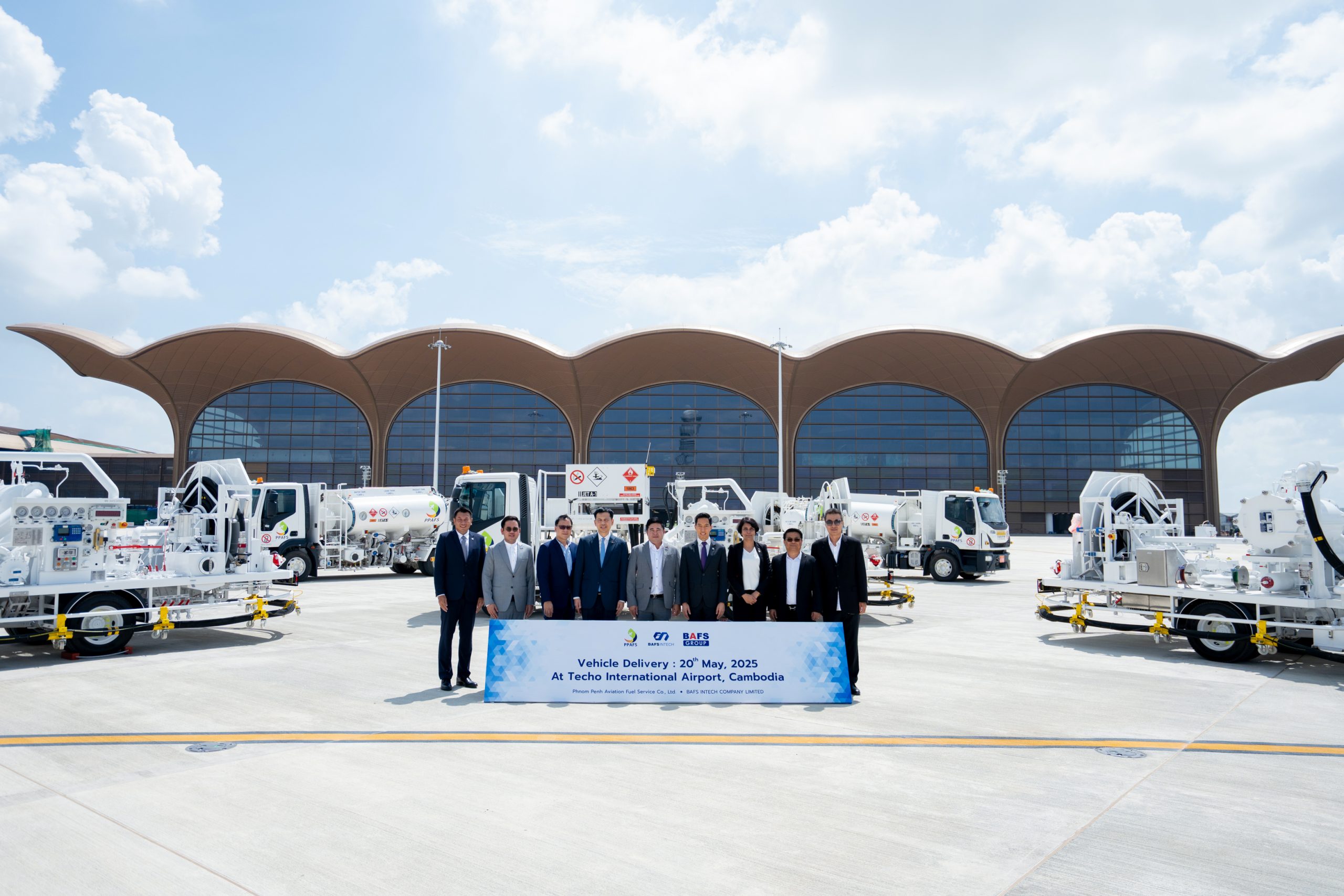
BAFS INTECH reinforces its leadership position as a leading Thai ground support vehicle manufacturer, aggressively expanding into international markets by delivering seven aircraft refueling vehicles and ground support vehicles to Cambodia’s new international airport, positioning itself to accommodate the burgeoning aviation industry across Southeast Asia.
BANGKOK, THAILAND – Media OutReach Newswire – 22 May 2025 – M.L. Nathasit Diskul, President of Bangkok Aviation Fuel Services Public Company Limited (BAFS), said BAFS INTECH Company Limited, a subsidiary of BAFS Group, specializes in the design, manufacture, and assembly of aircraft refueling vehicles and ground support vehicles for airport operations. Leveraging the expertise of its engineering and technical teams, BAFS INTECH integrates cutting-edge innovations with advanced safety technologies to produce high-performance, durable vehicles that meet the requirements of ground handling service providers throughout the region. The company is delivering seven units, including hydrant dispensers, ground support vehicles, and mobile refueling carts, to Phnom Penh Aviation Fuel Service Co., Ltd. (PPAFS) in May 2025. These units will service Techo International Airport in Phnom Penh, Cambodia, which will be officially opened this July, marking another significant milestone that underscores BAFS’s leadership in comprehensive aircraft refueling services.
BAFS INTECH’s aircraft refueling vehicle manufacturing business started with BAFS’s foundational knowledge and proficiency in aircraft refueling operations, enhanced by state-of-the-art technology. Its capacity to modify refueling vehicles to client specifications, offering various sizes and flow rates to fit different aircraft types and airport operational settings, is BAFS’s competitive advantage. This approach ensures optimal quality, safety compliance, and operational suitability, with manufacturing quality that conforms to the standards for supplying aviation fuel established by the Joint Inspection Group (JIG), the global benchmark for aviation refueling systems.
BAFS INTECH is committed to developing technologies related to aircraft refueling services to meet the expansion of the aviation industry, particularly in Southeast Asia, which is emerging as a regional transportation and logistics hub. Initially focusing on producing aircraft refueling vehicles for BAFS and domestic clients, the company has progressively expanded into neighboring markets. Over the past four years, BAFS INTECH has earned the trust of clients in Myanmar and Laos, who have selected the company to design and manufacture aircraft refueling vehicles and ground support vehicles.
M.L. Nathasit said, “With over 40 years of experience in providing international-standard aviation fuel supply services and a commitment to elevating ground handling services through Thai-designed and manufactured products, this delivery underscores BAFS INTECH’s capabilities and readiness as a leader in the design and manufacture of airport ground support vehicles. We have 16 more vehicles in production awaiting delivery this year, and we anticipate orders for 17 units in 2025. BAFS INTECH plans to penetrate international markets more extensively, particularly in Southeast Asia, by emphasizing our capabilities to produce high-performance vehicles tailored to meet Asian operational requirements. We aim to expand into Vietnam, Malaysia, the Philippines, and Singapore within the next five years.”
Hashtag: #BAFSINTECH #BAFS #refueling #vehicle
 https://www.bafsthai.com/th/home
 https://www.facebook.com/BAFSGROUP/
The issuer is solely responsible for the content of this announcement.



Media OutReach
Etiqa Insurance Singapore and AIA Singapore Join Forces to Expand Accessibility of Takaful for Customers
Under the partnership, Etiqa Insurance Singapore’s suite of Shariah-compliant Family Takaful products will be distributed through AIA Singapore and AIA Financial Advisers, the nation’s largest tied distribution channel comprising more than 6,300 highly professional, qualified AIA insurance representatives. This expanded reach significantly increases accessibility and choice for customers seeking principled and values-aligned protection and savings options.
Growing Demand for Values-Based Financial Solutions
Global demand for Takaful continues to rise as consumers increasingly prioritise financial solutions aligned with their personal values. The global Takaful market is projected to grow from US$36.5 billion in 2025 to US$63.6 billion by 2030, representing a compound annual growth rate (CAGR) of 11.7%[1]. Since launching its Takaful offerings, Etiqa Insurance Singapore has seen strong and accelerating momentum, supported by rising consumer awareness and growing confidence in Shariah-compliant financial protection.
Creating a Unified Takaful Ecosystem in Singapore
The partnership brings together the complementary strengths of both insurers to build a more cohesive and accessible Takaful ecosystem:
- Etiqa Insurance Singapore — The pioneer in reintroducing Takaful insurance to Singapore after more than a decade, with deep expertise and a dedicated Shariah advisory framework.
- AIA Singapore — One of the nation’s leading life and health insurers with extensive distribution capabilities, broad community reach and a diverse customer base.
Together, the two organisations are positioned to significantly expand the availability, understanding and adoption of Takaful solutions in Singapore.
“This partnership marks an important step in advancing access to Shariah-compliant protection and savings solutions in Singapore,” said Claudia Soh, Acting Chief Executive Officer, Etiqa Insurance Singapore. “By leveraging AIA’s extensive distribution network and strong presence within the Muslim community, we can scale Takaful solutions more effectively and reach customer groups that have historically been underserved. As demand for values-aligned financial planning grows, this collaboration reinforces our commitment to inclusive and responsible insurance.”
“This partnership with Etiqa is a pivotal step in our commitment to inclusivity and we are excited to work together,” said Alvin Fu, Chief Distribution Officer, AIA Singapore. “By integrating Etiqa’s Shariah-compliant expertise with our highly professional AIA insurance representatives, we can serve a wider customer base, close protection gaps and help more families live Healthier, Longer, Better Lives.”
Bringing Takaful to the Masses
While rooted in Islamic principles, Shariah-compliant, values-based Takaful solutions serve a broad spectrum of customers and appeal to increasingly values-driven consumers seeking ethical, transparent and socially responsible financial protection and savings solutions beyond the Muslim community.
Beyond distribution, Etiqa Insurance Singapore shares a long-term commitment to raising awareness, understanding and adoption of Takaful solutions across Singapore. Through educational programmes and community engagement initiatives, the partnership aims to enhance financial literacy, deepen understanding of Takaful principles and bring Takaful education directly to underserved communities, empowering consumers to make informed decisions on protection and savings.
Hashtag: #EtiqaSingapore #EtiqaSG
The issuer is solely responsible for the content of this announcement.
About Etiqa Insurance Pte. Ltd (Etiqa Insurance Singapore)
Etiqa Insurance Pte. Ltd. (EIPL) is a life and general insurance company licensed and regulated by the Monetary Authority of Singapore and governed by the Insurance Act 1966. Having protected customers in Singapore since 1961 under the name United General Insurance Co. Sdn. Bhd., the company transitioned into the Singapore branch of Etiqa Insurance Berhad in 2009. Today, EIPL in Singapore stands as the pivotal operating entity of Etiqa Insurance Group, a leading insurance and takaful provider in ASEAN.
EIPL offers a comprehensive range of life and general insurance products accessible through its diverse distribution channels, including bancassurance, agents, brokers, financial advisers, partnerships, direct and online sales via Tiq by Etiqa. Etiqa is rated ‘A’ by credit rating agency Fitch for the group’s ‘Favorable’ business profile. EIPL is owned by Maybank Ageas Holdings Berhad, a joint venture combining local market expertise with international insurance knowledge, with 69% ownership by Maybank, the fourth largest banking group in Southeast Asia, and 31% by Ageas, an international insurance group operating across 13 countries.
About AIA
AIA Group Limited and its subsidiaries (collectively “AIA” or the “Group”) comprise the largest independent publicly listed pan-Asian life insurance group. It has a presence in 18 markets – wholly-owned branches and subsidiaries in Mainland China, Hong Kong SAR[2], Thailand, Singapore, Malaysia, Australia, Cambodia, Indonesia, Myanmar, New Zealand, the Philippines, South Korea, Sri Lanka, Taiwan (China), Vietnam, Brunei and Macau SAR[3], and a 49 per cent joint venture in India. In addition, AIA has a 24.99 per cent shareholding in China Post Life Insurance Co., Ltd.
The business that is now AIA was first established in Shanghai more than a century ago in 1919. It is a market leader in Asia (ex-Japan) based on life insurance premiums and holds leading positions across the majority of its markets. It had total assets of US$345 billion as of 31 December 2025.
AIA meets the long-term savings and protection needs of individuals by offering a range of products and services including life insurance, accident and health insurance and savings plans. The Group also provides employee benefits, credit life and pension services to corporate clients. Through an extensive network of agents, partners and employees across Asia, AIA serves the holders of more than 44 million individual policies and over 16 million participating members of group insurance schemes.
AIA Group Limited is listed on the Main Board of The Stock Exchange of Hong Kong Limited under the stock codes “1299” for HKD counter and “81299” for RMB counter with American Depositary Receipts (Level 1) traded on the over-the-counter market under the ticker symbol “AAGIY”.
Two more world-class arts events are coming up this week, namely, Art Basel Hong Kong (27-29 March) and Art Central (25-29 March).
Art Basel Hong Kong returns to the Hong Kong Convention and Exhibition Centre with new sectors and fresh curatorial perspectives. Featuring 240 galleries from some 40 countries and territories, the fair presents artworks by established artists and emerging talents from around the world.
Highlight sectors include “Encounters”, showcasing 12 artworks of expansive sculptures and installations drawing on the Five Elements — space/ether, water, fire, wind and earth, while “Insights” features 20 projects focused on artists from Asia and the Asia-Pacific region. Among the newly added themes this year are “Echoes” – a brand new sector spotlighting works created within the past 5 years –, and “Zero 10” dedicated to art of the digital era.
Other returning sectors cover “Discoveries”, which is dedicated to solo presentations by emerging artists from 25 galleries and “Kabinett”, staging thematic presentations with a total of 35 projects, as well as public programmes offering free public access to “Film”, “Conversations” and “Exchange Circle”.
Hong Kong’s strength in global cultural connectivity is reflected in its position as a leading arts trading hub. “Later this month, we will finalise the details of our collaboration with Art Basel for the next five years. This is the result of sustained investment in our role as a global financial centre, cross-sectoral collaboration, and a shared commitment to make Hong Kong a place where the arts can truly flourish,” Law said.

There’s more for art enthusiasts to enjoy, with Art Central (25-29 March) lighting up the iconic Central Harbourfront, presenting works from over 100 galleries and 500 artists from Hong Kong, Asia, and beyond. The fair’s 11th edition sees the debut of Central Stage, spotlighting artists with recent, current, and upcoming participation in institutional exhibitions, biennials, and other landmark curatorial endeavours of international standing.
This trio of arts and cultural events is part of the wider Hong Kong Mega 8 – a legendary line-up of eight world-class events throughout March and April. Completing the line-up are the Hong Kong Derby and Champions Day (horse racing), UCI Track World Cup (cycling), Hong Kong Sevens (rugby) and LIV Golf Hong Kong.
“I am sure this exhilarating blend of sports, arts and culture will bring you many enjoyable moments and fond memories, infused with the city’s unique spirit and unstoppable momentum,” Law said.
Hashtag: #HongKong #BrandHongKong #Arts #Sports #MegaEvents
 https://www.brandhk.gov.hk/
 https://www.linkedin.com/company/brand-hong-kong/
 https://x.com/Brand_HK/
 https://www.facebook.com/brandhk.isd
 https://www.instagram.com/brandhongkong
The issuer is solely responsible for the content of this announcement.

“For many, the future may feel less certain, more complex, than it did when we were at this event a year ago. But rest assured: Hong Kong stands strong and unwavering – a city where capital, institutions and families can keep a firm footing, even as the world around them is shifting,” the Chief Executive, Mr John Lee, said in his welcome remarks. “More and more family offices are turning to Hong Kong. We are now home to over 3 380 single family offices – a 25 per cent increase in the past two years. More than half of them have second-generation members, or beyond, in leadership roles. This reflects the confidence that ultra-high-net-worth families have in Hong Kong as a base for wealth transfer between generations.”
The night was highlighted by a magnificent “human-robot lion dance” performance at the start, where traditional lion dancers performed alongside agile robot dogs, bringing the stage to life through vivid movements. The display was a seamless blend of cultural heritage and cutting-edge technology, embodying Hong Kong’s spirit of embracing both tradition and innovation, while echoing the Summit’s focus on frontier themes such as AI and robotics.
Set against a vibrant blend of heritage and innovation, attendees of the principal dinner had an enjoyable night filled with great food and lively exchanges. They were also impressed by the fascinating world-famous Hong Kong skyline, glamourised by photo spots decorated with neon light and retro Hong Kong vibes set up at an open area of the venue. The beautiful night scene created a more relaxing atmosphere for them to connect and share their ideas of bringing social impacts with their wealth.
Tomorrow, family office decision makers and successors from around the world will engage in thought leadership by speakers on three core themes – “Strategic Asset Management for Family Legacy”, “Cultural Value Foundation for a Thriving Market”, and “Smart Tech Innovation Driving Capital Appreciation”- as well as a fireside chat on “Sports and Philanthropy” at the WGHK Summit. These conversations aim to inspire participants in various ways towards building legacies, reinforcing Hong Kong’s status as the premier hub for global family offices for legacy planning and value creation.
Hashtag: #WGHK
The issuer is solely responsible for the content of this announcement.










-
 Feature/OPED6 years ago
Davos was Different this year
-
Travel/Tourism10 years ago
Lagos Seals Western Lodge Hotel In Ikorodu
-

 Showbiz3 years ago
Estranged Lover Releases Videos of Empress Njamah Bathing
-
 Banking8 years ago
Sort Codes of GTBank Branches in Nigeria
-

 Economy3 years ago
Subsidy Removal: CNG at N130 Per Litre Cheaper Than Petrol—IPMAN
-

 Banking3 years ago
Sort Codes of UBA Branches in Nigeria
-

 Banking3 years ago
First Bank Announces Planned Downtime
-

 Sports3 years ago
Highest Paid Nigerian Footballer – How Much Do Nigerian Footballers Earn