
Media OutReach
Jockey Club Multiple Pathways Initiative – CLAP-TECH Pathway Reveals Latest Talent Survey Results in Information and Communications Technology and Creative Media Industries

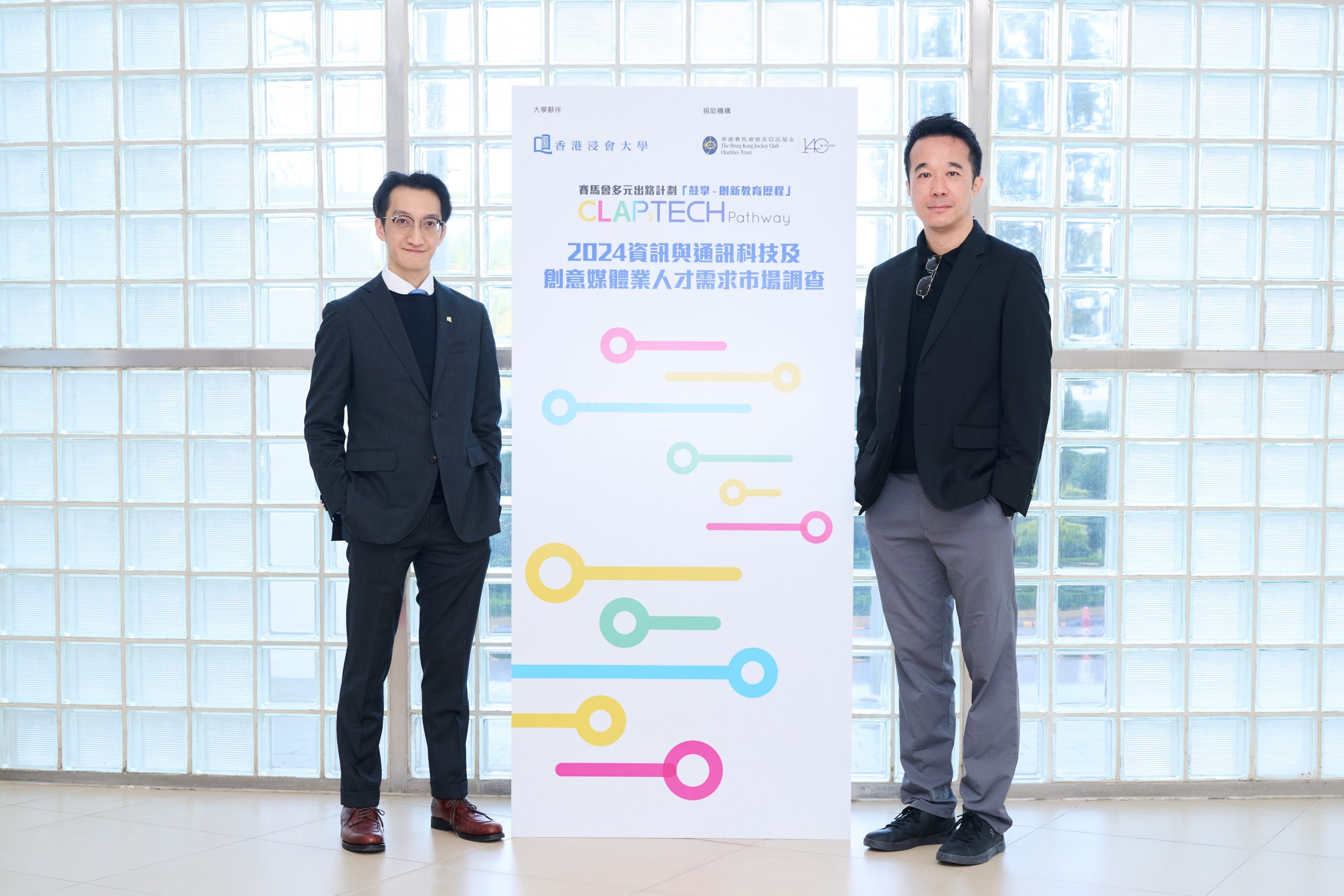
Employers in the ICT and Creative Media Industries Place Greater Emphasis on Soft Skills; Growing Recognition for Higher Diploma Graduates’ Competencies
HONG KONG SAR – Media OutReach Newswire – 20 December 2024 – Led by Hong Kong Baptist University (HKBU) and funded by The Hong Kong Jockey Club Charities Trust, the Jockey Club Multiple Pathways Initiative – CLAP-TECH Pathway (CLAP-TECH) has conducted its second annual survey, exploring the talent demands of the Information and Communications Technology (ICT) and Creative Media industries. The survey delved into aspects including starting salaries, hiring process duration, in-demand positions and overall talent supply. It aims to provide insights into employer expectations regarding the skills of fresh graduates with higher diplomas or university degrees, while providing valuable reference for students and industries.
This year’s survey results indicate a growing recognition among employers in both industries of the capabilities of higher diploma graduates. In the age of artificial intelligence, employers are placing greater emphasis on soft skills and acknowledging the role of Vocational and Professional Education and Training (VPET) in cultivating talent with market-relevant expertise.
Starting salaries for higher diploma and university degree fresh graduates remain between HKD 17,000 and HKD 23,000
Employers’ recognition of higher diploma graduates improves compared to last year
According to the survey, approximately 60% of employers believed that higher diploma graduates possess soft and hard skills comparable to, or even stronger than, those of university degree graduates. Employers’ recognition of the soft and hard skills of higher diploma graduates has increased by 8.8 and 17.1 percentage points respectively, compared to last year.
This growing acknowledgment is evident in graduates’ starting salaries. In the Creative Media industry, most higher diploma graduates (77.2%) and university degree fresh graduates (66.8%) receive a starting salary of HKD 17,000 to HKD 23,000. Notably, the proportion of higher diploma graduates with starting salaries between HKD 20,000 and HKD 23,000 has risen by 9.7 percentage points compared to last year. In the ICT industry, the majority of higher diploma graduates (68%) fit within the HKD 17,000 to HKD 23,000 starting salary range, mirroring last year’s findings (64.7%), while over half (56.4%) of university degree fresh graduates are in the same salary bracket this year.
Regarding hiring process duration and salary increments, employers in the ICT and Creative Media sectors reported an average time of nearly three months to fill suitable vacancies, with 8.8% of ICT employers indicating that some positions may take more than six months to fill. Some 70% of responding employers expect salary increments for higher diploma and university degree fresh graduates in 2025 to be between 2% and 5.9%, aligning with market expectations.
Andrew Ho, Director of the Jockey Club Multiple Pathways Initiative – CLAP-TECH Centre, said: “We are pleased to see a significant annual increase in employers’ recognition of higher diploma graduates’ soft and hard skills. Starting salaries for higher diploma graduates have also increased this year, particularly in the Creative Media sector. This reflects a growing market demand for quality graduate talent and demonstrates that higher diploma graduates with the right skills and qualifications are becoming increasingly competitive in the job market.”
Academic achievements are a lesser priority, with soft skills gaining greater competitiveness in the age of AI
As artificial intelligence (AI) continues to reshape education and the workplace, the survey revealed that over half (54.6%) of the surveyed employers have fully or partially integrated advanced technologies like AI and generative AI into their daily operations, while over one-third (37.4%) are considering such integration. However, as businesses increasingly adopt these technologies, employers prioritise soft skills such as “curiosity and lifelong learning”, “analytical thinking”, and “resilience, flexibility, and agility”. These skills are deemed more important than the knowledge and skills of AI and big data, which ranks fifth in importance in the next five to ten years.
During job interviews, employers have shifted their focus from candidates’ internships or practical experience to demonstrating soft skills such as communication (81.7%), problem-solving abilities (81.5%) and leadership potential (57.1%). Remarkably, the proportion of employers in the ICT and creative media sectors who value leadership potential surged, nearly doubling and increasing by over 1.7 times respectively compared to the previous year. More than 24.2% of employers in the ICT industry and 17.2% in the Creative Media industry believe that current candidates lack these skills, while academic performance and credentials are considered a lesser priority.
Employers in the Creative Media industry indicate that in the next five to ten years, talent will need to acquire “creative thinking” and “technological literacy” along with skills related to “artificial intelligence and big data”. Patrick Tam, Principal Advisor at 3 Screens Strategic Advisors Limited, an industry partner of the Jockey Club Multiple Pathways Initiative – CLAP-TECH Pathway, stated: “In today’s fast-evolving digital landscape, employers are increasingly in need of team members who possess a balanced blend of soft and hard skills. While proficiency in industry-specific skills is crucial, we also value employees who exhibit a strong sense of curiosity and a commitment to lifelong learning. As artificial intelligence becomes more prevalent in our daily workflow, it is imperative that our workforce applies their analytical skills, problem-solving abilities, and judgement to ensure the responsible implementation of AI technologies. The qualities of resilience, flexibility and agility will render employees indispensable in today’s dynamic work environment.”
Andrew Ho, Director of the Jockey Club Multiple Pathways Initiative – CLAP-TECH Centre, said: “To ensure that the CLAP-TECH curriculum aligns with industry needs, we engaged with industry partners early on to gain insights into emerging career trends and the essential role of both soft and hard skills. Through a tripartite partnership among HKBU, industry partners and secondary schools, we are dedicated to nurturing talents equipped with the skills necessary for the future workforce. The findings of this survey validate our vision: industry participation is key for talent development, and the significance of soft skills must not be overlooked in today’s rapidly evolving technology landscape.”
Over 90% of employers agree that vocational education produces more graduates with in-demand skills
The HKSAR Government rebranded vocational education and training in Hong Kong as Vocational and Professional Education and Training (VPET) in 2016, establishing a diverse range of teaching models and pathways for further education. The survey shows that over 90% of respondents believe VPET helps enhance the soft and hard skills, work attitudes and daily competencies of higher diploma graduates, thereby enriching the talent pool. Some 30% of the respondents stated that VPET can “significantly improve” practical skills.
Andrew Ho, Director of the Jockey Club Multiple Pathways Initiative – CLAP-TECH Centre, said: “Our survey results indicate a greater awareness among respondents regarding initiatives such as Universities of Applied Sciences (UAS), Industrial Attachment, and Career and Life Planning Grant. However, there remains a general lack of understanding regarding VPET. This highlights the need for the government to enhance VPET and its promotion to both employers and the public, emphasising its critical role in talent development and skills enhancement. This commitment will empower every talented young individual to chart their career paths, fully leverage their strengths and meet the future demands for various professional skills.”
Funded by The Hong Kong Jockey Club Charities Trust, the Jockey Club Multiple Pathways Initiative – CLAP-TECH Pathway (CLAP-TECH) commissioned a market research company to conduct its second annual online survey in October this year, interviewing a total of 500 local employers who had been involved in the recruitment process in the Information and Communications Technology (ICT) and/ or Creative Media industries in the past 12 months. Over 60% of the respondents frequently hire employees (every few months or multiple times per month) and have final decision-making authority or influence in the recruitment process.
Hashtag: #claptechpathway
The issuer is solely responsible for the content of this announcement.
Jockey Club Multiple Pathways Initiative – CLAP-TECH Pathway
Launched in 2020 and funded by The Hong Kong Jockey Club Charities Trust, Jockey Club Multiple Pathways Initiative – CLAP-TECH Pathway (CLAP-TECH) is Hong Kong’s first through-train Vocational and Professional Education and Training (VPET) pathway in mainstream senior secondary and post-secondary education. CLAP-TECH is a tripartite partnership among Hong Kong Baptist University, industry partners, and secondary schools. It currently consists of two Applied Learning Courses (i.e. Tech Basics and Multimedia Storytelling) and Higher Diplomas in Data Science and Art Tech Design. The programme equips students with technical and soft skills for the future workforce by incorporating career and life development in the curriculum. Since its establishment, over 40 industry partners have been involved in the programme, guiding and inspiring over 1,000 students from 100 secondary schools. For more details, please visit: https://www.claptech.hk/en/



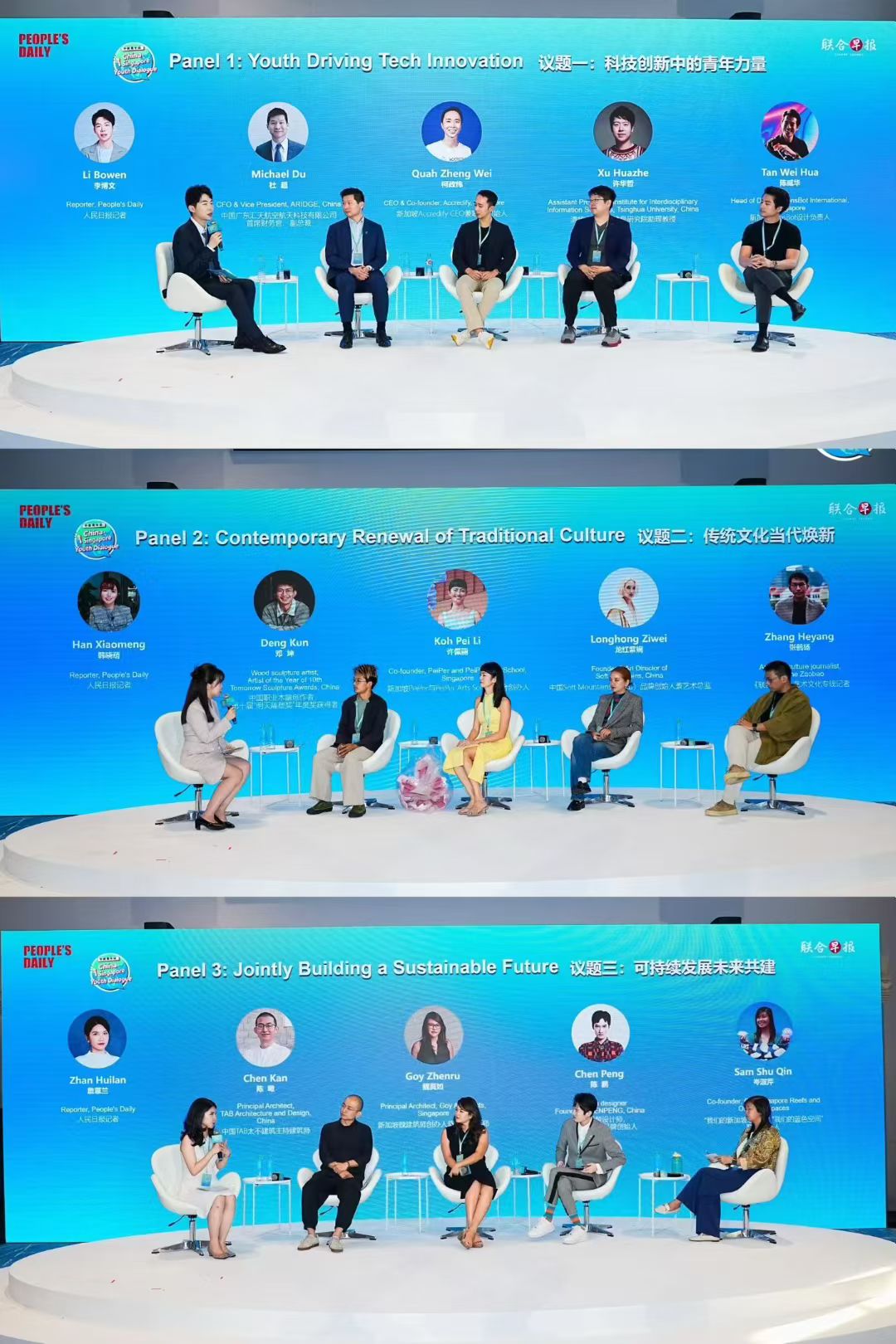
Co-organized by the People’s Daily and Lianhe Zaobao, the two-day event featured 12 young representatives who explored how their generation is shaping the future through innovation, cultural renewal and cross-border collaboration.
In the first panel, “Youth Driving Tech Innovation,” participants working in robotics, flying cars and data verification discussed both the opportunities and challenges of the AI era.
Tan Wei Hua, head of design at Singapore-based LionsBot International, addressed concerns over “AI anxiety” and its impact on jobs. “New jobs are going to be created. The next generation will be doing something entirely different,” he said, pointing to robotics as a growing field of opportunity.
Quah Zheng Wei, CEO and co-founder of Accredify, encouraged aspiring entrepreneurs to take the first step. With the tech industry evolving rapidly, he stressed that “nothing is holding you back.”
From an industry perspective, Michael Du, CFO and vice president of ARIDGE, said emerging technologies are expanding possibilities in everyday life. Meanwhile, Xu Huazhe, assistant professor at the Institute for Interdisciplinary Information Sciences at Tsinghua University, highlighted the strengths of younger generations: “With the correct taste, they will build the most meaningful things.”
The second panel, “Contemporary Renewal of Traditional Culture,” shifted focus from innovation to heritage. Artists and cultural practitioners in wood sculpture, paper art, jewelry design and journalism explored how tradition can be revitalized in modern contexts.

Wood sculpture artist Deng Kun emphasized the importance of cultivating an eye for beauty, while Lianhe Zaobao arts and culture journalist Zhang Heyang described traditional culture as “a place of spiritual haven for today’s youth.”
Designer Longhong Ziwei, founder and art director of the accessory brand Soft Mountains, said engaging with Yi heritage has inspired her work and resonated with international audiences.
Singaporean paper and mixed media artist Koh Pei Li, drawing inspiration from everyday urban life, highlighted the value of noticing overlooked details. Through her work, she hopes to reconnect people with the subtle beauty around them.
In the final panel, “Jointly Building a Sustainable Future,” speakers from architecture, fashion, and marine conservation offered interdisciplinary perspectives on sustainability.
Chen Kan, principal architect of TAB Architecture and Design, spoke about the philosophy of “being-with” as a guiding principle. “We need a deeper capacity to coexist with others,” he said.
Goy Zhenru, principal architect of Goy Architects in Singapore, emphasized designing in harmony with nature. She highlighted the importance of connecting living spaces with natural elements such as breeze and sunlight to create comfort and environmental awareness.
Sam Shu Qin, co-founder of Our Singapore Reefs and Our Blue Spaces, who describes herself as “a gardener underwater,” expressed hope that younger generations will recognize their ability to give back to the ocean.
For fashion designer Chen Peng, founder of brand CHENPENG, sustainability is both cultural and practical. “It should be culture-based and do no harm to the earth. It’s not a choice, but a natural extension of philosophy,” he said.
The dialogue marked a step forward in media cooperation and people-to-people exchanges between China and Singapore. By amplifying youth perspectives, it showcased the innovative energy and collaborative potential of both countries, while helping to build a long-term platform for bilateral engagement and shared progress.
The issuer is solely responsible for the content of this announcement.

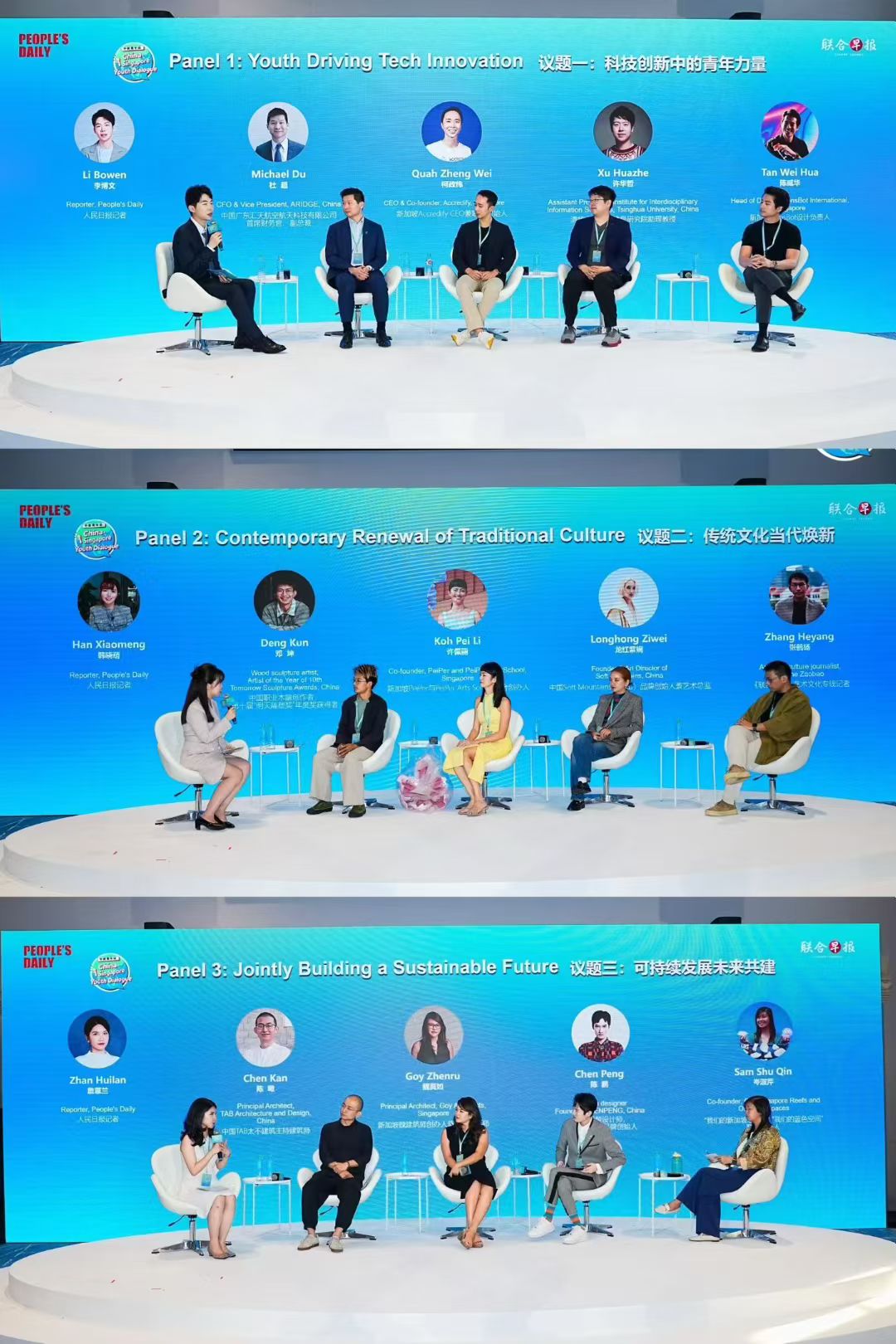
Co-organized by the People’s Daily and Lianhe Zaobao, the two-day event featured 12 young representatives who explored how their generation is shaping the future through innovation, cultural renewal and cross-border collaboration.
In the first panel, “Youth Driving Tech Innovation,” participants working in robotics, flying cars and data verification discussed both the opportunities and challenges of the AI era.
Tan Wei Hua, head of design at Singapore-based LionsBot International, addressed concerns over “AI anxiety” and its impact on jobs. “New jobs are going to be created. The next generation will be doing something entirely different,” he said, pointing to robotics as a growing field of opportunity.
Quah Zheng Wei, CEO and co-founder of Accredify, encouraged aspiring entrepreneurs to take the first step. With the tech industry evolving rapidly, he stressed that “nothing is holding you back.”
From an industry perspective, Michael Du, CFO and vice president of ARIDGE, said emerging technologies are expanding possibilities in everyday life. Meanwhile, Xu Huazhe, assistant professor at the Institute for Interdisciplinary Information Sciences at Tsinghua University, highlighted the strengths of younger generations: “With the correct taste, they will build the most meaningful things.”
The second panel, “Contemporary Renewal of Traditional Culture,” shifted focus from innovation to heritage. Artists and cultural practitioners in wood sculpture, paper art, jewelry design and journalism explored how tradition can be revitalized in modern contexts.

Wood sculpture artist Deng Kun emphasized the importance of cultivating an eye for beauty, while Lianhe Zaobao arts and culture journalist Zhang Heyang described traditional culture as “a place of spiritual haven for today’s youth.”
Designer Longhong Ziwei, founder and art director of the accessory brand Soft Mountains, said engaging with Yi heritage has inspired her work and resonated with international audiences.
Singaporean paper and mixed media artist Koh Pei Li, drawing inspiration from everyday urban life, highlighted the value of noticing overlooked details. Through her work, she hopes to reconnect people with the subtle beauty around them.
In the final panel, “Jointly Building a Sustainable Future,” speakers from architecture, fashion, and marine conservation offered interdisciplinary perspectives on sustainability.
Chen Kan, principal architect of TAB Architecture and Design, spoke about the philosophy of “being-with” as a guiding principle. “We need a deeper capacity to coexist with others,” he said.
Goy Zhenru, principal architect of Goy Architects in Singapore, emphasized designing in harmony with nature. She highlighted the importance of connecting living spaces with natural elements such as breeze and sunlight to create comfort and environmental awareness.
Sam Shu Qin, co-founder of Our Singapore Reefs and Our Blue Spaces, who describes herself as “a gardener underwater,” expressed hope that younger generations will recognize their ability to give back to the ocean.
For fashion designer Chen Peng, founder of brand CHENPENG, sustainability is both cultural and practical. “It should be culture-based and do no harm to the earth. It’s not a choice, but a natural extension of philosophy,” he said.
The dialogue marked a step forward in media cooperation and people-to-people exchanges between China and Singapore. By amplifying youth perspectives, it showcased the innovative energy and collaborative potential of both countries, while helping to build a long-term platform for bilateral engagement and shared progress.
The issuer is solely responsible for the content of this announcement.
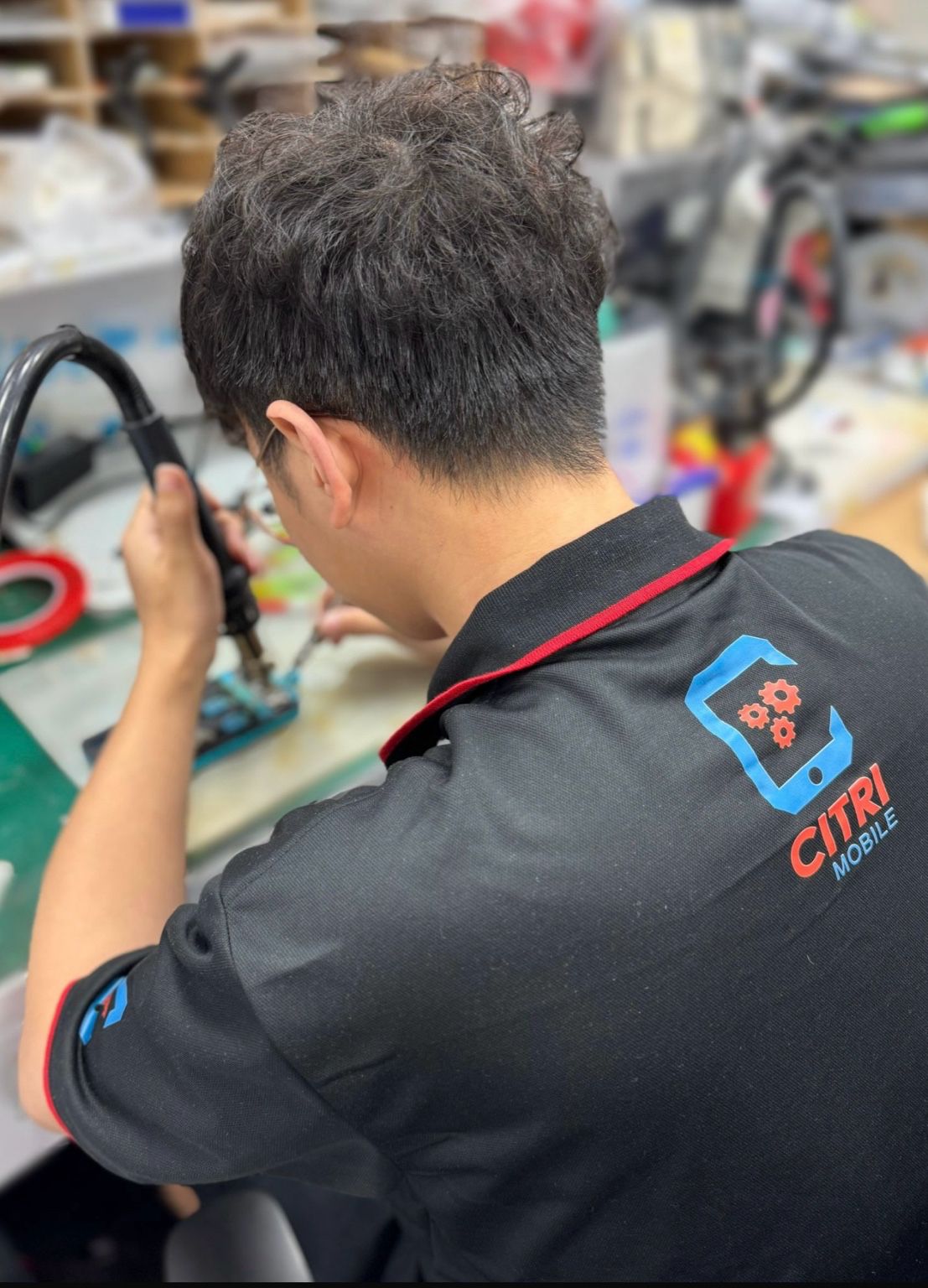
Expansion strengthens access to fast, reliable device repair services across Jurong, Yishun, Tampines and Chinatown as demand for urgent technical support rises
What often begins as a minor inconvenience can quickly escalate. A phone may take longer to charge, a screen may flicker briefly before stabilising, or a laptop may run hotter than usual during routine use. These early signs are often ignored until the device stops functioning at a critical moment.
Hashtag: #CitriMobile #SingaporeRepair #Jurong #Yishun
 https://citrimobile.com/
 https://x.com/CitriMobile
 https://www.facebook.com/CitriSG/
 https://www.instagram.com/citrimobilesghttps://www.carousell.sg/u/citrimobilesg/
The issuer is solely responsible for the content of this announcement.
C3 Smart Repair By Citri Mobile













-
 Feature/OPED6 years ago
Davos was Different this year
-
Travel/Tourism10 years ago
Lagos Seals Western Lodge Hotel In Ikorodu
-

 Showbiz3 years ago
Estranged Lover Releases Videos of Empress Njamah Bathing
-
 Banking8 years ago
Sort Codes of GTBank Branches in Nigeria
-

 Economy3 years ago
Subsidy Removal: CNG at N130 Per Litre Cheaper Than Petrol—IPMAN
-

 Banking3 years ago
Sort Codes of UBA Branches in Nigeria
-

 Banking3 years ago
First Bank Announces Planned Downtime
-

 Sports3 years ago
Highest Paid Nigerian Footballer – How Much Do Nigerian Footballers Earn