Showbiz
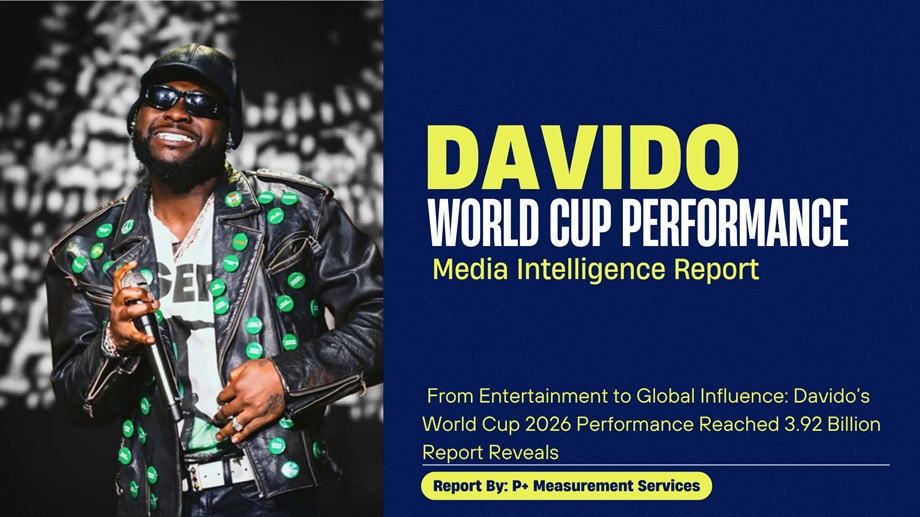
Davido’s World Cup 2026 Performance Reached 3.92 billion People Across 156 Countries
A newly released Media Intelligence Report by P+ Measurement Services reveals that Nigerian music icon Davido’s participation during the FIFA World Cup 2026 generated extraordinary levels of global media attention, audience engagement and positive sentiment, transforming a cultural performance into a worldwide conversation about unity, hope, justice and African influence.
The report analysed media coverage, public conversations and stakeholder engagement generated between June 10 and June 20, 2026, across print, online, broadcast and social media platforms worldwide. Beyond measuring visibility, the analysis examined the broader reputation implications of the campaign and its impact across traditional media ecosystems, digital communities and emerging AI-powered discovery environments.
According to the report, Davido generated approximately 1.48 million media mentions globally within the ten-day reporting period, reaching an estimated audience of 3.92 billion people and producing 6.78 billion impressions across media channels. Social conversations exceeded 432,700 discussions while total engagements surpassed 54.3 million interactions, highlighting one of the most impactful African entertainment-led communication moments recorded on the global stage in recent years.
The report found that public response to the performance was overwhelmingly favourable. Positive sentiment accounted for 89 per cent of all measured conversations, while neutral conversations represented only 2 per cent. Negative and strongly negative narratives combined accounted for less than 1 per cent of total discussions, indicating widespread approval not only of the performance itself but also of the underlying message embedded within the campaign.
At the centre of the conversation was Davido’s “Bring Them Home” message, which drew international attention to the plight of abducted schoolchildren and teachers from Oyo State. Rather than positioning the performance solely as entertainment, the campaign successfully integrated advocacy into one of the world’s largest cultural and sporting platforms.
The report suggests that this strategic combination of entertainment, social purpose and national storytelling significantly contributed to the scale and quality of media attention generated globally. In an era where audiences increasingly reward authenticity and meaningful narratives, the campaign demonstrated how celebrity influence can be leveraged to drive conversations that extend beyond music and popular culture.
One of the most significant findings of the report is the geographic diversity of the audience reached. While Nigeria remained a major contributor to conversations surrounding the performance, the United States emerged as the largest international market by reach, accounting for approximately 16 per cent of global visibility. Nigeria contributed 15 per cent, followed by the United Kingdom, Canada, Ghana, South Africa, France, Brazil, Germany and India.
The presence of conversations across 156 countries underscores the increasingly global nature of African cultural influence. It also reinforces the growing capacity of African creatives to shape narratives that resonate across continents and cultural boundaries.
For Nigeria, the findings provide further evidence that entertainment continues to function as one of the country’s most powerful soft power assets. While governments often invest heavily in national branding campaigns, the report indicates that cultural exports such as music, film and creative storytelling remain among the most effective vehicles for shaping international perception and projecting national influence.
The analysis further reveals that social media served as the primary engine of visibility throughout the reporting period. Social platforms generated approximately 1.32 million mentions, representing more than 89 per cent of total conversations recorded. X, formerly Twitter, accounted for the largest share of discussions, followed by Instagram, TikTok, Facebook and YouTube.
The dominance of social media highlights a broader shift in the communications landscape. Traditional media continues to play an important role in validating narratives and extending credibility, but public conversations increasingly originate and gain momentum through digital communities. For brands, institutions and public figures, this reinforces the importance of integrating earned media, influencer engagement and community-driven storytelling within communication strategies.
Online media also recorded significant performance, generating approximately 268,000 mentions and reaching an estimated audience of 1.65 billion people. Coverage was amplified by leading international and regional media organisations, including BBC News, CNN, Reuters, Al Jazeera, The Guardian and several influential African news platforms.
Broadcast media contributed an additional 11,500 mentions with a reach exceeding 452 million people, while print media generated more than 35,000 mentions and reached over 512 million audiences globally.
The report notes that the strength of this performance lies not merely in media volume but in media diversity. Visibility was achieved across multiple platforms, audience segments and geographic regions simultaneously, creating a highly resilient communication ecosystem capable of sustaining attention long after the initial event.
Analysis of audience demographics revealed particularly strong engagement among younger and economically active audiences. Individuals between the ages of 18 and 34 accounted for nearly 58 per cent of all measured social media engagement, reflecting the growing influence of youth-driven digital communities in shaping modern reputation outcomes.
From a communications and public relations perspective, the report identifies the campaign as a compelling case study in strategic narrative management. Traditionally, major sporting events have been viewed primarily as sponsorship and visibility opportunities. However, the Davido World Cup performance illustrates how organisations and personalities can use globally relevant moments to introduce social causes, build emotional connection and drive stakeholder engagement simultaneously.
For communications professionals, the findings reinforce the principle that visibility alone does not create influence. Influence emerges when visibility is supported by relevance, purpose and audience resonance. The campaign’s success demonstrates the effectiveness of aligning advocacy messages with cultural moments capable of generating significant public attention.
For the entertainment industry, the report highlights the increasing importance of purpose-driven storytelling. Audiences are becoming more responsive to artists and creators who leverage their platforms to address societal issues while maintaining authenticity. The performance illustrates how entertainment brands can generate both cultural impact and reputation value when social purpose is integrated into communication efforts.
For government institutions and policymakers, the findings offer important lessons regarding nation branding. The report suggests that Africa’s creative industries continue to represent one of the continent’s strongest tools for shaping international perception. As countries compete for tourism, investment and global relevance, cultural ambassadors such as musicians, filmmakers and creators are increasingly becoming key contributors to national reputation.
The report also presents significant implications for the public relations industry itself. As measurement frameworks evolve beyond traditional metrics such as impressions and advertising value equivalency, communications professionals are being challenged to evaluate influence through more sophisticated indicators, including sentiment quality, audience engagement, narrative ownership, stakeholder resonance and AI discoverability.
One of the report’s most forward-looking findings concerns performance within AI-powered information environments. An assessment of leading generative search and AI discovery platforms found exceptionally strong visibility for the campaign across ChatGPT, Perplexity AI, Claude AI and Microsoft Copilot.
Visibility scores ranged from 89 to 92 per cent across the evaluated platforms, indicating strong representation of campaign narratives within AI-generated responses and emerging search environments. Associated themes consistently included global impact, unity, humanitarian advocacy, African culture and Davido’s performance.
This development is particularly significant because reputation management is entering a new era where discoverability within AI systems increasingly influences public understanding. As users rely more on generative AI platforms to access information, organisations must ensure that their narratives are not only visible in traditional media but also accurately represented within AI-powered search and discovery ecosystems.
The report concludes that Davido’s World Cup 2026 performance represents far more than a successful entertainment event. It stands as a powerful example of how African talent can shape global conversations, amplify important social issues and create measurable influence across interconnected media environments.
More importantly, it demonstrates that purpose-driven storytelling, when combined with cultural relevance and strategic communications, can transform a single performance into a global reputation asset.
For PR practitioners, communication strategists, policymakers, marketers and brand leaders, the campaign offers valuable lessons on the future of influence. In a media environment increasingly driven by attention scarcity, algorithmic discovery and AI-generated information, success will belong to those who can create narratives that are not only seen but remembered, shared, trusted and discovered.
As Africa continues to strengthen its voice on the global stage, the findings reinforce a growing reality: the continent is no longer merely participating in global conversations. It is increasingly helping to shape them.
As part of its ongoing commitment to advancing evidence-based communications practice, P+ Measurement Services continues to make industry intelligence, measurement frameworks and media insights available to communications professionals, helping organisations move beyond assumptions and make informed decisions based on data, reputation intelligence and stakeholder understanding. With more than a decade at the forefront of media intelligence and communications measurement in Nigeria, the firm remains committed to strengthening the practice of public relations through research, accountability and meaningful evaluation.
Showbiz
This Weekend on GOtv: Nollywood Movies Worth Watching
What happens when one tragic event forces a family to confront secrets they’ve spent years trying to bury? In The Journal, the mysterious death of a family member brings five siblings back together, but instead of finding answers, they uncover hidden truths that threaten to change everything they thought they knew about each other. To catch The Journal, tune in on Africa Magic Showcase Ch 8 on Saturday at 7:15 PM.
Stories like this are what make Nollywood impossible to ignore. Whether you’re in the mood for emotional family drama, romance, suspense or stories packed with unexpected twists, GOtv has a lineup of Nollywood movies to keep you entertained all weekend.
If you’re looking for what to watch, here are some Nollywood movies to add to your watchlist this weekend.
Iya
Some battles don’t happen outside the home. In Iya, a mother is determined to drive a wedge between her son and his wife. She goes to great lengths to frustrate her daughter-in-law, hoping to push her back into the life she once lived, making money from her beauty. It’s an emotional story about family interference, manipulation and the lengths some people will go to get what they want.
Showing on Africa Magic Yoruba Ch 2 on Saturday at 8:25 PM.
One Man
Nkechi and Amara share a close bond as sisters, but poverty tears them apart while they are still young. Years later, fate brings them back together, but their reunion doesn’t go as expected. Instead, a shocking decision threatens to change both of their lives forever. It’s a touching story about family, sacrifice and the unexpected turns life can take.
Showing on Africa Magic Epic Ch 6 on Saturday at 11:05 AM.
Unlucky
Kenny and Nora’s relationship is already far from perfect, but things become even more complicated when Mabel, a brilliant tech enthusiast, moves in next door. What starts as a simple neighbourly connection soon turns into a complicated love triangle that leaves everyone questioning where their hearts truly belong.
Showing on Africa Magic Showcase Ch 8 on Sunday at 10:14 PM.
My Madam And I
Chief Donald and Jifeofor have spent years as rivals, but life has a funny way of changing the script. While the two men continue their feud, their children unexpectedly fall in love. Now they must decide whether love is strong enough to overcome pride, family rivalry and years of bad blood.
Showing on Africa Magic Family Ch 7 on Sunday at 11:05 PM.
Whether you’re in the mood for family drama, romance, suspense or stories packed with emotional twists, GOtv’s Nollywood lineup has you covered this weekend. So settle in and let these stories take over your screen.
To upgrade, subscribe or reconnect, download the MyGOtv App or dial *288#. For catch-up and on-the-go viewing, download the GOtv Stream App and enjoy your favourite shows anytime, anywhere.
Showbiz
Beyond the Olodo Uprising: How Entertainment Is Influencing Learning in Nigeria
As conversations around the “Olodo Uprising” trend continue to dominate social media, it has reopened an old debate about intelligence, education, and what it really means to learn in today’s Nigeria.
The memes and jokes surrounding the “Olodo Uprising” may be entertaining, but beneath the humour lies a more important question: where are Nigerians actually learning today?
For many people, education no longer begins and ends in classrooms or textbooks. Every day, millions of Nigerians spend hours consuming content across television, social media, streaming platforms, and digital communities. These spaces are increasingly shaping how people think about money, health, relationships, politics, and even citizenship.
This is where entertainment, advertising, and education have quietly begun to overlap.
The rise of learning through entertainment
Brands and organisations have gradually moved away from simply telling audiences what to think. Instead, they now invite people to participate.
Campaigns have become more interactive, relying on games, storytelling, influencer collaborations, audience participation, and competition to communicate ideas. Rather than presenting information in a lecture-style format, they build experiences that people can engage with and remember.
It is a response to today’s attention economy. People are far more likely to retain information when they are emotionally invested or actively involved.
Reality television has become one of the clearest examples of this shift, with Big Brother Naija standing out as perhaps the country’s biggest stage for this style of communication. But the idea of using entertainment to deliver social messages existed long before BBNaija became a cultural phenomenon.
Advocacy found its way into popular culture long before it became fashionable
Years before brands fully embraced reality TV, advocacy organisations were already experimenting with entertainment as a way to reach audiences.
ONE.org, for example, introduced advocacy-focused challenges that encouraged contestants to develop campaigns around healthcare, governance, and citizen participation. Rather than simply discussing social issues, participants were asked to propose solutions and communicate them in ways that mirrored real-world policy campaigns. Some winners later gained exposure through international advocacy platforms, including the UN General Assembly.
BBNaija explored this idea as far back as Season 2, See Gobe edition. Housemates took part in a girl-child education task in partnership with ONE Campaign, where they learnt about the challenges many girls face in accessing education and presented their ideas on how to address them. Bisola’s presentation was selected as the best, earning her the chance to represent the campaign at the United Nations General Assembly as a ONE Ambassador for girls’ education. The task showed that reality television could do more than entertain. It could help people learn about important issues, encourage meaningful conversations, and even create opportunities for real-world impact.
Looking back, these campaigns were early signs of a model that has since become common across Nigerian media.
When brand tasks became learning experiences
As BBNaija evolved, sponsored tasks became more ambitious. Instead of simply promoting products, many brands began building challenges that required contestants to learn new concepts, solve problems, work in teams, and communicate ideas under pressure.
During Season 6, Shine ya Eye edition, PiggyVest introduced a financial literacy challenge centred on saving, spending, and financial planning. Rather than delivering a traditional financial education campaign, the concepts were woven into competitive tasks that made them easier to understand and more engaging to watch.
SuperSport adopted a similar approach, designing challenges around teamwork, strategy, puzzles, and creative thinking.
Other sponsors followed suit.
Health-focused campaigns encouraged conversations around public wellbeing and civic responsibility. Airtel challenged housemates to interpret communication briefs and present marketing ideas. Cooking tasks sponsored by brands such as Munch It and Arla tested creativity, collaboration, and time management while introducing conversations around food and nutrition.
The common thread was never the prize money. It was the process. Contestants had to absorb new information quickly, apply it in real time, and explain their thinking in front of millions of viewers. That is a form of learning, even if it doesn’t resemble a classroom.
Health education moved to centre stage
Recent seasons have made the educational element even more deliberate.
In Season 10, 10/10 edition, Colgate’s oral health challenge required housemates to study information about dental hygiene before competing in games built around oral care, common myths, and healthy habits.
Carex adopted a similar approach with its hygiene challenge, combining entertainment with lessons around germs, handwashing, and infection prevention.
These tasks were designed to be memorable because audiences were watching people learn while being entertained. The products remained visible, but so did the message.
What the “Olodo Uprising” conversation reveals
The current online debate often assumes that young Nigerians are becoming less interested in learning. Yet the same people making that argument spend hours discussing content that regularly exposes audiences to financial literacy, health awareness, communication skills, teamwork, and civic issues.
Learning hasn’t disappeared. It has simply moved into places that don’t always look educational.
Reality television, brand campaigns, creator content, podcasts, and even viral social media conversations have become part of Nigeria’s informal learning ecosystem as they increasingly shape public knowledge and everyday behaviour.
The “Olodo Uprising” conversation reflects that shift. While people continue to debate who is intelligent and who isn’t, the ways Nigerians acquire knowledge have become far more diverse than they once were.
Learning has changed its address
The real lesson is not that reality television is educational by default. It is that education now travels through entertainment because that is where attention lives.
From advocacy campaigns and financial literacy challenges to health awareness initiatives and branded storytelling, Nigerian popular culture has become an unexpected classroom.
The platforms may be different, but the outcome is familiar: people encounter new ideas, engage with them, and carry parts of those lessons into everyday life.
The conversation sparked by “Olodo Uprising” will eventually fade, as most viral trends do. What is likely to remain is the growing recognition that learning today is shaped as much by culture and media as it is by classrooms.
Showbiz
5 BBNaija Seasons That Left Us With Unforgotten Moments
One thing BBNaija has never struggled to deliver is premium entertainment. Every season has introduced new personalities, sparked conversations, created fan favourites and given Nigerians moments that live far beyond the finale. From iconic fights and unforgettable ships to underdog victories and shocking twists, every edition has added something to the show’s legacy.
With Season 11 around the corner, we are taking a trip down memory lane to revisit five seasons that gave us some of the franchise’s most unforgettable moments, and why we are excited to see what the next housemates will bring.
Double Wahala (Season 3)
For many fans, this was the season that defined modern BBNaija.
Cee-C and Tobi’s complicated relationship had viewers emotionally invested from start to finish, while Bambam and Teddy A gave us a love story that would continue outside the house. Alex wore her heart on her sleeve, Nina and Miracle became one of the season’s biggest ships, and Anto and Khloe’s return after eviction remains one of the twists fans still talk about.
In the middle of all the drama, Miracle quietly played one of the smartest games in BBNaija history. While louder personalities dominated conversations, he focused on the competition, won crucial tasks and walked away with the grand prize, proving that strategy could be just as powerful as popularity.
Pepper Dem (Season 4)
If any season understood the meaning of premium entertainment, it was Pepper Dem.
Mercy, Mike, Frodd, Omashola, Seyi and Diane all brought something different to the house, but it was the rivalry between Mercy and Tacha that became the defining story of the season. Their clash, which ended with Tacha’s disqualification, remains one of the most talked-about moments in BBNaija history.
Mercy went on to become the first female winner of the show, while Tacha built one of the biggest fan communities the franchise has ever seen. Years later, both names are still impossible to leave out of any BBNaija conversation.
Lockdown (Season 5)
When Nigerians needed an escape in 2020, Lockdown delivered.
Laycon’s journey from underestimated housemate to overwhelming winner is still one of the greatest underdog stories the show has produced. Erica’s disqualification changed the course of the game overnight, while her relationship with Kiddwaya kept viewers glued to their screens.
Then there was Ozo’s relentless pursuit of Nengi, a storyline that sparked endless debates, and Dorathy, whose honesty and resilience earned her fans across the country. It was a season full of memorable personalities, and many of them remain household names today.
All Stars (Season 8)
Bringing back former housemates was always going to be risky, but All Stars proved the gamble was worth it.
Old friendships were tested, rivalries resurfaced and experienced players quickly realised that reputation alone couldn’t win the game. Mercy, Cee-C, Alex, Pere, Cross, Angel and Neo all returned with something to prove, but it was Ilebaye who ended up writing the biggest story.
Often underestimated in the early weeks, she quietly navigated the game, survived nominations and completed one of the biggest comeback stories in BBNaija history with her win.
10/10 (Season 10)
A decade in, BBNaija showed it could still surprise us.
Season 10 introduced a fresh cast that wasted no time creating memorable moments. Imisi’s eventual win capped off an impressive run that included some of the season’s biggest talking points, especially her rivalry with Faith. Isabella and Thelma also had viewers talking after their heated exchanges, reminding everyone that no BBNaija season is complete without a little gbas gbos.
The romance wasn’t in short supply either. Mide and Bright Morgan quickly became one of the season’s favourite couples, while Denari and Doris kept fans invested in their relationship. Dede added a lighter twist to the season with her famous “three fishes” Kola, Jason Jae and Koyin, all competing for her attention, even as she and Koyin insisted they were nothing more than friends.
The season took another dramatic turn when Faith was disqualified after his clash with Sultana, a moment that completely changed the dynamics in the house and show. By the finale, Imisi had earned her place as winner, closing out a milestone season with plenty of memorable moments.
And that’s the thing about BBNaija. Every season leaves us with stories we’ll reference for years, while introducing new personalities who become part of the culture.
Season 11 now has its own opportunity to do the same. New housemates, new twists, new alliances, new rivalries and moments nobody can predict. If history has taught us anything, it’s that by the time the finale rolls around, we’ll already be talking about the moments that defined another unforgettable season.


Pingback: Davido’s World Cup 2026 Performance Reached 3.92 billion People Across - Africa Media Today™
Pingback: Davido’s World Cup 2026 Performance Reached 3.92 billion People Across