Sports
Algeria Defeat Tunisia to win Inaugural FIFA Arab Cup 2021
By Adedapo Adesanya
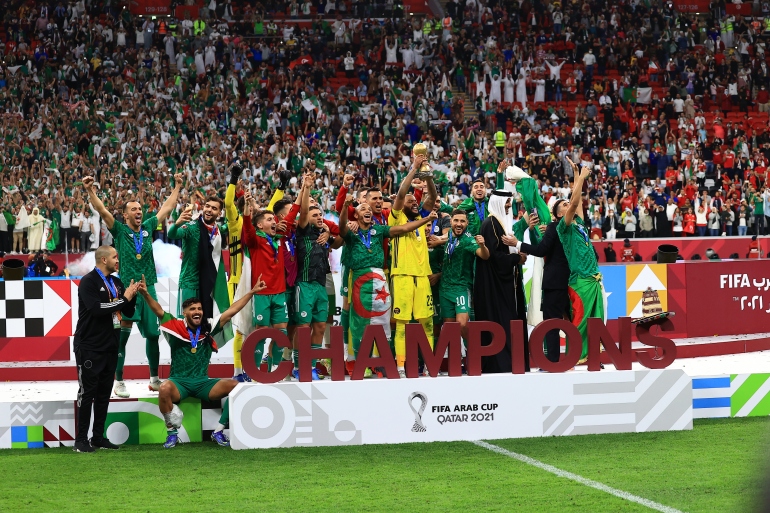
Algeria beat Tunisia 2-0 to be crowned the champions of the inaugural edition of the FIFA Arab Cup 2021 played in Qatar.
The Desert Warriors settled the game in extra time with goals from Amir Sayoud and Yacine Brahimi to take victory witnessed by FIFA President, Mr Gianni Infantino and Qatar’s Emir Sheikh Tamim bin Hamad al-Thani.
Amir Sayoud scored in the ninth minute of extra-time while Yacine Brahimi scored with the final kick of the game after a breakaway as Tunisia pushed everyone up for a last-gasp corner at the Al-Bayt Stadium in Al Khor city.
The win means Algeria now possess both the Arab title and the Africa Cup of Nations which they won in 2019 and are scheduled to defend starting next month in Cameroon.
Tunisia made it to the final by beating fellow African side Egypt 1-0 in the semi-final stage, while Algeria beat the hosts 2-1.
Egypt played Qatar in the third-place game, with the host team emerging 5-4 victorious in a post-match penalty shootout.
Besides the FIFA President and the Qatari Emir, representatives of the FIFA Council and delegates from several member associations were also present in Doha to watch the final games on Saturday.
The Confederation of African Football (CAF) President, Mr Patrice Motsepe and his Asian Football Confederation (AFC) counterpart Sheik Salman bin Ibrahim Al Khalifa were also present to witness their respective member associations in action.
According to FIFA, the final game attracted a crowd of 60,456. At half-time, a ceremony was conducted to recognize the efforts of healthcare workers in fighting the COVID-19 pandemic.
The FIFA President made an on-the-pitch medal presentation to a group of front line health workers who have been supporting the local efforts in this fight.
Following the successful completion of the 16-team tournament, Mr Infantino said the FIFA Arab Cup will not be a one-off event.
“We will make it possible, under the umbrella of FIFA: the FIFA Arab Cup will continue,” said Mr Infantino. “It has to continue [because] it’s such a successful event.”
“It is proof of what football can do; bringing continents together, bringing people together, bringing countries together, bringing fans together, and bringing players together,” he added. “This joy, this emotion, which we have been feeling throughout this tournament – not only in Qatar but in the entire Arab World and all over the world.”
The 2022 World Cup will take place in Qatar from November 21 to December 18.
The Al-Bayt stadium, which is modelled after tents used in Qatar’s deserts, will be the venue for the upcoming tournament’s opening match.
Sports
France Appoint Zinedine Zidane as Head Coach After Deschamps’ Exit
By Adedapo Adesanya
Mr Zinedine Zidane has been appointed as France’s new head coach, replacing Mr Didier Deschamps, who resigned after the just-concluded 2026 FIFA World Cup hosted by the trio of the United States, Canada, and Mexico.
The French Football Federation (FFF) president, Mr Philippe Diallo, announced Mr Zidane’s appointment at the organisation’s headquarters in Paris on Tuesday, saying he has been given a four-year contract.
“This is an exceptional moment, exceptional because of the person sat next to me,” Mr Diallo said. “Zinedine is one of the legends of French soccer, and for many years he said one of his dreams was to take charge of the France team.”
The 54-year-old Zidane has not coached since leaving Real Madrid in 2021, where he won the Spanish league title twice as well as the UEFA Champions League thrice in a row from 2016 to 2018.
“For me it’s a continuity, a dream,” he said. “I had some offers during the five years I was away to take charge of a club, but I turned them all down for the France team. It was the only thing I wanted to do.”
Mr Zidane, who had a stellar career as a French player, called it “an immense joy” to take charge of the team he starred for from 1994 to 2006. “I have so many emotions, I am ready for the challenge,” he said. “That’s what motivates me.”
Mr Zidane praised Mr Deschamps, who won the 2018 World Cup and stepped down after the recent tournament, where Les Bleus lost in the semi-finals to Spain.
“Today I have the opportunity to be in charge of this team, and I will give everything so that this team can win,” he said. “I would also like to congratulate DD for these remarkable years.”
“What motivates me is the game; I was a No 10, I like goals,” Zidane said. “I was a leader on the field, and now I want to be a leader by experience.”
According to the President of the French football body, talks with the former France captain commenced in February 2025 after Mr Deschamps said he would stand down after the 2026 World Cup.
Mr Zidane will be looking to recreate his stellar player-coach career in Real Madrid with the French team, where he won the 1998 World Cup, scoring two iconic headed goals in the final to beat Brazil 3-0, as well as the Euro 2000, where he spearheaded the French midfield to a 2–1 final win over Italy, winning Player of the Tournament honours.
At the 2006 World Cup, he came out of international retirement to lead France to the final, winning the Golden Ball despite receiving a red card in his final professional match for a headbutt on Italy’s Marco Materazzi. France lost the game 5-3 on penalties.
Sports
Super Falcons Open WAFCON Campaign Live On SuperSport
Nigeria’s Super Falcons prepare to begin their quest for an 11th continental title, as they take on Malawi on Tuesday in the ongoing WAFCON hosted by Morocco. All the matches of the tournament air live on SuperSport via DStv and GOtv.
The tournament opened on Sunday with Algeria claiming a 2-0 victory over Senegal before hosts Morocco thrilled their home fans with a commanding 4-0 win over Kenya to top Group A after the opening round of matches.
Monday’s Group B action delivered mixed fortunes, with Tanzania stunning the 2024 champions South Africa 2-1 before Ivory Coast cruised to a 4-1 victory over Burkina Faso.
Today’s action follows Zambia as they take on Egypt in Group C. Later today, the Super Falcons open their Group C campaign against Malawi at 9:00 pm, with the two matches expected to provide an early indication of how one of the tournament’s most competitive groups could unfold.
Nigeria head into the competition as Africa’s most successful women’s national team, having won a record 10 WAFCON titles. The Super Falcons return as defending champions after reclaiming the continental crown in 2024 and will be aiming to retain the trophy in Morocco.
Beyond Nigeria, hosts Morocco will be hoping to build on the momentum of their opening victory and improve on their runner-up finish in 2022. South Africa, champions in 2022, remain among the leading contenders despite their opening defeat to Tanzania, while Zambia are widely tipped as one of the tournament’s dark horses after their recent rise in African women’s football.
This year’s competition is the biggest in WAFCON history, with 16 teams competing across four groups. The top two teams from each group will advance to the quarter-finals, while the four semi-finalists will secure automatic qualification for the 2027 FIFA Women’s World Cup in Brazil.
Matchday 1 Upcoming Fixtures
Tuesday, July 28
-
Zambia vs Egypt – 6:00 pm
-
Nigeria vs Malawi – 9:00 pm
Wednesday, July 29
-
Ghana vs Cape Verde – 6:00 pm
-
Cameroon vs Mali – 9:00 pm
SuperSport Brings All the Live Action
Catch every match of WAFCON Morocco 2026 live on SS Football (Ch. 202, GOtv Ch. 61) and SS Football Plus (DStv Ch. 202) on DStv and GOtv. Fans can also stream every match live on DStv Stream from ₦6,000, with no decoder or dish required.
Beyond WAFCON, sports fans can also catch the Glasgow 2026 Commonwealth Games, which is live every day on SuperSport across DStv and GOtv. New customers can get a DStv decoder, dish and one-month Compact subscription from ₦15,000, while existing customers can reconnect from ₦6,000 on DStv or ₦5,800 on GOtv. To subscribe or reconnect, visit DStv.com or GOtvAfrica.com, dial *288#, or use the MyDStv or MyGOtv app.
Sports
Why Reward Programs Keep Users Coming Back to Digital Platforms
Reward systems have become a standard feature across nearly every digital platform people use daily, from streaming apps to shopping services to online entertainment. What used to be a simple points card at a physical store has evolved into complex digital systems that shape how people interact with technology every single day.
Understanding why these systems work helps explain a lot about modern app design and user behavior.
The Psychology Behind Rewards
Reward programs tap into a basic psychological principle: people respond strongly to positive reinforcement, especially when it feels earned rather than random. A small bonus after completing an action creates a sense of accomplishment that encourages repeat behavior.
This is not a new discovery. Behavioral psychologists identified this pattern decades ago, but digital platforms have refined it into something far more precise. Apps can now track exactly which actions lead to engagement and design rewards around those specific behaviors.
The unpredictability factor matters too. When rewards are not entirely predictable, whether it is a surprise bonus or a random discount, users check back more often just to see what they might receive. This mechanism explains why so many apps in Nigeria and Kenya use daily login bonuses and surprise offers rather than fixed, predictable rewards.
Why Loyalty Programs Work
User retention is one of the most expensive challenges digital platforms face. Acquiring a new user costs significantly more than keeping an existing one engaged, which is why loyalty systems have become central to long-term business strategy rather than an occasional marketing tactic.
Loyalty programs work because they change how users perceive their relationship with a platform. Instead of a single transaction, the relationship becomes ongoing, with each interaction building toward a larger benefit. This shift from transactional to relational thinking keeps users returning even when competitors offer similar core services.
The most effective loyalty programs share a few common characteristics. They tend to include the following elements:
- Tiered structures: users move through levels, with each tier unlocking better rewards than the last.
- Clear progress tracking: users can see exactly how close they are to the next reward, which encourages continued activity.
- Achievable early wins: new users receive a small reward quickly to establish the habit before bigger incentives kick in.
These elements work together to create a sense of ongoing progress rather than a single isolated reward.
Personalization and User Engagement

Generic rewards sent to every user rarely perform as well as personalized ones. Customer engagement improves significantly when platforms use behavioral data to offer rewards that match individual habits rather than broadcasting the same offer to everyone.
A user who plays mobile games every evening responds differently to a reward than someone who logs in once a week. Platforms that segment their user base and adjust reward timing, size, and type based on actual behavior see stronger engagement results than those using one-size-fits-all approaches.
This level of personalization requires solid data infrastructure, but the payoff is measurable. Users who receive rewards that feel relevant to their specific habits are more likely to view the platform as understanding their preferences, which builds trust over time.
How Digital Platforms Build Long-Term Relationships
Bonus systems work best when they feel like an ongoing relationship rather than a one-time transaction. Digital entertainment platforms across Africa increasingly design bonus structures around consistent engagement rather than single large payouts.
A Pin Up bonus, for example, illustrates how modern platforms structure rewards around regular activity rather than one-off promotions, encouraging users to return through small, consistent incentives instead of relying solely on a single large welcome offer.
Digital incentives that reward consistency, like weekly bonuses or milestone-based rewards, tend to build stronger long-term habits than large one-time offers that lose relevance after the first use.
Future Trends
AI-driven personalization will likely make reward timing even more precise, predicting the exact moment a user is most likely to respond positively to an incentive. Platforms are also expected to move toward more transparent reward structures, showing users exactly what they need to do to unlock the next benefit.
Gamified elements, like progress bars and achievement badges, are also expanding beyond gaming apps into shopping, fitness, and finance platforms, borrowing techniques that have proven effective at keeping users engaged over time.
In conclusion, reward programs succeed because they align with basic human psychology while adapting to individual behavior patterns. Platforms that build genuine, personalized reward systems will continue to see stronger user retention than those relying on generic, one-size-fits-all incentives.