

Sports
How Accumulator Bets Work in Nigerian Football Betting

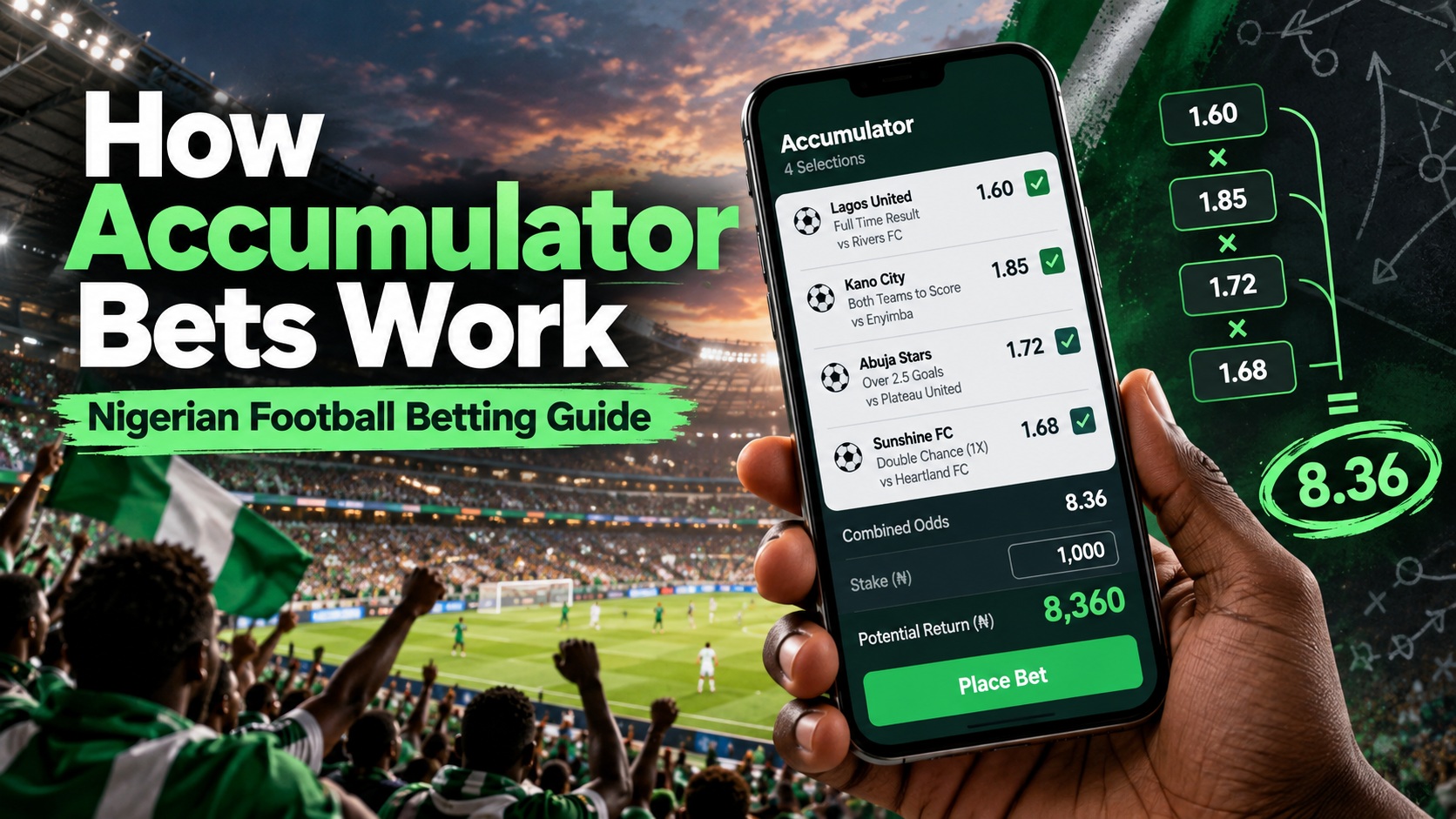
Accumulators sit at the centre of most Nigerian welcome offers. One operator’s sports bonus, available after signing up to 1xBet with a code, has to be wagered on slips of at least three selections, each priced at 1.40 or higher, which means a new customer meets the accumulator before placing a single bet of their own. Understanding how these slips are priced, and why they lose so often, is the first step before staking any money on a weekend of NPFL and Premier League fixtures.
How an Accumulator Pays Out
An accumulator, or “acca”, combines several selections into one bet. The odds of each leg are multiplied together, and the whole stake rides on every selection winning. The bet is known as a parlay in North America, and the principle is identical: if a single leg loses, the slip loses, however well the other picks performed.
A worked example shows the mechanics. Take three hypothetical selections: a home win for Enyimba at 1.50, an Arsenal win at 1.80 and over 2.5 goals in a Serie A match at 2.00. Multiplying 1.50 × 1.80 × 2.00 gives combined odds of 5.40. A ₦1,000 stake returns ₦5,400 if all three land, a profit of ₦4,400. Placed as three separate ₦1,000 singles, the same picks would cost ₦3,000 and return ₦5,300 in total if every one won.
That gap explains the appeal. Small stakes can produce large returns, which suits bettors working with a modest weekly budget. The drawback appears as soon as one selection fails: the three singles would still return something, while the accumulator returns nothing.
Why Each Extra Selection Raises the Risk
Decimal odds can be turned into an implied probability by dividing 1 by the odds. At 1.50 the bookmaker’s price suggests a 66.7% chance, at 1.80 about 55.6% and at 2.00 exactly 50%. Multiplying those figures gives the chance of the full slip winning: roughly 18.5%, or a little under one in five.
The numbers fall quickly as legs are added. Ten selections each priced at 1.40 look safe individually, since 1.40 implies about a 71% chance. Combined, they produce odds of about 28.9, yet the implied chance of all ten winning drops to around 3.5%. A ₦500 slip with those legs would return about ₦14,460, but on those figures it would be expected to win roughly once in every 29 attempts.
There is also the bookmaker’s margin. Every price includes a small built-in edge, and in an accumulator those edges multiply along with the odds, so the gap between the true chance and the payout widens with each extra leg. As a simple illustration, if each of five legs is priced with a market total of 105%, the combined slip carries 1.05 multiplied five times, or roughly 128%.
Accumulator Bonuses and Wagering Requirements
Many Nigerian operators offer boosts on winning accumulators. The usual structure starts with a small percentage added to winnings once a slip reaches a set number of selections, often five, and the boost grows as more legs are added. Minimum odds per selection, commonly around 1.35 to 1.40, stop bettors from padding slips with near-certain favourites.
A worked example clarifies what a boost is worth. A five-fold slip at combined odds of 6.00 with a ₦1,000 stake returns ₦6,000. A 5% boost on the ₦5,000 profit adds ₦250. The boost is pleasant, but it does nothing to change the odds of all five legs winning, so it should never be the reason to add a fifth selection.
Welcome bonuses carry wagering requirements, and these often specify accumulators. If a ₦10,000 bonus must be wagered five times, the bettor needs ₦50,000 of turnover on qualifying slips before withdrawing. At three legs per slip and minimum odds of 1.40, that turnover takes many bets, and each one carries the compounding risk described above.
The Regulatory Picture After the 2024 Supreme Court Ruling
Betting regulation in Nigeria changed shape in late 2024. On 22 November 2024 the Supreme Court nullified the National Lottery Act 2005, holding that the power to legislate on lotteries in the states rests with state Houses of Assembly rather than the National Assembly. The federal National Lottery Regulatory Commission keeps its role in the Federal Capital Territory.
For operators, the ruling raises questions about licensing. An analysis by law firm Aluko & Oyebode notes that businesses holding only a federal licence may need state licences where they operate outside Abuja, and that the treatment of online platforms remains unclear. For bettors, the practical point is simpler: checking which authority licenses a platform, and in which state, is part of choosing where to open an account.
Practical Habits for Building Accumulators
A few habits keep accumulators manageable. Shorter slips of two to four legs win far more often than ten-fold ones, and they make it easier to judge whether each selection deserves its place. A fixed stake, such as a small share of a monthly betting budget set aside in advance, prevents one bad weekend from dictating the next.
Keeping a record also helps. Noting every slip, its odds and its result for a month shows quickly whether long accumulators are paying off or simply draining a balance. A pattern worth looking for is a single leg, often the “banker” added at the last minute, that keeps failing. Dropping that habitual extra selection is usually the quickest improvement available.