
Sports
Younes Rachidi Banned from Tennis for Match-Fixing


The conviction of Moroccan Younes Rachidi for 135 charges of match-fixing has struck a chord with all sports fans. His lifetime ban from professional sports came as a surprise, even to the top sports betting sites in the Middle East. Although Rachidi was far from a household name, having never reached the top 1,000 rankings, he was a regular on the ITF Futures Tour, the amateur tennis circuit, where he managed to reach his highest doubles ranking of 475 on the ATP list.
The Investigation
The International Tennis Federation (ITF) conducted a thorough investigation and issued the ban in August 2021. In addition to the permanent restriction, The International Tennis Integrity Agency (ITIA) also imposed a $34,000 fine for the 135 violations of TACP. Following the joint investigations by Belgian law enforcement and the ITIA, it was also discovered that Rachidi had been involved in match-fixing together with two Algerian players who also received a ban.
After a thorough investigation, it was revealed that Rachidi had been actively involved in fixing match results in Spain, Portugal, Egypt, and Nigeria. Those activities included losing sets, games, and occasionally entire matches, in order to manipulate the results.
The Verdict
In her ruling, Independent Anti-Corruption Hearing Office Janie Soublière concluded that all allegations of the report were factually true. Consequently, Younes Rachidi was permanently barred from attending, coaching, or taking part in any tennis event recognized or authorized by the tennis governing bodies. The Anti-Corruption Hearing Office also imposed sanctions on the two Algerian players who were found to be accomplices in the match-fixing scheme while also implying that these offenses are despicable for any tennis player.
Match-Fixing: A Serious Offense in Sports
Interfering in a game is a major breach of professional sports etiquette, particularly in tennis. The International Tennis Federation (ITF) has a zero-tolerance policy for match-fixing and any report of inappropriate behavior is taken very seriously. The integrity of the sport is upheld by the ITF, which investigates all criminal complaints, no matter how small or large the infraction may be.
Every sporting competition is built on fair play, which provides all participants with an equal chance to win. Players begin the game with a competitive spirit and a desire to win. They strive to keep the game’s quality high while providing spectators with an exciting and unpredictable match.
That is why any form of cheating in professional sports must be strongly condemned by organizations like the ITF. According to a statement made by the ITF’s integrity unit, any other individuals who may have been involved in the match-fixing activities will be the subject of further investigation.
The tennis ethics regulatory bodies implied that the 135 offenses committed by the Moroccan player in 2017 and 2018 involved violations of the Tennis Anti-Corruption Programs (TACP).
Rule D.1 states that anyone playing professional tennis is prohibited to “directly or indirectly, contrive or attempt to manipulate the result or any other element during competition”. And yet, the former tennis player never ceased to break this rule of TACP, applicable to all professional tennis players.
The ITIA was created by the international governing organizations of the sport to manage issues that might affect the integrity of sports. It has proven its commitment to preserving tennis’ honesty by taking decisive actions against those who manipulate match results.
Although the situation with Younes Rachidi is unfortunate, it serves as a warning to other competitors showing that cheating has serious consequences and that the ITF will not hesitate to take legal action and punish offenders if proven guilty.
Final Thoughts
The Younes Rachidi scandal has emphasized the importance of upholding the principles of sportsmanship and fair play in professional sports. The ITF’s decision to fine Rachidi $34,000 and forever ban him from stepping on a professional tennis court serves as a warning that match-fixing is a serious breach of sports ethics and will not be tolerated under any circumstance.
Unfortunately, sports controversies are a fact of life, but they should not be taken lightly. Such behavior not only erodes the competitive nature of the game but also damages the reputation of the sport and the trust of the fans in the athletes. This case is a stark reminder that any sports game must preserve its fairness in order to earn the respect of fans and fellow players.













The 12 Hours of Sebring stands as one of endurance racing’s most punishing and prestigious events. Your favorite races are available if you try 1xBet website for betting today.
It is a relentless test of 3 aspects:
- speed;
- stamina;
- and survival.
First held on March 15, 1952, at a former military airfield in Florida, the race quickly became a cornerstone of international motorsport. It attracts elite drivers and manufacturers from around the world. Motorsports fans are also invited to try the 1xBet website for betting on their favorite sports too.
A brutal race
What makes Sebring so grueling is not just its duration, but the unique brutality of the circuit itself. Built from a mix of old concrete runways and asphalt, the track is notoriously bumpy, shaking cars, and drivers, to their limits over 12 continuous hours. Combined with the intense Florida heat and humidity, these conditions push mechanical reliability and human endurance to the edge. Before the next edition of this race starts, you may also want to enjoy best slots casino from the 1xBet website.
The race begins in daylight and ends in darkness, creating constantly changing conditions. Drivers must adapt from glaring sun to the reduced visibility of night racing, all while navigating heavy traffic from multiple classes of cars. Fatigue becomes a critical factor, as teams rotate drivers in a delicate balance between rest and performance. The best casino slots from 1xBet are perfect to enjoy while waiting for other amazing motorsports drivers as well.
Every mistake is amplified over time, and even minor mechanical issues can spell disaster in such a long contest.
Becoing ready for other events
Historically, Sebring has also been a proving ground. Throughout the 1950s and 1960s, it was a key round of the World Sportscar Championship and drew legendary figures such as Juan Manuel Fangio and Stirling Moss. Victories here often signaled readiness for the even longer 24 Hours of Le Mans, with teams using Sebring as a vital preparation event. All those big races are available for betting on the go through the 1xBet download application.
Yet the race’s history also reflects the dangers of endurance racing. A tragic 1966 edition, marked by multiple fatalities, forced significant safety improvements to the circuit. Since then, continuous upgrades have made the track safer while preserving its challenging character.
Today, the 12 Hours of Sebring remains a centerpiece of the IMSA SportsCar Championship and a highlight of the global endurance racing calendar. And if you follow this calendar, it is also a great idea to download the 1xBet app and bet on the tons of available motorsports events available.
Disclaimer:
BCLB №: 0000348
18+
T@C apply
Play responsibly
By Dipo Olowookere
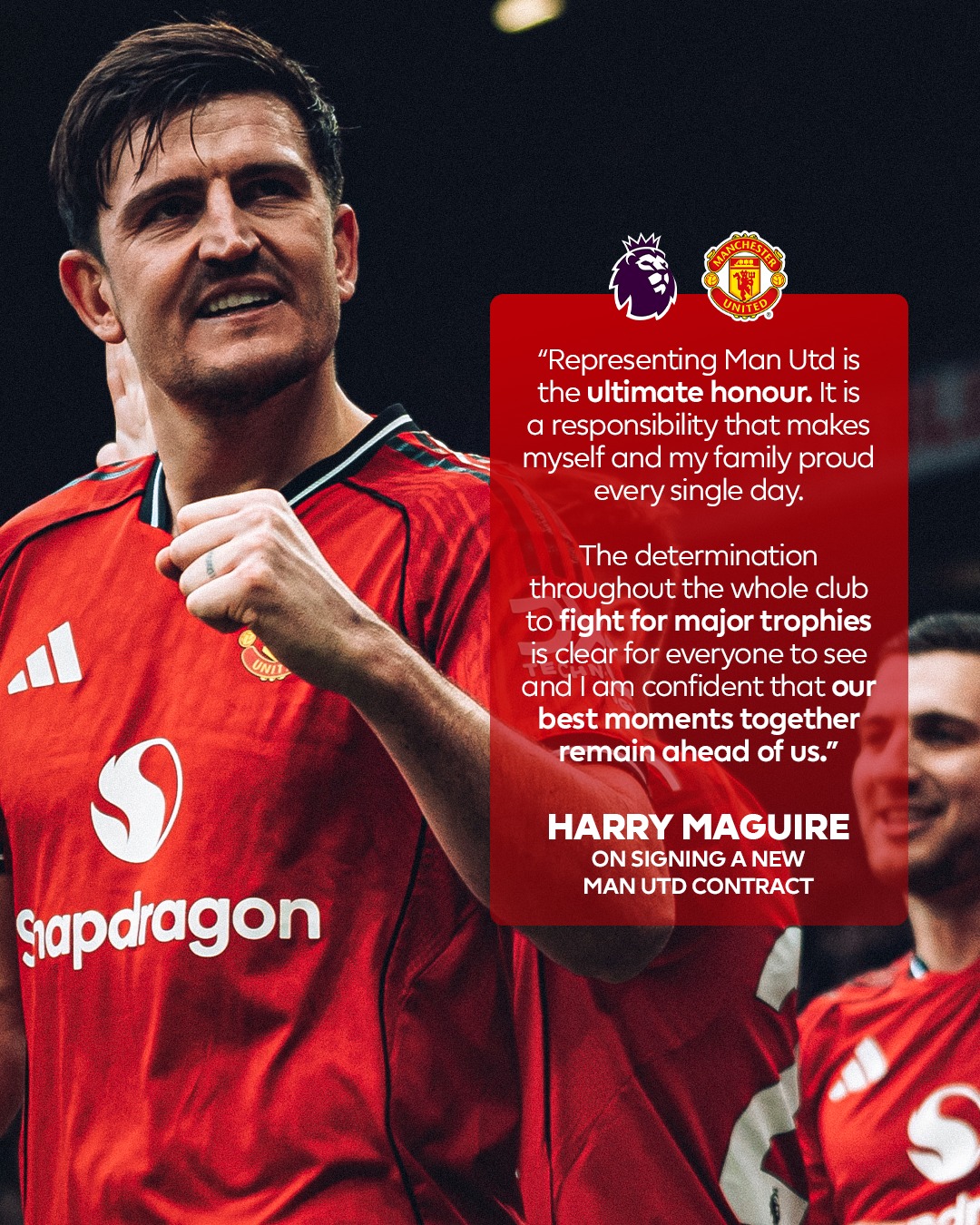
Manchester United centre-back, Harry Maguire, has signed a new contract with the football club for an additional year.
He will remain at the Theatre of Dreams until June 2027, with the option for a further year, a statement from the Red Devil said.
“Representing Manchester United is the ultimate honour. It is a responsibility that makes me and my family proud every single day.
“I am delighted to extend my journey at this incredible club to at least eight seasons and continue to play in front of our special supporters to create more amazing moments together.
“You can feel the ambition and potential of this exciting squad. The determination throughout the whole club to fight for major trophies is clear for everyone to see, and I am confident that our best moments together remain ahead of us,” the club’s former captain stated.
“Harry represents the mentality and resilience required to perform for Manchester United. He is the ultimate professional who brings invaluable experience and leadership to our young, ambitious squad.
“Harry, like everyone at the club, is completely determined to help Manchester United to achieve regular and sustained success,” the Director of Football at Manchester United, Mr Jason Wilcox, was quoted as saying in the statement.
The Three Lions defender has made 266 appearances and won the Carabao Cup and Emirates FA Cup since joining the club in 2019.

European club football enters its decisive quarter-final phase in the UEFA Champions League, Europa League, and Conference League. With semi-final places on the line, the first-leg fixtures promise high-intensity clashes. All matches will be broadcast live on SuperSport, available on DStv and GOtv.
Champions League: Heavyweights Collide
At 8:00 PM, Real Madrid host Bayern Munich in the standout tie of the round. Both sides were emphatic in the previous stage, with Madrid dismantling Manchester City and Bayern delivering a dominant performance against Atalanta. The match airs live on SS Premier League (GOtv Ch. 65, DStv Ch. 203).
Madrid arrive off a disappointing domestic setback, while Bayern continue to show resilience and attacking firepower. The Bernabéu will be central to Madrid’s hopes against a side currently scoring with ease.
Also at 8:00 PM, Sporting Lisbon face Arsenal in Lisbon, live on SS Football Plus HD (DStv Ch. 202). Arsenal come into the tie under pressure following consecutive cup losses in the Carabao and FA Cups, while Sporting are full of confidence after an impressive run of form. With momentum firmly on the Portuguese side, this fixture presents a significant test of Arsenal’s mentality.
At 8:00 PM on Wednesday, Barcelona welcome Atletico Madrid in what promises to be a tightly contested tactical encounter. The game will be shown live on SS Premier League (GOtv Ch. 65, DStv Ch. 203). Barcelona claimed a recent league victory between the sides, but Atletico have already proven their ability to disrupt them this season. Expect a high-stakes contest between two teams who know each other well.
Also at 8:00 PM, Paris Saint-Germain take on Liverpool in Paris, live on SS Football Plus HD (DStv Ch. 202). PSG have emerged as one of the competition’s most dominant sides, carrying strong momentum into the tie. Liverpool, meanwhile, arrive under pressure following a heavy domestic defeat and will need a significant improvement to remain competitive heading into the second leg.
Europa & Conference League: Thursday Night Stakes
While the Champions League dominates midweek headlines, Thursday brings its own high-stakes quarter-final action across the UEFA Europa League and UEFA Conference League.
In the Europa League, Bologna host Aston Villa in a compelling first-leg encounter, live on SS La Liga (GOtv Ch. 62, DStv Ch. 204) at 8:00 PM, . Aston Villa have impressed throughout the competition and arrive well-rested, while Bologna’s path to this stage has been defined by resilience and high-intensity performances. The contrast in preparation could shape the outcome.
Also at 8:00 PM, FC Porto face Nottingham Forest, with the match airing on SS Premier League (GOtv Ch. 65, DStv Ch. 203). Porto will look to assert themselves at home after previous meetings between the sides, while Forest have already demonstrated their ability to navigate difficult knockout ties.
For the Conference League, Crystal Palace take on Fiorentina at Selhurst Park, live on SS Football (GOtv Ch. 61, DStv Ch. 205) at 8:00 PM. Palace continue their pursuit of European silverware against a Fiorentina side balancing continental ambition with inconsistent domestic form. The hosts will aim to build a first-leg advantage before the return fixture in Italy.
Quarter-Final Fixtures – First Legs
UEFA Champions League
-
Real Madrid vs Bayern Munich – Tue, 8:00 PM (SS Premier League)
-
Sporting Lisbon vs Arsenal – Tue, 8:00 PM (SS Football Plus HD)
-
Barcelona vs Atletico Madrid – Wed, 8:00 PM (SS Premier League)
-
Paris Saint-Germain vs Liverpool – Wed, 8:00 PM (SS Football Plus HD)
UEFA Europa League
-
Bologna vs Aston Villa – Thu, 8:00 PM (SS La Liga)
-
FC Porto vs Nottingham Forest – Thu, 8:00 PM (SS Premier League)
UEFA Conference League
-
Crystal Palace vs Fiorentina – Thu, 8:00 PM (SS Football)
Follow the Action
Catch all the UEFA Champions League, Europa League, and Conference League action live on SuperSport on DStv and GOtv. Matches are also available to stream via DStv Stream and GOtv Stream. Manage or upgrade your subscription via the MyDStv or MyGOtv apps, visit www.dstv.com or www.gotvafrica.com, or dial *288# to stay connected.
-
 Feature/OPED6 years ago
Davos was Different this year
-
Travel/Tourism10 years ago
Lagos Seals Western Lodge Hotel In Ikorodu
-

 Showbiz3 years ago
Estranged Lover Releases Videos of Empress Njamah Bathing
-
 Banking8 years ago
Sort Codes of GTBank Branches in Nigeria
-

 Economy3 years ago
Subsidy Removal: CNG at N130 Per Litre Cheaper Than Petrol—IPMAN
-

 Banking3 years ago
Sort Codes of UBA Branches in Nigeria
-

 Banking3 years ago
First Bank Announces Planned Downtime
-

 Sports3 years ago
Highest Paid Nigerian Footballer – How Much Do Nigerian Footballers Earn