
Technology
9% Communications Tax May Affect 20m Nigerians—ATCON



By Modupe Gbadeyanka
Senate President, Mr Bukola Saraki, has been informed that if the nine per cent Communications Service Tax bill currently before the upper legislative chamber of the National Assembly is passed into law, it may deprive about 20 million Nigerians access to telecommunications services in the country.
This warning was made when the Association of Telecommunication Companies of Nigeria (ATCON) paid a courtesy visit to Mr Saraki.
In a statement issued on Saturday in Lagos by ATCON president, Mr Olusola Teniola, the association appealed to the Senate to use its powers to reduce tax to 0.2 percent from nine percent.
“ATCON’s mandate is to make meaningful input to all aspects of economic development, including legislation and management of telecommunications industry, so it continues to oil growth and development.
“The ongoing work on the proposed nine per cent Communication Service Tax Bill is a trending subject.
“We will be happy to support government to make the best of our tax efforts, which certainly are key components of strengthening the economy and sustaining our industry.
“Contrary to uninformed opinions; we do not object to reforms in taxation, neither do we regard taxes as burden.
“We ask for a reconsideration of the CST Bill, we recommend, as an alternative, a tax reform that increases the current VAT by a new one per cent added for the purpose of development of communications.
“Another alternative is that the tax being proposed in the Bill be limited to 0.2 per cent,” the group said in the statement.
Mr Teniola further said “there is severe over taxation in our industry. It explains the slow penetration of services into areas yet to be covered by our services across the country.”
He said, “Contrary to popular belief, telecommunication operators and service providers are barely sustaining existence in these times.
“There are reasons to suggest that the desire to widen the tax net is laudable and that as things stand telecommunications is about one of the few areas where the net-capture may be widened.
“We, therefore, suggest that an increase in VAT tax, which is already included in all services of telecommunications by an increase that is not beyond one per cent will be a good reform strategy.”
In his response, the Senate President assured ATCON that the red chamber would look into the requesting, describing the telecommunications sector as critical to the nation’s economy.
“The ICT sector is critical to the Nigerian economy; as a result, the Senate will never make laws that will push the sector into a negative performance.
“Rather, the Senate will make laws that will increase its performance to generate revenue and create jobs.”






By Aduragbemi Omiyale
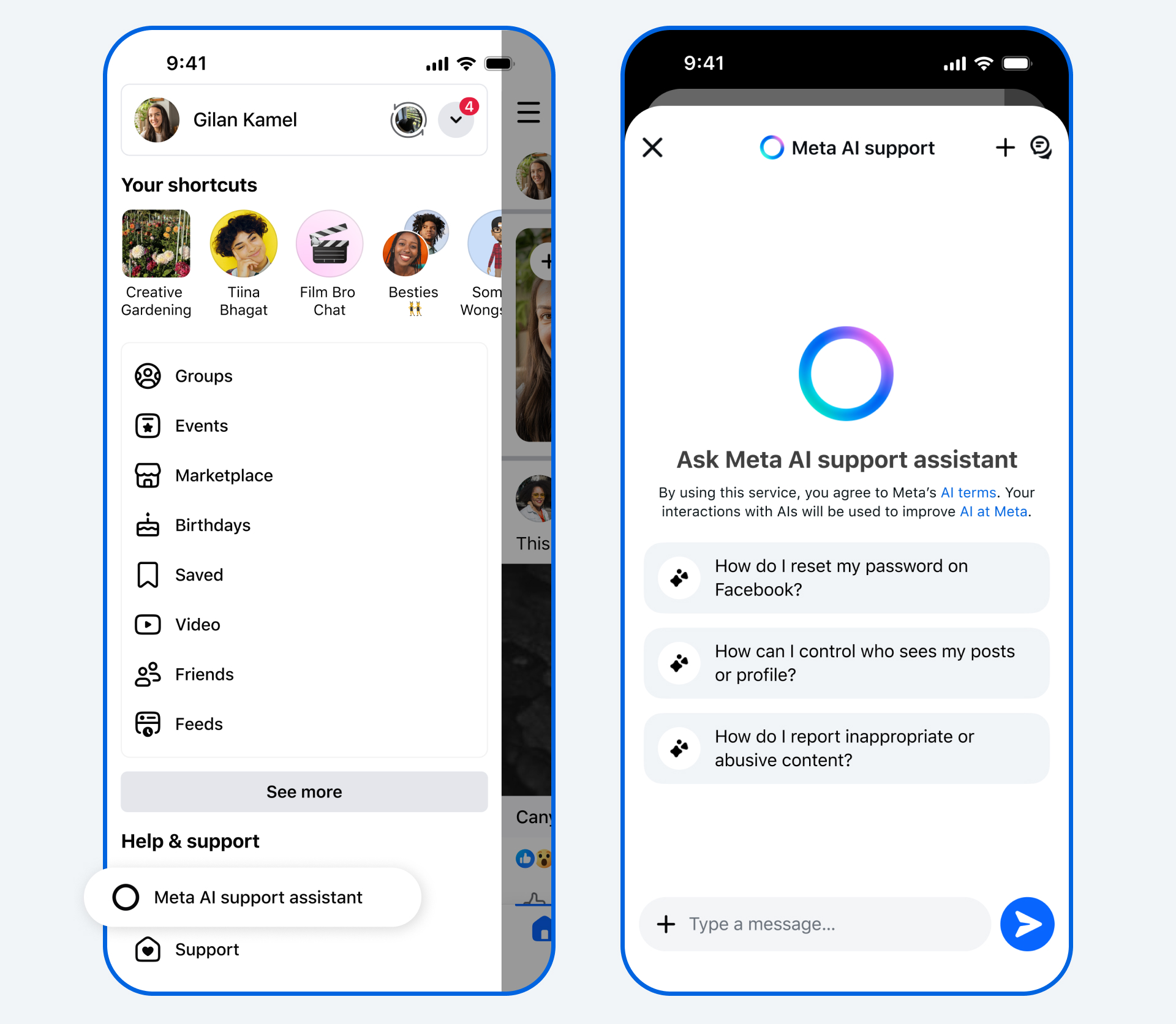
New Artificial Intelligence (AI) tools designed to provide support for users of its applications have been launched by Meta.
The AI Support Assistant will work on the Facebook and Instagram apps, the company said in a statement.
The tools will help users to receive reliable and action-oriented assistance when needed.
In December, the Meta AI support assistant, a tool designed to provide reliable, 24/7 support for nearly any support issue at any time, was previewed.
Now, Meta is rolling it out globally on the Facebook and Instagram apps for iOS and Android, and within Help Centre on Facebook and Instagram on desktop, with even more capabilities and ways to help.
The new Meta AI support assistant is designed to help resolve account problems from start to finish. It offers answers for any question, like notification settings or new features, and can also take action for users on a growing set of requests directly within Facebook and, in the future, on Instagram.
The feature can report scams, impersonation accounts, or problematic content, make it easier to see why content was taken down, provide appeal options, track what happens next, manage privacy settings, reset passwords, and update profile settings.
The Meta AI support assistant can respond to requests typically in under five seconds, dramatically reducing wait times compared to traditional help centre searches or seeking answers on external websites.
“The Meta AI support assistant is a major step in our work to deliver stronger support on our apps. In fact, among people who have provided feedback, the majority report a positive experience with the Meta AI support assistant. It’s rolling out now in all languages supported by Facebook and Instagram for support topics.
“We’re continuing to invest in AI- powered tools to make support more accessible, reliable, and effective — and we’ll keep evolving the Meta AI support assistant as more people use it and as the technology advances, so it continues to improve over time,” the organisation disclosed.
Meta has also deployed AI to improve content enforcement to help users reduce the chance that scammers trick people into giving away their login details, ultimately finding and mitigating 5,000 scam attempts per day that no existing review team had caught before.
Meta said over the next few years, it would be deploying these more advanced AI systems across its apps once they consistently perform better than its current methods of content enforcement, transforming its approach.
“As we do this, we’ll reduce our reliance on third-party vendors for content enforcement and focus on strengthening our internal systems and workforce.
“While we’ll still have people who review content, these systems will be able to take on work that’s better-suited to technology, like repetitive reviews of graphic content or areas where adversarial actors are constantly changing their tactics, such as with illicit drug sales or scams,” it stated.

By Modupe Gbadeyanka
As part of its commitment to celebrating and rewarding creativity, Facebook has updated its guidance, with clear definitions of what counts as original and unoriginal content.
In a message on Monday, the social media platform said it was offering content creators new tools to report impersonation.
Launched last year, the content protection tool is expanding beyond detecting reel matches across Meta platforms to now also flag potential impersonation.
Creators can take action on content theft and easily submit impersonation reports all in one place.
Facebook, in the statement received by Business Post, said creators can check for access to content protection in their professional dashboard or apply for access here.
The platform also disclosed that in 2025, it removed over 20 million accounts impersonating large content creators, and impersonation reports related to large content creators dropped by 33 per cent.
Further, Facebook is deprioritising unoriginal content by making sure they do not perform well on its platform.
It noted that content that is duplicated from other sources or makes low-value changes to someone else’s content may see significantly reduced reach, and accounts that primarily post unoriginal content may lose eligibility for recommendations and monetisation.
It was emphasised that “these changes provide creators who post original content with greater reach and monetisation opportunities, provide stronger protections for their work, and reduce the reach of unoriginal content.”


By Dipo Olowookere
A new high-density appliance that enables enterprises to scale cloud-managed physical security without forcing cloud-only storage or infrastructure replacement has been launched by a global leader in enterprise physical security software, Genetec.
The product, Cloudlink 2210, was designed for complex, enterprise-scale deployments and supports multiple workloads, including video management, access control, and intrusion detection, in a single appliance. By consolidating these workloads into one appliance, it reduces system sprawl, simplifies management in large-scale environments, and lowers operational overhead.
Unlike solutions that separate workloads across multiple proprietary systems, Genetec Cloudlink 2210 is built on an open architecture that supports a wide range of third-party devices, including cameras, access control systems, and intrusion panels. This enables organisations to modernise at scale within a unified, cloud-managed model designed to preserve architectural flexibility, while securely integrating existing hardware, maintaining business continuity, and reducing migration risks.
The company disclosed that Cloudlink 2210 also supports hundreds of connected devices per appliance and provides up to 240 TB of local storage per unit, making it well-suited for deployments with high device density and long retention policies. The Cloudlink 2210 is ideal for enterprise environments where uptime and local retention requirements are operational priorities because its design minimises dependence on cloud storage, helping organisations control long-term storage costs while maintaining the performance and availability required in enterprise environments.
The new product also incorporates hardware-level resiliency to support strict uptime and retention requirements. RAID-protected storage and redundant system components help ensure data protection and OS availability. Security workloads continue operating locally, independent of cloud connectivity, allowing deployments to maintain continuity even during network disruptions. Dual network interfaces provide redundancy and support network isolation to strengthen cybersecurity.
It scales by adding units as requirements grow, enabling organisations to increase device counts and storage capacity without redesigning their infrastructure. Centralised cloud management maintains visibility and control across deployments.
Genetec Cloudlink 2210 is part of the broader Genetec approach to deployment flexibility. The cloud-managed appliance portfolio enables organisations to operate on premises, in the cloud, or across hybrid environments based on their operational and regulatory requirements. By combining high-performance local processing and storage with centralised cloud operations and management, Cloudlink 2210 supports scalable, cloud-managed deployments without compromising control or performance.
The Product Director for Unified Solutions at Genetec Incorporated, Mr Christian Chenard Lemire, said, “Enterprises don’t want to choose between innovation and operational certainty.
“With Cloudlink 2210, we’re redefining what cloud-managed physical security looks like at scale by giving organisations the freedom to modernise on their own terms, control long-term costs, and maintain the resiliency and continuity their most critical environments demand.”













-
 Feature/OPED6 years ago
Davos was Different this year
-
Travel/Tourism10 years ago
Lagos Seals Western Lodge Hotel In Ikorodu
-

 Showbiz3 years ago
Estranged Lover Releases Videos of Empress Njamah Bathing
-
 Banking8 years ago
Sort Codes of GTBank Branches in Nigeria
-

 Economy3 years ago
Subsidy Removal: CNG at N130 Per Litre Cheaper Than Petrol—IPMAN
-

 Banking3 years ago
Sort Codes of UBA Branches in Nigeria
-

 Banking3 years ago
First Bank Announces Planned Downtime
-

 Sports3 years ago
Highest Paid Nigerian Footballer – How Much Do Nigerian Footballers Earn