World
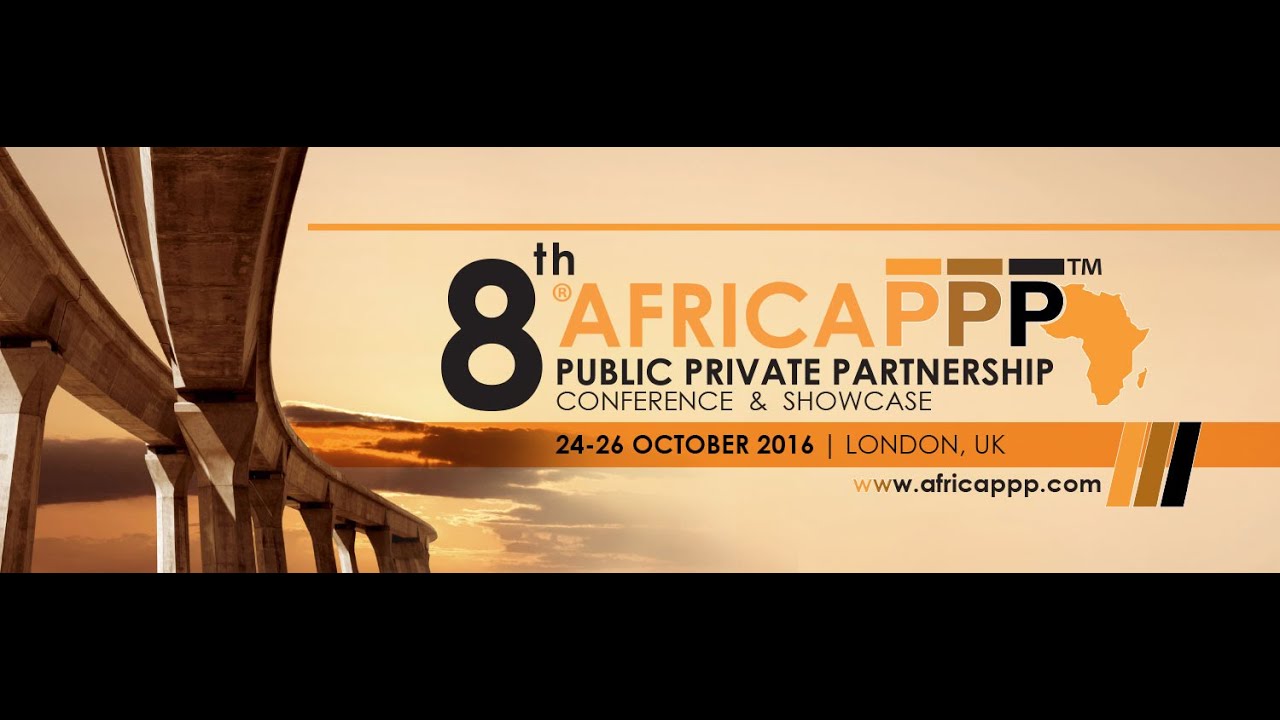
Africa PPP Conference Holds October In London
By Dipo Olowookere
Since its inception in 2009, the Africa Public Private Partnership Conference and Showcase (Africa PPP) has become the definite platform for discussing, informing and instigating the successful implementation of PPPs across the continent.
The 8th edition of Africa PPP will once again showcase investment opportunities and planned infrastructure development projects from across Africa.
Organised by AME Trade, the event will take place from the 24 – 26 October 2016 at the Radisson Blu Hotel, London, UK, building on the success of the previous editions which have been held in Tunis, Nairobi, Abuja, Johannesburg, Abidjan and London.
Watch the industry highlights from the speakers’ interviews: http://apo.af/HoIEB5
Based on the outcomes from the 2015 event, the conference programme will focus on the following key topics:
Harmonisation in PPP Policies and Regulatory Frameworks
Best Practice Scenarios – Successful PPPs in Africa – Case Studies
Investing in Infrastructure – Financing PPPs
Project Preparation Facilities – Expediting Bankable PPPs
Lessons from India – The World’s largest PPP market
Working towards Integrated PPPs
Focus Session – Opportunity Showcase of Investable Infrastructure Projects
Risk and Reward – Why PPPs need to continue to grow
“The quality of discussions has been excellent. There were ministerial people and parliamentarians in attendance and it is that caliber of people that attend these particular conferences, they come here to learn to be able to go back to their countries and take the best practices scenario’s back,” Senior Project Advisor PPP, National Treasury, South Africa.
This edition of the event is host to an excellent line-up of speakers and nine PPP units from Senegal, Egypt, South Africa, Uganda, Mali, Ethiopia, Kenya, Cameroon and Nigeria would be showcased.
Confirmed speakers are:
Ibrahima Fall, Director of Fundings and Public-Private Partnerships, Ministry for Investments Promotion and Partnerships, Senegal
Stanley Kamau, Director, PPP Unit, Ministry of Finance, Kenya
James Aiello, Senior Project Advisor, PPP Unit, National Treasury, South Africa
Atter Ezzat Hannoura, Director PPP Control Unit Ministry of Finance, Egypt
Paul Horrocks, Lead Manager, Private Investment, OECD
Aboubacar Guissé, Technical Adviser on Legal Issues and Institutional, Ministry of Investment Promotion and Private Sector, Mali
Romain Py, Head of Transactions, AIIM
Eng M C Munodawafa, Chief Executive Officer, Zambezi River Authority
John Seed, Head of Infrastructure Finance, Europe, Russia & Africa, Mott MacDonald
Abebe Tadesse, Senior Expert and ISP-PPP Coordinator, Ministry of Finance and Economic Cooperation, Ethiopia
Jack van der Merwe, CEO, Gautrain Management Agency
William Dachs, COO, Gautrain Management Agency
Rafael Perez Feito, International Operations Director, FCC Aqualia
Ekow Coleman, Senior Investment Officer, Ghana Infrastructure Investment Fund (GIIF)
Joan Miquel Vilardell, Partner, AGL Transportation Infrastructure and Logistics
Ziria Tibalwa Waako, Director, Technical Regulation, Electricity Regulatory Authority Uganda
Sheila Galloway, Group CEO, Utho Capital (Pty) Ltd
Dominique Ndong, General Co-ordinator, Investment Promotion & Majore Projects Agency (APIX)
Heleen Goussard, Associate, Riscura
Hoda Moustafa, Regional Head – Africa, MIGA
Jacqueline Odula-Lyakurwa, Activities Co-ordinator, African Development Institute, African Development Bank
Alex Katon, Executive Director, Infraco Africa Ltd
Chidi K.C. Izuwah Snr, Executive Director, The Presidency, Infrastructure Concession Regulatory Commission
Junglim Hahm Regional Program Leader, East & South Africa, Middle East, Public Private Infrastructure Advisory Facility (PPIAF)
Hannes van Wyk, Managing Director, Toll Infrastructure Services
Jean-Noël Ekoman Ekoman, Technical Expert, Support Council for the Realization of Partnership Contracts (CARPA)
François Serres, Lawyer, Francois Serres & Associates
Tony Clamp, PPP Expert, Compass Infrastructure
Matthew Rees, Deputy Coordinator, Power Africa, USAID
Chinyelu Oranefo, Senior Associate, Nabarro LLP
Gori Olusana Daniel, Lead Transaction Advisor, Africa PPP Advisory
Senator Udoma Udo Udoma, Honorable Minister, Ministry of Budget and National Planning, Federal Republic of Nigeria
Beatrice Florah Ikilai, Acting Director, PPP Unit, Ministry of Finance Planning and Economic Development
Tom Minney, African Growth Partners
APPP 2016 is an ideal match-making platform for both project sponsors and financiers to explore options for increasing infrastructure development via PPPs.
Register as a delegate online (http://APO.af/jADS4u) or request brochure (http://APO.af/99qtoI) for more information.
World
Nigeria Leads Africa in Equity Funding as Startup Investment Hits $254m in H1 2026
By Adedapo Adesanya
Nigeria regained its position as Africa’s leading destination for equity startup investment in the first half of 2026, raising $214 million in equity financing and a total of $254 million across equity and debt, according to the latest Africa: The Big Deal report.
The report, titled H1 2026: Mapping the Money, showed that Nigeria ranked second on the continent in total funding, behind Egypt, which attracted $327 million, while Kenya and South Africa followed with $126 million and $83 million, respectively.
However, the report noted that Egypt’s top position was largely driven by a single fundraising by electric mobility company Spiro, which secured $327 million, including $270 million in equity and $57 million in debt. Excluding debt financing, Nigeria emerged as Africa’s largest equity funding market in the first six months of the year.
According to the breakdown by Africa: The Big Deal, Nigeria’s equity funding of $214 million was higher than Egypt’s $183 million, while South Africa and Kenya attracted $66 million and $46 million, respectively.
Beyond funding value, Nigeria also led the continent in the number of startups that raised at least $100,000 during the review period, reclaiming the top spot after what the report described as an “underwhelming” second half of 2025.
The publication observed that Nigeria’s fundraising performance has remained relatively stable over the past few years and exceeded the $250 million mark for the first time since 2022, pointing to renewed investor confidence in the country’s startup ecosystem.
It also found that while the Big Four startup markets—Nigeria, Egypt, Kenya and South Africa—continued to dominate Africa’s investment landscape, their combined share of total funding stood at 58 per cent in the first half of 2026.
“Zooming back on the Big Four (110 out of 190 $100k+ deals, i.e. 58%), Nigeria is head and shoulders above its peers, with Egypt and Kenya almost tying, and South Africa in fourth position again,” the report noted.
The report highlighted contrasting performances among the continent’s largest startup ecosystems. While Nigeria and Egypt maintained strong funding momentum, Kenya recorded its weakest funding performance since early 2021 after a strong second half of 2025, and South Africa failed to attract $100 million in funding during the period despite leading the continent a year earlier.
Africa: The Big Deal also noted a broader shift in investor behaviour, with funding increasingly concentrated in larger transactions while early-stage investments continued to decline. According to the publication, the drop in smaller funding rounds reflects growing concerns about limited capital available for early-stage startups across Africa.
World
SCRYPT Expands Stablecoin Settlement Infrastructure to East Africa
By Aduragbemi Omiyale
Accessing the US Dollar in the East Africa region has now been made easier with the expansion of the stablecoin settlement infrastructure of SCRYPT.
This development enables banks, payment providers and corporate treasury teams to move value into and out of the continent in real time.
Businesses paying international suppliers frequently have to convert local currency into USD before purchasing stablecoins for settlement, incurring FX conversions and spreads before any payment is made.
But SCRYPT is eliminating this intermediate conversion by enabling direct settlement corridors for local African currencies into stablecoins.
This development allows businesses to move from local currency to stablecoin settlement in a single licensed transaction, without first sourcing rationed bank dollars, as stablecoins are increasingly becoming settlement infrastructure rather than an investment product.
The expansion adds settlement support across four African currencies: the Kenyan shilling (KES), Tanzanian shilling (TZS), Rwandan franc (RWF) and Ugandan shilling (UGX). Each corridor is delivered through the same full-stack infrastructure our clients already use for trading, custody and treasury operations.
Speaking on this, the chief executive of SCRYPT, Norman Wooding, said, “Across Africa, stablecoin adoption is driven by economic need, not speculation.
“Businesses here are not chasing yield; they are trying to pay suppliers and manage treasury without losing margin to a banking system that rations dollars. Licensed, fair-rate dollar access is the clearest proof of what this infrastructure is for.”
Also commenting, the Managing Director of Markets & Trading at SCRYPT, Mr Gabriel Titopoulos, said, “Until now, reaching stablecoins from local African currencies meant buying scarce dollars and incurring several layers of conversion costs.
“SCRYPT removes this friction. Firms and payment providers can now settle straight from local currencies through live corridors, with local partners.”
World
African Graduates Association Promoting Multifaceted Initiatives With Russian Educational Institutions
By Kestér Kenn Klomegâh
In preparations for the third Russia-Africa Summit, scheduled for late October 2026, Dr Francois Ngan, deputy chairman of the Union of Associations of African Graduates of Soviet and Russian Universities, during an official working visit, has held a consultative meeting with Professor Vladimir Filippov, the President of the Russian University of Peoples’ Friendship (RUDN), and former Minister of Higher Education of Russia, Chairman of the National Commission for Accreditation of Higher Education.
RUDN is an educational institution established in 1960, primarily to provide higher education to Third World students. It has now become a popular multidisciplinary spot for many students, especially from developing countries. The university offers various academic programmes and has research infrastructure that comprises laboratories and interdisciplinary centres. The university is named after the former Congolese leader, Patrice Lumumba.
Dr Francois Ngan and Professor Filippov discussed the importance of the Graduates Association as a continental platform dedicated to strengthening unity, cooperation, and promoting shared progress among African graduates who studied in the former Soviet Union and in the Russian Federation. They also reviewed multifaceted initiatives that could bring together alumni associations from across Africa, whose members obtained education and professional training, and cultural experiences in Soviet and Russian institutions of higher learning.
Professor Filippov expressed optimism in addressing emerging challenges as a result of shifting geopolitical changes, emphasised strategic cooperation in the educational sphere with Africa, in general, and with the Republic of Cameroon, in particular, and further about the integration of African students during their studies in the Russian Federation.
The meeting also touched on academic and scientific work, the possibility of rewriting a scientific thesis, and the official organisation of transferring versions translated into six languages for the library of RUDN. Significant questions relating to Russia’s educational opportunities, collaborations and partnerships involving African countries were thoroughly discussed.
The Union of Associations of African Graduates of Soviet and Russian Universities was created under one continental umbrella to promote friendship, for professional networking, to engage in cultural exchange, and with particular emphasis on forging strategic cooperation between Africa and Russia.