World
BRICS New Development Bank Battling Multipolar Challenges
By Kestér Kenn Klomegâh
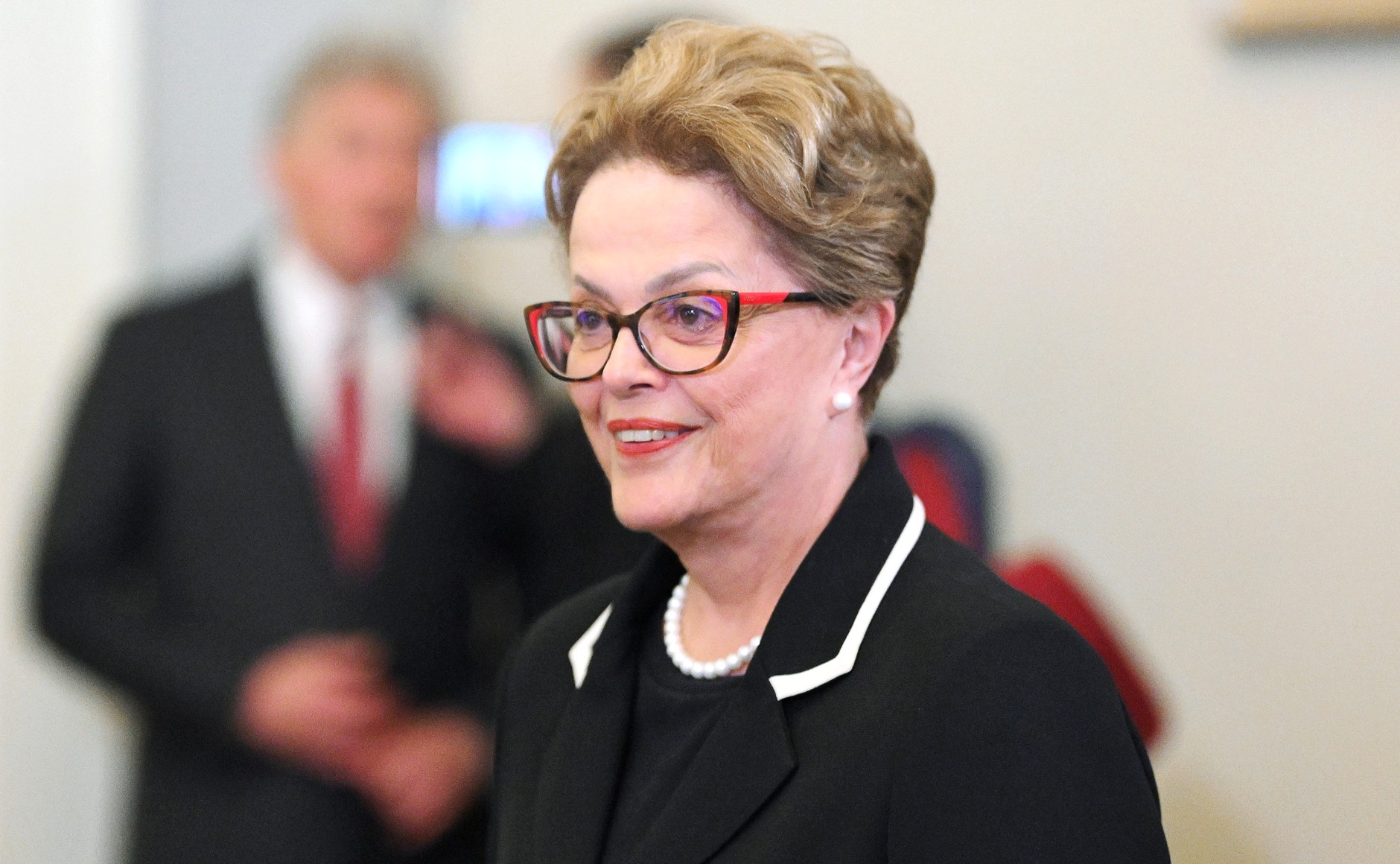
On the sidelines of the St Petersburg International Economic Forum (SPIEF), Russian President Vladimir Putin has held a working discussion with Dilma Rousseff, President of the New Development Bank (NDB) established by BRICS countries. According to official reports made available by the Kremlin, Putin urged the bank to consider seriously the adoption of new financial payment systems and the possibility of settlements in national currencies.
“There are issues that require special attention. I mean the expansion of the possibility of settlements in national currencies, and further joint efforts to create a digital platform for settlements and investments,” Putin stressed in his comments at the meeting, and reminded that this question was thoroughly discussed at the last summit of BRICS leaders in Kazan, Tatarstan.
While congratulating her re-election to the position of the head of the New Development Bank, which implies that all members of the bank highly appreciated her work, Putin further underlined that currently the New Development Bank (NDB) has approved and financed approximately 120 projects worth US$39 billion.
In her brief response, Dilma Rousseff, President of the New Development Bank (NDB), informed and confirmed the fact that the Russian Federation proposed her candidacy for re-election as the NBR president. “For my part, I will do everything possible and make every effort to fulfil my duties in this post as best as possible,” Rousseff told Putin in the presence of the Deputy Chief of Staff of the Presidential Executive Office Maxim Oreshkin, Finance Minister Anton Siluanov, and Central Bank Governor Elvira Nabiullina.
Established in 2015 by the BRICS leaders, the New Development Bank (NDB) has since faced multitude of challenges, especially now with geopolitical changes and emerging economic hurdles. “Of course, we face a number of challenges. These are mutual settlements in national currencies, as well as the creation of digital platforms for the implementation of mutual settlements, including in local currencies. Currently, there are various mechanisms that make it possible to tokenize mutual settlements,” explained Dilma Rousseff, President of the New Development Bank.
Rousseff, in addition, referred to the second very important issue, including the expansion of member countries of the international development bank, as well as the addition of new members partners of the bank. Two countries have already been selected as new members: Uzbekistan and Colombia. And two more countries are still under consideration: Ethiopia and Indonesia.
According to media reports, other multilateral development institutions, including the World Bank, have expressed an intention to work together with the NDB. In September 2016, NDB and World Bank Group signed a memorandum of understanding on cooperation and it was announced that the NDB and WBG’s cooperative efforts focusing primarily on infrastructure development in BRICS member countries.
The New Development Bank (NDB), formerly referred to as the BRICS Development Bank, is a multilateral development bank established by the BRICS (Brazil, Russia, India, China, and South Africa). According to the agreement on the NDB, “the Bank shall support public or private projects through loans, guarantees, equity participation and other financial instruments.” Moreover, the NDB “shall cooperate with international organizations and other financial entities, and provide technical assistance for projects to be supported by the bank.”
In May 2022, the New Development Bank set up a regional office in India in the state of Gujarat with the goal of financing and observing infrastructure projects in both India and Bangladesh. In May 2023, Saudi Arabia expressed its intention to join the NDB. The bank is headquartered in Shanghai, China. The first regional office of the bank was opened in Johannesburg, South Africa in 2016. Subsequently, regional offices were established in São Paulo in Brazil, Ahmedabad in India and Moscow in the Russian Federation.
World
CANAL+ Eyes MultiChoice Turnaround as Stocks Debut on JSE
By Adedapo Adesanya
CANAL+ has expressed confidence in its ability to turn around the fortunes of struggling broadcaster MultiChoice as it marks a milestone by becoming the first French company listed on the Johannesburg Stock Exchange (JSE).
The secondary listing of CANAL+ signals strong international confidence in South Africa’s capital markets and reinforces the JSE’s role as a conduit between global capital and African growth opportunities, it said in a statement.
CANAL+ enhances the JSE’s sectoral diversity and provides local investors with direct, rand-denominated exposure to a globally diversified media and entertainment business with a significant African footprint. CANAL+ listed on the London Stock Exchange in December 2024.
The group’s listing on the JSE aligns with its long-term strategy to expand its presence in high-growth markets, particularly in sub-Saharan Africa, where rising connectivity, a young and growing population (expected to increase by 800 million by 2050), strong GDP growth (4.5 per cent growth expected between 2026 and 2030) and accelerating demand for content and connectivity continue to drive sector growth.
The JSE listing will increase CANAL+ liquidity and enable African investors to benefit from CANAL+ growth.
According to Mr Maxime Saada, CEO of CANAL+ said, “Joining the Johannesburg Stock Exchange is a statement of our ambition and illustrates our belief in Africa’s future and its creative industry.
“We are proud to become the first French company ever to list in Johannesburg and the only global media and entertainment company listed on the exchange.
“Following our listing on the London Stock Exchange 18 months ago, this dual listing reinforces our ambition to be a bridge between Europe and Africa and anchors our dual-continental approach, consolidating our unique position in the global media and entertainment industry,” he said.
He noted that CANAL+ serves more than 40 million subscribers and generates €9bn in annual revenue.
“Africa will be our growth engine for years to come, and we are dedicated to creating value on the continent and sharing it with our African partners, investors and the creative community. By welcoming African investors, we deepen our roots, diversify our investor base and lay the foundation for the next phase of our growth.”
Commenting on the listing, Ms Valdene Reddy, Group CEO of the JSE, said, “We are proud to welcome CANAL+ to the JSE and to mark the first listing of a French company on our exchange.
World
AfDB President Sees More African Nations Regaining Investment-Grade Ratings
By Adedapo Adesanya
The President of the African Development Bank (AfDB), Mr Sidi Ould Tah, says more African countries are likely to regain or achieve investment-grade credit ratings by next year as reforms begin to deliver results and economic growth accelerates.
Several African sovereigns have already been upgraded in recent months, including Nigeria. However, Nigeria is not yet near investment-grade status.
In May, S&P Global Ratings upgraded Nigeria’s sovereign credit ratings to ‘B’ with a stable outlook, citing structural reforms under President Bola Tinubu and key drivers like higher oil production and improved fiscal revenue.
The country is still five notches from investment-grade. Under S&P’s rating scale, the progression follows— B → B+ → BB- → BB → BB+ → BBB- (investment grade).
S&P raised Morocco to investment grade last year and increased South Africa by one level to BB in November. Ghana, Zambia, the Ivory Coast and Kenya have also benefited from positive rating action linked to fiscal, debt and economic reforms.
“We’re quite confident that the continent will continue to grow very strongly and that African countries will be better rated in the coming years,” Mr Ould Tah said in an interview with Bloomberg.
“We’ve seen Morocco receive investment grade during the last few months, and we expect other countries by next year to get toward that,” he added.
The outlook reflects improving fiscal positions and reforms implemented across countries on the continent, even as the conflict in the Middle East threatens to slow economic growth and raise costs for energy-importing nations. Better credit ratings can help countries borrow at lower rates and fund development projects.
The AfDB projects the continent’s gross domestic product expansion will accelerate to 4.4 per cent next year, if the conflict in the Middle East does not extend for a longer period. It expects the continent to slow to 4.2 per cent this year.
The war in Iran has benefited oil producers such as Nigeria, Angola and Gabon, while exerting pressure on the fiscal positions of net energy importers such as South Africa, Kenya, Ghana and Senegal.
Mr Ould Tah said the bank is ready to support countries facing budget constraints and high debt burdens due to the impact of the Iran crisis, including increasing credit lines to them.
“The board of directors of the bank will examine in the coming days how the bank can increase the volume of resources it will provide to its member countries in this specific situation,” he said.
World
State Duma Reviews Africa’s Food Security
By Kestér Kenn Klomegâh
Within the framework of the Expert Council on Africa at Russia’s State Duma, the lower chamber of parliamentarians, during its annual round-table conference, held in late May 2026, focused concretely on food security in Africa.
Under the chairmanship of Deputy Speaker of the State Duma, Alexander Babakov, the council’s round-table session on Russian-African cooperation in the field of ensuring food security, introduction of closed cycle technologies in agricultural and bioeconomy projects, was held in the State Duma.
Opening the meeting, Alexander Babakov noted the importance of continuing cooperation with African countries already in the new convocation of the State Duma, to which elections will be held in September 2026. “I am sure that right from the beginning of the work of the new convocation, the theme of cooperation between Russia and African countries will work as an example for circulation and use in other areas,” he said.
Member of the Committee on the Development of the Far East and the Arctic, deputy chairman of the Expert Council on Africa, Nikolai Novichkov, in his speech stressed the importance of a gradual transition to trade with African high-tech countries. “Our African partners are interested in producing and processing food locally, including earning a living on it,” the parliamentarian stated.
Director of the Department of Partnership with Africa at the Russian Foreign Ministry, Tatiana Dovgalenko, drew attention to the continued importance of the humanitarian component of Russian-African cooperation, which, despite efforts, “unforeseen, including and along the lines of specialised UN agencies, the number of hungry people in the world, according to experts, has been growing over the past few years.” According to Dovgalenko, the food crisis is localised in about 10 countries, four of which are in Africa.
As first deputy chairman of the Committee on International Affairs, Alexei Chepa noted, the food crisis and a number of other serious threats on the African continent are today exacerbated by a complex international situation, with the United States and Israel versus Iran causing rising energy prices worldwide. “This has also reflected on the cost of fertilisers that needed to be purchased previously. Even if prices fall in a few months, the yield still won’t. And there will be problems in Africa. At the same time, we understand that population growth in the coming years will be at Africa’s expense,” Chepa underlined in his contribution at the meeting.
Alexei Chepa also mentioned the special role of security enhancement in Africa, including in countering extremism and terrorism.
As part of the continuation of the work of the roundtable to promote cooperation with African countries in ensuring food security, the introduction of closed-loop technologies in agricultural and bioeconomics projects was discussed. As a traditional procedure, some recommendations are addressed to the Government of the Russian Federation.
In addition to representatives of the State Duma, diplomats, scientists, experts from related fields, representatives of the Government of the Russian Federation and the business community took part in the round-table discussion.
-
Feature/OPED6 years agoDavos was Different this year
-
Travel/Tourism10 years ago
Lagos Seals Western Lodge Hotel In Ikorodu
-
Showbiz3 years agoEstranged Lover Releases Videos of Empress Njamah Bathing
-
Banking8 years agoSort Codes of GTBank Branches in Nigeria
-
Economy3 years agoSubsidy Removal: CNG at N130 Per Litre Cheaper Than Petrol—IPMAN
-
Banking3 years agoSort Codes of UBA Branches in Nigeria
-
Banking3 years agoFirst Bank Announces Planned Downtime
-
Sports3 years agoHighest Paid Nigerian Footballer – How Much Do Nigerian Footballers Earn