World
Cameroon: Experts Urge Govt to Halt Violence Against Minority

By Dipo Olowookere
Two United Nations human rights experts have called on the government of Cameroon to exercise restraint and begin dialogue, amid rising attacks on peaceful protesters.
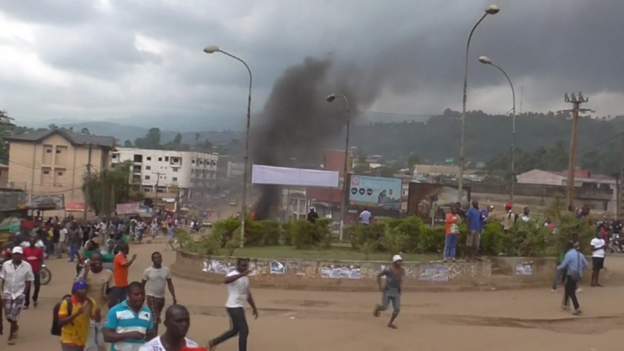
Special Rapporteurs Maina Kiai and Rita Izsak-Ndiaye said they were deeply concerned about the worsening violence in the north-west and south-west, which has included the use of force against English-speaking demonstrators protesting against the growing appointment of French-speaking civil servants in their regions.
Most of the protests have been led by regional bar associations and teachers’ unions.
English speakers have long complained that they face discrimination and marginalization, and are excluded from top civil service positions and public services. They also claim their access to justice is limited because the majority of legislation and judicial proceedings are in French.
“We call on the authorities to engage in a fruitful and inclusive dialogue with civil society, particularly the lawyers’ and teachers’ unions in Anglophone regions who are asking for bilingual public services and more inclusion of English speakers in the public sphere,” said the experts.
Mr Kiai, the Special Rapporteur on the rights to freedom of peaceful assembly and association, said he was particularly alarmed by reports that security forces used excessive force during demonstrations on 28 November in Buea and 8 December in Bamenda.
Sources say that police used live bullets to disperse protesters, leading to the death of at least four people. Dozens more were injured, arbitrarily arrested and allegedly tortured.
“I urge the Government of Cameroon to conduct a thorough investigation into the use of force against protesters in recent months, and to exercise the utmost restraint in policing future demonstrations,” Mr Kiai said.
“In democratic societies, demonstrations and protests are key to raising awareness about human rights, and political and social concerns, including those regarding minority issues,” he stressed. “Peaceful protests play a critical role in amplifying the voices of people who are marginalized, and present an alternative narrative to established political interests.”
The Special Rapporteur on minority issues, Rita Izsak-Ndiaye, who carried out an official visit to Cameroon in 2013*, said there were significant challenges over linguistic minorities. “When I visited Cameroon, discrimination against Anglophones was brought to my attention as a key area of concern in Bamenda, in particular in the areas of access to public posts and political office,” she noted.
Ms Izsak-Ndiaye called on the Government to address the concerns raised by the English speakers over the exercise of their linguistic rights, and to fully implement the State’s policy of official language bilingualism.
“Fulfilling the language rights of minorities is not only essential to prevent tensions from escalating further, but is also a fundamental element of good governance,” the Special Rapporteur emphasized.
The experts’ call for restraint and dialogue has been endorsed by the Special Rapporteur on the situation of human rights defenders, Michel Forst.
World
BRICS Facing Political Divergences, Suspends its Future Expansion
By Kestér Kenn Klomegâh
At the 12th Primakov Readings conference held in Moscow on June 24, Russia’s Foreign Minister, Sergey Lavrov, categorically emphasised that BRICS (Brazil, Russia, India, China and South Africa) has suspended its future ambitions of expansion, citing divergences and rising perceptions over emerging geopolitical changes between members of the BRICS association. BRICS has experienced tectonic appreciation for its latest expansion from five to ten members, and for creating ‘partner membership’ status for 13 countries. While this was considered a significant achievement under Russia’s chairmanship in 2024, it has now turned into an obstacle confronting BRICS.
Lavrov acknowledged this key obstacle, sharp differences and disputes, as tarnishing the image and hindering, to some degree, the progress of the BRICS association. Primakov Readings was held to underline one of its aspirations, that is, to advance the growing question of multipolarity. In order to make a noticeable headway in establishing a new world order, it is necessary to rope in the East and the Global South to denounce the “rules-based order” and hegemony of the United States and Europe. BRICS, thus, conveniently, provides a platform for these countries to raise their voice and interaction in multilateral institutions and organisations. Acting collectively, they could considerably participate and expectedly rise to the global stage.
In his speech, Lavrov reiterated that the United States and the West in general have not accepted the objective reality of an emerging multipolar world order. They prefer propping up their weakening positions by forcing others to side with them, imposing sanctions, enacting bans, issuing threats and taking other illegitimate measures to force the Global Majority to play their game.
Lavrov, however, raised his genuine criticism: The West persists in its refusal to abide by the universally recognised international norms as outlined in the UN Charter, and has never fully respected them, in fact, even if everyone signing and ratifying the Charter undertakes to fully comply with its norms in their entirety and interconnection. This includes the sovereign equality of states and non-interference in domestic affairs, as well as respecting and guaranteeing human rights regardless of race, sex, language, or religion, to quote the UN Charter.
To unlock the potential of new powerhouses in Asia, Africa, and Latin America, a comprehensive agreement was initiated between China and Russia, as staunch driving forces behind BRICS, to increase its numerical strength by proposing new membership for BRICS. It all started with a pretext by inviting South Africa to join BRICS in 2010, then, under Russia’s presidency in 2024, the association moved from five to ten, by total membership.
Nevertheless, after only a couple of years, the planned ‘membership drive’ ultimately proved to be an obstacle to be managed within the current framework of BRICS. For China and Russia, this is a matter of regulatory principle – apparently, it will certainly not produce any positive results. In the end, to logically suspend BRICS’ future expansion. Without mincing words, Lavrov noted this point clearly: “We continue to comprehensively develop them while trying to stimulate the trilateral RIC – Russia-India-China – group. That format was shaped about 30 years ago at the initiative of Yevgeny Primakov and formed the core of BRICS. In our associations, cooperation is based on mutual respect and readiness to search for consensus solutions even when this is a challenging task. These things happen, and quite often. But the solutions we eventually find are guaranteed to serve common interests. That is why the number of countries willing to join the operations of BRICS and the SCO keeps growing, namely, in Central and Southeast Asia, Africa and Latin America,” Lavrov said.
Mentioning BRICS during the Primakov Readings forum in late June 2026 was quite important, as Yevgeny Primakov anticipated the evolutionary social development trends during his time. After the collapse of the Soviet era in 1991, we can see that the number of BRICS member states has almost doubled. While explaining these latest developments, that the number of full members has increased from five to ten, Lavrov further pointed out that “this is not how it happened when BRIC accepted South Africa, and the addition of one country posed questions that needed to be clarified to ensure forward movement. When BRICS turned into a group of ten, it was decided to give the new members time to adjust to each other. I believe that it is a correct decision.”
During the meeting of the BRICS Council of Foreign Ministers in India, discussions were held, in practical terms, a difficult conversation between Iranian and Emirati members. This happened in the hottest period of the Gulf confrontation, but eventually, it was managed to coordinate a joint document, despite the highly emotional opinions expressed by both sides. This was one case in point.
But, according to Lavrov’s explanation, other examples go deeper, to clashing economic interests. That is why it has been decided against pushing for further expansion for a few years. But the partner countries attend these events, which is creating grounds for giving BRICS a more universal dimension.
As for the agenda, BRICS is not an organisation, but rather an informal association. This is its strong side, because it would be wrong to create a rigid structure, at least at the current stage, especially a global structure rather than a continental or regional one. Many find this confusing. At least Russia won’t propose formalising BRICS, with the same structural status as the United Nations (UN).
Interesting to note and remind here, in an interview with Sky News Arabia on September 20, 2024, Lavrov expressed scepticism but was straight to the point about the strategic expansion of BRICS. Under Russia’s BRICS presidency, five countries – Ethiopia, Egypt, Iran, Saudi Arabia and the United Arab Emirates became the second wave of the newest members to join BRICS.
Tracking down the history, operations and achievements, Lavrov acknowledged, in his interview, that BRICS is consolidating its positions and cooperating with some countries. At the same time, this association is facing serious challenges. It is necessary to promote collaboration based on a balance of interests, and most importantly, BRICS functions based on consensus. The consensus principle primarily aims at finding agreements that reflect the mutual accord of all participants. In practical terms, the more partners, the harder it is to search for accord. It takes more time to finalise any consensus-based agreement than a vote-based solution.
According to Lavrov, BRICS expansion has sparked debates and discussions over the past several years. The foreign minister indicated, and repeatedly explained, the “suspension” of membership in BRICS was primarily due to internal differences, perceptions and approach to geopolitical changes. As stipulated by the guidelines, there are no concrete criteria or rules for admission except using the flexible term “consensus” – a general agreement at summits, which was utilised in the selection process.
At the Primakov Readings, previously held in June 2024, the key point was an announcement by Sergey Lavrov over the ‘suspension’ of new membership. Then, in mid-June 2024, Lavrov hosted the BRICS Foreign Ministers Council in Russia’s Nizhny Novgorod. The BRICS Foreign Ministers decided to suspend admission of new members, and this step was reflected in the final documents.
At present, the annual agenda is determined by the rotating presidency of BRICS. However, practice shows that every successive presiding country strives to ensure continuity. For example, during India’s presidency, BRICS members have been actively working to implement the initiatives which Russia presented during the Kazan summit in autumn 2024. Therefore, it is true that many countries are willing to join the group, which is an inspiring fact. However, BRICS looks for new forms of partner engagement and will, most probably, expand the informal association again.
As a show of indivisible and close-partnered bilateral relationship, Russian President Vladimir Putin and Chinese leader Xi Jinping, without the least hesitancy, underlined this final decision to postpone BRICS expansion, at the summit in Kazan, capital of the autonomous Tatarstan Republic of the Russian Federation.
World
Africa Takes Centre Stage as Addis Ababa Hosts the World Public Summit
By Kestér Kenn Klomegâh
For the first time in its history, the World Public Summit will be held on the African continent. On 29–30 July 2026, Addis Ababa, the capital of Ethiopia, will host the World Public Summit. Africa — “A New World: Africa in Shaping a Shared Future.”
The Summit is organised by the World Peoples Assembly in cooperation with African partner organisations. It will bring together leaders of public diplomacy, representatives of international intergovernmental and non-governmental organisations, academics, experts, representatives of the education and cultural sectors, youth leaders, socially responsible businesses, media professionals, and civil society institutions from across Africa and other regions of the world.
The World Public Summit. Africa continues the work initiated during the First World Public Assembly “A New World of Conscious Unity,” held in Moscow in September 2025, and serves as one of the key milestones in preparation for the Second World Public Assembly “A New World: Values That Unite,” which will take place in Moscow on 18–19 September 2026.
Today, Africa is emerging as one of the principal centres of global development. Rapid demographic growth, expanding entrepreneurship, strengthening regional integration, rich cultural heritage, and the growing role of civil society institutions make the continent an increasingly important contributor to the future architecture of international cooperation.
The Summit will focus on issues of genuine sovereignty and sustainable development, public diplomacy, preservation of cultural and historical heritage, international cooperation in education and science, youth engagement, innovation-driven development, creative industries, and the formation of new partnerships among countries and peoples.
The main business programme of the Summit will take place on 30 July 2026 at the headquarters of the United Nations Economic Commission for Africa (UNECA) in Addis Ababa. Holding the Summit at UNECA highlights its pan-African dimension and creates opportunities for broad international dialogue on humanitarian cooperation and public diplomacy.
The programme will include plenary sessions, strategic dialogues, and expert panels dedicated to values-based development, education, culture, youth leadership, innovation, and international cooperation.
Participation has already been confirmed by Professor Saidou Madougou, Director of the Department of Education, Science, Technology and Innovation of the African Union; Rita Bissoonauth, Director of the UNESCO Liaison Office to the African Union and UNECA in Addis Ababa; Zuzana Schwidrowski, Director of the Macroeconomics, Finance and Governance Division of UNECA, as well as ministers, leaders of public organisations, and representatives of the business community from a number of African countries.
On the same day, the ADWA Victory Memorial Museum—Ethiopia’s national memorial complex dedicated to the Victory of Adwa and an important centre for preserving the historical memory of the Ethiopian people—will host the award ceremony of the regional stage of the V International Competition “Leader of Public Diplomacy”, followed by a large-scale cultural programme.
One of the key outcomes of the Summit will be the adoption of the African Communiqué, reflecting proposals and recommendations aimed at strengthening humanitarian, educational, cultural, and public cooperation between African countries and other regions of the world.
The outcomes, initiatives, and recommendations were developed during the World Public Summit. Africa will be presented at the Second World Public Assembly “A New World: Values That Unite”, to be held in Moscow on 18–19 September 2026.
According to Andrey Belyaninov, General Secretary of the World Peoples Assembly, “the Addis Ababa Summit is an important step toward building a new world founded on mutual respect, cultural diversity, dialogue and sustainable development.”
World
UK Set for Seventh Prime Minister in 10 Years as Keir Starmer Resigns
By Adedapo Adesanya
The United Kingdom will get its seventh Prime Minister in 10 years as Mr Keir Starmer announced his resignation on Monday.
The Minister said he is stepping down as leader of the governing Labour Party and will leave office within weeks, scarcely two years after being elected in a landslide.
Mr Starmer says he will remain caretaker prime minister until a new Labour leader is chosen by the party.
Mr Starmer made the announcement after facing growing pressure to hand over to a new leader who can try to revive the government’s flagging fortunes.
He led Labour to a landslide election victory in July 2024, but since then, his popularity and that of the party have plummeted.
His departure was triggered by the victory of Mr Andy Burnham in a special election last week. The popular ex-mayor of Greater Manchester planned to challenge the existing PM for the Labour leadership.
Mr Starmer made the announcement outside the prime minister’s 10 Downing St. residence with a brief statement on Monday.
“The question my party is asking now is whether I am best placed to lead us into the next general election,” Mr Starmer said. “I have heard the answer of my parliamentary party to that question, and I accept that answer with good grace.
Mr Starmer is the sixth prime minister in a decade to stand outside 10 Downing Street and announce a premature departure.
It comes the day before Britain marks the 10th anniversary of its vote to leave the European Union, a decision that still affects the country’s economy and politics.
Over the past decade, 10 Downing Street has had six occupants, including Mr David Cameron, who left office in 2016 after the Brexit referendum and was succeeded by Ms Theresa May. She was followed by Mr Boris Johnson, whose tenure covered Brexit and the COVID-19 pandemic. After Mr Johnson came Ms Liz Truss, whose 49-day premiership was the shortest in British history. Mr Rishi Sunak then took office before being succeeded by Mr Starmer, the outgoing occupant of Number 10.
-
Feature/OPED6 years agoDavos was Different this year
-
Travel/Tourism10 years ago
Lagos Seals Western Lodge Hotel In Ikorodu
-
Showbiz3 years agoEstranged Lover Releases Videos of Empress Njamah Bathing
-
Banking8 years agoSort Codes of GTBank Branches in Nigeria
-
Economy3 years agoSubsidy Removal: CNG at N130 Per Litre Cheaper Than Petrol—IPMAN
-
Banking3 years agoSort Codes of UBA Branches in Nigeria
-
Banking3 years agoFirst Bank Announces Planned Downtime
-
Sports3 years agoHighest Paid Nigerian Footballer – How Much Do Nigerian Footballers Earn