World
France Ensuring Africa’s Partnership Sustainability
By Kestér Kenn Klomegâh
The United States-Israeli war in the Islamic Republic of Iran is shattering Africa’s economic landscape and leaving emotional devastation. Europe is fractured, but completely. France has taken the initiative to create a platform in Nairobi, the capital of Kenya, located in East Africa. More than 2,500 corporate executives from across the continent, spanning 55 African countries, would take up the challenge during a two-day in-depth discussion on the existential threat of the Middle East conflict. Participating business leaders’ engagement over geopolitics, finding new paths to massive new investment, would be the central theme, while expressing commitment to forge new mechanisms for economic cooperation between Africa and France. The high-ranking guests from regional economic blocs are expected to join, teaming up to share practical thoughts and build awareness beyond the current Middle East conflicts and their impact on Europe and Africa.
The common goal: new perspectives on innovation, new business directions in the context of geopolitical threats. Based on Africa’s untapped natural resources and human capital, communicating clearly with business executives and political leaders, high-ranking speakers plan to dissect and design the future. Strengthening Africa’s and France’s economic cooperation forms the irreversible target and will ultimately be incorporated into the conference declaration. Cautious reflection indicated that the relationship between Africa and France is still pragmatic, as both agreed to renew and thoroughly review the existing economic potentials at the two-day conference in Nairobi.
Experts and Conference coordinators told this article’s author that the French government and business circles involved in trade and economic cooperation with African countries were invited to participate, lay out their comprehensive business architecture. Africa and France will focus on the developing manufacturing and extractive industries, setting up special economic zones, energy and transport infrastructure, digitalisation, and the agro-industrial complex—education and training in the sphere of entrepreneurship.
France has already worked out a financial mechanism to support joint business across Africa, while Africa’s financial institutions pledge their commitment, plan corporate strategies and support for joint investments in the localisation of production chains in Africa, which covers both agricultural and mineral processing.
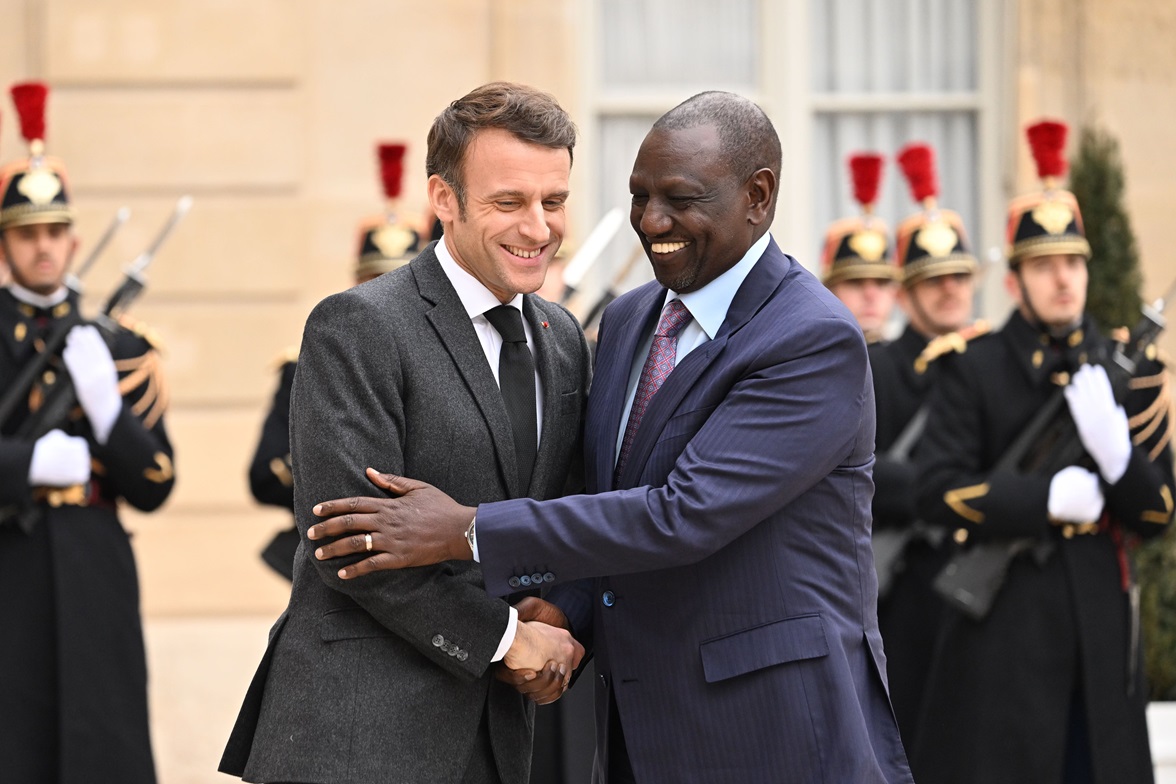
President William Ruto and French President Emmanuel Macron both acknowledged that the strategic pathway should focus on unlocking Africa’s potential, driving sustainable industrialisation, and targeting economic growth across Africa. Harnessing the untapped resources and utilising the huge human resources is France’s priority in consolidating the current bilateral engagement and collaboration.
In a statement, President Ruto underlined tthat he summit reflects a shared commitment to strengthening bilateral ties and deepening multilateral cooperation to advance global goals. The agenda will focus on key areas, including reform of the international financial architecture, energy transition, green industrialisation, the blue economy and connectivity, artificial intelligence, sustainable agriculture, and health. It will spotlight the role of young entrepreneurs, civil society, and international organisations in shaping solutions to pressing global and regional challenges. The May summit is described as part of the renewal of relations between France and Africa, emphasising genuine partnerships and shared progress.
The agenda will focus on key areas, including reform of the international financial architecture, energy transition, green industrialisation, the blue economy and connectivity, artificial intelligence, sustainable agriculture, and health.
In addition to the May summit by France, the European Union countries are increasingly strong economic partners for many African countries. It therefore beholds African leaders and business people to necessarily explore available possibilities and windows that have been opened. The EU has unveiled €300 billion ($340 billion) alternative to China’s Belt and Road initiative — an investment programme the bloc claims will create links, not dependencies.
In an official document, it said the European Commission is examining:
– Support AfCFTA implementation and the green transition;
– Improve trade and investment climate between the EU and Africa;
– Reinforce high-level public-private dialogue;
– Enhance long-term dialogue structures between the EU and African Business Associations;
– Unlock new business and investment opportunities, including in the areas of manufacturing and agro processing, as well as regional and continental value chains development.
It is further included in the joint communication of the European Commission (EC) entitled “Toward a Comprehensive Strategy with Africa”, which sets forth what the EU plans with Africa. The Joint EU-Africa Strategy takes into cognisance the most common interests such as climate change, global security and the achievement of the United Nations Sustainable Development Goals (SDGs).
Just as China, India and the United States, so also France, and other European countries are exploring emerging opportunities offered by the African Continental Free Trade Area (AfCFTA), which provides a unique and valuable access to an integrated African market of 1.5 billion people. In practical reality, it aims at creating a continental market for goods and services, with free movement of business people and investments in Africa.
Looking ahead, France intends to capitalise on Africa’s most transformative economic sectors and make strategic moves by collaborating, as a mutual partnership remains dynamic and adaptable. Despite growing geopolitical tensions, France’s approach and its long-standing ties still offer an alternative partnership model that many African leaders find very appealing.
The challenge for the future will be to ensure these ties evolve in ways that serve Africa’s development needs, while navigating the increasingly complex global politics. As Africa is indiscriminately open for business, on May 11-12, 2026, African and French Heads of State and Government meet together to chart a new path for innovation, growth, and cooperation. Kenya will hold this investment summit for France to position Africa as a key partner in global innovation and economic development while strengthening bilateral ties with France and advancing Africa’s collective agenda on the international stage.
World
Nigeria Leads Africa in Equity Funding as Startup Investment Hits $254m in H1 2026
By Adedapo Adesanya
Nigeria regained its position as Africa’s leading destination for equity startup investment in the first half of 2026, raising $214 million in equity financing and a total of $254 million across equity and debt, according to the latest Africa: The Big Deal report.
The report, titled H1 2026: Mapping the Money, showed that Nigeria ranked second on the continent in total funding, behind Egypt, which attracted $327 million, while Kenya and South Africa followed with $126 million and $83 million, respectively.
However, the report noted that Egypt’s top position was largely driven by a single fundraising by electric mobility company Spiro, which secured $327 million, including $270 million in equity and $57 million in debt. Excluding debt financing, Nigeria emerged as Africa’s largest equity funding market in the first six months of the year.
According to the breakdown by Africa: The Big Deal, Nigeria’s equity funding of $214 million was higher than Egypt’s $183 million, while South Africa and Kenya attracted $66 million and $46 million, respectively.
Beyond funding value, Nigeria also led the continent in the number of startups that raised at least $100,000 during the review period, reclaiming the top spot after what the report described as an “underwhelming” second half of 2025.
The publication observed that Nigeria’s fundraising performance has remained relatively stable over the past few years and exceeded the $250 million mark for the first time since 2022, pointing to renewed investor confidence in the country’s startup ecosystem.
It also found that while the Big Four startup markets—Nigeria, Egypt, Kenya and South Africa—continued to dominate Africa’s investment landscape, their combined share of total funding stood at 58 per cent in the first half of 2026.
“Zooming back on the Big Four (110 out of 190 $100k+ deals, i.e. 58%), Nigeria is head and shoulders above its peers, with Egypt and Kenya almost tying, and South Africa in fourth position again,” the report noted.
The report highlighted contrasting performances among the continent’s largest startup ecosystems. While Nigeria and Egypt maintained strong funding momentum, Kenya recorded its weakest funding performance since early 2021 after a strong second half of 2025, and South Africa failed to attract $100 million in funding during the period despite leading the continent a year earlier.
Africa: The Big Deal also noted a broader shift in investor behaviour, with funding increasingly concentrated in larger transactions while early-stage investments continued to decline. According to the publication, the drop in smaller funding rounds reflects growing concerns about limited capital available for early-stage startups across Africa.
World
SCRYPT Expands Stablecoin Settlement Infrastructure to East Africa
By Aduragbemi Omiyale
Accessing the US Dollar in the East Africa region has now been made easier with the expansion of the stablecoin settlement infrastructure of SCRYPT.
This development enables banks, payment providers and corporate treasury teams to move value into and out of the continent in real time.
Businesses paying international suppliers frequently have to convert local currency into USD before purchasing stablecoins for settlement, incurring FX conversions and spreads before any payment is made.
But SCRYPT is eliminating this intermediate conversion by enabling direct settlement corridors for local African currencies into stablecoins.
This development allows businesses to move from local currency to stablecoin settlement in a single licensed transaction, without first sourcing rationed bank dollars, as stablecoins are increasingly becoming settlement infrastructure rather than an investment product.
The expansion adds settlement support across four African currencies: the Kenyan shilling (KES), Tanzanian shilling (TZS), Rwandan franc (RWF) and Ugandan shilling (UGX). Each corridor is delivered through the same full-stack infrastructure our clients already use for trading, custody and treasury operations.
Speaking on this, the chief executive of SCRYPT, Norman Wooding, said, “Across Africa, stablecoin adoption is driven by economic need, not speculation.
“Businesses here are not chasing yield; they are trying to pay suppliers and manage treasury without losing margin to a banking system that rations dollars. Licensed, fair-rate dollar access is the clearest proof of what this infrastructure is for.”
Also commenting, the Managing Director of Markets & Trading at SCRYPT, Mr Gabriel Titopoulos, said, “Until now, reaching stablecoins from local African currencies meant buying scarce dollars and incurring several layers of conversion costs.
“SCRYPT removes this friction. Firms and payment providers can now settle straight from local currencies through live corridors, with local partners.”
World
African Graduates Association Promoting Multifaceted Initiatives With Russian Educational Institutions
By Kestér Kenn Klomegâh
In preparations for the third Russia-Africa Summit, scheduled for late October 2026, Dr Francois Ngan, deputy chairman of the Union of Associations of African Graduates of Soviet and Russian Universities, during an official working visit, has held a consultative meeting with Professor Vladimir Filippov, the President of the Russian University of Peoples’ Friendship (RUDN), and former Minister of Higher Education of Russia, Chairman of the National Commission for Accreditation of Higher Education.
RUDN is an educational institution established in 1960, primarily to provide higher education to Third World students. It has now become a popular multidisciplinary spot for many students, especially from developing countries. The university offers various academic programmes and has research infrastructure that comprises laboratories and interdisciplinary centres. The university is named after the former Congolese leader, Patrice Lumumba.
Dr Francois Ngan and Professor Filippov discussed the importance of the Graduates Association as a continental platform dedicated to strengthening unity, cooperation, and promoting shared progress among African graduates who studied in the former Soviet Union and in the Russian Federation. They also reviewed multifaceted initiatives that could bring together alumni associations from across Africa, whose members obtained education and professional training, and cultural experiences in Soviet and Russian institutions of higher learning.
Professor Filippov expressed optimism in addressing emerging challenges as a result of shifting geopolitical changes, emphasised strategic cooperation in the educational sphere with Africa, in general, and with the Republic of Cameroon, in particular, and further about the integration of African students during their studies in the Russian Federation.
The meeting also touched on academic and scientific work, the possibility of rewriting a scientific thesis, and the official organisation of transferring versions translated into six languages for the library of RUDN. Significant questions relating to Russia’s educational opportunities, collaborations and partnerships involving African countries were thoroughly discussed.
The Union of Associations of African Graduates of Soviet and Russian Universities was created under one continental umbrella to promote friendship, for professional networking, to engage in cultural exchange, and with particular emphasis on forging strategic cooperation between Africa and Russia.