Connect with us

World

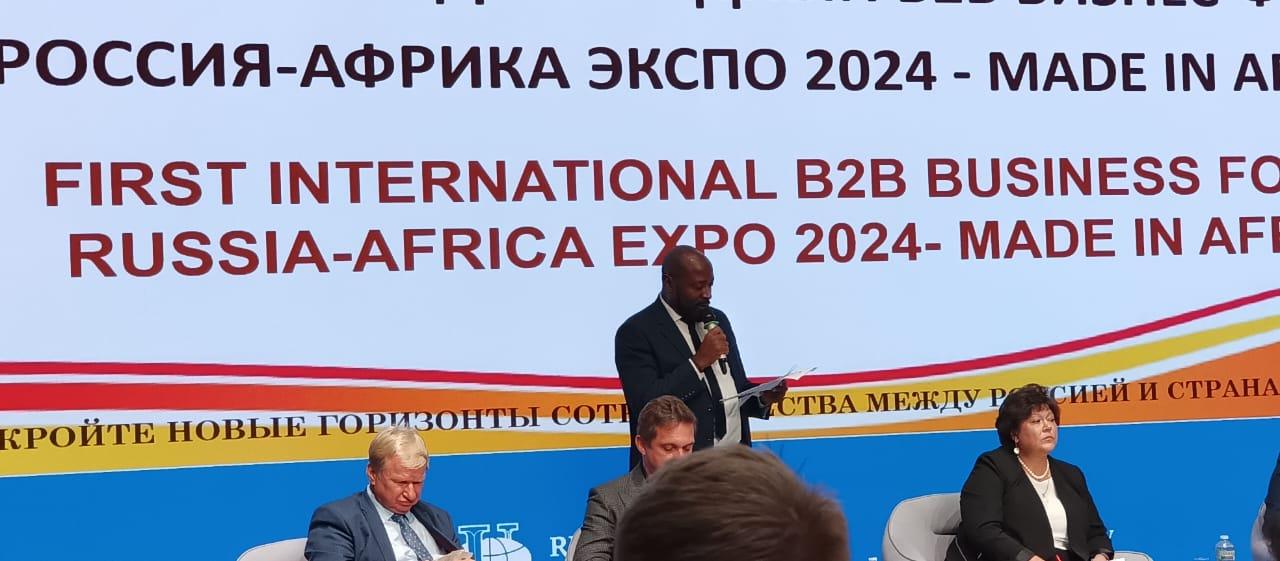
Russia-Africa B2B Forum and Expo 2024 — Made in Africa

Published

on

First Russia-Africa Expo Made in Africa

By Kestér Kenn Klomegâh

 The first international Russia-Africa B2B business forum and expo 2024 — Made in Africa — took place on October 16th. Organized by the Russia-Africa Club of Moscow State University named after M.V. Lomonosov, the Patrice Lumumba People’s Friendship University of Russia (RUDN), the African Business Club, and the Russian Foundation for Peace, the forum aimed to open new horizons for cooperation between Russia and African countries.

The forum was attended by representatives of government bodies, businesses, and state corporations from Russia and Africa. The forum was truly nationwide, with representatives from Russian businesses in Tula, Yaroslavl, Khabarovsk Krai, Tyumen Oblast, Mordovia, Yekaterinburg, Voronezh, Lipetsk, Kazan, St. Petersburg, Naberezhnye Chelny, and other regions.

The forum opened with a plenary session moderated by Luis Gouwend, Chairman of the Commission on Work with African Diasporas of the Russia-Africa Club of Moscow State University named after M.V. Lomonosov, and Inna Vitalyevna Andronova, Doctor of Economics, Professor, and Dean of the Faculty of Economics of RUDN.

The following speakers addressed the participants with welcoming speeches:

  • Dmitry Ilyich Suchkov, Head of the Department of Pan-African Issues and Regional Organizations of the African Affairs Department of the Ministry of Foreign Affairs of the Russian Federation, who read a welcoming speech from Anatoly Gennadievich Bashkin, Director of the Department of Africa of the Ministry of Foreign Affairs of the Russian Federation.
  • Violetta Nikolaevna Medvedeva, Chairman of the Board of the Moscow Regional Branch of the Russian Foundation for Peace, who read a welcoming speech from Leonid Eduardovich Slutsky, Chairman of the State Duma Committee on International Affairs.
  • Andrey Georgievich Dorokhin, Head of the Department of Foreign Trade Analytics and Relations with International Organizations of the Department of Foreign Economic and International Relations of the City of Moscow.
  • Alexander Fedorovich Berdnikov, Executive Secretary of the Russia-Africa Club of Moscow State University named after M.V. Lomonosov.

During the plenary session, Russian and African entrepreneurs shared insights on doing business in Africa and Russia, highlighting the most attractive areas for investment and trade, as well as existing support mechanisms.

Speakers from the Russian side included:

  • Vitaly Andreevich Stepanov, General Director of the ANO “Moscow Export Center,” who spoke about the city of Moscow’s cooperation with African countries and the opportunities for exporters to receive support.
  • Andrey Vladimirovich Severilov, Member of the Board of the Russian Union of Industrialists and Entrepreneurs (RSPP), Chairman of the Subcommittee on Logistics and Supply Chains, and President of A7 Holding, presented an analysis of the existing infrastructure and outlined key areas for optimizing goods transportation.
  • Yegor Alexandrovich Ivankov, Chairman of the Commission on the Development of Creative Industries on the Council for Financial and Industrial and Investment Policy of the Chamber of Commerce and Industry of the Russian Federation, spoke about support measures for strengthening Russian-African cooperation.
  • Marina Yuryevna Nesterenko, Chairman of the Subcommittee on Leasing of the Council of the Chamber of Commerce and Industry of the Russian Federation on Financial and Industrial and Investment Policy and Editor-in-Chief of the “Banking Business” magazine, presented current financial instruments for trade with African countries.
  • Alexey Evgenievich Podenok, President of the Moscow Association of Entrepreneurs, spoke about accelerating and reducing the cost of delivering Russian export goods to countries in East and South Africa using the North-South International Transport Corridor.
  • Andrey Sergeevich Gromov, Member of the Board of Directors of AREA and Founder of the GR-Group consulting agency, presented new solutions in the energy sector for comprehensive development of relations between Russia and Africa.

Speakers from the African side included:

  • Marie Caroline Ngo Tovada, General Director of Kindak Advys Sarl (Cameroon), who spoke about “MADE IN AFRICA” products and their potential appeal to the Russian market.

Following the plenary session, forum guests participated in the opening of business and cultural exhibitions featuring more than ten countries from the African continent. The exhibition of African goods showcased agricultural, cosmetic, souvenir, and tourism industries.

Next, as part of a panel discussion, a section titled “Informal Dialogue Russia-Africa: What Can We Offer Each Other” was held, where Russian and African companies presented themselves, their products, and areas of activity.

Following this, a large number of B2B meetings took place on the sidelines of the forum between representatives of Russian and African business circles.

Several contracts for the supply of products from Africa to Russia are being prepared for signing as a result of the forum.

The event received positive feedback from participants. Plans are underway to make the forum annual and expand the B2B meeting program to several days.

The forum concluded with a concert of African music and a screening of African cinema at the Engineering Corps of the Tretyakov Gallery.

Quotes:

From the address of Anatoly Gennadievich Bashkin, Director of the Department of Africa of the Ministry of Foreign Affairs of the Russian Federation, to the participants of the “Russia-Africa Expo 2024” forum:

“Russia, as a country with solid potential and sufficient competencies in various areas of the economy, modern technologies, is ready to share its experience, knowledge, and expertise with its African friends, to carry out mutually beneficial trade interactions,” he noted. “We fully support the aspirations of Africans to strengthen economic sovereignty.”

Anatoly Gennadievich Bashkin noted that Africa is a dynamically developing region with enormous growth potential, an attractive internal market, and an expanding export potential. “In recent years, it [the African continent] has been confidently strengthening its international authority, increasingly asserting itself as an influential participant in global politics in one of the centers of the emerging multipolar world order,” the director of the department added.

“Considering all these factors, it is quite natural that our country attaches great importance to building long-term and mutually beneficial partnerships with Africa, with which it has much in common – from traditions of joint anti-colonial struggle to a similar vision of many key issues of our time, and, importantly, a commitment to common basic values,” Bashkin concluded.


Click to comment

Leave a Reply

Your email address will not be published. Required fields are marked *

World

S&P Restores Afreximbank to Investment-Grade Status After 12 Years

Published

on

Afreximbank

By Adedapo Adesanya

Credit ratings agency, S&P Global Ratings, has restored the African Export-Import Bank (Afreximbank) ​to investment grade, nearly 12 years after its last assessment, citing the entity’s countercyclical lending record and ‌strong shareholder support.

The BBB+ rating with a stable outlook is one notch above Moody’s Baa2 and comes months after Afreximbank severed ties with Fitch Ratings.

The lender accused the agency of misjudging its mission, following a downgrade to junk status amid disagreements over the bank’s role in debt ​restructurings for Ghana and Zambia. Fitch subsequently withdrew its ratings entirely and flagged governance concerns.

S&P said in ​a statement on Thursday that Afreximbank’s record as a countercyclical lender and its substantial shareholder ⁠support served as rationale for its rating. Credit ratings often guide the costs of capital for a borrower.

The lender’s total assets, S&P noted, had expanded to $42.3 billion by the end of 2025, up ​from $7.1 billion in 2015.

S&P said it did not incorporate preferred creditor status into its assessment because Afreximbank ​provides almost 80 per cent of its loans to private-sector entities.

However, it acknowledged that Afreximbank, alongside other institutions, had experienced prolonged payment arrears in ‌recent ⁠years, notably following the defaults and debt restructurings in Ghana and Zambia.

S&P noted that Afreximbank said in December that it had come to an agreement with Ghana on its $750 million loan, but that the lender had not announced a resolution with Zambia.

The agency warned that further sovereign restructurings could weigh on Afreximbank’s asset quality.

S&P’s assessment described Afreximbank’s governance and management as “adequate”, saying the ⁠inclusion of ​two independent directors and the African Development Bank (AfDB) as a permanent board ​member provided institutional oversight.

It noted that while increasing participation of private-sector investors through Class D shares could influence the bank’s risk appetite, Class A ​shareholders retained veto rights over big institutional changes, balancing potential risk.

Continue Reading

World

Elon Musk Becomes World’s First Trillionaire as SpaceX Soars in Nasdaq Debut

Published

on

elon musk spacex

By Adedapo Adesanya

Mr Elon Musk, the world’s richest man, is now a trillionaire as his SpaceX rose 11 per cent in its Nasdaq debut on Friday, lifting its valuation to about $1.96 trillion as investors piled into the world’s largest initial public offering (IPO).

The stock opened for trading at $150 compared with the IPO price of $135 per share.

The landmark listing cemented Mr Musk’s status as the first trillionaire ever and propelled SpaceX into the ranks of the ⁠world’s most valuable companies

The listing is being used as a benchmark of what is to come for the market ahead of forthcoming IPOs for AI heavyweights Anthropic and OpenAI.

The record IPO is a culmination of Mr Musk’s long-held ambitions in space and technology.

Most of Musk’s wealth now rests with SpaceX, where ⁠he holds a stake worth roughly $866 billion. Along with Tesla and the rest of his properties, his net worth will exceed $1.1 trillion when the stock begins trading on Friday.

At a quoted $75 billion, the deal’s proceeds were more than double those of Saudi Aramco’s record-setting 2019 IPO.

The valuation could rise further should underwriters exercise their right to sell additional shares, a decision typically made within 30 days after the offering.

Although SpaceX may have to wait for entry into the S&P 500, its expected fast-track inclusion in the Nasdaq 100 will soon make it a major holding for passive funds and ETFs that track the index, creating a fresh source of demand for its shares.

It will take about a month before it gets added to that index under Nasdaq’s new fast-entry rules, as opposed to a typical wait of as much as a year.

SpaceX said its market opportunity spans $28.5 trillion, a figure it called the largest in human history.

Mr Musk, 54, was born in Pretoria, South Africa, to a Canadian mother and South African father. He attended the University of Pennsylvania, graduating in 1997.

He took over as Tesla’s CEO in 2008. Beyond Tesla and SpaceX, Mr Musk ‌has co-founded ⁠five other companies, including tunnelling startup The Boring Company and brain implant maker Neuralink.

Continue Reading

World

Bridge Awards Symbolize a Definitive Choice of Life in Russia—Sammy Kotwani

Published

on

Sammy Kotwani

By Kestér Kenn Klomegâh

Under the presidential decree, authorising an initiative to tap the best brains and professionals from abroad to integrate into Russian society, the Agency for Strategic Development plans to hold its first Bridge Awards, which honour the contributions of foreign citizens and repatriates who have made a definitive life choice in favour of Russia. The Bridge Awards was founded by entrepreneur Philip Hutchinson and public figure Guy Eames.

Launched in February 2026, the competition for the awards has attracted a lot of potential candidates from more than 40 countries competing for victory across 12 categories. The highest number of applications came from the United States, totalling 18. There are also a number of candidates from Europe, Asia, and Africa. The “Business” category proved to be the most geographically diverse, drawing applicants from 12 countries.

The Bridge Awards recognise the valuable contributions of foreign citizens and repatriates to the Russian society. It is also dedicated to raising awareness, recognising achievements, and building strong connections with the international community.

According to the official reports made available, among the winning applicants and world-renowned celebrities for the Business Category were Sammy Manoj Kotwani, President, Indian Business Alliance; President, SITA/Indian National Cultural Centre; President, Overseas Friends of BJP Russia; and Founder, Imperial Tailoring Company.

In this conversation, Sammy Kotwani talks about how he has lived and worked in Russia for more than three decades, his entrepreneurial achievements, and his contributions to Russian society. Here are the interview excerpts:

What really motivates you to participate in the first competition for Bridge Awards?

For me, the Bridge Awards are not only a competition. They are a recognition of a life journey. I have lived and worked in Russia for more than three decades. Russia gave me the opportunity to build my business, serve the Indian community, promote Indian culture, and create real business connections between India and Russia.

My motivation is very simple: I want to show that a foreign citizen can love Russia, respect its people, contribute to its economy, and at the same time remain deeply connected to his own roots and motherland.

Through the Indian Business Alliance, through cultural activities, through India–Russia business forums, through meetings with governors and regional leaders, my work has always been to build bridges — not only between governments, but between people, entrepreneurs, regions, cultures, and families.

So, when I heard about the Bridge Awards, I felt that this platform represents exactly what I have tried to do for many years: turn friendship into action, and respect into real cooperation.

You were selected by the Jury for the business category. What are the implications of this category?

Being selected in the business category is a very meaningful honour because business is where friendship becomes practical.

India and Russia already have strong political trust, historic goodwill, and a strategic partnership. But the real question today is: how do we convert this goodwill into trade, investment, joint ventures, logistics solutions, industrial cooperation, and regional development?

That is why the business category is important. It recognises those who are not only speaking about cooperation, but actually working on the ground to make it happen.

For me personally, it reflects the work of the Indian Business Alliance in connecting Indian entrepreneurs with Russian regions, supporting business missions, encouraging investment, discussing opportunities with governors, and identifying practical sectors such as textiles, pharmaceuticals, logistics, food processing, energy, technology, education, tourism, and skilled manpower.

This category is not only about personal achievement. It is about responsibility. It means we must continue to create platforms where Indian and Russian businesses can meet, trust each other, and build long-term partnerships.

Do you think the “Time to Live in Russia” programme has good future prospects for foreign citizens who choose to relocate and live in Russia?

Yes, I believe the “Time to Live in Russia” programme has strong future potential, provided it remains practical, transparent, and welcoming.

Many foreign professionals, entrepreneurs, investors, teachers, doctors, engineers, cultural workers, and skilled specialists are looking for countries where they can build a meaningful life. Russia has space, resources, education, culture, business opportunities, and strong regional potential.

But relocation is not only about visas or documents. A person who comes to Russia needs guidance, integration, language support, business orientation, community support, and confidence that he or she can build a stable future.

This is where such a programme can become very powerful. If it helps talented foreigners understand Russia better, settle smoothly, respect Russian society, and contribute to the economy, then it can become a serious instrument of international cooperation.

From the Indian perspective, I see strong potential. Many Indians are skilled in technology, medicine, education, trade, textiles, pharmaceuticals, engineering, hospitality, and entrepreneurship. If the right mechanism is created, India and Russia can benefit greatly from this human bridge.

How would you characterise the International Bridge Awards by the Agency for Strategic Initiatives and decreed by President Vladimir Putin?

I would characterise the Bridge Award as a timely and visionary initiative. In today’s world, countries need more than formal diplomacy. They need people who understand both sides, who can translate culture into trust, and trust into practical cooperation.

The Bridge Award gives recognition to such people — foreign citizens and repatriates who have chosen Russia not only as a place to live, but as a place to contribute.

For me, this award carries a very important message: Russia values those who sincerely work for its development, its international friendships, and its multicultural society.

The involvement of the Agency for Strategic Initiatives gives the award a serious institutional direction. It shows that this is not just a symbolic gesture, but part of a larger vision — to make Russia a place where international talent, entrepreneurs, cultural leaders, and public figures can participate in national development.

I believe this award can become a powerful platform for public diplomacy. It can show the world that Russia is open to sincere partners, serious professionals, and people who are ready to build, not just observe.

For me, as an Indian who has lived in Russia for many years, the word “bridge” is very personal. A bridge connects two banks. It allows people to cross, meet, understand, and build together. That is exactly what India and Russia need today—more bridges, more trust, more implementation, and more human connection.

Continue Reading

Trending