World
Russia and Angola: Cooperating On Trade, Arms Delivery and Natural Resource Exploration
By Kester Kenn Klomegah
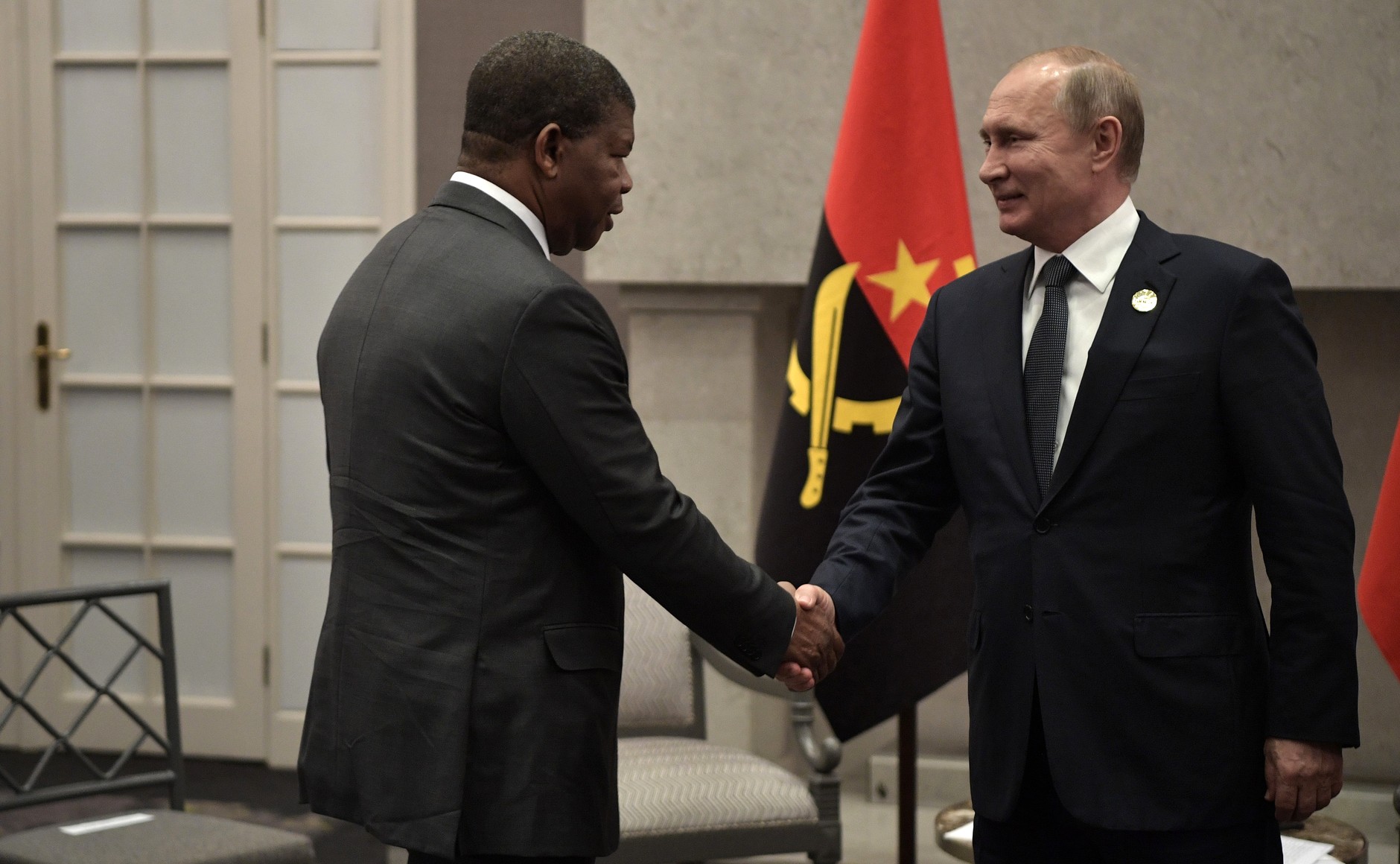
Russia is ready to raise its full-fledged bilateral ties and strengthen multifaceted cooperation by signing a series of agreements with Angola, one of Russia’s key partners in the African region, during the meeting scheduled early April between President Vladimir Putin and Angolan counterpart Joao Manuel Goncalves Lourenco in the Kremlin, Moscow.
Putin has expressed his confidence that Joao Lourenco official visit marks a new stage in the development of bilateral relations between the two countries. Putin has had bilateral connectivity with this southern African country, for example, during the leadership of Jose Eduardo Dos Santos who visited in October 2006.
Russia-Angolan relations have been developing actively “on the principles of mutual respect, trust and sincere friendship.” It is worth saying that Russia and Angola successfully cooperate in resolving actual international and regional problems and in ensuring security, law and order in the world.
In July 2018, Vladimir Putin held a meeting with President of Angola Joao Lourenco on the sidelines of the BRICS Summit. “Russia and Angola have longstanding and friendly relations that we greatly treasure. We are actively cooperating in political matters, security, and at international organizations. Our trade is quite modest so far, but in general, we have good projects that can be implemented. Our military and technical cooperation is also developing,” Putin told his Angolan Joao Lourenco.
During the Cold War, Russia always supported the Angolan people and helped achieve what is now treasure most of all: independence. Even after independence, Angola has enjoyed political freedom for 42 years, Russia never turned its back on Angola; it always supported and helped us fight the apartheid regime, which was a threat to Angola and the entire African continent.
“Rest assured that the people of Angola will never forget the friendship between our countries that was forged in battle. Now, we are focused on development. We want our country to develop in all areas. Speaking about economic cooperation, we are counting on interaction with Russia. First of all, Russian enterprises work in our mining complex. But, we would also like Russian businesses to be represented in other industries,” Joao Lourenco, in his turn, told Putin.
Russia plans large-scale economic engagement with Angola. Last year February, during a working meeting between Vladimir Putin and Alrosa CEO Sergei Ivanov in Kremlin, it came out that Russia’s Alrosa plans to develop one of the largest diamond deposits, Luaxe in Angola. “We are currently conducting a feasibility study. We have met with the President of Angola. Everything is on schedule. I am certain it will be a significant asset that will help us maintain our leadership,” according to Sergei Ivanov.
Soon, the truth in his words comes to fruition. In March 2019, Joao Lourenco gave an exclusive interview to a Russian media, Itar-TASS, he outlined some of his plans. The Angolan leader hinted that his country was ready to undertake the building factories to manufacture Russian weapons and military equipment for the African market.
“As for our military and technical cooperation with Russia – it will continue and be deepened. We would like to evolve from our current state of purchasers of Russian military equipment and technologies towards becoming the manufacturers and having an assembly point of Russian military equipment in our country,” he told the news agency.
Russia and Angola have military and technical cooperation. In 2018, Russia agreed to supply arms and military equipment to Angola worth US$2.5 billion, including spare parts for the Soviet-made weaponry, light weapons, ammunition, tanks, artillery and multi-purpose helicopters.
Besides, there are a number of Russia companies interested in Angola. For example, Mazepin’s companies considers an important step building nitrogen fertilizer plant in Angola. Zarubezhneft, an intermediary for the state interests in the field of fuel and energy complex on the international arena, plans to work in the oil and gas industry – from exploration and field construction to the pipeline systems construction and supply of equipment to the oil facilities.
Zarubezhneft has sealed a memorandum of understanding with Angola’s authorities to cooperate when exploring and producing from crude oil fields of that African country. For this purpose, the consortium eyes the Atlantic shelf of Angola, expecting to produce from it in partnership with Angola’s Sonangol and Dark Oil Company, which licenses for the area.
On the other hand, it was also reported in March 2017 that Angola had given two Russian companies the green light to build a major refinery complex and railroad. The US$12bn mega project put forward by companies Rail Standard Service and Fortland Consulting Company, which have set up a consortium with local partners.
Gustavo Plácido Dos Santos, Researcher at the Portuguese Institute of International Relations and Security (IPRIS), wrote recently that Angola has been on the frontline of Russia’s expansion in sub-Saharan Africa. Luanda enjoys strong historical ties with Moscow. Although political ties have failed to translate into deeper commercial interactions, it is worth highlighting Angola’s potential for Russian companies, especially in terms of mineral resources.
According to him, Sub-Saharan Africa is set to produce more gas than Russia by 2040. Thus, the region becomes a viable alternative for the European Union’s aim of diversifying energy sources away from Russia. In this sense, given the geographic proximity, countries such as Nigeria would be in the front line to satisfy Europe’s diversification goals. However, instability in Nigeria and its neighborhood positions Angola — one of Africa’s most stable energy producers — as a viable alternative.
Interesting to recall that back in June 2009, Dmitry Medvedev and Jose Eduardo dos Santos also held bilateral talks. A joint communique issued following the talks sets out the priority areas for developing the partnership between the two countries. The sectors in question include mining, energy, transport, telecommunications, military-technical cooperation, health and education.
Both leaders then witnessed the signing of a number of bilateral agreements, in particular, an intergovernmental agreement on air transport links, an agreement on encouragement and mutual protection of investment, and the medium-term program for economic and trade, science and technology as well as agreements on cooperation in geology and higher professional education.
In addition, there was a contract signed for the building and financing of Angola’s national satellite communications and broadcasting system, AngoSat. Energiya corporation reaffirmed its intention to fulfill the contract that envisions creation of a satellite network for telecommunication and broadcasting in Angola.
This April, some of the large-scale economic and investment projects crystallized in the documents signed covering projects in energy, minerals exploration, and high technology, in particular building a satellite communications system, and that of economic cooperation to a new level. There are the desires and the possibilities, but the need to reflect on setting up new financial mechanisms, according to South African based Senior Analyst on African policy, Kelvin Dewey Stubborn.
In his discussion for this article, Dewey Stubborn acknowledged that there are various forms of cooperation two largest state-owned companies, Zarubezhneft and Sonangol. There are a number of projects to develop and find new hydrocarbon deposits. This is certainly of interest because of very big players in the oil market, but this does not mean that Russians cannot cooperate in this field. Regarding the overall situation, Africa is a continent developing very dynamically, a continent on the rise, and second, Africa today has powerful countries that have chosen their own development paths.
Experts, such as Professors Vladimir Shubin and Alexandra Archangelskaya, Institute for African Studies in Moscow, have also argued that “both Angola and Russia still need to be more strategic in aligning their interests, and more proactive in carving out efficient bilateral instruments and mechanisms in order to promote economic exchanges and reap the benefits of a fully-fledged partnership.”
According to Wikipedia, compared to the Soviet era, trade between Russia and Angola is still minimal. In 2016, exports from Russia to Angola amounted to US$567.9 million and Angolan exports to Russia amounted to just US$14.94.
Angola has diamonds, oil, gold, copper and a rich wildlife, forest and fossil fuels. Since independence, oil and diamonds have been the most important economic resource. The Republic of Angola is a country in south-central Africa, the seventh largest by territorial size and bordered by Namibia to the south, Democratic Republic of Congo to the north and Zambia to the east, and on the west the Pacific Ocean.
Kester Kenn Klomegah writes frequently about Russia, Africa and the BRICS.
World
Outcome of Russia-Congo Strategic Talks
By Kestér Kenn Klomegâh
Congolese President Denis Sassou Nguesso tightly embraced and shook hands with President Vladimir Putin, signalling the highest level of cordial friendship, and later settled down for official talks focusing on strengthening the multifaceted Russian-Congolese comprehensive strategic economic partnership, including in the context of the upcoming high-level third Russia-Africa Summit scheduled for October 2026.
In St George’s Hall of the Grand Kremlin Palace, Putin told his Congolese counterpart, Denis Nguesso, and the delegation that there were “good prospects for developing relations in a variety of areas” and reminded them that the full-fledged relations between Russia and the Congo have been making strides. Russian companies are ready and eager to work in the country’s market, primarily because the political situation has been stable, which is good for business. The Intergovernmental commissions are operational.
Denis Nguesso’s official visit, from April 28 to 29, has immense significance for the Kremlin. Moscow is stepping up to tackle important corporate investments ranging from an industrial and technological standpoints, which open pathways for knowledge transfer, human capital development, and Congo’s integration into defence innovation value chains. At the geo-strategic level, Moscow is seemingly positioning itself as a regional security hub and as an incredible partner, particularly in Congo, while strengthening a broader strategic influence in the central African region.
On the agenda, Russia will begin design work this year for the construction of an oil product pipeline in Congo, under an agreement signed in 2024. The Pointe-Noire – Loutete – Moluko-Tresho oil product pipeline that Russia plans to build in the African country under an intergovernmental agreement is supposed to go into operation by the end of 2029.
It was reported earlier that Russia is hoping to create a channel for shipping oil products that is protected from sanctions by building this pipeline in the Congo, as well as becoming a strategic partner in ensuring the energy security of the whole region. The agreement on the project, which was signed in Moscow on September 28, 2024, provides for the creation of favourable conditions to carry out the pipeline’s construction.
Under the agreement, the authorised organisations responsible for the implementation of the project are Zakneftegazstroy-Prometei LLC and the National Petroleum Company of Congo (SNPC), which is the client of the project. They will form a joint venture to carry out the project in which the Russian side will own a 90% stake and the Congolese side will hold 10%.
A build-own-operate-transfer concession agreement will be signed with the joint venture to build and operate the pipeline for 25 years, with a guaranteed price for transport that will ensure the utilisation of the pipeline and a return on investment in the project. The Russian Ambassador to Congo, Georgy Chepik, said earlier that the pipeline will run between the country’s two largest cities, Pointe-Noire and the capital Brazzaville.
In particular, the two sides discussed the prospects of implementing joint projects and forging mutual cooperation prospects in a wide range of areas, including geological prospecting, energy, logistics, agriculture, trade, and manufacturing. The sides also “noted readiness to gradually increase their transport cooperation. The Republic of Congo is seen as a key logistics hub in Central Africa and a crucial participant in a promising international transport route between Russia and the African continent,” the statement said.
Nearly 80% of the population still lives in abject poverty, even though the country boasts huge resources. Congo is the fourth-largest oil producer in the Gulf of Guinea, providing the country with a high degree of potential prosperity, despite its internal ethnic conflicts and economic disparity. It has a large untapped mineral wealth and large untapped metal, gold, iron, and phosphate deposits. In 2018, the Republic of the Congo joined the Organisation of Petroleum Exporting Countries (OPEC).
Historical records show that Denis Nguesso, several times as a civil servant during the Soviet era, and as president, visited Russia, including participation in the two Russia-Africa Summits held in Sochi and St. Petersburg, and consequently was gifted with a collage of photographs and Pravda newspaper clips documenting these visits. President Putin has also awarded him with the Order of Honour, while Moscow State University of International Relations (MGIMO) gifted him with a Doctorate Degree. The document, published on the Kremlin website, for instance, says Nguesso has been honoured with the award “for his major contribution to boosting and strengthening relations between the Russian Federation and the Republic of the Congo.”
Congolese Denis Nguesso, who has shuttled frequently between his city and Moscow, underlined the fact that bilateral relations have been developing for many decades. These are ties of solidarity and cooperation that bind the two parties in all areas, including security, defence, and the economy. He emphasised the point that the time has arrived to act more concretely, to accelerate the implementation of the jointly elaborated programme. Both parties will have the opportunity to sign more bilateral agreements in Brazzaville in September 2026, before the new Russia-Africa summit, to be held in Moscow.
The third Summit is expected to solidly reaffirm the development of relations between African states and the Russian Federation. For decades, Russia has supported Africa’s ideals for freedom, independence and sovereignty. Next, Russia-Africa cooperation has a big future. Africa is rich in resources. And Russia contributes to efforts to ease the debt burden that African countries are facing. The total debt Russia has cancelled, previously and so far, stands at $23 billion, according to reports.
In addition, Russia and African states have coordinated efforts for building a new, fairer global architecture, and further working together to protect international law, the UN Charter and the central role of that global organisation, while at the same time, trying to coordinate their positions on the main issues on the international agenda. African regional structures have substantially enhanced these geopolitical profiles, and within the general objectives of the African Union.
World
Germany Acquires Equity Stake in ATIDI to Strengthen Economic Partnership With Africa
By Aduragbemi Omiyale
About $32 million has been put into the African Trade and Investment Development Insurance (ATIDI) by Germany through KfW Development Bank.
This funding package allows the European nation to become a D2-class shareholder of ATIDI, a status dedicated to Export Credit Agencies and Non-African Public Entities.
Of this amount, $18.4 million is funded from BMZ budget resources, with the remaining $13.6 million coming from KfW’s own resources. As such, it will assume the obligations and benefits related to its new shareholding status, including representation in ATIDI Governance and decision-making structures, and equally participating towards improving German trade and investments in Africa in alignment with the G20 Compact with Africa (CwA 2.0).
KfW’s subscription in ATIDI is the culmination of a dynamic partnership between the two organisations.
On behalf of the German Federal Ministry of Economic Cooperation and Development (BMZ), KfW has supported several countries’ membership in ATIDI with over $100 million in financing, thus strengthening the organisation’s capital base and expanding its ability to mitigate risk and mobilise private investment across African markets.
The new equity participation adds a direct shareholding to this long‑standing cooperation.
KfW is the 13th Institutional shareholder in Africa’s premier development insurer, further strengthening the organisation’s capital base and its capacity to support trade and investment across the continent.
At the official signing of the subscription agreement in Nairobi, Kenya, a member of the executive board of KfW, Ms Christiane Laibach, said, “Our membership is executed on behalf of the Federal Republic of Germany. It is only the latest culmination of a successful cooperation that has enabled the ATIDI membership of several African states and has created innovative insurance solutions to attract foreign investment on the continent.”
The chief executive of ATIDI, Mr Manuel Moses, said, “This milestone is iconic in many ways. First, it elevates our already dynamic bond with KfW and creates more opportunities for German investors looking to engage in Africa. It is also a recognition of ATIDI’s earned status as Africa’s top development insurer and the acknowledgement of the soundness of our business. Last, it underscores the power of partnerships in a global context increasingly marked by volatility and uncertainty. ATIDI will spare no effort to make this partnership a successful one.”
Established in 1948, KfW is Germany’s state-owned promotional and development bank and a key implementing partner of BMZ in international financial cooperation. Its shareholding in ATIDI is expected to stimulate up to $500 million in trade and investment between German companies and African markets.
Over the past 25 years, ATIDI has grown to become Africa’s premier provider of development insurance and one of its highest-rated financial organisations. It leverages its partnerships with leading multilaterals and regional bodies, including the African Union, the World Bank Group, COMESA, the European Investment Bank (EIB), and the Norwegian Agency for Development Cooperation (NORAD), to offer innovative credit and investment insurance products that foster sustainable and transformational growth across the continent.
World
Essent Slashes Contact Centre Technology Costs by 50%
By Modupe Gbadeyanka
The Netherlands’ largest energy provider, Essent, has cut the technology costs of its contact centre infrastructure by half.
The organisation, which serves 2.5 million customers, recorded zero critical incidents post-migration and improved agent workplace satisfaction by 36 per cent.
The migration was delivered in partnership with AI-first customer experience transformation specialists, Sabio Group, and was completed in under 12 weeks for an operation spanning over 1,000 agents across two locations.
Agents were forced to juggle multiple disconnected screens simultaneously — a workflow that was as inefficient as it was stressful.
“Our agents were constantly working with different screens — multiple chat instances open at once, multiple agent desktop instances. It was messy, and in some cases, quite stressful,” SAFe Product Manager for Customer Interaction, Omnichannel and Digital Transformation at Essent, Michiel Kouijzer, stated.
“A lot of colleagues were saying I was mad for even suggesting this approach. It kind of feels like a victory on a personal level that it did work out. You just have to be a little ambitious — and have the right expert partner who can make it work,” Kouijzer added.
With stable cloud infrastructure now firmly in place, Essent is turning its attention to the capabilities that were impossible in its legacy environment: AI-powered call summarisation, agentic customer self-service, and next-generation workforce optimisation.
Rather than a reckless ‘big bang’ cutover that could have affected service to millions of households, Sabio engineered a phased migration strategy — beginning with Essent’s SME segment to validate technical readiness before scaling to the full enterprise operation.
“This project showcases Sabio’s unique position in the contact centre technology landscape. We’re not just moving Essent to the cloud — we’re establishing a foundation for continuous improvement in their customer experience delivery,” the Country Manager for Sabio Group Benelux, Wouter Bakker, commented.
-
Feature/OPED6 years agoDavos was Different this year
-
Travel/Tourism10 years ago
Lagos Seals Western Lodge Hotel In Ikorodu
-
Showbiz3 years agoEstranged Lover Releases Videos of Empress Njamah Bathing
-
Banking8 years agoSort Codes of GTBank Branches in Nigeria
-
Economy3 years agoSubsidy Removal: CNG at N130 Per Litre Cheaper Than Petrol—IPMAN
-
Banking3 years agoSort Codes of UBA Branches in Nigeria
-
Banking3 years agoFirst Bank Announces Planned Downtime
-
Sports3 years agoHighest Paid Nigerian Footballer – How Much Do Nigerian Footballers Earn