

World
Russia, Ghana Economic Relations Enter New Phase

By Kestér Kenn Klomegâh
Russia’s economic influence and investment collaboration with Ghana have entered a new phase, as Foreign Minister Samuel Okudzeto Ablakwa and Russia’s Sergey Lavrov, in their high-level discussions mid-August 2026, pledged to take advantage of the existing opportunities in both countries. Russia, in particular, has re-positioned itself during the diplomatic talks for deeper economic cooperation and to explore opportunities in energy, agriculture, geological exploration and mineral development, and further to raise prospects for new investment and promote bilateral trade.
Economic and diplomatic ties
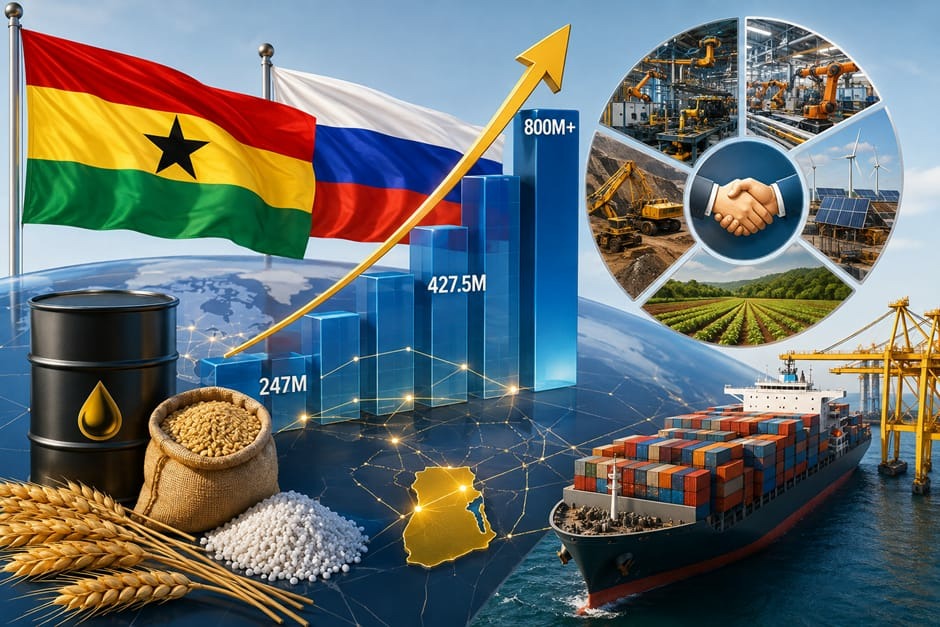
Ghana and Russia are expanding their economic and diplomatic ties, with bilateral trade surpassing $800 million. That has grown, rising from $247 million in 2022, most driven by multiple factors. Current trade and key sectors include significant imports from Russia. Our research and monitoring show that Russia supplies vital commodities to Ghana, including petroleum products, fertilisers, and grains. Both parties agreed on finding alternatives for settling payments in local currency and bypassing existing financial hurdles and obstacles. Russia, however, considers Ghana as its gateway to expand broader West African market access, in principle its position as the host Secretariat of the African Free Trade Area (AfCFTA).
With solid political stability and security, together with the very attractive investment package and easy accessibility, not to mention the legendary Ghanaian hospitality, investing in Ghana is worthwhile and extremely profitable to foreign investors. Thus, Russian investors should seize the opportunity to invest in the country. Russia and Ghana have, since independence, supported diplomatic relations based on trust and traditional friendship.
With bilateral growth, the trade volume has more than tripled over recent years, leading both parties to pursue deeper commercial integration. Economic potential areas will focus on mining and the possibility of adding value to raw materials. Ghana is a major gold producer and seeks to industrialise by processing raw materials locally rather than exporting them in a raw form. Russia has tacitly expressed interest in expanding investment and engaging in technology transfer in Ghana’s mining sector. Later this year, Russia plans to dispatch technical expertise in geological expansion and mineral development.
Energy and Nuclear Cooperation
Discussions between officials emphasised peaceful nuclear-energy collaboration as Ghana works on long-term power generation plans, alongside oil and gas partnership. Certainly, Russia can play a significant role in the long-term generation of power in Ghana, as the Soviets already laid down the foundation for the first Nuclear Power Plant (NPP), with design power units of 1000-1200 MW capacity, together with other affiliated nuclear projects for the nation-building drive. Ghana’s nuclear aspirations have had a chequered history, interrupted in 1966. The nuclear programme was rejuvenated in 2008; Russia signed an agreement in 2015. By 2024, Russia, China, France, Korea and the United States became the leading contenders for vendor identification. What’s important is vendor-partner’s financial readiness. In any case, getting the power-generating project will have a considerable impact on Mahama’s 24-HR Economic Policy Programme.
Agriculture and Food Security
Joint development in the agro-industrial complex aims to stabilise food supplies and improve agricultural output. Scaling up investment in Ghana’s production capacity points to the need for a transformative partnership-based strategy to ensure food security, rather than Russia exporting its agricultural products to the country, which is agricultural in nature and has huge land and human resources.
Education and Technology
Russia doubled its annual government scholarships for young Ghanaian students to 240, focusing on fields like engineering, fintech and digitalisation, artificial intelligence, and agronomy. Ghana could benefit a lot from Russia’s education, advanced knowledge and technological skills transfer. Human resource development is a priority for the country. Emphasis should be placed on developing ‘people-to-people’ relations, as part of the learning process, whereby the people of both countries would have a better understanding of each other in the cultural and educational spheres.
As a result of the bilateral negotiations, an agreement on visa-free travel was signed. The two countries signed this visa-waiver agreement for diplomatic and service passport holders to ease official travel and accelerate cooperation. Institutional framework: further discussions are planned through the Russia-Ghana Intergovernmental Commission to solidify joint mega-projects and large-scale cooperation. The PJCC, since its establishment in 2013, have pushed forward the agenda of fostering economic cooperation, first and foremost, in their relations. Meetings take place alternately in Accra and Moscow, bringing government officials and business leaders to review and deliberate a wide range of issues on cooperation.
For more than seven decades, Ghana and Russia have had excellent diplomatic relations and are looking forward to building a stronger multifaceted cooperation. In the meantime, President John Mahama is expected at the forthcoming third Russia-Africa Summit, scheduled for October 2026. Mahama will continue the political dialogue and negotiations for bilateral cooperation as Ghana and Russia are reliable development partners, and will also address international issues, including those relating to United Nations reforms and reparations.



Pingback: Las relaciones económicas entre Rusia y Ghana entran en una nueva fase - Noticias Bolivia