World
Sochi to Host African Leaders at Russia-Africa Summit
By Kester Kenn Klomegah
In a February decree posted to the portal of legal information, Russian President Vladimir Putin has appointed his aide Yuri Ushakov to chair the organizing committee paving the way for the first Russia-Africa summit that Moscow plans to host in Sochi.
The Russian government is to ensure financing of the expenditures related to hosting the summit and the decree has further assigned Rosscongress, a major organizer of international conventions, exhibitions and public events, the task performer.
The idea to hold a Russia-Africa forum was initiated by President Putin at the BRICS (Brazil, Russia, India, China and South Africa) summit in Johannesburg in July 2018. This first Russia-Africa summit will definitely enhance mutual multifaceted ties, reshape diplomatic relationship and significantly to roll-out ways to increase effectiveness of cooperation between Russia and Africa.
Policy experts have suggested, however, that Kremlin has to substantiate its future African policy agenda with consistency, activeness and support, and enhance its participation in the economic development of Africa.
“Indeed, through the summit, Russia has to discover specific expectations, new directions and how to deal with Africa. The games there have completely changed, many global players have also adopted investment strategies more appealing and acceptable for Africans,” Dr. Kelvin Dewey Stubborn, South African based Senior Analyst on BRICS and African policy, told me by email from South Africa.
He suggested that “the Russia-Africa summit has to focus discussions on new development-oriented thinking and how to transfer Russian technology to industry and agriculture more collaboratively, and a lot more cooperation on employment creation across sectors. That’s the best way to sustain peace and eradicate conflicts in Africa.”
South African business tycoon, Sello Rasethaba, questioned how Russia was going to establish a thriving trade relationship with Africa for the benefit all and sundry. In reality and effective practical terms, how Russia wants to reposition itself in relation with Africa. With business relationship, Russia has to consider practical strategies in consultation with African countries. The fact that the middle class is growing in leaps and bounds in Africa makes this market even more attractive and opens more opportunities also for Russian businesses.
“The current investment and business engagement by foreign players with Africa is on the increase. There are so many unknowns up there in Russia, it’s crucial that Russia has a clear vision of the relationship it wants with Africa. Russia together with African countries must setup sovereign wealth funds using the resources power of those countries,” he said.
There are similar views and sentiments. Rex Essenowo, Member of the Board of Trustees of Nigerians in Diaspora Europe and Senior Executive of Asian Africa Trade, a Moscow based business lobbying NGO, said it was unfortunate that some people consistently undermine Africa’s strategic interest, that is infrastructural development and lifting its vast population out of poverty in Africa. Playing the conflict card is strategically destructive because the warring parties want to present Africa as unsafe for investments.
“It is for African leaders to remain focused on the right direction, resolute in conflict management and as well rolling out new implementable policies oriented towards building infrastructure, modernizing agriculture, investment in manufacturing and industry – these will offer employment for the youth. Meanwhile, we are not even using one tenth of our capacities on investment promotion at the international platforms,” he added.
Essenowo further argued that the future of Russia-Africa relations has to take into cognizance the true meaning of building a platform for civil, media and cultural as well as people-to-people interaction, helping to change the attitudes and mentality, remove old stereotypes, – these are important steps for improving business cooperation. In addition, Russia could help to deepen understanding through regular dialogue with the civil society and governments, as basis for economic growth, development, as well as motivation for confidence among Russian investors within the region.
Despite its global status, Russia lacks assertiveness in Africa. Zimbabwe’s Ambassador to Russia, Major General (rtd) Nicholas Mike Sango, told me in an interview discussions that, “For a long time, Russia’s foreign policy on Africa has failed to pronounce itself in practical terms as evidenced by the countable forays into Africa by Russian officials. The Russian Federation has the capacity and ability to assist Africa overcome these challenges leveraging on Africa’s vast resources.”
Mike Sango further expressed his views as follows: “Africa’s expectation is that Russia, while largely in the extractive industry, will steadily transfer technologies for local processing of raw materials as a catalyst for Africa’s development.”
Many former Ambassadors, mostly from Southern African region, have also tasked African leaders to prioritize concrete development projects and reminded them that it was necessary to make rational choices, push for “African solutions to African problems” within the Sustainable Development Goals (SDGs) when they finally gather at the forthcoming October summit in Sochi.
The summit sessions have to discuss thoroughly “the whole range of development issues that will ultimately form the future African agenda” and analyze them through the prism of rivalry and competition among foreign players on the continent, according to a summarized separate media interviews with the former African envoys who served in the Russian Federation. Now, Africa finds itself in an excellent position of having many suitors – each offering something it needs for its development, they acknowledged.
Quite recently, Vyacheslav Volodin, the Chairman of the State Duma, told an instant meeting held with the Ambassadors of African countries in the Russian Federation, that Russia would take adequate steps to deliver on pledges and promises with Africa countries. “We propose to move from intentions to concrete steps,” Volodin reassured.
On the summit, Foreign Affairs Minister Sergey Lavrov has explained earlier that arranging an event on such a large-scale with the participation of over fifty heads of state and government required most careful preparation, including in terms of its substantive content and equally important was African businesspeople who have been looking to work on the Russian market.
“The economic component of the summit has a special significance as it would be of practical interest for all the parties. As such, specific Russian participants in bilateral or multilateral cooperation should be identified, which are not only committed to long-term cooperation but are also ready for large-scale investments in the African markets with account of possible risks and high competition,” Minister Lavrov noted in an interview posted to his official website.
For decades, Russia has been looking for effective ways to promote multifaceted ties and new strategies for cooperation in energy, oil and gas, trade and industry, agriculture and other economic areas in Africa.
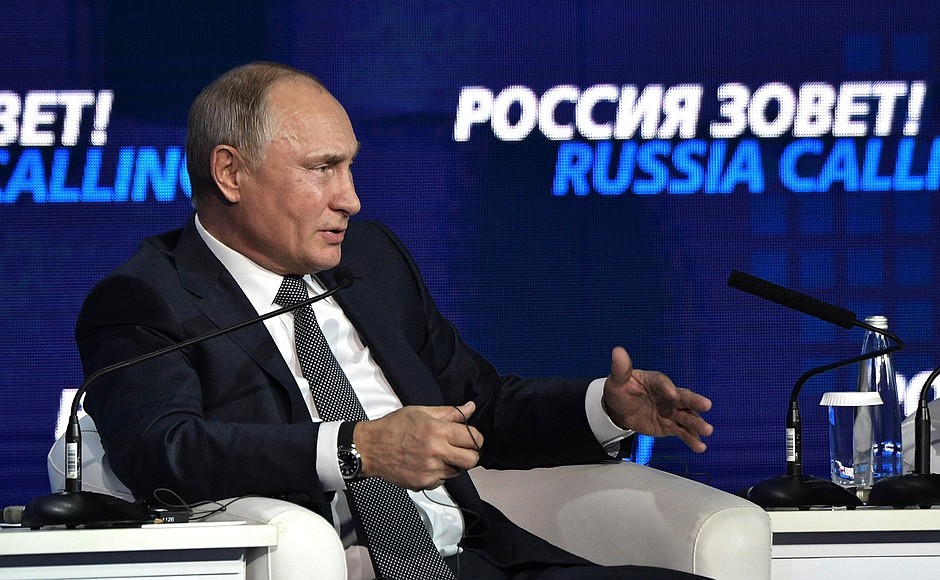
President Vladimir Putin noted at the VTB Capital’s Russia Calling Forum, that many countries had been “stepping up their activities on the African continent” but added that Russia could not cooperate with Africa “as it was in the Soviet period, for political reasons.” In his opinion, cooperation with African countries could be developed on a bilateral basis as well as on a multilateral basis, through the framework of BRICS (Brazil, Russia, India, China and South Africa).
But so far, Russia has not pledged adequate funds toward implementing its business projects and other policy objectives in Africa.
Russia’s investment efforts in the region have been limited thus far which some experts attributed to lack of a system of financing policy projects.
While Russia government is very cautious about making financial commitments, Russia’s financial institutions are not closely involved in foreign policy initiatives in Africa.
As publicly known, China has offered $60 billion, Japan $32 billion, and India $25 billion, while large investment funds have also come from the United States and European Union, all towards realizing the Sustainable Development Goals (SDGs) in Africa.
World
Russia, Tanzania Boost Bilateral Economic Ties
By Kestér Kenn Klomegâh
From Africa’s perspectives on attaining economic sovereignty, Tanzania, located in East Africa, has seriously begun showing the investment model as Russia pledges tremendous support during the meeting of the Russian-Tanzanian intergovernmental commission in Arusha, in mid-May 2026. Russia is undertaking various development projects as well as addressing bilateral issues relating to investment, trade and innovation on the African continent, and described Tanzania as the gateway to the broader East African region.
Step 1: Gazprom is interested in implementing comprehensive gas projects in Tanzania, according to the report issued by the Ministry of Economic Development. It says Gazprom, in addition to selling natural gas, LNG, and petrochemical products, is ready to supply technologies and equipment for gas production, processing, transportation, and sales. It says Gazprom is continuing its work on a pilot project launched last year to supply two mobile gas tankers to Tanzania.
NOVATEK has also indicated its preparedness to participate in natural gas exploration and production projects in Tanzania, and for now, the staff are awaiting information on the date of the fifth round of license allocation for exploration blocks, as well as on the acquisition of blocks outside the tender process—specifically, at the Ntorya field. “Tanzania has significant resource potential, and the economy’s growing demand for electricity and fuel opens up significant opportunities for joint projects. The current situation in the Strait of Hormuz compels us to seek new solutions to ensure that it does not reduce economic growth on the African continent, and particularly in Tanzania,” said Maxim Reshetnikov, head of the Ministry of Economic Development, speaking at a meeting of the Russian-Tanzania intergovernmental commission in Arusha.
Step 2: Russia and Tanzania plan to sign a memorandum of cooperation in tourism in Moscow. In June, as part of the “Travel!” forum in Moscow (June 10-14), the Tanzanian delegation was already given the invitation to participate, noted Reshetnikov while further explaining that Russia is interested in launching direct air service between the two countries, which would “give a powerful boost to tourism development.”
Air Tanzania’s initiative to launch flights from Moscow to Dar es Salaam, with high hopes that Russia and Tanzania will complete the necessary procedures for the entry into force of the new air traffic agreement as quickly as possible. In particular, officials are awaiting notification from the Tanzanian side regarding the entry into force of this agreement.
Air Tanzania will begin flights from Dar es Salaam, Tanzania’s largest city, on May 28. According to the online flight information at the capital’s Vnukovo Airport, flights on this route will include a stopover on the island of Zanzibar. Flights will operate three times a week, on Tuesdays, Thursdays, and Saturdays. The program will run until October 24.
Step 3: Tanzanian President Samia Suluhu Hassan is expected on an official state visit to Russia in June, and that will boost bilateral trade and investment, and provide an additional impetus to developing mutual cooperation.
“In preparation for the upcoming high-level meeting, I propose discussing both promising areas and specific projects… and identifying key areas for further cooperation. In addition to trade, these include energy, transport, industry, agriculture, tourism, science, and education,” Reshetnikov said.
The Tanzanian delegation is expected to participate in the St. Petersburg International Economic Forum, which will be held from June 3 to 6. Usually, at the St. Petersburg forum, the African agenda is of great importance. The programme includes the Russia-Africa Business Dialogue, which, since 2016, has been the annual meeting place for representatives of Russian and African business and official communities. Roscongress Foundation organises it.
World
AFC Backs Future Africa, Lightrock in $100m Tech VC Funding Bet
By Adedapo Adesanya
Infrastructure solutions provider, Africa Finance Corporation (AFC), has committed parts of a $100 million investment to fund managers—Future Africa and Lightrock Africa—to boost African tech venture backing.
The commitment to Lightrock Africa Fund II and Future Africa Fund III is the first tranche of a broader deployment, AFC noted.
The corporation added that it is actively evaluating a pipeline of additional Africa-focused funds spanning a range of strategies and stages, with further commitments expected in the near term.
This is part of its efforts to plug a persistent gap in long-term institutional capital on the continent, which constrains the development and scaling of high-potential technology businesses across the continent, especially with a drop in foreign investments.
“Through this commitment, AFC will deploy catalytic capital in leading Africa-focused technology Funds and, in particular, African-owned fund managers,” it said in a statement on Monday.
AFC aims to address the underrepresentation of local capital in venture funding by catalysing greater participation from African institutional investors and deepening local ownership within the ecosystem.
Despite some success stories on the continent, local institutional capital remains significantly underrepresented across many fund cap tables, with the majority of venture funding continuing to flow from international sources.
AFC’s commitment is designed to shift that dynamic, according to Mr Samaila Zubairu, its chief executive.
“Across the continent, young Africans are not waiting for the digital economy to arrive; they are seizing the moment — adopting technology, creating markets and solving real economic problems faster than infrastructure has kept pace. That is the investment signal.
“AFC’s $100 million Africa-focused Technology Fund will accelerate the convergence of growing demand, rapid technology adoption, youthful demographics and the enabling infrastructure we are building.
“Digital infrastructure is now as fundamental to Africa’s transformation as roads, rail, ports and power — enabling productivity, payments, logistics, services, data and cross-border trade, while creating jobs and industrial scale.”
Mr Pal Erik Sjatil, Managing Partner & CEO, Lightrock, said: “We are delighted to welcome Africa Finance Corporation as an anchor investor in Lightrock Africa II, deepening a strong partnership shaped by our collaboration on high-impact investments across Africa, including Moniepoint, Lula, and M-KOPA.
“With aligned capital, a long-term perspective, and a shared focus on value creation, we are well positioned to support exceptional management teams and scale category-leading businesses that deliver attractive financial returns alongside measurable environmental and social outcomes,” he added.
Adding his input, Mr Iyin Aboyeji, Founding Partner, Future Africa, said: “By investing in AI-native skills, financing productive tools such as phones and laptops, and expanding energy, connectivity and compute infrastructure, we can convert Africa’s greatest asset — its people — into critical participants in the new global economy. AFC’s US$100 million commitment is the anchor this moment demands.
“As our first multilateral development bank partner, AFC is sending a clear signal that digital is as fundamental to Africa’s transformation as agriculture, manufacturing and physical infrastructure. We trust that other development finance institutions, insurers, reinsurers and pension funds will follow AFC’s lead.”
World
Africa ‘Reawakening’ In Emerging Multipolar World
By Kestér Kenn Klomegâh
In this interview, Gustavo de Carvalho, Programme Head (Acting): African Governance and Diplomacy, South African Institute of International Affairs (SAIIA), discusses at length aspects of Africa’s developments in the context of shifting geopolitics, its relationships with external countries, and expected roles in the emerging multipolar world. Gustavo de Carvalho further underscores key issues related to transparency in agreements, financing initiatives, and current development priorities that are shaping Africa’s future. Here are the interview excerpts:
Is Africa undergoing the “second political re-awakening” and how would you explain Africans’ perceptions and attitudes toward the emerging multipolar world?
We should be careful not to overstate novelty. African states exercised real agency during the Cold War, too, from Bandung to the Non-Aligned Movement. What has actually shifted is the structure of the international system around the continent. The unipolar moment has faded, the menu of partners has widened, and a generation of policymakers under fifty operates without the inhibitions of either the Cold War or the immediate post-Cold War period. African publics, however, are more pragmatic than multipolar rhetoric assumes. Afrobarometer’s surveys across more than thirty countries consistently show citizens evaluating external partners on tangible outcomes such as infrastructure, jobs and security, rather than on civilisational narratives. China is generally associated with positive economic influence, the United States retains the strongest pull as a development model, and Russia, despite a louder political profile, registers a smaller and more geographically concentrated footprint. Multipolarity is not a destination Africans are arriving at. It is a working environment that creates more options and more risks at once.
Do you think it is appropriate to use the term “neo-colonialism” referring to activities of foreign players in Africa? By the way, who are the neo-colonisers in your view?
The term has analytical value when used carefully, and loses it when deployed selectively against whichever power one wishes to embarrass. Nkrumah’s 1965 formulation was precise: political independence accompanied by continued external control over economic and political life. The honest test is whether contemporary patterns reproduce that asymmetry, irrespective of the capital from which they originate. The structural picture is well documented. Africa still exports primary commodities and imports manufactured goods. Intra-African trade hovers around fifteen per cent of total trade, well below Asian or European levels. African sovereigns pay a measurable risk premium on debt that exceeds what fundamentals alone justify. Applied consistently, the lens directs attention to opaque resource-for-infrastructure contracts, security-for-mineral bargains, debt agreements with confidentiality clauses, and aid architectures that bypass African institutions. That description fits legacy French commercial arrangements in francophone Africa, Chinese mining concessions in the DRC, Russian-linked gold extraction in the Central African Republic and Sudan, Gulf-backed port and farmland deals along the Red Sea, and Western corporate practices that have not always met the standards their governments preach. Naming a single neo-coloniser tells us more about the speaker’s politics than about the structure.
How would you interpret the current engagement of foreign players in Africa? Do you also think there is geopolitical competition and rivalry among them?
Competition is real and intensifying, and the proliferation of Africa-plus-one summits is the clearest indicator. Russia has held two summits, in Sochi in 2019 and St Petersburg in 2023. The EU, Turkey, Japan, India, the United States, South Korea, Saudi Arabia and the UAE all host their own variants. Trade figures give a more honest sense of weight than diplomatic theatre. China-Africa trade reached around 280 billion dollars in 2023, United States-Africa trade sits in the 60 to 70 billion range, and Russia-Africa trade is roughly 24 billion, heavily concentrated in grain, fertiliser and arms. Describing the continent as a chessboard, however, understates how African states themselves are shaping these dynamics, sometimes through skilful diversification and sometimes through security bargains that entail longer-term costs. The Sahel illustrates the latter starkly. Between 2020 and 2023, Mali, Burkina Faso and Niger expelled French forces, downgraded their relationships with ECOWAS and the UN stabilisation mission, and welcomed Russian security contractors. ACLED data shows civilian fatalities from political violence rising rather than falling across the same period. Substituting providers without strengthening domestic institutions does not produce sovereignty. It changes the terms of dependence.
Do you think much depends on African leaders and their people (African solutions to African problems) to work toward long-term, sustainable development?
The principle is correct, and it is regularly weaponised in two unhelpful directions. External actors invoke it to justify withdrawing from responsibilities they continue to hold, particularly over financial flows and arms transfers that pass through their own jurisdictions. Some African leaders invoke it to deflect legitimate scrutiny of governance failings, repression or corruption. Genuine African agency requires more than rhetoric. The AU’s operating budget remains modest in absolute terms, and external partners still cover a significant share of programmatic activities, which shapes what gets funded. The African Standby Force, conceived in 2003, remains only partially operational more than two decades on. The African Continental Free Trade Area, in force since 2021, has rolled out more slowly than drafters hoped because the political will to lower national barriers lags the speeches. Long-term development depends on African leaders financing more of their own security and development priorities, on publics holding them accountable, and on a clearer-eyed view of what foreign forces can deliver. Whether the actors are Russian-linked contractors in the Sahel and Central African Republic, Western counter-terrorism deployments, or others, external security providers tend to address symptoms while leaving the political and economic drivers of insecurity intact.
Often described as a continent with huge, untapped natural resources and large human capital (1.5 billion), what then specifically do African leaders expect from Europe, China, Russia and the United States?
Expectations differ across the three relationships, and that differentiation is itself a marker of agency. From China, leaders expect infrastructure financing, sustained commodity demand, and a partnership that does not condition itself on domestic governance reforms. FOCAC commitments have delivered visible results in ports, railways and power generation, though Beijing itself has shifted toward smaller, more selective lending since around 2018. From Russia, expectations are narrower because the economic footprint is. Moscow’s offer is political backing in multilateral forums, arms transfers, grain and fertiliser supply, civilian nuclear cooperation in a handful of cases, and security partnerships, including those involving private military formations. The record of those security arrangements in the Central African Republic, Mali, Sudan and Mozambique deserves a sober assessment on its own terms, because the human and political costs are documented and uneven. From the United States, leaders look for market access through instruments such as AGOA, whose post-2025 future has generated significant uncertainty, alongside private capital, technology partnerships and a posture that treats the continent as more than a counter-terrorism theatre. The priorities across all three relationships are essentially the same: transparency in the terms of agreements, arrangements that preserve future policy space, and partnerships that build domestic productive capacity rather than substitute for it. The continent’s leverage in this multipolar moment is real, but it is not permanent. It will be squandered if used to rotate among external dependencies rather than reduce them.
-
Feature/OPED6 years agoDavos was Different this year
-
Travel/Tourism10 years ago
Lagos Seals Western Lodge Hotel In Ikorodu
-
Showbiz3 years agoEstranged Lover Releases Videos of Empress Njamah Bathing
-
Banking8 years agoSort Codes of GTBank Branches in Nigeria
-
Economy3 years agoSubsidy Removal: CNG at N130 Per Litre Cheaper Than Petrol—IPMAN
-
Banking3 years agoSort Codes of UBA Branches in Nigeria
-
Banking3 years agoFirst Bank Announces Planned Downtime
-
Sports3 years agoHighest Paid Nigerian Footballer – How Much Do Nigerian Footballers Earn