
World
WTO DG Job: Nigeria to Engage Relevant Stakeholders

By Adedapo Adesanya
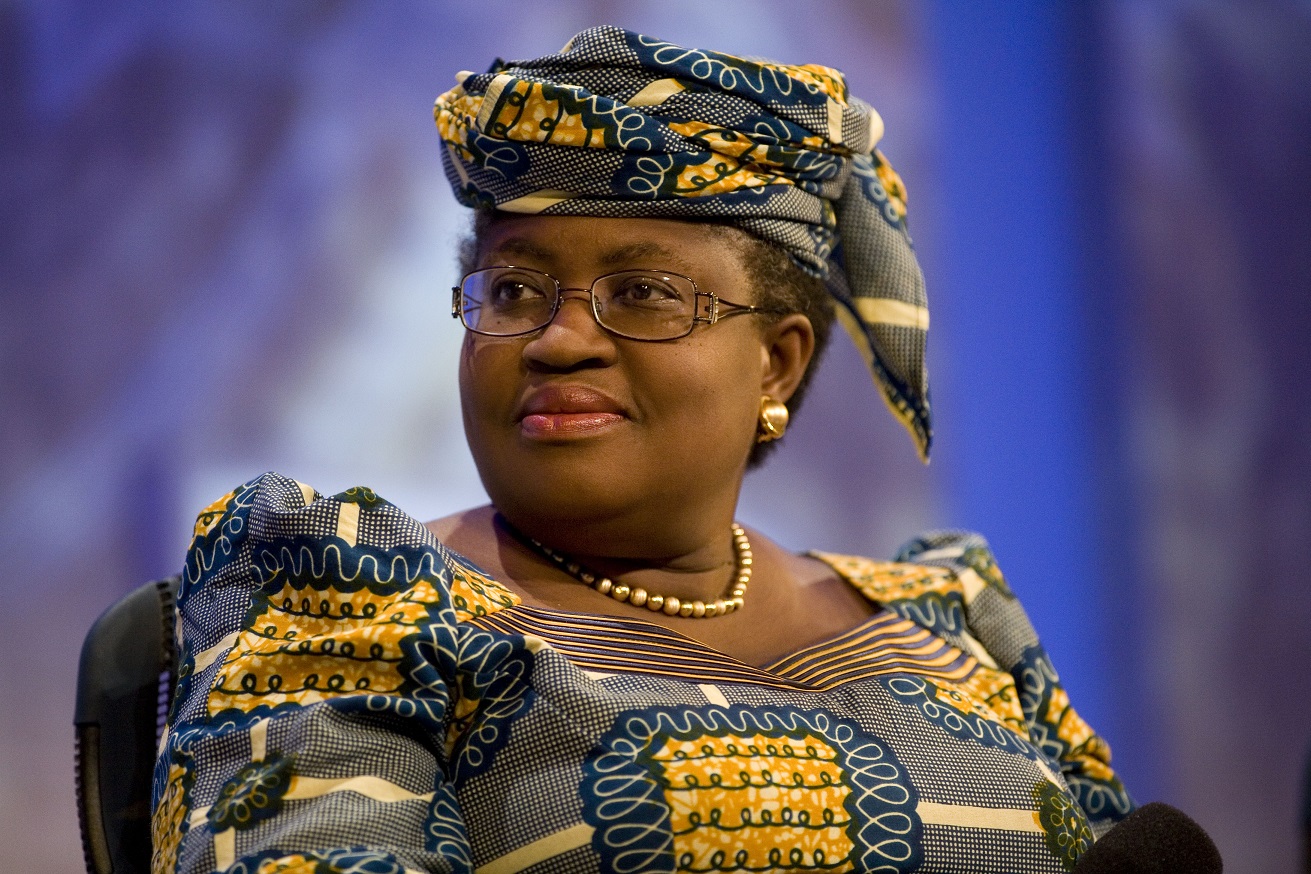
The federal government has said it will continue to engage relevant stakeholders to ensure the emergence of Mrs Ngozi Okonjo-Iweala as the next Director-General of the World Trade Organisation (WTO).
This was disclosed through a spokesperson for the Ministry of Foreign Affairs, Mr Ferdinand Nwonye, in a statement released on Thursday in Abuja.
He noted that the third and final round of the selection process for the director-general of the global trade organisation was concluded on Tuesday and the result was formally announced the day after.
The spokesperson added that Mrs Okonjo-Iweala, a former Minister of Finance, had gotten the support of the majority of the member countries but explained that she was yet to be declared and returned the winner because all the 164 member states of the organisation were expected to adopt the winner by consensus.
“The Ministry of Foreign Affairs wishes to inform that the third and final round of the selection process of the Director-General of the World Trade Organization (WTO) was concluded on Tuesday, October 27, 2020, and the result was formally announced on Wednesday, October 28, 2020.
“The candidate from Nigeria, Dr Ngozi Okonjo-Iweala, has secured the support of the majority of the member countries but is yet to be declared and returned the winner.
“This is because apart from winning the election, all the 164 member states of WTO were expected to adopt the winner by consensus, in accordance with the rule of procedure of the WTO,” he noted.
The WTO’s bid to elect a new leader was thrown into uncertainty following the rejection of the former minister by the United States.
The US, critical of the WTO’s handling of global trade, wants Mrs Okonjo-Iweala’s rival, South Korea’s Yoo Myung-hee, saying she could reform the body.
In a statement, the Office of the US Trade Representative, which advises President Donald Trump on trade policy, said the organisation “must be led by someone with real, hands-on experience in the field”.
Ms Yoo had “distinguished herself” as a trade expert and “has all the skills necessary to be an effective leader of the organisation”, the statement said.
It added: “This is a very difficult time for the WTO and international trade. There have been no multilateral tariff negotiations in 25 years, the dispute settlement system has gotten out of control, and too few members fulfil basic transparency obligations. The WTO is badly in need of major reform.”
Mrs Okonjo-Iweala and Nigeria are hopeful as they await a meeting scheduled for November 9 for the final decision on the election process.
On Wednesday, a WTO nominations committee recommended the group’s 164 members appoint Ngozi Okonjo-Iweala. She would be the first woman and first African to lead the WTO.



By Adedapo Adesanya
Pan-African multilateral financial institution, the African Export-Import Bank (Afreximbank), has approved a $10 billion Gulf Crisis Response Programme (GCRP) to insulate African and Caribbean economies, financial institutions and corporates from the impact of the ongoing Iran war.
The GCRP builds on a series of timely emergency interventions introduced by the lender in recent years, which have helped cushion most economies from the impact of recent shocks such as the commodity shock of 2015/16, the COVID-19 Pandemic of 2020/2021 and the Ukraine crisis of 2023/24.
The latest conflict, which escalated on February 28, 2026, has sent shockwaves through the global economy, with African and Caribbean economies bearing the largest share of the brunt. These impacts specifically affect nations that heavily rely on fuel, fertiliser, and food imports, alongside those exposed to Gulf shipping corridors, investment flows, tourism and remittance inflows.
According to Afreximbank in a statement on Tuesday, GCRP is designed to, among others, sustain essential imports – including fuel, LNG, food, fertiliser, pharmaceuticals – by providing vital short-term Foreign Exchange (FX) and liquidity to support vulnerable member states. It further aims to empower African energy and minerals exporters to capitalise on elevated prices and rerouted trade flows by scaling productive capacity in strategic commodities through pre-export finance, working capital, and inventory financing. Additionally, it provides short-term relief to African and Caribbean member states whose tourism and aviation industries have been adversely impacted by the crisis.
The programme is also designed to build the medium to long-term resilience of African and Caribbean economies against future shocks by scaling productive capacities for producers and exporters of energy, minerals while accelerating the completion of critical energy, port, and logistics infrastructure projects in African and Caribbean member states, delayed by the conflict.
Commenting on the facility, launched on March 31, 2026, Mr George Elombi, President and Chairman of the Board of Directors at Afreximbank, said: “This crisis response programme is in tune with our DNA. We understand how our economies work and the pain points associated with these transitory crises. The programme will support African countries in adjusting smoothly to the crisis while strengthening their resilience to future shocks through interventions that transform the structure of their economies.”
Through GCRP, Afreximbank has already begun taking proactive steps through partnerships with banks and corporates to secure fuel, other energy supplies, fertilisers, and essential food imports, whose supplies have been interrupted by the elongation of the crisis.
Beyond the financing, Afreximbank will spearhead a coordinated regional response in partnership with the UN Economic Commission for Africa (UNECA), the African Union Commission (AUC), the African Continental Free Trade Area (AfCFTA) Secretariat, and the Caribbean Community (CARICOM) Secretariat to strengthen regional coordination on energy security, trade resilience, and supply chain diversification.

By Kestér Kenn Klomegâh
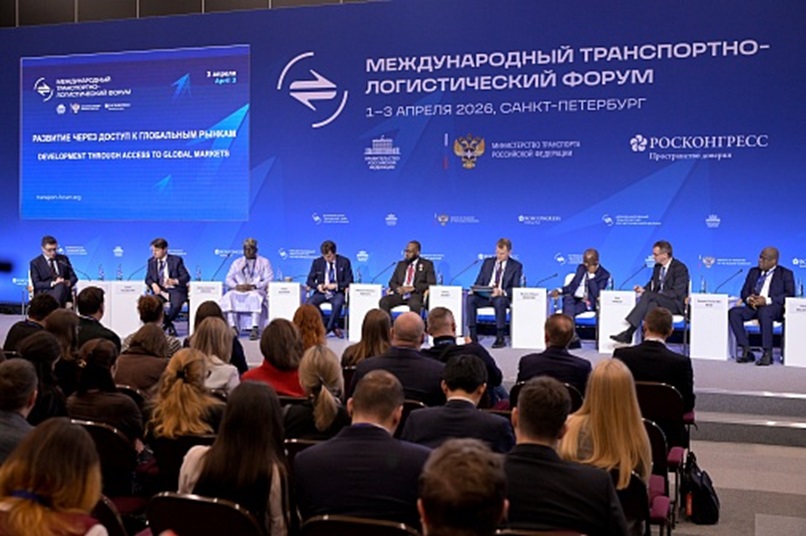
At the plenary session under the theme “Development Through Access to Global Markets” organised during the first International Transport and Logistics Forum held in St. Petersburg, both Russian and African speakers have acknowledged, in their high-quality presentations, the importance of fostering understanding of transport innovations, shifting investment and the possibility of addressing current infrastructure challenges for economic growth.
In promoting comprehensive cooperation in the transport and logistics sphere, Deputy Minister of Transport of the Russian Federation, Dmitry Zverev, stressed that the African continent is one of the fastest-growing regions of the world, demonstrating an average GDP growth rate of 4.5% per year.
According to expert projections, by 2050, Africa’s population will reach 2.5 billion people. To ensure logistical links, it is necessary to build a clear and understandable dialogue with partners, working simultaneously at two levels: at the level of governments, through intergovernmental agreements, and at the level of co-business partnerships. Russian transport corridors guarantee the stability of supplies. Today, there are issues of food security, fertiliser supply and formation of new chains, and other emerging geopolitical challenges facing Africa.
As the guest/main speaker, Zverev explained that Russian companies such as FESCO, RZD, GLONASS and Avtodor are actively involved in this process. This is a unique experience sharing technology and infrastructure solutions in significant volumes. “And frankly, that’s an important image distinction of Russia: we’re not just exporting or selling something – we’re offering technologies and cooperation. Together with technologies, we provide training and prepare national personnel who will work on their transport infrastructure in the future,” asserted Zverev.
Minister of Energy and Infrastructure of the United Arab Emirates, Suhail Mohammed Al Mazrouei, spoke of his country’s decision to invest significant money in the development of its railway infrastructure, with work already underway to connect to Oman by rail and open up new opportunities for freight transportation to Africa and Asia.
“We continue to invest in the development of our country’s logistics network and alternative routes. Russia is an important exporter of raw materials, and development in its regions will contribute to economic growth across the globe. Central Asia is also emerging as a key player, and we are investing in the region’s infrastructure and connecting China to the global economy through Russia and the Middle East,” he said.
Minister Delegate for Maritime Economy of the Ministry of Maritime Economy, Fisheries, and Coastal Protection of the Togolese Republic, Kokou Edem Tengue, spoke of the importance of understanding the African perspective on changing maritime routes as the situation around the Suez Canal and the Strait of Hormuz creates new opportunities for West Africa.
The Port of Lomé, the largest container port in Sub-Saharan Africa, handles approximately 30 million tonnes of goods annually, and its importance for the region is difficult to overstate. “We are actively working with Mali, Burkina Faso, and Niger; the Port of Lomé is a key logistics hub for the landlocked nations of the Sahel,” he said. “It should be noted that Africa relies on chemical fertilisers and grain produced in Russia. We believe that the Port of Lomé could be a part of new sea routes between Africa and Russia.”
In his speech, Minister of Transport of the United Republic of Tanzania, Makame Mnyaa Mbarawa, reported on the active modernisation of the Dar es Salaam port. Previously, the depth of the water was 9–12 meters; now it has increased to 12–15 meters. An increase in the number of operators operating in the port is planned. Thanks to these measures, cargo turnover increased significantly, and ship handling times decreased from 10 days to 2–3. This is an important achievement, after all, speed is a key factor for investors.
However, the port cannot function in isolation; it needs modern rail infrastructure. Tanzania’s government is leading the construction of a new railway to Kigoma, and then into Burundi and south, creating a reliable transportation artery. Dar es Salaam will become a gateway to Burundi, Rwanda, Malawi and Zambia, which depend on cargo flow through this port. Therefore, the development of the port and associated railway is of strategic importance in the region.
“In parallel, the modernisation of the TAZARA railway is going on – a historic artery that requires an upgrade. The private sector is actively involved in this work. After revitalisation, this line will become a key link between Dar es Salaam port and Zambia, he stated. The Government of Tanzania will make every effort to implement these projects and will work closely with the private sector. We invite Russian companies – both state and private – to participate in logistics projects and port infrastructure modernisation.”
As far as road safety in Niger is concerned, the country is facing various challenges that require finding ways to improve the situation, according to the Speaker from Niger, Abdurakhaman Amadou. Within the framework of the discussion, he also noted that an important step was to upgrade the car park and road network. As Niger has no access to the sea, the emphasis is on road traffic to ensure the country’s supply.
“We have access to the port of Lome in the Togolese Republic, which remains neutral towards us. However, the Caton port is closed for us, which created serious difficulties as 80% of our exports and imports passed through it. Recently, the situation has started to improve due to the construction of a railway by Nigeria, which will provide us with access to its ports,” Abdurakhaman informed.
In addition, diplomatic relations with Algeria have been restored after a long hiatus, which opens an exit to the Mediterranean. The conference of Islamic states confirmed the intention to build a grand railway linking Dakar and Djibouti across the entire continent from west to east. This railway will partially pass through Niger, which will be an important step in the development of the region’s transportation infrastructure.
President Vladimir Putin, in a message to participants, organisers, and attendees of the International Transport and Logistics Forum, says that Russia is ready to share its experience through joint science and technology programmes and, of course, by training specialists able to ensure the development of transport and logistics in the 21st century, using a new technological foundation. The Transport and Logistics forum was held for the first time on April 1-3 in St. Petersburg, the second-largest city in the Russian Federation.
By Kestér Kenn Klomegâh
The Arab Republic of Egypt, a country spanning the northeast corner of Africa and the southwest corner of Asia, has a highly strategic location and attracts multifaceted interests of foreign players. For decades, Russia has established diplomatic relations with Egypt and has consistently sustained diverse ties with this country. It is no secret that Russia’s lust for the region is primarily due to the strategic importance of the Mediterranean Sea for investment and economic cooperation with the Maghreb region.
Determined to strengthen, particularly, economic cooperation, Russian President Vladimir Putin has maintained regular contacts with his colleague, President of Egypt, Abdel Fattah el-Sisi, mostly discussing both bilateral cooperation and broader regional developments. The current world’s geopolitical development, for instance, the United States-Israeli war on Iran in the Middle East, constitutes one theme both leaders frequently review, attempting to find long-term solutions.
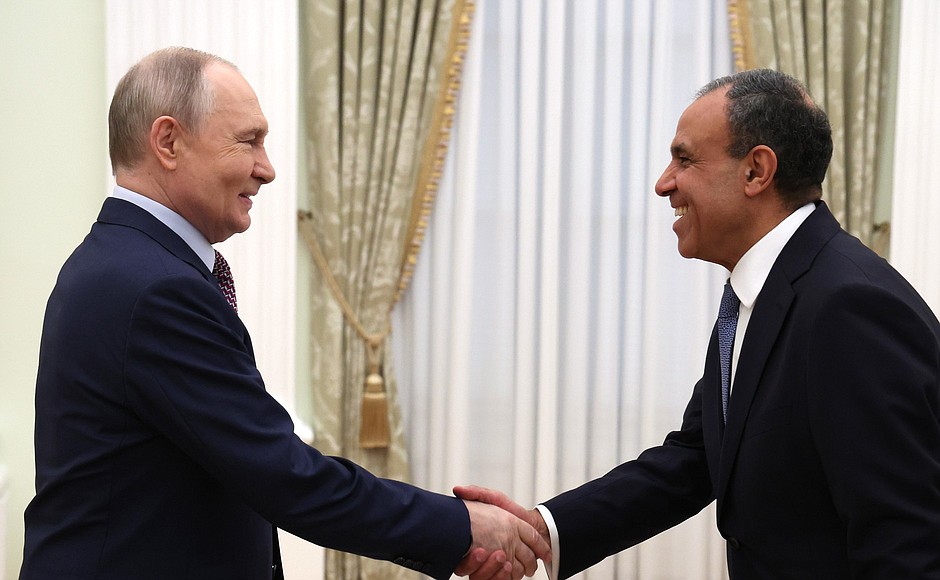
On April 2, Putin met with the Minister of Foreign Affairs, Emigration, and Egyptian Expatriates of the Arab Republic of Egypt, Badr Abdelatty, in the Kremlin – the seat of Russia’s presidency. In attendance during the official talks on the Russian side were Foreign Minister Sergei Lavrov and Presidential Aide Yury Ushakov, while Egypt was represented by Ambassador Extraordinary and Plenipotentiary to the Russian Federation Hamdy Shaaban. Ultimately, there is no need to overstate the importance of this meeting.
Russia’s footprints are expanding in Egypt, highlighting the growing industrial investment and the strengthening of bilateral manufacturing ties by undertaking projects to ensure energy security. At the same time, maintaining regular dialogue remains very important for both leaders.
Putin, speaking with the three-member delegation in the Kremlin, underlined the fact that there are many promising initiatives underway, many of which are already being implemented. He has previously spoken in detail about the construction of a nuclear power plant and the construction of an industrial zone, and over ten major Russian companies have expressed interest in participating in this project.
Nuclear Plants in El-Dabaa, Egypt
The construction of nuclear plants in the city of El-Dabaa, about 320 kilometres northwest of Cairo, the capital of Egypt. It is the first nuclear power plant in Egypt, and will have four VVER-1200 reactors, making Egypt the only country in the region to have a Generation III+ reactor. On November 19, 2015, Egypt and Russia signed an initial agreement, under which Russia agreed to build and finance Egypt’s first nuclear power plant. These are now being carried out, not as a charity project, but with a loan of $28 billion. According to reports, Russia will finance 85% as a state loan of $25 billion, and Egypt will provide the remaining 15% in the form of instalments. The Russian loan has a repayment period of 22 years, with an annual interest rate of 3%.
At the meeting, Putin also raised the construction of an industrial zone in Egypt. There are many appealing and related opportunities in this, regarding having an industrial zone to be located on the banks of the Suez Canal. The industrial zone is also entering a new phase, as Russian auto-manufacturing enterprises are advancing distinctive plans to expand local vehicle production, reinforcing the country’s role as a regional manufacturing hub. The move reflects broader economic linkages between Russia and Africa, particularly in industrial development and supply chain integration.
Conveying Greetings and Reviewing the Middle East Situation
Naturally, the situation in the region remains a shared concern, according to Putin, and further hope that the ongoing conflict will be promptly resolved. “As you know, President Trump also addressed this issue yesterday. Let me reiterate that we are prepared to make every effort to help stabilise the situation and, as they say in such cases, return it to normal,” he stressed during the meeting. In this context, it is particularly important to know Egypt’s assessment as a key country in the Middle East.
Putin reminded the delegation of another Russia-Africa summit, which is planned for October 2026. With high hopes that Egypt will be represented by a strong, high-level delegation. Should the Egyptian President’s schedule allow, he would, of course, ahead of the summit, be very pleased to welcome him to Moscow. Jointly chaired by Vladimir Putin and Abdel Fattah el-Sisi, the first Russia-Africa summit, an important acute phase of the developments with Africa, under the motto of ‘For Peace, Security and Development’, was held for the first time in October 2019, in Sochi, a city located on the Black Sea coast. The idea to hold a Russia-Africa forum was initiated by President Putin at the BRICS (Brazil, Russia, India, China and South Africa) summit in Johannesburg in July 2018.
The head of the Egyptian Foreign Ministry, as traditionally expected, conveyed greetings from President El-Sisi to the Russian president and handed over a written message. President el-Sisi places great value on all aspects of the bilateral cooperation, and is extremely grateful for constructive collaboration on the El Dabaa Nuclear Power Plant, which represents a key milestone in the partnership. Despite the challenges, it is evident that the project is moving forward and will be completed by 2028.
In summary, as Egypt and Russia are reliable and time-tested partners, Putin plans to promote strategic projects, particularly in trade, economics, energy, and food security. With over 107 million inhabitants, Egypt is the most populous country in the Arab world, the third-most populous country in Africa, and the 15th-most populous in the world.
-
 Feature/OPED6 years ago
Davos was Different this year
-
Travel/Tourism10 years ago
Lagos Seals Western Lodge Hotel In Ikorodu
-

 Showbiz3 years ago
Estranged Lover Releases Videos of Empress Njamah Bathing
-
 Banking8 years ago
Sort Codes of GTBank Branches in Nigeria
-

 Economy3 years ago
Subsidy Removal: CNG at N130 Per Litre Cheaper Than Petrol—IPMAN
-

 Banking3 years ago
Sort Codes of UBA Branches in Nigeria
-

 Banking3 years ago
First Bank Announces Planned Downtime
-

 Sports3 years ago
Highest Paid Nigerian Footballer – How Much Do Nigerian Footballers Earn