

Economy
Nigeria Still Safe to Borrow Additional N7.9trn—FSDH

By Dipo Olowookere
Some days ago, the Debt Management Office (DMO) released the public debt profile of the country and from their report, Nigeria’s debt stood at N24.4 trillion as at December 31, 2018.
The release of the report stirred another debate in the country, with different stakeholders appealing to federal government to reduce its borrowings.
But analysts at FSDH Research have said Nigeria still has room to borrow an additional N7.89 trillion before reaching a threshold of about N32 trillion.
In its report released this week, which was obtained by Business Post, the Lagos-based investment company said based on the fact that the public debt-to-GDP ratio of Nigeria, Africa’s largest economy, was still under 20 percent, precisely 18.89 percent, it can still get more loans to reach the 25 percent benchmark set for itself and the 56 percent international threshold set for countries in Nigeria’s peer group.
FSDH Research argued that countries like China, South Africa, India, UK and USA all have high debt-to-Gross Domestic Product (GDP) of over 50 percent, but stressed that they have successfully managed to deploy their borrowings into activities that can stimulate revenue generation including education, transportation, construction, security, technology, and other growth-enhancing infrastructure.
“By utilizing these borrowed funds in areas that improve the ease of doing business in their countries, they have been able to grow their economies further, create job opportunities, and create more avenues for their governments to grow their revenue,” the report said.
It advised the Nigerian government to diversify its revenue and create multiple sources so as to change the present narrative.
“Just as FSDH Research has suggested several times in our previous reports, there is an urgent need to expand the revenue base of the country through the growth of the non-oil sector.
“We suggest that the government should adopt strategies to increase and broaden its revenue. Some of these strategies include an increase in the tax base of the country (apart from an increase in the tax rate), removal of all administrative delays in obtaining licences and approvals (including titles to landed properties for building and agricultural purposes), the sale of unprofitable government assets and, removal of subsidies on electricity and Premium Motor Spirit (PMS).
“In addition, we emphasize that borrowing should be tied to specific projects that can improve the competitiveness of the country, such as the FGN Sukuk Bond.
“To conclude, as individuals and business entities in Nigeria, we can help government generate more revenue by paying our taxes and other dues as and when due. And government must surely reciprocate with the provision of appropriate facilities that will make life better for all,” it said.
Read the full report below
Have you ever had to borrow money and accumulate debt? Some individuals believe that debt is bad and as a result they live within their limited resources. But are debts really bad? Now, imagine that you run a chocolate-production business and you receive a large order to supply chocolates to a big customer who will surely pay you after supply.
After considering your resources, you find out that you do not have sufficient funds to purchase the raw materials required to produce the chocolates.
You are then faced with a decision to either borrow money from a willing lender to finance the operation and make your money later or not to borrow and lose the business. What will you do? It is your choice to make but borrowing is definitely a better option if the money is used for productive activities that have the capacity to pay back the debt as well as its associated interest.
Just as individuals and companies are faced with the dilemma of whether or not to borrow, countries also face the same problem.
Although it is difficult to find any country that does not borrow, there are key questions each country must ask. How much debt should they contract? What projects will the debt be used for? How will the loan be repaid on top of the associated interest? Whom should they approach to lend the money? What will be the impact of the loan servicing on the country’s ability to perform her obligations to the citizens? Some countries have shown that debt is not bad in itself. What truly matters is the productivity of the debt that is contracted.
Countries such as China, South Africa, India, UK and USA have high Debt-to-Gross Domestic Product (GDP) of over 50%. Our computation shows that despite the significant increase in Nigeria’s public debt in recent years, standing at N24 trillion, Nigeria’s Public Debt-to-GDP ratio is less that 20%. Based on this measure, Nigeria could borrow more.
The countries mentioned above, however, have managed to deploy their borrowings into activities that can stimulate revenue generation including education, transportation, construction, security, technology, and other growth-enhancing infrastructure. By utilizing these borrowed funds in areas that improve the ease of doing business in their countries, they have been able to grow their economies further, create job opportunities, and create more avenues for their governments to grow their revenue.
So, you might now be thinking, maybe debt is not bad after all. But, you must not be quick to say this. The matter of public debt must be weighed carefully and thoroughly. Just as there are countries that have done well because of increased borrowing, there are other countries whose high, unsustainable debt levels have not translated into economic development.
In reviewing Nigeria’s debt profile, FSDH Research observes that the level of debt has been on the increase over the years. As at December 2018, the total public debt increased to N24.39trillion. But this is not where the issue lies.
A further analysis shows that the Public Debt-to-GDP ratio is 18.89%, which is below the 25% benchmark the Federal Government of Nigeria (FGN) sets for Nigeria and the 56% international threshold set for countries in Nigeria’s peer group.
The 25% benchmark gives Nigeria a leeway to borrow an additional N7.89 trillion given her level of GDP. But before you are quick to celebrate, there is the need to consider one very important factor: the ability of the country to service the debt without causing untold hardship on the country.
In measuring the ability of a country to service her debt obligations, we look at the ratio of domestic debt service-to-FGN FAAC allocation.
This is where the problem lies for Nigeria. Low revenue generation makes it very difficult for the FGN to meet its debt obligations without sacrificing other important responsibilities of government.
FSDH Research notes that the current high debt service to revenue structure in Nigeria is unsustainably high and the high figure is due to the low revenue of the country. Although the strategies of the Debt Management Office (DMO) in debt management and the Central Bank of Bank of Nigeria (CBN) in monetary policy administration have reduced the interest burden of the government, Nigeria needs to accelerate revenue generation to enable it to meet all her debt obligations without stress.
The way to change this narrative is for Nigeria to diversify her revenue and create multiple sources. Just as FSDH Research has suggested several times in our previous reports, there is an urgent need to expand the revenue base of the country through the growth of the non-oil sector.
We suggest that the government should adopt strategies to increase and broaden its revenue. Some of these strategies include an increase in the tax base of the country (apart from an increase in the tax rate), removal of all administrative delays in obtaining licences and approvals (including titles to landed properties for building and agricultural purposes), the sale of unprofitable government assets and, removal of subsidies on electricity and Premium Motor Spirit (PMS).
In addition, we emphasize that borrowing should be tied to specific projects that can improve the competitiveness of the country, such as the FGN Sukuk Bond.
To conclude, as individuals and business entities in Nigeria, we can help government generate more revenue by paying our taxes and other dues as and when due. And government must surely reciprocate with the provision of appropriate facilities that will make life better for all.




By Adedapo Adesanya
Three bellwether stocks lifted the NASD Over-the-Counter (OTC) Securities Exchange by 0.62 per cent on Friday, December 12 with the NASD Unlisted Security Index (NSI) jumping by 22.20 points to 3,600.43 points from 3,578.23 points.
In the same vein, the market capitalisation of the trading platform increased by N13.28 billion to close at N2.154 trillion from the previous day’s N2.140 trillion.
During the session, Central Securities Clearing System (CSCS) Plc went up by N2.53 to close at N39.71 per share compared with the previous day’s N37.18 per share, Geo-Fluids Plc added 35 Kobo to its price to finish at N5.00 per unit versus Thursday’s closing price of N4.65 per unit, and FrieslandCampina Wamco Nigeria Plc appreciated by 23 Kobo appreciation to sell at N60.23 per share versus N60.00 per share.
It was observed that yesterday, the price of Golden Capital Plc went down by N1.05 to N9.45 per unit from N10.50 per unit, and UBN Propertiy Plc declined by 21 Kobo to N2.01 per share from the N2.22 per share it was traded a day earlier.
There was a significant improvement in the level of activity for the day, as the volume of transactions increased by 6.2 per cent to 37.4 million units from the previous day’s 35.2 million units, the value of trades went up by 265.1 per cent to N4.9 billion from N1.4 billion, and the number of deals soared by 13.80 per cent to 33 deals from 29 deals.
Infrastructure Credit Guarantee Company (InfraCredit) Plc ended the last trading day of this week as the most active stock by value on a year-to-date basis with 5.8 billion units valued at N16.4 billion, the second spot was taken by Okitipupa Plc with 178.9 million units traded for N9.5 billion, and third space was occupied by a new comer in MRS Oil Plc with 36.1 million units worth N4.9 billion.
InfraCredit Plc also finished the session as the most active stock by volume on a year-to-date basis with 5.8 billion units transacted for N16.4 billion, followed by Industrial and General Insurance (IGI) Plc with 1.2 billion units valued at N420.3 million, and Impresit Bakolori Plc with 537.0 million units sold for N524.9 million.

By Dipo Olowookere
The bullish run on the Nigerian Exchange (NGX) Limited continued on Friday with a further 1.00 per cent growth buoyed by gains recorded by Guinness Nigeria, Champion Breweries, and others.
Data showed that the consumer goods space expanded by 1.53 per cent during the last trading session of the week, as the insurance counter grew by 0.51 per cent, and the industrial goods sector marginally gained 0.01 per cent.
However, the banking index depreciated by 0.54 per cent due to a pocket of profit-taking, and the energy industry shrank by 0.09 per cent, while the commodity sector closed flat.
Guinness Nigeria gained 10.00 per cent to trade at N217.80, Morison Industries rose by 9.84 per cent to N4.69, Champion Breweries jumped by 9.69 per cent to N14.15, Austin Laz grew by 9.66 per cent to N2.27, and C&I Leasing appreciated by 9.62 per cent to N5.70.
Conversely, eTranzact lost 10.00 per cent to finish at N12.60, Chellarams slumped by 9.00 per cent to N13.20, Eunisell depleted by 9.89 per cent to N75.15, Africa Prudential moderated by 9.77 per cent to N12.00, and DAAR Communications decreased by 9.18 per cent to 89 Kobo.
The busiest stock on Friday was Access Holdings with 107.6 million units sold for N2.2 billion, Consolidated Hallmark traded 59.9 million units worth N245.8 million, Zenith Bank transacted 48.2 million units valued at N3.1 billion, Transcorp Power transacted 42.8 million units for N13.1 billion, and Champion Breweries exchanged 36.4 million units valued at N510.2 million.
At the close of business, a total of 602.8 million units worth N30.7 billion exchanged hands in 20,550 deals yesterday, in contrast to the 529.7 million units valued at N12.3 billion traded in 18,159 deals on Thursday, representing a surge in the trading volume, value, and number of deals by 13.80 per cent, 149.59 per cent, and 13.17 per cent apiece.
Business Post reports that the All-Share Index (ASI) soared during the session by 1,485.89 points to 149,436.48 points from 147,950.59 points and the market capitalisation moved up by N945 billion to N95.264 trillion from N94.319 trillion.
By Adedapo Adesanya
An intervention of the Central Bank of Nigeria (CBN) in the foreign exchange (FX) market eased the pressure on the Naira on Friday.
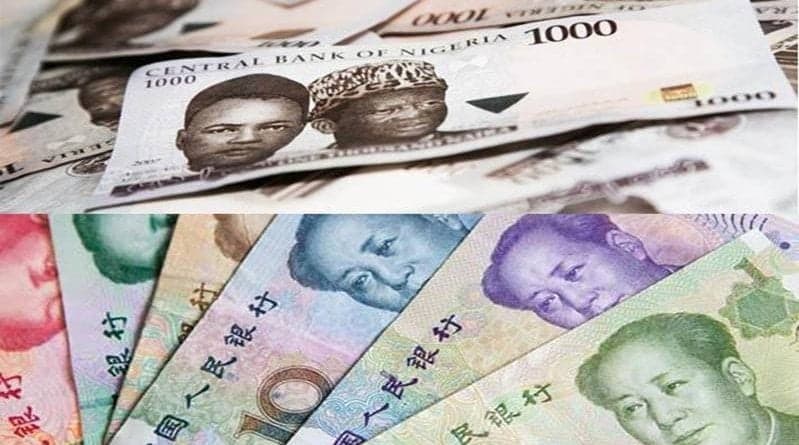
The apex bank sold forex to banks and other authorised dealers in the official window to defend the domestic currency, helping to calm the FX demand pressure, with the Nigerian currency appreciating against the US Dollar in the Nigerian Autonomous Foreign Exchange Market (NAFEM) by 0.11 per cent or N1.57 to sell at N1,454.50/$1 compared with Thursday’s closing price of N1,456.07/$1.
Also, the domestic currency improved its value against the Pound Sterling in the official market yesterday by N3.95 to close at N1,946.15/£1 versus the previous day’s N1,950.11/£1 but lost 10 Kobo on the Euro to quote at N1,706.46/€1 compared with the N1,706.36/€1 it was exchanged a day earlier.
At the black market segment, the Nigerian Naira maintained stability against the Dollar during the session at N1,470/$1 and also traded flat at N1,463/$1 at the GTBank forex counter.
Despite the sigh of relief, demand pressures outweighed the robust supply from the CBN and inflow from offshore players looking to participate at the OMO bills auction.
Gross FX reserves increased for the twenty fifth consecutive week, growing by a strong $396.84 million week-on-week to $45.44 billion.
As for the cryptocurrency market, it was down on Friday as pressure remained after Federal Reserve chair Jerome Powell’s speech on Wednesday, which hinted at a possible rate cut pause in January. As a result, markets now expect only two rate cuts in 2026 instead of three.
However, Chicago Federal Reserve President Austan Goolsbee, who was against a December rate cut, said he expects more in 2026 than the current median projection.
Ethereum (ETH) slumped by 5.1 per cent to $3,090.61, Solana (SOL) declined by 4.5 per cent to $132.79, Cardano (ADA) depreciated by 3.8 per cent to $0.4103, and Dogecoin (DOGE) dropped 2.5 per cent to trade at $0.1373.
In addition, Bitcoin (BTC) lost 2.4 per cent to sell at $90,342.74, Litecoin (LTC) tumbled by 1.9 per cent to $81.86, Binance Coin (BNB) fell by 0.6 per cent to $886.93, and Ripple (XRP) slipped by 0.5 per cent to $2.02, while the US Dollar Tether (USDT) and the US Dollar Coin (USDC) traded flat at $1.00 each.








-
 Feature/OPED6 years ago
Davos was Different this year
-
Travel/Tourism9 years ago
Lagos Seals Western Lodge Hotel In Ikorodu
-

 Showbiz3 years ago
Estranged Lover Releases Videos of Empress Njamah Bathing
-
 Banking7 years ago
Sort Codes of GTBank Branches in Nigeria
-

 Economy3 years ago
Subsidy Removal: CNG at N130 Per Litre Cheaper Than Petrol—IPMAN
-

 Banking3 years ago
First Bank Announces Planned Downtime
-

 Banking3 years ago
Sort Codes of UBA Branches in Nigeria
-

 Sports3 years ago
Highest Paid Nigerian Footballer – How Much Do Nigerian Footballers Earn