

Economy
How to Begin Stock Market Trading


By Dipo Olowookere
Many times, I have been asked to explain how the stock market works and the steps needed to begin investment in that critical sector of the economy.
This article is mainly to give those interested in joining the stock market the key things they need to know before jumping on the train.
It is important to state that the stock market is highly volatile and not for those not willing to take ‘calculated risks.’
Before I continue, we need to understand what the stock market is.
The stock or equity market is a place or platform set aside for the exchange of stocks of companies admitted to trade their securities to investors.
Now, before you begin to trade stocks on the exchange, you need to acquaint yourself with the terms used. You can check this article for assistance Understanding Terms Used in Stock Market (Part 1).
To the subject matter, I will try to make things very simple as I can, though I am not a very good teacher, I must admit.
Before you jump on the train, you need to ask yourself these important questions, why do I want to invest in the stock market. Am I investing as a trader, long term investor or medium?
When you find answers to these questions, you can then look for the company that fits into your investment tenor.
Let me quickly explain the terms I just used above; trader, long term and medium-term investors.
Traders at the stock market are mainly those interested in buying stocks when they are cheap and sell immediately they hit their target price, mostly within the shortest possible time say a week or less or slightly more.
For the long-term investors, they buy stocks for the future purpose and are not after any immediate gains. These people have investment plan of 5 years or more, while those in the medium-term category invest for dividend, price appreciation, say within 3 month, 6 months or a year.
So, when you consider which of the three categories you want, you can then study the stocks that can perfectly fit and then invest.
Now on the stock buy, you have to read a lot about the performances of the companies listed on the exchange and study their trends and price movements, checking the 52-week lows and highs so as to know when to buy and sell.
In Nigeria, the banking stocks, most especially the tier-one, are good because they have good price appreciation and dividend payout.
Another thing you must also consider is the amount you’ve earmarked to invest in stocks. This will help you determine the stocks to buy.
The good thing is you don’t have to have millions or hundreds of thousands to begin stock market trading. You can have as low as N10,000 to begin with. What this means is that your amount will determine the number of units of the stock you can acquire at that particular time. If you have like N10,000 and you are interested in buying a stock selling at N50 per unit, you will only be able to get 200 units minus the brokerage fee.
This takes me to the next thing you must consider before joining the stock market; getting a good stockbroker.
You need a stockbroker, who is a professional authorised to help investors or clients buy and sell shares at the stock market.
There are several authorised stockbrokers in Nigeria. Some of them even have trading platforms where you can trade yourself. Some of them offer free trading and investment tips, suggesting which stocks you can buy, sell or hold.
However, before you choose a broker, you need to select those who charge lower brokerage fee. This is the amount they charge clients for executing your order. You pay this fee whenever you are using them to buy or sell your stocks.
Most times, they will require you to register with them and fund your account by paying to a bank account. They will help you with the creation of an account with the Central Securities Clearing System (CSCS), which is like a database of all investors at the stock market.
When you buy shares through a stockbroker, your account will be credited with the volume of shares purchased and when they are sold, the number of stocks offloaded by you would be subtracted from your account. Let me just put it in a simple term, the CSCS is like your bank account.
After all these, it is important to try demo trading before the real thing. This will give you an idea of how the market works. You can use this opportunity to see if you understand stock market trading. In most cases, these demo trading platforms give you a virtual money to trade with. They make it look real, with the brokerage charges deducted.
I must confess to you, investing in stock market is fun and you need to experience it. However, like they say in a stock market group I belong to, be ready to ‘pay school fees’ to the Nigerian Stock Exchange. This simply means you must be prepared to lose some money in the stock market, but this must not discourage you because before a child starts to walk and run, he must first crawl and fall. We all have paid and are sometimes still paying.
Before I stop for now to take your questions, you must understand that there are some factors that tinker with stock prices. So, you need to watch out for these.
Now, I will be ready to take your questions.




By Adedapo Adesanya
Three bellwether stocks lifted the NASD Over-the-Counter (OTC) Securities Exchange by 0.62 per cent on Friday, December 12 with the NASD Unlisted Security Index (NSI) jumping by 22.20 points to 3,600.43 points from 3,578.23 points.
In the same vein, the market capitalisation of the trading platform increased by N13.28 billion to close at N2.154 trillion from the previous day’s N2.140 trillion.
During the session, Central Securities Clearing System (CSCS) Plc went up by N2.53 to close at N39.71 per share compared with the previous day’s N37.18 per share, Geo-Fluids Plc added 35 Kobo to its price to finish at N5.00 per unit versus Thursday’s closing price of N4.65 per unit, and FrieslandCampina Wamco Nigeria Plc appreciated by 23 Kobo appreciation to sell at N60.23 per share versus N60.00 per share.
It was observed that yesterday, the price of Golden Capital Plc went down by N1.05 to N9.45 per unit from N10.50 per unit, and UBN Propertiy Plc declined by 21 Kobo to N2.01 per share from the N2.22 per share it was traded a day earlier.
There was a significant improvement in the level of activity for the day, as the volume of transactions increased by 6.2 per cent to 37.4 million units from the previous day’s 35.2 million units, the value of trades went up by 265.1 per cent to N4.9 billion from N1.4 billion, and the number of deals soared by 13.80 per cent to 33 deals from 29 deals.
Infrastructure Credit Guarantee Company (InfraCredit) Plc ended the last trading day of this week as the most active stock by value on a year-to-date basis with 5.8 billion units valued at N16.4 billion, the second spot was taken by Okitipupa Plc with 178.9 million units traded for N9.5 billion, and third space was occupied by a new comer in MRS Oil Plc with 36.1 million units worth N4.9 billion.
InfraCredit Plc also finished the session as the most active stock by volume on a year-to-date basis with 5.8 billion units transacted for N16.4 billion, followed by Industrial and General Insurance (IGI) Plc with 1.2 billion units valued at N420.3 million, and Impresit Bakolori Plc with 537.0 million units sold for N524.9 million.
By Dipo Olowookere
The bullish run on the Nigerian Exchange (NGX) Limited continued on Friday with a further 1.00 per cent growth buoyed by gains recorded by Guinness Nigeria, Champion Breweries, and others.
Data showed that the consumer goods space expanded by 1.53 per cent during the last trading session of the week, as the insurance counter grew by 0.51 per cent, and the industrial goods sector marginally gained 0.01 per cent.
However, the banking index depreciated by 0.54 per cent due to a pocket of profit-taking, and the energy industry shrank by 0.09 per cent, while the commodity sector closed flat.
Guinness Nigeria gained 10.00 per cent to trade at N217.80, Morison Industries rose by 9.84 per cent to N4.69, Champion Breweries jumped by 9.69 per cent to N14.15, Austin Laz grew by 9.66 per cent to N2.27, and C&I Leasing appreciated by 9.62 per cent to N5.70.
Conversely, eTranzact lost 10.00 per cent to finish at N12.60, Chellarams slumped by 9.00 per cent to N13.20, Eunisell depleted by 9.89 per cent to N75.15, Africa Prudential moderated by 9.77 per cent to N12.00, and DAAR Communications decreased by 9.18 per cent to 89 Kobo.
The busiest stock on Friday was Access Holdings with 107.6 million units sold for N2.2 billion, Consolidated Hallmark traded 59.9 million units worth N245.8 million, Zenith Bank transacted 48.2 million units valued at N3.1 billion, Transcorp Power transacted 42.8 million units for N13.1 billion, and Champion Breweries exchanged 36.4 million units valued at N510.2 million.
At the close of business, a total of 602.8 million units worth N30.7 billion exchanged hands in 20,550 deals yesterday, in contrast to the 529.7 million units valued at N12.3 billion traded in 18,159 deals on Thursday, representing a surge in the trading volume, value, and number of deals by 13.80 per cent, 149.59 per cent, and 13.17 per cent apiece.
Business Post reports that the All-Share Index (ASI) soared during the session by 1,485.89 points to 149,436.48 points from 147,950.59 points and the market capitalisation moved up by N945 billion to N95.264 trillion from N94.319 trillion.
By Adedapo Adesanya
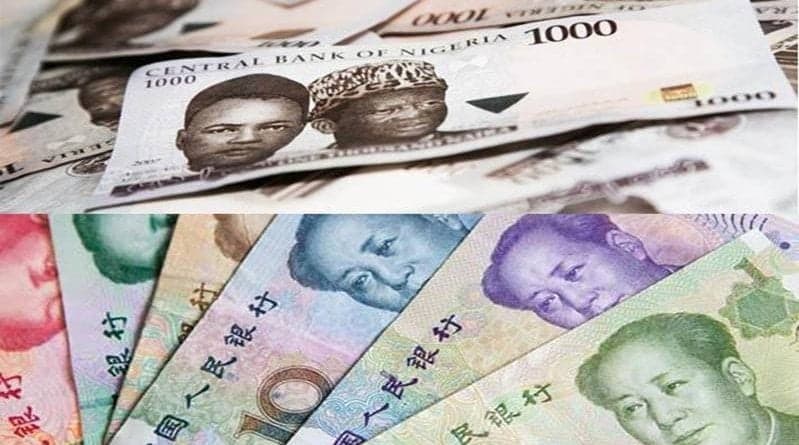
An intervention of the Central Bank of Nigeria (CBN) in the foreign exchange (FX) market eased the pressure on the Naira on Friday.
The apex bank sold forex to banks and other authorised dealers in the official window to defend the domestic currency, helping to calm the FX demand pressure, with the Nigerian currency appreciating against the US Dollar in the Nigerian Autonomous Foreign Exchange Market (NAFEM) by 0.11 per cent or N1.57 to sell at N1,454.50/$1 compared with Thursday’s closing price of N1,456.07/$1.
Also, the domestic currency improved its value against the Pound Sterling in the official market yesterday by N3.95 to close at N1,946.15/£1 versus the previous day’s N1,950.11/£1 but lost 10 Kobo on the Euro to quote at N1,706.46/€1 compared with the N1,706.36/€1 it was exchanged a day earlier.
At the black market segment, the Nigerian Naira maintained stability against the Dollar during the session at N1,470/$1 and also traded flat at N1,463/$1 at the GTBank forex counter.
Despite the sigh of relief, demand pressures outweighed the robust supply from the CBN and inflow from offshore players looking to participate at the OMO bills auction.
Gross FX reserves increased for the twenty fifth consecutive week, growing by a strong $396.84 million week-on-week to $45.44 billion.
As for the cryptocurrency market, it was down on Friday as pressure remained after Federal Reserve chair Jerome Powell’s speech on Wednesday, which hinted at a possible rate cut pause in January. As a result, markets now expect only two rate cuts in 2026 instead of three.
However, Chicago Federal Reserve President Austan Goolsbee, who was against a December rate cut, said he expects more in 2026 than the current median projection.
Ethereum (ETH) slumped by 5.1 per cent to $3,090.61, Solana (SOL) declined by 4.5 per cent to $132.79, Cardano (ADA) depreciated by 3.8 per cent to $0.4103, and Dogecoin (DOGE) dropped 2.5 per cent to trade at $0.1373.
In addition, Bitcoin (BTC) lost 2.4 per cent to sell at $90,342.74, Litecoin (LTC) tumbled by 1.9 per cent to $81.86, Binance Coin (BNB) fell by 0.6 per cent to $886.93, and Ripple (XRP) slipped by 0.5 per cent to $2.02, while the US Dollar Tether (USDT) and the US Dollar Coin (USDC) traded flat at $1.00 each.








-
 Feature/OPED6 years ago
Davos was Different this year
-
Travel/Tourism9 years ago
Lagos Seals Western Lodge Hotel In Ikorodu
-

 Showbiz3 years ago
Estranged Lover Releases Videos of Empress Njamah Bathing
-
 Banking7 years ago
Sort Codes of GTBank Branches in Nigeria
-

 Economy3 years ago
Subsidy Removal: CNG at N130 Per Litre Cheaper Than Petrol—IPMAN
-

 Banking3 years ago
First Bank Announces Planned Downtime
-

 Banking3 years ago
Sort Codes of UBA Branches in Nigeria
-

 Sports3 years ago
Highest Paid Nigerian Footballer – How Much Do Nigerian Footballers Earn