

Economy
Flour Mills to Drive Profitability Across Key Segments

By Adedapo Adesanya
Following a run-of-the-mill performance in the year ended March 31, 2019, Flour Mills of Nigeria Plc is looking forward to drive profitability across its key segments in order to emerge stronger and better.
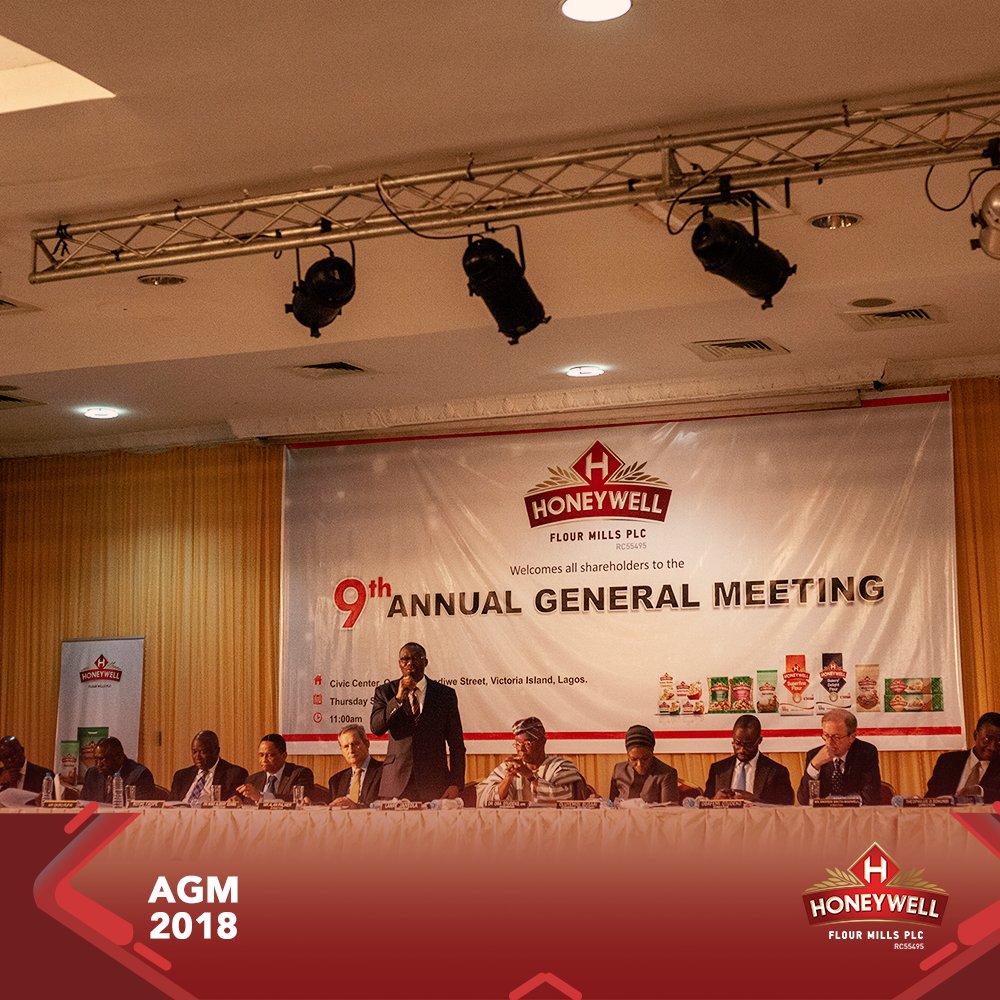
This was disclosed by the company’s Chairman, Mr John Coumantaros, at the company’s Annual General Meeting (AGM) on Wednesday, September 4, 2019 in Lagos.
Mr Coumantaros noted that following the previous period’s performance, the company was committed and determined to focus on strategies that will improve efficiency and synergy, while driving profitability in all key segments of the group.
Flour Mills, in the previous financial year, recorded drops in revenue, profit, and basic per earning shares indices. The poor performance was attributed to constraints caused by poor power and infrastructure, traffic, soaring input costs, and socio-economic circumstances.
However, the Chairman assured that the board recognizes the importance of improving ahead of the new financial year in progress, noting that the initiatives put in place had started yielding desired results.
“Our strategy to further restructure our balance sheet and optimize the financing costs achieved appreciable results with the significant reduction in net debt by N21.2 billion, while financing costs reduced by 30 percent (N9.8 billion) to N22.9 billion as at 31st March, 2019,” he said.
Accordingly, he also mentioned that working across the four main pillars of the company’s operations – Food Division, Sweetener Division, Agro-allied Division, and Support Services Division, the group was positioned to take the essential leap for continued growth and profitability.
In its food division, the key 5 value chains of grains; oils and fats; sweeteners; proteins and starches are to receive the necessary structure and support in bringing about share gain as imperative strategies has continued to strengthen the service delivery and implemented regionally differentiated plans and offerings.
Working on its innovation, Mr Coumantaros said the group has introduced new and exciting product focused on local content.
“These include the introduction of Golden Penny ‘Dawavita’ which is made from 100 percent natural, yellow Sorghum. Our consumers who are based in the northern part of Nigeria can now enjoy ‘Tuwon Dawa,’ a popular local staple.
“We also introduced Mai Kwabo Pasta and two new flour variants – Easy Bake and Classic flour,” he added.
‘In improving growth across its Sweetener Division through the Golden Sugar Company (GSC), Mr Coumantaros explained: “We introduced the GSC Operational excellence programme which is helping us reduce direct costs, raw material waste and chemical usage resulting in significant savings and employee engagement.”
Despite a drawback due to flood that resulted in damage of its cultivations, he assured that the company has recovered the land and fortified the channel effectively.
“I am happy to report that we have been able to recover the areas lost to the flood and a project to further strengthen our dyke by placing 300,000m3 additional material along 13km has also been completed,” he announced to shareholders present at the meeting yesterday.
Within its Agro-allied division, he assured that there had been significant structural changes along core business business functions disclosing that the agro-allied businesses of the company would now operate under a wholly-owned Agro-allied holding company.
“This was achieved through a Scheme of External restructuring between flour mills of Nigeria Plc and Golden Fertilizer Company Limited (GFC) where GFC emerged as the holding company for the agro-allied businesses and value chains,” Mr Coumantaros said.
The Chairman then assured shareholders that the manufacturing company has started exporting its Golden Penny Garri and High-Quality Cassava Flour (HQCF) to the United States of America and Europe.
“We are looking forward to build even further on this during the current financial year by creating more avenues for Nigerians in the diaspora to get access to our Garri, and equally provide a gluten-free flour alternative for those who are gluten intolerant,” he said.
He then assured shareholders that with the expansion, proper alignment and restructuring coupled with optimal operation of its supply chain put in place that the business would remain in a position of strength and continue to generate growth and create value for shareholders in the coming years.




By Dipo Olowookere
Subscription for the July 2026 edition of the FGN savings bond is closing today, Friday, July 10.
The exercise started on Monday, July 6, with two tenures of two years and three years on offer to retail investors.
The retail bonds are sold by the federal government through the Debt Management Office (DMO) to raise funds for the country’s budget deficits.
The savings bond offers investors steady tax-free income. It is risk-free, backed by the Nigerian government, and listed on the Nigerian Exchange (NGX) Limited, allowing for secondary market trading and easy exit before maturity.
For the two-year FGN savings bond maturing on July 15, 2028, the debt office is offering it at a 14.716 per cent per annum interest rate, while the three-year FGN savings bond due July 15, 2029, is at 15.716 per cent per annum, with the interest on the investment being paid by the government every quarter.
Intending investors can purchase the debt instrument at a unit price of N1,000, subject to a minimum subscription of N5,000 and in multiples of N1,000 thereafter, subject to a maximum subscription of N50.0 million.

By Dipo Olowookere
The upward trend on the Nigerian Exchange (NGX) Limited continued on Thursday despite profit-taking in energy stocks by investors.
The local exchange further appreciated by 0.62 per cent yesterday, as market participants mopped up equities in the other key sectors, especially in the financial services.
The banking space rose by 1.33 per cent, the consumer goods counter expanded by 1.21 per cent, and the insurance index grew by 0.26 per cent, while the industrial goods segment closed flat, with the energy sector down by 0.19 per cent.
At the close of business, the All-Share Index (ASI) gained 1,498.75 points to finish at 243,958.73 points compared with the previous day’s 242,459.98 points, and the market capitalisation advanced by N962 billion to N156.548 trillion from N155.586 trillion.
The market breadth index remained positive, though the bears are giving the bulls a close marking. Customs Street ended the session with 28 price gainers and 26 price losers, representing strong investor sentiment.
International Breweries improved by 10.00 per cent to N12.10, First Holdco appreciated by 9.96 per cent to N69.55, Abbey Bank grew by 9.88 per cent to N8.90, Trans-Nationwide Express rose by 9.76 per cent to N3.26, and Honeywell Flour increased by 9.68 per cent to N17.00.
Conversely, Thomas Wyatt declined by 10.00 per cent to N2.70, Geregu Power shrank by 10.00 per cent to N825.70, McNichols moderated by 9.76 per cent to N5.55, UPDC slipped by 9.20 per cent to N3.95, and Neimeth contracted by 8.16 per cent to N9.00.
A total of 1.7 billion stocks valued at N112.0 billion were traded in 44,780 deals yesterday, in contrast to the 518.4 million stocks worth N22.8 billion traded in 48,495 deals on Wednesday, indicating a slip in the number of deals by 7.66 per cent, and a surge in the trading volume and value by 227.93 per cent and 391.23 per cent, respectively.
First Holdco was the busiest equity for the day, with a turnover of 1.3 billion units worth N85.6 billion. Zenith Bank exchanged 43.8 million units for N4.7 billion, Access Holdings transacted 41.0 million units valued at N1.0 billion, FCMB traded 17.7 million units worth N188.3 million, and Fidelity Bank sold 16.0 million units valued at N315.2 million.

By Adedapo Adesanya
Crude oil slid about 2 per cent on Thursday amid worries that rising inflation and other economic concerns could weigh on global oil demand despite fresh Middle East tensions.
Brent futures fell by $1.72 or 2.2 per cent to settle at $76.30 a barrel, while the US West Texas Intermediate (WTI) crude went down by $1.44 or 2.0 per cent to $72.08 per barrel.
Iranian armed forces launched attacks on US military infrastructure in Gulf states on Thursday following America’s strikes on its southern coastal and eastern provinces, further straining a three-week-old ceasefire agreement.
This adds to continued supply constraints as the US-Iran conflict has delayed the full reopening of the Strait of Hormuz, where about 20 per cent of global oil supplies passed through the strait before the war.
On Thursday, only one tanker reportedly moved along the waterway, and it was a sanctioned Very Large Crude Carrier (VLCC) that passed along the Iran-controlled route along with an Iranian container ship.
According to Bloomberg, around 14 commodity-carrying vessels had traversed the Strait of Hormuz on Wednesday. In the past three weeks, following the ceasefire deal, the strait saw an average of 34 tanker crossings per day, peaking at 59 on June 24, data from Kpler showed.
Axios reported that the US Administration believes it has more room for escalation as millions of barrels of oil have managed to exit the Strait of Hormuz in recent weeks, easing concerns about oil price spikes.
Qatar, which has often mediated between the US and its adversaries, including Iran, condemned attacks on commercial shipping and called for a return to diplomacy. The foreign ministers of Turkey and Oman also stressed the need to avoid further military escalation in calls with their Iranian counterpart, Mr Abbas Araqchi.
Minutes of the US Federal Reserve’s June 16 to 17 meeting showed policymakers’ concerns about inflation mounted last month. When the US central bank boosts interest rates to keep inflation in check, it can reduce economic growth and cut oil demand.
In China, the world’s second-biggest economy behind the US, producer price inflation surged in June to its highest level in four years, piling pressure on manufacturers’ profit margins as weak domestic demand limited pricing power.
