Connect with us

General

Abidjan-Lagos Highway Could Be West Africa’s Game Changer

Published

on

Abidjan-Lagos Highway

By Adedapo Adesanya

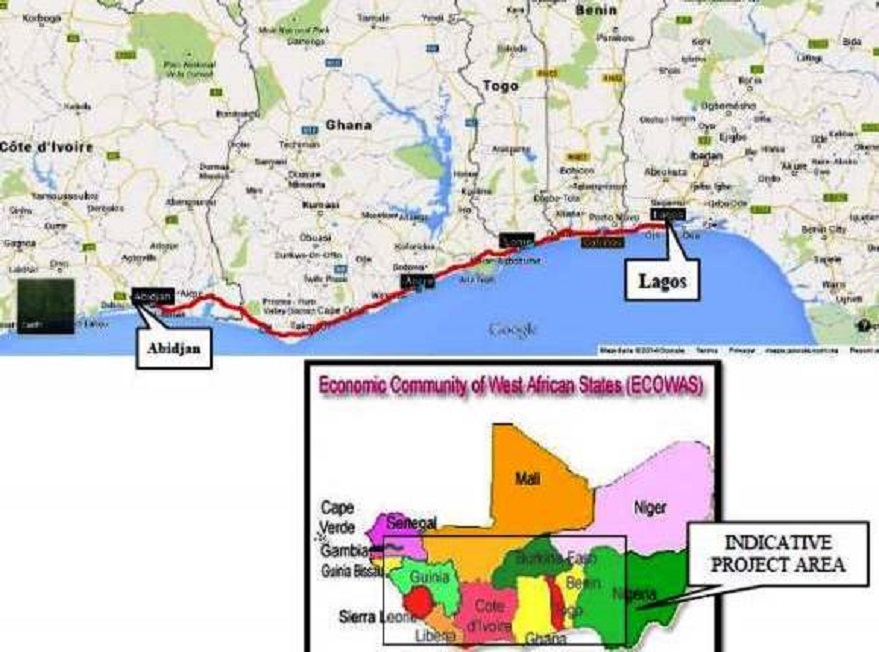
Amid recent political turmoils like military coups and the spate of internal terrorism that has seized the region, one of the many good things to look forward to in West Africa is the 1,081 kilometres highway that will soon link Abidjan and Lagos.

Once achieved, the $15.6 billion road project will connect five West African countries – Nigeria, Benin, Togo, Ghana, and Ivory Coast, and this spells a big opportunity to transfer population and geographical advantages into economic prosperity.

The purpose of this Abidjan-Lagos highway is to strengthen trade and integration in West Africa, in particular by providing maritime port access to landlocked countries. It is also expected to join other corridors along the north-south axis and connects landlocked countries such as Burkina Faso, Mali, Niger and Chad.

The ECOWAS Commission had, on behalf of five countries, requested the support of the African Development Bank (AfDB) in financing the Abidjan–Lagos highway corridor project.

The lender recently announced that it has secured $15.6 billion to fund the game-changing infrastructure which is set to be completed in 2025.

Bingerville in Abidjan and Mile 2 in Lagos will be the locations for the two ends of the large dual, 3-lane corridor project. The highway has three parts, the Abidjan – Takoradi section of 295 kilometres; the Takoradi – Akanu (both in Ghana) section of 466 kilometres; and the Noepe (in Togo) – Cotonou – Lagos section, of 320 kilometres.

The project, when fully implemented, is expected to promote the free movement Agenda of ECOWAS, generate social and economic activities, promote cross-border trade and integrate the economies of countries in the region.

The five countries that the highway passes through have a combined GDP of $590 billion and a population of 284 million.

People and goods will be able to move easily between seaport cities and their landlocked neighbouring cities. It will also be easier to capitalise on the Gulf of Guinea to mobilize movements and trades.

Lagos, Nigeria’s commercial capital with more than 15 million people will be open to opportunities to further boost its revenue generation capabilities.

Abidjan with five million people, the Ghanaian cities of Takoradi and Accra have more than three million, while Cotonou with less than three million will get to enjoy these benefits.

It could also be what turbulent states like Niger, Burkina Faso and Mali need at the moment following tumultuous events like political instability and insurgency coupled with threats of economic drought and growing civil unrest.

Members of the West African bloc in the coming years need to sign treaties and arrangements that will boost cross-border trading and travel. This will allow the growing tech industry, potential manufacturing sectors, new industrial cities, and logistic hubs to find footings.

This is particularly needed as the African continent is expected to be home to at least 25 per cent of the world’s population by 2050, compared with less than 10 per cent in 1950.

This will particularly be a necessity for West Africa as other African regional blocs are making similar moves.

The East African Community (EAC) has six cross-border road projects, totalling 1504 kilometres, while the Economic and Monetary Community of Central Africa (CEMAC) – which groups central African nations – and Southern African Development Community (SADC) also have similar programmes.

Last week, the Democratic Republic of Congo joined the EAC immediately upgrading the region’s GDP by 30 per cent to $250 billion, a move that shows that integration will be crucial to the continent’s development.


Adedapo Adesanya is a journalist, polymath, and connoisseur of everything art. When he is not writing, he has his nose buried in one of the many books or articles he has bookmarked or simply listening to good music with a bottle of beer or wine. He supports the greatest club in the world, Manchester United F.C.

Advertisement
Click to comment

Leave a Reply

Your email address will not be published. Required fields are marked *

General

Pastor Ogbueli’s Abuja Night of Glory Holds Today

Published

on

Abuja Night of Glory

By Blaise Udunze

Momentum is gathering for the Abuja Night of Glory taking place today, Friday, December 5, 2025, at the main bowl of the Moshood Abiola National Stadium.

The crusade is being hosted by Dominion City Church headed by Pastor David Ogbueli and it starts by 7pm.

The all-night programme will feature dynamic worship leaders like Nathanial Bassey, Dunsin Oyekan, Theophilus Sunday, Chioma Jesus, Kaestrings, Sunmisola Agbebi Okeleye, Minister GUC, Ebuka Songs, Anthony Kani, and DC Angels.

Reputed as a teacher of righteousness and anointed minister of the gospel, evidenced by the miracles that have trailed his ministry, and one who champions the cause of the poor through empowerment initiatives, Dr. David Ogbueli will be joined by renowned ministers from within and outside Nigeria, including Evangelist Andres Bisonni, Dr. Charles Ndifon, Evangelist Dan Scott, Apostle Ikechukwu Nnajiofor, and several others.

Night of Glory has, in previous editions held across Nigeria’s cities, recorded remarkable results, such as immediate healings and freedom from chronic ailments, recovery of vision and movement after many years of paralysis, along with liberation from dependencies and emotional distress. Numerous participants have also shared testimonies of breakthroughs and big personal changes after the experience. Organisers state that this year’s event, in Abuja, is anticipated to exceed previous editions.

The event is intended for all individuals trusting God for divine intervention in any area of life.

Understanding the role of faith in the destiny of individuals and nations, a dedicated prayer session for Nigeria will take place during the crusade to tackle some of the current challenges being faced in the country and also to uplift he leaders and institutions before God.

Attendance is free, and registration is encouraged via the QR codes on event banners. Organisers expect a massive turnout as worshippers travel from across the country for what is anticipated to be a transformative encounter.

Adequate security and free transportation have been put in place ALL over the city of Abuja, while those outside Abuja are expected to join online.

Continue Reading

General

Rivers Speaker, 15 Other Lawmakers Leave PDP for APC

Published

on

rivers speaker Martin Amaewhule defect

By Modupe Gbadeyanka

The Speaker of the Rivers State House of Assembly, Mr Martin Amaewhule, has defected to the All Progressives Congress (APC).

At the plenary on Friday, Mr Amaewhule joined the ruling party from the opposition Peoples Democratic Party (PDP), along with 15 other members of the state parliament.

This development comes some months after they had earlier declared their support for the APC in the wake of a crisis with the state governor, Mr Sim Fubura.

The lawmakers had an issue with Mr Fubura, which led to a state of emergency declared on the oil-rich state by President Bola Tinubu in March 2025.

This embargo was only lift in September 2025 after the duration of the six-month emergency rule in the state.

A few days ago, members of the Rivers Assembly passed a vote of confidence on President Tinubu, backing him to remain in office till 2031, when he would have spent eight years in office if re-elected in 2027.

Announcing their defection today, the lawmakers pinned their decision on the crisis rocking the PDP at the national level.

It is not certain if their political godfather, Mr Nyesom Wike, who is the current Minister of the Federal Capital Territory (FCT), will join them in APC.

Mr Wike, who governed Rivers State from 2015 to 2023, has been accused of instigating the crisis in the opposition PDP. He was expelled from the party last month at a national convention held in Ibadan, Oyo State.

Continue Reading

General

Nigeria Risks Brain Drain in Energy Sector—PENGASSAN

Published

on

energy sector

By Adedapo Adesanya

The Petroleum and Natural Gas Senior Staff Association of Nigeria (PENGASSAN) has warned that Nigeria risks massive brain drain in the oil and gas sector due to poor remuneration.

The president of PENGASSAN, Mr Festus Osifo, said at the end of the National Executive Council (NEC) meeting of the union on Thursday in Abuja that the industry was facing challenges arising from Naira devaluation and inflation, noting that, oil and gas skills remained globally competitive.

Painting an example, he said, “A drilling engineer in Nigeria does the same job as one in the US or Abu Dhabi,” noting that the union must take steps to bridge the wage gap to prevent members from leaving the country for better opportunities abroad.

“If we don’t act, the brain drain seen in other sectors will be child’s play,” he said.

According to him, PENGASSAN has recorded significant gains through collective bargaining across oil and gas branches.

“We signed numerous agreements across government agencies, IOCs, service and marketing sectors,” he said.

He said the agreements brought relief to members facing rising costs of living, adding that, the association’s duty is to protect members’ jobs and enhance their pay.

Mr Osifo urged companies delaying salary reviews and those foot-dragging as a result of the prevailing economic realities, to do the needful.

He said the industry employed some of the nation’s best talents, making competitive pay critical to retaining skilled workers.

“This industry recruits the best. Companies must provide the best conditions,” he said.

On insecurity, Mr Osifo urged government to take decisive action against terrorism and kidnappings across the country.

“We are tired of condemnations. government must expose sponsors and protect citizens,” he said.

He urged government at all levels to prioritise tackling insecurity through better funding and equipment for security agencies.

Mr Osifo said PENGASSAN supported calls for state police to improve local security response, adding that decentralising policing will protect citizens better than rhetoric.

He also said economic indicators meant little, if food prices remained high and farmers could not return to farms due to insecurity.

“Nigerians want to see food on the table, not macroeconomic figures,” he said, urging the government to coordinate fiscal and monetary policies to ensure economic gains reach households.

Continue Reading

Trending