Connect with us

World

The Era of Unipolar World Order Has Ended—Putin Tells US, Others

Published

on

Vladimir Putin unipolar world order

By Kestér Kenn Klomegâh

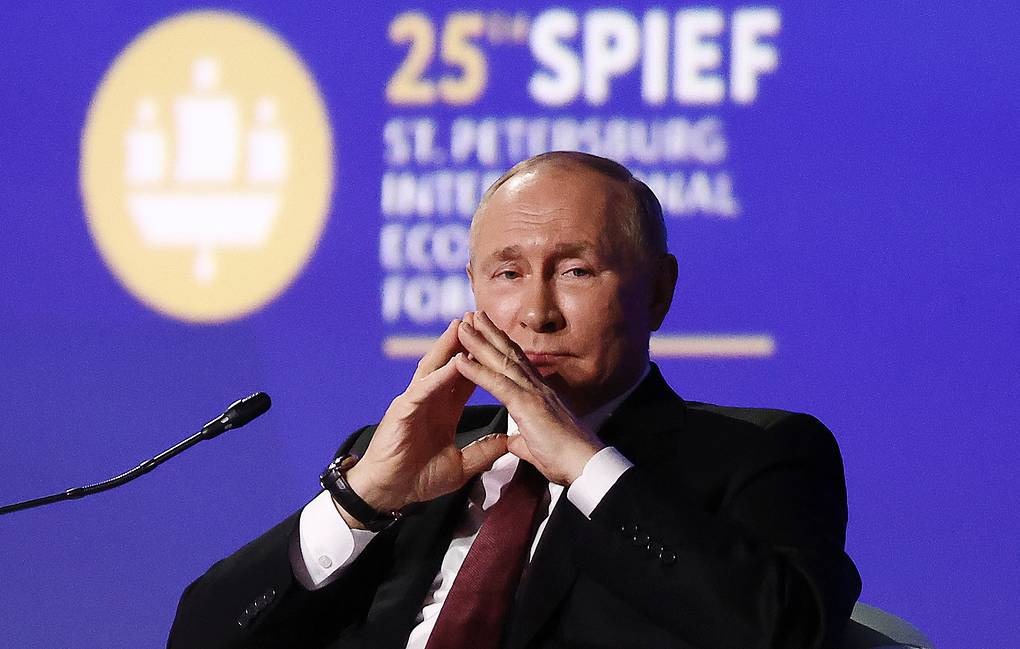
At the plenary session of the 25th year of the St. Petersburg International Economic Forum (SPIEF), Russia’s President, Vladimir Putin, lambasted the United States and its Western and European allies, wholeheartedly predicted the end of the unipolar system and bristled at the idea of creating a new global order that might ensure equality and drastically change living standards of impoverished millions around the world.

Putin believes that the United States sees itself as a “messenger of God on Earth”, who has interests but no responsibility. “The United States is ostensibly unaware that over the past decades, new powerful centres have emerged around the globe and their voice is heard ever louder. Each of them is developing its own political system and public institutions and implements its own model of economic growth and, of course, has the right to protect them and to ensure national sovereignty,” Putin stressed.

While emphasizing the problems currently faced by the world’s economy at large, unfair competition among states, trade and financial wars, sanctions, restrictions, and so on, he asserted that the era of the unipolar world order has ended. The United States for the sake of ambitions and in the name of preserving outdated geopolitical illusions really don’t understand that the world based on such dogmas is definitely unsustainable.

In his opinion, “we are witnessing objective processes and truly revolutionary tectonic changes,” in the world. “After claiming victory in the Cold War, the United States declared it was the messenger of God on Earth, who has no obligations, but only interests – and these interests are sacrosanct,” Putin said. A world order based on the dogmas of unipolarity is unstable. Western elites are largely “clinging to ghosts of the past,” thinking that Western dominance is “an unchangeable and everlasting thing. Nothing lasts forever.”

New world order is still emerging but it’s clear that its rules will be created by those “who aren’t moving along a path set out by others.” “Only strong and sovereign states can have a say in this emerging world order or they will have to become or remain colonies with no rights,” Putin noted.

He further described as “thoughtless” and “insane” unprecedented sanctions imposed on Russia by a number of Western countries. “The idea was clear: crush the Russian economy violently, in a swoop, and deal a blow to industries, finance and living standards of people by destroying business chains, forcibly pulling Western companies out of the Russian market and freezing domestic assets,” he said.

Putin highlighted six principles constituting the basis for the development of the national economy during the forum. These are openness, reliance on freedoms of entrepreneurship, balanced macroeconomic policy, social justice, advanced development of infrastructure and achievement of technological sovereignty.

State sovereignty cannot be partial or fragmentary in the 21st century, all of its elements have equal importance. They reinforce and complement each other. That is why it is important not only to defend the political sovereignty and national identity but also to strengthen everything that ensures the country’s economic independence, its self-sustainability and independence in the matters of finances, workforce and technology,” Putin explained.

The president said that Russia changed in recent years through a planned effort to create a sustainable macroeconomic structure, ensure food security, enable import substitution and establish its own payment system.

Nevertheless, the sanctions have brought about “numerous difficult tasks” that Russia has to solve, he continued. “On the other hand, this situation creates new opportunities for us. We are saying this quite often, but this is really so. All of this will be an incentive to build an economy whose technological, production, workforce and scientific independence and potential is full rather than partial,” Putin said.

In a clear and concise but tense language, he expressed optimism that Russia would become stronger than before, taking advantage of emerging opportunities and new initiatives to build a better economy. With Russia under wide sanctions after sending troops into Ukraine, Putin spoke at length acknowledging the economic difficulties Russia faces as it tries to promote itself to international businesses, and the evolutionary processes in the new global configuration.

Chinese President Xi Jinping and Egyptian President Abdel Fattah el-Sisi, by video link, took part in a plenary meeting together with Russian President Vladimir Putin and Kazakh President Kassym-Jomart Tokayev. The forum brought representatives from Latin America, Africa and mostly Asia. There were a number of international organizations as well as representatives from more than 90 countries, compared to 140 countries during the pre-corona pandemic years.

Under the chosen theme ‘New Opportunities in a New World’ that reflects the changing global situations, the conference from June 15 to June 18 marked the 25th year of the St. Petersburg International Economic Forum (SPIEF) since its establishment. Over the last 24 years, the forum has become a leading global platform for members of the business community to meet and discuss the key economic issues facing Russia, emerging markets, and the world as a whole. Since 2006, has been held under the auspices of the President of the Russian Federation.


Click to comment

Leave a Reply

Your email address will not be published. Required fields are marked *

World

Africa Takes Centre Stage as Addis Ababa Hosts the World Public Summit

Published

on

Addis Ababa World Public Summit

By Kestér Kenn Klomegâh

For the first time in its history, the World Public Summit will be held on the African continent. On 29–30 July 2026, Addis Ababa, the capital of Ethiopia, will host the World Public Summit. Africa — “A New World: Africa in Shaping a Shared Future.”

The Summit is organised by the World Peoples Assembly in cooperation with African partner organisations. It will bring together leaders of public diplomacy, representatives of international intergovernmental and non-governmental organisations, academics, experts, representatives of the education and cultural sectors, youth leaders, socially responsible businesses, media professionals, and civil society institutions from across Africa and other regions of the world.

The World Public Summit. Africa continues the work initiated during the First World Public Assembly “A New World of Conscious Unity,” held in Moscow in September 2025, and serves as one of the key milestones in preparation for the Second World Public Assembly “A New World: Values That Unite,” which will take place in Moscow on 18–19 September 2026.

Today, Africa is emerging as one of the principal centres of global development. Rapid demographic growth, expanding entrepreneurship, strengthening regional integration, rich cultural heritage, and the growing role of civil society institutions make the continent an increasingly important contributor to the future architecture of international cooperation.

The Summit will focus on issues of genuine sovereignty and sustainable development, public diplomacy, preservation of cultural and historical heritage, international cooperation in education and science, youth engagement, innovation-driven development, creative industries, and the formation of new partnerships among countries and peoples.

The main business programme of the Summit will take place on 30 July 2026 at the headquarters of the United Nations Economic Commission for Africa (UNECA) in Addis Ababa. Holding the Summit at UNECA highlights its pan-African dimension and creates opportunities for broad international dialogue on humanitarian cooperation and public diplomacy.

The programme will include plenary sessions, strategic dialogues, and expert panels dedicated to values-based development, education, culture, youth leadership, innovation, and international cooperation.

Participation has already been confirmed by Professor Saidou Madougou, Director of the Department of Education, Science, Technology and Innovation of the African Union; Rita Bissoonauth, Director of the UNESCO Liaison Office to the African Union and UNECA in Addis Ababa; Zuzana Schwidrowski, Director of the Macroeconomics, Finance and Governance Division of UNECA, as well as ministers, leaders of public organisations, and representatives of the business community from a number of African countries.

On the same day, the ADWA Victory Memorial Museum—Ethiopia’s national memorial complex dedicated to the Victory of Adwa and an important centre for preserving the historical memory of the Ethiopian people—will host the award ceremony of the regional stage of the V International Competition “Leader of Public Diplomacy”, followed by a large-scale cultural programme.

One of the key outcomes of the Summit will be the adoption of the African Communiqué, reflecting proposals and recommendations aimed at strengthening humanitarian, educational, cultural, and public cooperation between African countries and other regions of the world.

The outcomes, initiatives, and recommendations were developed during the World Public Summit. Africa will be presented at the Second World Public Assembly “A New World: Values That Unite”, to be held in Moscow on 18–19 September 2026.

According to Andrey Belyaninov, General Secretary of the World Peoples Assembly, “the Addis Ababa Summit is an important step toward building a new world founded on mutual respect, cultural diversity, dialogue and sustainable development.”

Continue Reading

World

UK Set for Seventh Prime Minister in 10 Years as Keir Starmer Resigns

Published

on

Keir Starmer

By Adedapo Adesanya

The United Kingdom will get its seventh Prime Minister in 10 years as Mr Keir Starmer announced his resignation on Monday.

The Minister said he is stepping down as leader of the governing Labour Party and will leave office within weeks, scarcely two years after being elected in a landslide.

Mr Starmer says he will remain caretaker prime minister until a new Labour leader is chosen by the party.

Mr Starmer made the announcement after facing growing pressure to hand over to a new leader who can try to revive the government’s flagging fortunes.

He led Labour to a landslide election victory in July 2024, but since then, his popularity and that of the party have plummeted.

His departure was triggered by the victory of Mr Andy Burnham in a special election last week. The popular ex-mayor of Greater Manchester planned to challenge the existing PM for the Labour leadership.

Mr Starmer made the announcement outside the prime minister’s 10 Downing St. residence with a brief statement on Monday.

“The question my party is asking now is whether I am best placed to lead us into the next general election,” Mr Starmer said. “I have heard the answer of my parliamentary party to that question, and I accept that answer with good grace.

Mr Starmer is the sixth prime minister in a decade to stand outside 10 Downing Street and announce a premature departure.

It comes the day before Britain marks the 10th anniversary of its vote to leave the European Union, a decision that still affects the country’s economy and politics.

Over the past decade, 10 Downing Street has had six occupants, including Mr David Cameron, who left office in 2016 after the Brexit referendum and was succeeded by Ms Theresa May. She was followed by Mr Boris Johnson, whose tenure covered Brexit and the COVID-19 pandemic. After Mr Johnson came Ms Liz Truss, whose 49-day premiership was the shortest in British history. Mr Rishi Sunak then took office before being succeeded by Mr Starmer, the outgoing occupant of Number 10.

Continue Reading

World

AXIAN Energy Secures $60m for Expansion Across Africa

Published

on

axian energy

By Aduragbemi Omiyale

A financing facility of up to $60 million has been secured by AXIAN Energy, the energy division of the AXIAN Group.

The funding package was provided by MCB, one of the leading financial institutions in the Indian Ocean region.

It comprises a $40 million revolving credit facility with a three-year tenor and extension option, and $20 million in unfunded instruments, providing AXIAN Energy with enhanced financial flexibility, enabling the company to rapidly mobilise resources and seize development opportunities across its target markets.

The energy firm is expected to use the capital to deliver large-scale energy infrastructure projects across Africa.

Over the past two years, AXIAN Energy has significantly accelerated its growth by expanding its renewable energy project pipeline, with solar projects currently under development in Senegal, Benin, Zambia, Côte d’Ivoire, Madagascar, and Burkina Faso.

Building on this momentum, AXIAN Energy now operates a portfolio comprising 350 MW of installed renewable energy capacity, supported by 77 MWh of energy storage capacity, positioning the AXIAN Group as a major contributor to Africa’s energy transition.

The chief executive of AXIAN Energy, Mr Benjamin Memmi, said, “This transaction marks a key milestone in AXIAN Energy’s growth trajectory. It provides us with the financial capacity to sustain the momentum we have built over the past two years, further strengthening our renewable energy portfolio and expanding our presence across new African markets.”

Also commenting, the Global Head of Structured Finance at MCB, Mr Mathieu Delteil, said, “We are proud to support AXIAN Energy in structuring this facility, reaffirming our commitment to enabling transformative projects across Africa.

“By leveraging our sector expertise and deep understanding of regional markets, we have delivered a tailored financing solution that aligns with AXIAN’s long-term renewable energy ambitions.

“This partnership highlights our role as a strategic financial partner, mobilising capital towards investments that drive sustainable growth and accelerate the energy transition across the continent.”

The financing agreement between the two organisations strengthens their long-standing relationship because it is driven by a shared commitment to supporting infrastructure development and economic growth across Africa.

Continue Reading

Trending