Economy
Oil Theft Has Become a Franchise in Nigeria—Ejiofor
By Dipo Olowookere
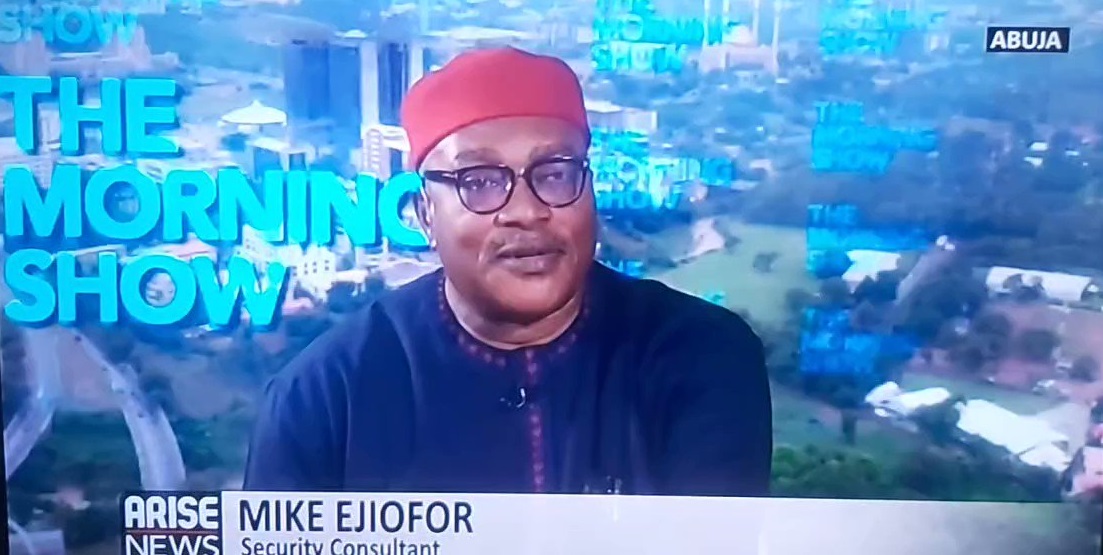
A former director of the Department of State Services (DSS), Mr Mike Ejiofor, has stated that oil theft has become a franchise in Nigeria, noting that it involves some powerful persons in the country.
He made this disclosure while speaking on Thursday on Arise TV breakfast programme, The Morning Show, anchored by the duo of Mr Reuben Abati and Mr Rufai Oseni.
“Why it (oil theft) has become a challenge now is that it has become a franchise. The thief should not steal more than the owner, but now, the bunkerers have the greater share of our national wealth, and it becomes worrisome,” he said.
“So, what should we do to bring this to an end?” Mr Ejiofor queried, stating that, “If you look at the whole situation, it is mindboggling.”
During the show, the security expert disclosed that the intelligence community in Nigeria do get intel about the activities of oil thieves, but the political leaders always fail to act.
He cited an instance when in about 2004, he and a military officer, after getting reports about oil bunkerers, they planned to bust them, but before the action was taken, the information was leaked, and he later received a call from a former militant leader, Mr Government Ekpemupolo, otherwise known as Tompolo, about the botched invasion.
Mr Ejiofor said the oil theft was draining the country as revenue that should be used to develop Nigeria is going into private pockets, depriving most citizens of a good life.
Some days ago, the Group Chief Executive Officer of the Nigerian National Petroleum Company (NNPC) Limited, Mr Mele Kyari, said a four-kilometre pipeline used to siphon oil from Forcados in Delta State to the Sea. He also said this illegal pipeline and a Loading Port had been operated in the last nine years.
He made the disclosure some days after the presidential candidate of the Labour Party in the 2023 election, Mr Peter Obi, said the government was complicit in crude oil theft, noting that only powerful individuals, in connivance with government officials, could steal crude oil and get the commodity out of the country through the waters.
During a visit to the illegal pipeline, Mr Kyari and the Chief of Defence Staff, General Lucky Irabor, promised to investigate and ensure those found culpable face the wrath of the law.
The revelation about the 4km pipeline cropped up after some Nigerians criticised the award of oil pipeline surveillance to Tompolo. The ex-Niger Delta militant said his team has discovered several points oil thieves use to steal crude oil from the country.
Economy
Naira Cools to N1,360 Per Dollar at Official FX Market
By Adedapo Adesanya
Foreign exchange (FX) pressure eased on the Naira on Wednesday. August 12, at the Nigerian Autonomous Foreign Exchange Market (NAFEX). Its value appreciated against the United States Dollar by 0.17 per cent or N2.31 to close at N1,360.58/$1 compared with the previous day’s N1,364.89/$1.
The Nigerian Naira also improved its value against the Pound Sterling at midweek at the official FX market by N1.62 to quote at N1,840.99, in contrast to Tuesday’s rate of N1,842.61/£1. It gained N3.49 against the Euro during the session to settle at N1,572.01/€1 versus the preceding session’s N1,575.50/€1.
However, the Naira depreciated against the greenback yesterday at the GTBank forex counter by N3 to sell for N1,370/$1 compared with the previous day’s N1,367/$1, and at the parallel market, it maintained stability at N1,395/$1.
Data from the Central Bank of Nigeria (CBN) indicated that interbank FX turnover rose sharply by 481 per cent to $168.758 million from $29.060 million due to an increase in banks’ activities as intermediaries for their customers.
The apex bank data indicated that the number of deals at the interbank FX market surged to 190 from 47 the previous day.
As for the digital currency market, benchmarked tokens were more positive in line with the US inflation report that eased nerves but failed to spark a broad crypto rally.
Headline inflation rose 0.1 per cent on the month and 3.4 per cent on the year, with the core measure that strips out food and energy up 0.2 per cent and easing to 2.5 per cent.
July inflation matched forecasts, reinforcing expectations that the Federal Reserve can wait on further rate moves and prompting modest gains in gold, equities and some digital assets.
TRON (TRX) grew by 0.7 per cent to $0.3374, Binance Coin (BNB) jumped by 0.4 per cent to $612.84, Ethereum (ETH) rose by 0.3 per cent to $1,892.73, Solana (SOL) increased by 0.3 per cent to $76.37, and Bitcoin (BTC) added 0.2 per cent to sell at $63,768.51.
On the flip side, DOGE slipped by 1.6 per cent to $0.0705, Cardano (ADA) lost 1.1 per cent to end at $0.1844, and Ripple (XRP) declined by 0.7 per cent to $1.01, while the US Dollar Tether (USDT) and the US Dollar Coin (USDC) traded flat at $1.00 apiece.
Economy
NGX Tumbles by 1.12% on Sell-Offs in BUA Foods, Others
By Dipo Olowookere
The Nigerian Exchange (NGX) Limited tumbled by 1.12 per cent on Wednesday as a result of selling pressure in three of the five key sectors of the bourse.
Yesterday, the insurance space rose by 0.71 per cent and the energy counter appreciated by 0.02 per cent. But these gains were erased by the three other sectors, with the consumer goods index down by 4.93 per cent, the industrial goods sector down by 0.42 per cent, and the banking segment down by 0.30 per cent.
Consequently, the All-Share Index (ASI) receded by 2,756.48 points to 243,967.09 points from 246,723.57 points, and the market capitalisation dropped by N1.762 trillion to close at N157.494 trillion compared with Tuesday’s N159.256 trillion.
The worst-performing stock for the day was BUA Foods, which lost 10.00 per cent to trade at N760.60. Unilever Nigeria shed 9.97 per cent to close at N131.40, John Holt depreciated by 9.90 per cent to N9.10, AVA Capital declined by 9.50 per cent to N8.10, and Austin Laz crashed by 8.81 per cent to N2.90.
The best-performing stock for the session was International Energy Insurance, which chalked up 10.00 per cent to quote at N4.40. Ecobank gained 9.93 per cent to settle at N71.40, Trans-Nationwide Express expanded by 9.77 per cent to N2.36, CWG grew by 9.74 per cent to N21.40, and Cornerstone Insurance improved by 6.80 per cent to N5.50.
Yesterday, 1.5 billion shares were sold for N20.9 billion in 39,085 deals compared with the 3.9 billion shares worth N32.4 billion exchanged in 45,608 deals a day earlier, representing a decline in the trading volume, value, and number of deals by 61.54 per cent, 35.49 per cent, and 14.30 per cent, respectively.
On top of the activity chart was Fortis Global Insurance, with a turnover of 853.2 million units sold for N2.6 billion. Universal Insurance exchanged 251.8 million units worth N214.1 million, Chams transacted 40.0 million units valued at N181.0 million, First Holdco traded 28.3 million units worth N3.9 billion, and Access Holdings sold 25.4 million units valued at N702.4 million.
Economy
SEC Fixes 5 pm T+1 Settlement Deadline for Equities, Commodities
By Aduragbemi Omiyale
As part of the implementation of the T+1 settlement cycle in the Nigerian capital market, the Securities and Exchange Commission (SEC) has fixed 5:00 pm on the first business day after a transaction (T+1) as the settlement deadline for equities and commodities traded and settled through the Central Securities Clearing System (CSCS).
In a circular on Wednesday to capital market operators and other market participants, the capital market regulator noted that all transactions in the affected securities must be fully paid by 5:00 pm T+1 to ensure compliance with the standard Delivery versus Payment (DvP) settlement procedure.
It warned that where a broker/dealer’s trading account is not adequately funded to meet its settlement obligation within the prescribed period, the default would be managed in line with the CSCS Default Management Procedure and the applicable transaction settlement guidelines of the relevant exchange.
The commission also clarified that foreign portfolio investors are not required to prefund their accounts for trades in the Nigerian capital market.
However, it said capital market operators facilitating transactions on behalf of foreign portfolio investors must establish and maintain appropriate controls and processes to ensure timely funding and completion of settlements within the prescribed timeframe.
The clarification follows earlier SEC circulars on the implementation of the T+2 settlement cycle for equities transactions, issued on June 3, 2025, and the transition to the T+1 settlement cycle, issued on May 15, 2026.
The T+1 cycle means that eligible securities transactions are settled one business day after the trade date, reducing the period between execution and final settlement.
The SEC said the transition represents a significant milestone in its efforts to build a more efficient, resilient and internationally aligned trading and post-trade environment, adding that the shorter settlement cycle would improve settlement efficiency, reduce counterparty risk, enhance liquidity and strengthen the competitiveness of the Nigerian capital market.
According to the agency, the reforms would ultimately improve the attractiveness of the Nigerian market to both domestic and international investors.