Connect with us

Economy

Nigerian Bourse Shrinks 6.67% as Investors Panic Over Scary Economic Forecast

Published

on

nigerian bourse

By Dipo Olowookere

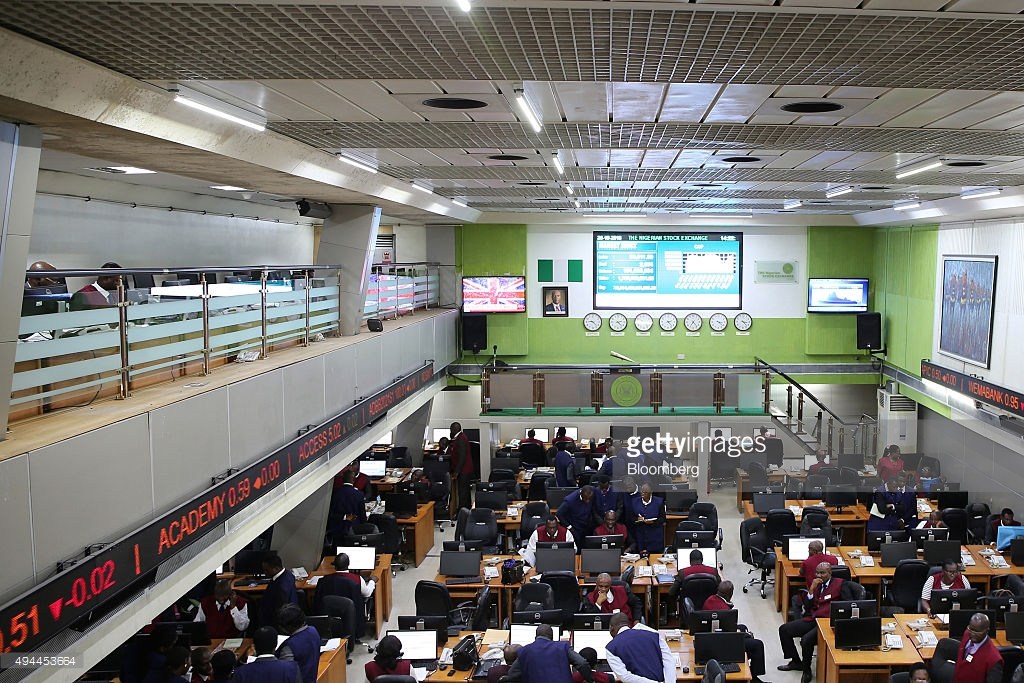
The Nigerian bourse fell by 6.67 per cent week-on-week last week after 29 equities came under heavy selling pressure caused by macroeconomic uncertainty.

Last week, investors were faced with a scary economic forecast from Moody’s, which raised doubts over the ability of Nigerian banks to meet their obligations due to the foreign exchange (forex) crisis in the country.

The global rating agency later downgraded the rating of Nigeria over concerns that the government would find it difficult to boost its earnings despite the price of crude oil rising in the global market.

Traders of stocks at the Nigerian Exchange (NGX) Limited reacted to these fears last week, as they quickly trimmed their exposure in the asset class so as not to get their fingers burnt.

Data showed that the All-Share Index (ASI) and the market capitalisation depreciated by 6.67 per cent to 44,396.73 points and N24.182 trillion, respectively.

Similarly, all other indices finished lower except NGX CG, banking, pension, NGX AFR bank, NGX AFR Div Yield, NGX MERI growth, NGX MERI Value, and industrial indices, which appreciated by 0.17 per cent, 0.15 per cent, 0.58 per cent, 2.10 per cent, 2.45 per cent, 1.22 per cent, 3.12 per cent, and 3.22 per cent, apiece, as the ASeM, growth and sovereign bond indices closed flat.

Business Post reports that Customs Street printed 33 price gainers, 29 price losers, and 95 price flatters in the week, in contrast to the 25 price gainers, 24 price losers and 108 price flatters recorded the earlier week.

Airtel Africa was the worst-performing stock as its value went down by 27.10 per cent to N1,312.20, NEM Insurance lost 9.98 per cent to trade at N4.42, Beta Glass also depreciated by 9.98 per cent to N41.50, Royal Exchange fell by 9.78 per cent to 83 Kobo, and MRS Oil lost 9.76 per cent to close at N12.95.

The best-performing stock for the week was Academy Press, which rose by 11.45 per cent to N1.46, Fidelity Bank gained 10.14 per cent to sell for N3.80, United Capital appreciated by 10.13 per cent to N12.50, BUA Cement improved by 9.73 per cent to N62.00, and PZ Cussons stretched by 9.52 per cent to N9.20 per cent.

In the five-day trading week, traders bought and sold 938.020 million shares worth N16.701 billion in 15,700 deals as against the 491.815 million shares worth N11.922 billion transacted in 14,350 deals a week earlier.

Financial equities dominated the activity chart with 501.278 million units valued at N5.080 billion carried out in 8,279 deals, accounting for 53.44 per cent and 30.42 per cent of the total trading volume and value, respectively.

ICT stocks trailed with 316.347 million units valued at N8.729 billion executed in 1,249 deals, while energy shares recorded the sale of 28.244 million units worth N983.561 million in 846 deals.

A breakdown indicated that CWG, GTCO and Fidelity Bank attracted most of the transactions, with 490.324 million units worth N2.905 billion traded in 2,860 deals, contributing 52.27 per cent and 17.39 per cent to the total trading volume and value, respectively.


Dipo Olowookere is a journalist based in Nigeria that has passion for reporting business news stories. At his leisure time, he watches football and supports 3SC of Ibadan. Mr Olowookere can be reached via [email protected]

Economy

Crude Oil Slumps Amid Hopes of Strait of Hormuz Reopening

Published

on

west texas intermediate WTI crude

By Adedapo Adesanya

Crude oil plummeted on Wednesday on hopes ​of the reopening of the Strait of Hormuz after US President Donald Trump agreed to a two-week ceasefire with Iran.

Brent crude futures moderated to $94.75 a barrel, while the US West Texas Intermediate (WTI) crude eased to $94.41 a barrel.

President Trump said on Wednesday that the US will work closely with Iran and will be talking about tariff and sanctions relief with Iran.

However, analysts cautioned that the ceasefire is a temporary two-week reprieve rather than a permanent resolution, and the global energy system remains fragile due to structural damage to regional infrastructure.

Reuters reported that Iran could open the strait in a limited and controlled way on Thursday or Friday ahead ​of a meeting between U.S. and Iranian ​officials in Pakistan.

Agence France-Presse (AFP) reported that two ships appeared to have transited the Strait of Hormuz since the US-Iran ceasefire deal. A Greek-owned bulk carrier and a Liberia-flagged vessel both transited the waterway early on Wednesday.

Meanwhile, Israel carried out its heaviest strikes on Lebanon since the conflict with Hezbollah broke out last month, even as the Iran-aligned group paused attacks on northern Israel and Israeli troops in Lebanon under the ceasefire.

Also, Saudi Arabia’s East-West Pipeline, a critical artery bypassing the Strait of Hormuz, was reportedly hit in an Iranian drone attack. Prior to the attack, the pipeline was pumping at its emergency capacity of 7 million barrels per day to bypass the shuttered strait.

The strikes occurred just hours after a US-Iran ceasefire announcement, which has so far failed to halt regional hostilities. Other facilities in the kingdom were also targeted in the wave of strikes, which the Islamic Revolutionary Guard Corps (IRGC) claimed included oil facilities owned by American companies in Yanbu.

US crude stocks rose by 3.1 million barrels to 464.7 million barrels ​during the week ended April 3, the Energy Information Administration (EIA) said.

Continue Reading

Economy

Insurance Firms Must Submit 2025 Assessment Returns by May 31—NAICOM

Published

on

NAICOM Conplaint Management Portal

By Adedapo Adesanya

The National Insurance Commission has issued new guidelines for the collection, management, and administration of the Insurance Policyholders’ Protection Fund.

In a circular issued to all insurance institutions on Tuesday, the regulator also set May 31, 2026, as the deadline for insurers to submit their assessment returns for the 2025 financial year.

Recall that on August
 5, 2025, 
President Bola Tinubu signed
 into 
law
 the 
Nigerian 
Insurance 
Industry Reform 
Act (
NIIRA
2025).


This 
landmark legislation 
repeals 
the 
Insurance 
Act 
2003, 
and
 consolidates 
related 
provisions, 
ushering 
in 
a 
modern regulatory framework. It lays a strong foundation for sustainable growth and increased investment in the country’s insurance sector.

The commission said the guidelines were issued in exercise of its powers under the 2025 Act and other existing insurance laws and regulations to provide regulatory clarity, improve guidance, and ensure ease of compliance across the industry.

According to NAICOM, the guidelines establish a comprehensive structure for the operation of the IPPF, which serves as a statutory safety net to protect insurance policyholders in the event of distress or insolvency of a licensed insurer or reinsurer. The framework also provides direction on the reimbursement of loans by insurers and reinsurers.

NAICOM stated, “The guidelines ensure regulatory clarity, guidance and ease of compliance, as it provides a comprehensive regulatory framework for the collection, management, and administration of the Fund, which serves as a statutory safety net designed to protect insurance policyholders against distress and insolvency of a licensed insurer or reinsurer, including guidance for the reimbursement of loans by an insurer or reinsurer.

“Please be informed that the IPPF Assessment Returns in respect of the year 2025 shall be submitted to the Commission not later than 31st May 2026, while subsequent submissions shall be in line with Section 4.3 of the Guideline on Insurance Policyholders Protection Fund.”

Continue Reading

Economy

Dangote Refinery Sells Petrol at N1,200/L as Global Oil Prices Slump

Published

on

Dangote refinery import petrol

By Adedapo Adesanya

The Dangote Refinery on Wednesday returned the petrol price to N1,200 per litre, less than 24 hours after it increased it by 5 per cent.

The private refinery had raised the ex-depot price by N75 on Tuesday, citing pressure from volatile global oil markets, but quickly brought it back to N1,200 per litre from N1,275 per litre.

The swift downward review is directly linked to a sharp drop in international crude prices. Brent crude has plunged to $95.05 per barrel, after a 13 per cent decline, while the US West Texas Intermediate (WTI) crude closed at $97.18, recording nearly a 14 per cent drop.

This development comes after US President Donald Trump announced a conditional two-week ceasefire with Iran, which eased fears of immediate supply disruptions in the global oil market.

“This will be a double-sided CEASEFIRE!” Trump said on social media, marking a sharp reversal from his earlier warning that “a whole civilisation will die tonight” if Iran failed to comply with US demands.

Iran’s Foreign Minister, Mr Abbas Araqchi, confirmed that the country would halt attacks provided strikes against Iran cease and transit through the Strait of Hormuz is coordinated by Iranian forces.

Despite the breakthrough, tensions remain elevated across the region, with several Gulf states reporting missile launches, drone activity, or issuing civil defence warnings.

While oil prices have fallen back below $100, they remain significantly elevated after surging by a record amount in March. Market analysts noted that regardless of how successful the ceasefire is, geopolitical risk related to the Strait of Hormuz is likely to remain elevated for the foreseeable future under the control of Iran.

Continue Reading

Trending