Banking
Customers to ‘Fill Uncountable Forms’ for Large Cash Withdrawals—Emefiele
By Modupe Gbadeyanka
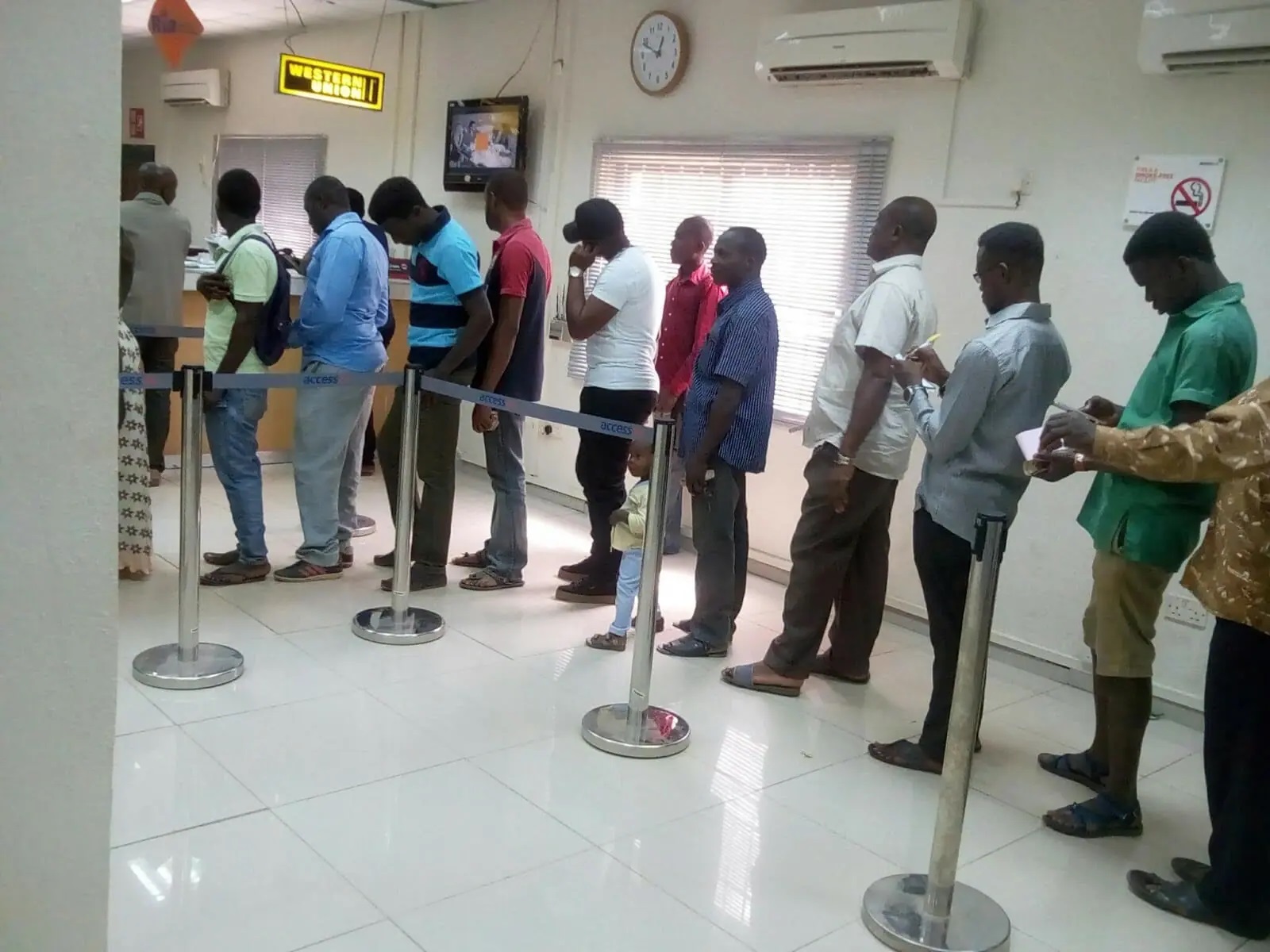
The Governor of the Central Bank of Nigeria (CBN), Mr Godwin Emefiele, has declared that the bank would limit the amount of cash in circulation, noting that the bank will intensify its cashless policy and ensure that stringent procedures are put in place to discourage cash withdrawals at over-the-counter.
According to him, for large withdrawals, customers would have to fill out several forms, which would be aimed at collecting data concerning the use of the funds.
Speaking after President Muhammadu Buhari unveiled the newly designed Naira notes of the N200, N500, and N1,000 denominations in Abuja, the apex bank boss explained that the idea is to control the volume of cash in circulation and deepen its cashless policy, which has not been largely successful despite efforts to make it attractive to bank customers.
Recall that on October 26, 2022, at a briefing in the nation’s capital, Mr Emefiele lamented that more than 80 per cent of cash in circulation was in the hands of corrupt persons, politicians, kidnappers and other criminals.
It was because of this the bank decided to redesign the legal tender and said the current notes would no longer be used for legitimate financial transactions after January 31, 2023. The new notes, according to him, would be introduced by December 15, 2022.
While speaking with journalists on Wednesday, the CBN boss said customers would be monitored by the Economic and Financial Crimes Commission (EFCC) and other security agencies whenever they withdraw cash above limits at over-the-counter.
“We would ensure that cashless policy is nationwide. We will restrict the volume of cash that people will withdraw over the counter. If you need to withdraw a large volume of cash, you will fill uncountable forms. We will take your data, BVN, and NIN so that security agencies like EFCC, and ICPC can follow you and be sure that you are taking that money for a good purpose,” he said.
Banking
The Alternative Bank Opens New Branch in Ondo
By Modupe Gbadeyanka
A new branch of The Alternative Bank (AltBank) has been opened in Ondo State as part of the expansion drive of the financial institution.
A statement from the company disclosed that the new branch would support export-oriented agribusinesses through Letters of Credit and commodity-backed trade finance, ensuring that local producers can scale beyond state borders.
For SMEs, the bank is introducing robust payment rails, asset financing for equipment and inventory, and supply chain-backed facilities that strengthen working capital without trapping businesses in interest-based debt cycles.
The Governor of Ondo State, Mr Lucky Aiyedatiwa, represented by his Chief of
Staff, Mr Olusegun Omojuwa, at the commissioning of the branch, underscored the importance of financial institutions in economic development.
“The pivotal role of financial institutions to economic growth and development of any economy cannot be overemphasised. It provides access to capital, supporting small and medium-scale enterprises and encouraging savings.
“Therefore, I have no doubt in my mind that the presence of The Alternative Bank in Ondo State will deepen financial services, create employment opportunities and stimulate economic activities across various sectors,” he said.
In her remarks, the Executive Director for Commercial and Institutional Banking (Lagos and South West) at The Alternative Bank, Mrs Korede Demola-Adeniyi, commended the state government’s leadership and outlined the lender’s long-term vision for Ondo State.
“As Ondo State steps into its next fifty years, and into the future anchored on the sustainable development championed during the recent anniversary celebrations, The Alternative Bank is here to be the financial engine for that vision. We didn’t come to Akure to hang banners. We came to fund work, farms, shops, and factories.”
With Ondo State’s economy anchored largely on agriculture, particularly cocoa production, poultry farming, and other cash crops, alongside a growing SME and trade ecosystem, AltBank is deploying sector-specific financing solutions tailored to these strengths.
For cocoa aggregators, processors and poultry operators, the bank will provide production financing, facility expansion support, machinery lease structures, and structured trade facilities under its joint venture and cost-plus financing models, with transaction cycles of up to 180 days for commodity trades and longer-term structured asset financing for equipment and infrastructure.
The organisation is a notable national non-interest bank with a physical network now surpassing 170 locations, deploying capital to solve real-world challenges through initiatives such as the Mata Zalla project, which saw to the training of hundreds of women as electric tricycle drivers and mechanics.
Banking
Recapitalisation: 20 Nigerian Banks Now Fully Compliant—Cardoso
By Adedapo Adesanya
The Governor of the Central Bank of Nigeria (CBN), Mr Yemi Cardoso, announced on Tuesday that the country’s banking sector is making strong progress in the recapitalisation drive, with 20 banks now fully compliant.
Mr Cardoso disclosed this during a press conference at the first Monetary Policy Committee (MPC) meeting of 2026, where he also highlighted positive developments in the nation’s foreign reserves.
On March 28, 2024, the apex bank announced an increase in the minimum capital requirements for commercial banks with international licences to N500 billion.
National and regional financial institutions’ capital bases were pegged at N200 billion and N50 billion, respectively.
Also, CBN raised the merchant bank minimum capital requirement to N50 billion for national licence holders.
The banking regulator said the new capital base for national and regional non-interest banks is N20 billion and N10 billion, respectively.
To meet the minimum capital requirements, CBN advised banks to consider the injection of “fresh equity capital through private placements, rights issue and/or offer for subscription”.
Following the development, several banks announced plans to raise funds through share and bond issuances.
In January, Zenith Bank said it had raised N350.46 billion through rights issue and public offer to meet the CBN minimum capital requirement.
Guaranty Trust Holding Company Plc (GTCO), on July 4, said it had successfully priced its fully marketed offering on the London Stock Exchange (LSE).
In September, the CBN governor said 14 banks fully met their recapitalisation requirements — up from eight banks in July.
With one month to the central bank’s March 31, 2026, recapitalisation deadline, 13 Nigerian lenders are yet to cross the finish line.
Additionally, the governor noted that 33 banks have raised funds as part of the ongoing recapitalisation exercise, signalling robust capital mobilisation across the sector.
He stated that gross foreign reserves have climbed to a 13-year high of $50.4 billion as of mid-February 2026.
Banking
Public Offer: Sterling Holdco Allots 13.812 billion Shares to 18,276 Shareholders
By Aduragbemi Omiyale
Sterling Financial Holdings Company Plc has allotted shares from its public offer of 2025 to investors with valid applications.
The allotment follows the earlier receipt of final approval from the Central Bank of Nigeria (CBN) and the recent clearance by the Securities and Exchange Commission (SEC).
In September 2025, the financial institution offered for sale about 12,581,000,000 ordinary shares of 50 kobo each at N7.00 per share in public offer.
However, the exercise received wide participation from the investing public, with the company getting 18,280 applications for 16,839,524,401 ordinary shares valued at approximately N117.88 billion.
Following a thorough verification process, valid applications were received from 18,276 shareholders for a total of 13,812,239,000 ordinary shares, representing a subscription level of 109.79 per cent and reflecting sustained confidence in Sterling Holdco’s strategic direction, governance, and long-term growth prospects.
The firm approached the capital market for additional funds for the recapitalisation of its two flagship subsidiaries, Sterling Bank and The Alternative Bank.
The capital injection will support the commencement of full operations and contribute to the group’s revenue diversification objectives.
In line with the guidelines set out in the offer prospectus, Sterling Holdco confirmed that all valid applications will be allotted in full. Every investor who complied with the terms of the offer will receive all the shares for which they applied.
A very small number of applications were not processed or were partially rejected due to non-compliance with the offer terms, including duplicate payments and failure to meet the minimum subscription requirement of 1,000 units or its multiples, as stipulated in the offer documents.
The group ensures a seamless post-offer process, with refunds for excess or rejected applications, along with applicable interest, to be remitted via Real Time Gross Settlement or NIBSS Electronic Funds Transfer directly to the bank accounts detailed in the application forms.
Simultaneously, the electronic allotment of shares has be credited to successful shareholders’ accounts with the Central Securities Clearing System (CSCS) on February 17, and for applicants who do not currently have CSCS accounts, their allotted shares will be temporarily held in a registrar-managed pool account pending the submission of their completed account opening documentation to Pace Registrars Limited, after which the shares will be transferred to their personal CSCS accounts.
-
Feature/OPED6 years agoDavos was Different this year
-
Travel/Tourism10 years ago
Lagos Seals Western Lodge Hotel In Ikorodu
-
Showbiz3 years agoEstranged Lover Releases Videos of Empress Njamah Bathing
-
Banking8 years agoSort Codes of GTBank Branches in Nigeria
-
Economy3 years agoSubsidy Removal: CNG at N130 Per Litre Cheaper Than Petrol—IPMAN
-
Banking3 years agoSort Codes of UBA Branches in Nigeria
-
Banking3 years agoFirst Bank Announces Planned Downtime
-
Sports3 years agoHighest Paid Nigerian Footballer – How Much Do Nigerian Footballers Earn